
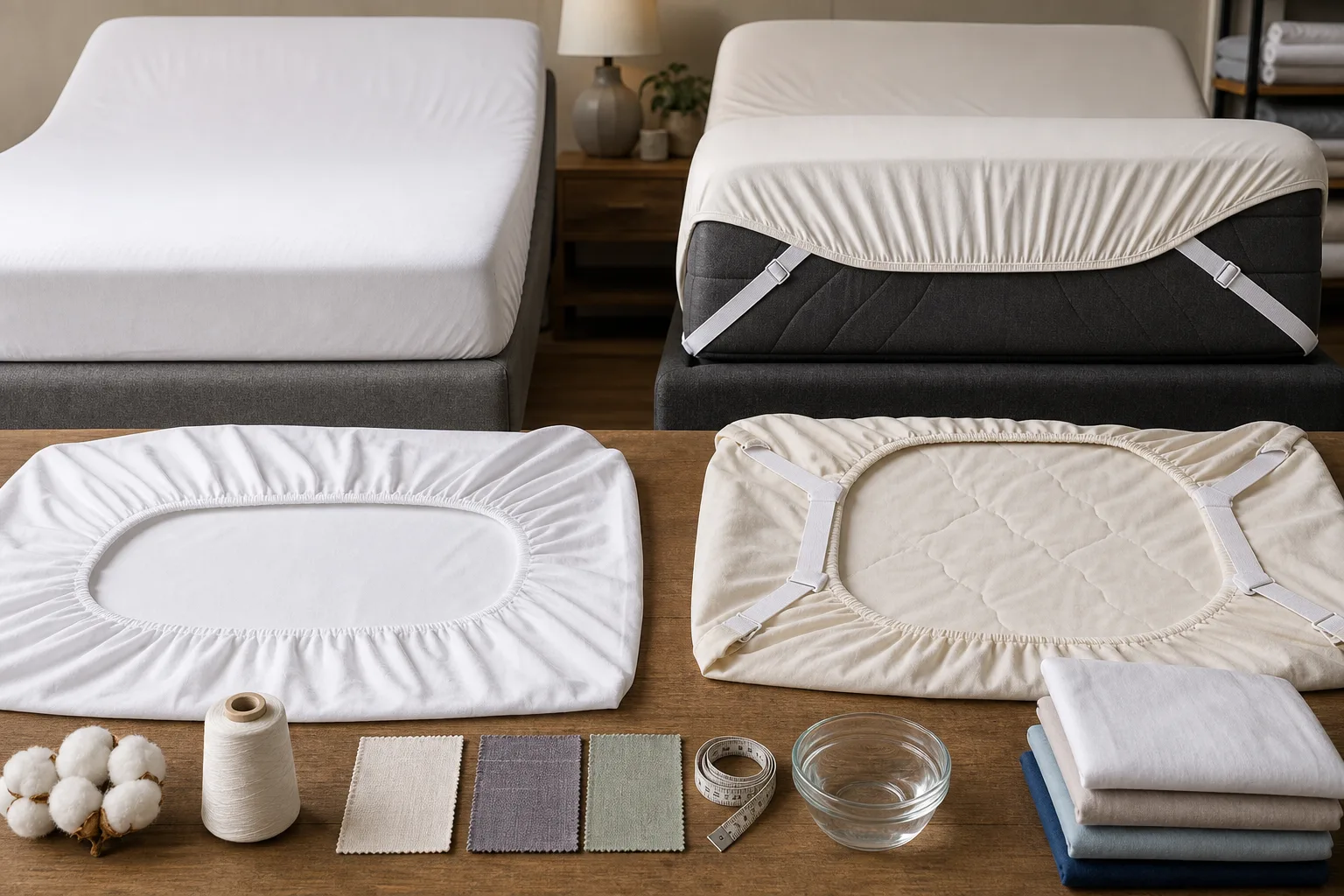
For most beds, 360° elastic is the better starting point because it applies tension around the entire fitted-sheet perimeter rather than only at four locations. Corner straps can provide stronger, more adjustable anchoring at the corners, especially on deep mattresses or beds that move. The most secure design may combine both. However, neither feature guarantees that a sheet will stay in place: pocket dimensions, mattress shape, added protectors, post-wash shrinkage, elastic quality and excess fabric can matter as much as the retention system.
360° elastic vs corner straps: the practical difference
These are genuinely different construction approaches. In a 360° design, elastic runs around all or nearly all of the fitted sheet’s lower edge. Corner straps are separate elastic bands positioned across or near the corners, sometimes with sliders that allow the user to change their effective length.
From a mechanical standpoint, continuous perimeter elastic distributes tension along the sides and corners. Corner straps concentrate restraint at selected points. That distinction explains why the systems can behave differently even when both are advertised as providing a “secure fit.” It does not establish a universal winner, because sellers rarely disclose comparable measurements for elastic tension, elongation or recovery.
| Factor | 360° elastic | Corner straps |
|---|---|---|
| Where tension acts | Around the fitted-sheet perimeter | Primarily at four corners |
| Typical advantage | Balanced edge retention and easier everyday fitting | Targeted anchoring, sometimes with adjustable tension |
| Possible limitation | Weak, narrow or poorly attached elastic can still lose grip | Straps may twist, be difficult to reach or leave side fabric loose |
| Best initial match | Conventional mattresses with correctly sized pockets | Deep, layered or mobile sleep surfaces needing extra corner control |
| Useful hybrid | Continuous perimeter elastic plus adjustable corner straps | |
The word “360°” describes elastic placement, not measured performance. It does not reveal the elastic’s width, composition, applied tension, stretch recovery, seam strength or durability after laundering. Likewise, “corner straps” does not tell you whether the straps are adjustable, how securely they are sewn or whether their hardware tolerates repeated use.
Why pocket depth and sheet dimensions often decide the result
A deeper pocket is not automatically a tighter fit
Pocket depth is the vertical fabric allowance intended to cover the mattress side and tuck beneath it. If a pocket is too shallow, the sheet may not reach far enough underneath the mattress to resist movement. If it is much deeper than the sleep surface requires, surplus fabric can gather along the sides or beneath the corners.
That excess fabric matters. Elastic can pull an edge inward, but it cannot make an oversized sheet behave as though it were precisely cut for the mattress. Loose fabric on the sleeping surface may migrate, wrinkle or place irregular loads on the corners. Corner straps can keep the corners attached while leaving the long side panels comparatively relaxed.
Measure the full sleep system
Measure mattress length, width and total height rather than relying only on the size name. Include any topper and mattress protector that remain on the bed under the sheet. A thick quilted protector or foam topper changes both the required pocket depth and the shape the fitted sheet must follow.
Compare those measurements with the manufacturer’s stated sheet dimensions and mattress-height range. A broad claim such as “fits up to 18 inches” gives a maximum, not necessarily an ideal fit across every shallower mattress. Look for a stated minimum as well, or ask the seller how the design controls fabric on lower-profile beds. For more measurement detail, see the guide to fitted-sheet pocket depth after washing.
Which system works better on an adjustable bed?
An adjustable base changes the geometry of the mattress as the head or foot rises. The sheet must accommodate bending while its lower edge moves relative to the mattress platform. This makes correct sizing and under-mattress engagement particularly important.
Well-tensioned 360° elastic is generally the more balanced foundation because it can restrain the side and end edges as well as the corners. Adjustable corner straps may add useful localized security where corners tend to lift. A hybrid design is therefore worth considering for an adjustable bed, but only if the straps can be installed safely without interfering with moving components.
Before buying, check the adjustable-base and mattress manufacturers’ instructions. Do not route aftermarket straps through hinges, linkages, electrical parts or gaps that change size during movement. Built-in straps attached to the sheet are usually simpler than independent fasteners, but their placement still needs to suit the bed. See fitted sheets for adjustable beds for a focused setup guide.
What if a mattress protector is involved?
A protector can alter the friction, thickness and contour under the fitted sheet. Smooth protector faces may allow more relative movement than textured surfaces, while padded protectors increase the height the pocket must cover. If the protector also has a skirt and elastic lower edge, the two fitted products can pull against one another.
Test the complete stack rather than judging the sheet on a bare mattress. After fitting the protector and sheet, raise and lower an adjustable base slowly and inspect every corner. Stop if a strap catches, becomes highly tensioned or approaches the mechanism.
Cotton fabric and elastic perform different jobs
Cotton fiber content describes the sheet fabric, not the effectiveness of its retention system. Cotton contributes characteristics such as moisture absorption, hand and fabric strength, while the elastic component provides extensible tension. The final behavior also depends on yarn, weave or knit structure, finishing, pattern dimensions, seams and laundering history.
A sheet may be labeled “100% cotton” even when it includes non-cotton elastic treated as trim. FTC guidance says household bedding is covered by textile-labeling requirements and explains that an all-cotton product may include non-cotton trim without that trim changing the stated fiber content of the main textile product.[1][2] Consequently, a 100% cotton claim should not be interpreted as a promise that the elastic is cotton, natural, plastic-free or biodegradable.
Read the required fiber-content statement, country of origin and responsible-company identification, then treat phrases such as “luxury fit,” “hotel fit” or “stay-put technology” as marketing descriptions unless the seller provides measurable specifications. FTC guidance requires cotton fiber claims to be truthful and not misleading, but fiber content alone does not establish fit quality.[1]
Do not use thread count to predict grip
Thread count concerns the construction of the base fabric; it does not measure pocket accuracy or elastic recovery. A high stated thread count cannot compensate for weak attachment seams, an oversized pocket or a retention system poorly matched to the mattress. Compare the features separately, using the thread-count guide for fabric questions and the fit checks below for retention.
Washing can change a fitted sheet’s fit
Cotton fabrics can change dimensions during laundering. CottonWorks identifies fiber, yarn, construction, wet processing, finishing, cut-and-sew methods and care as factors affecting shrinkage performance.[3] This is why an unwashed sheet that fits precisely may feel tighter after repeated care—or why a generously cut sheet may settle into a better fit.
Elastic also has its own performance characteristics. A NIST household-textiles compliance guide lists recognized test methods for the tension and elongation of elastic fabrics and for textile stretch properties.[4] Their existence reinforces an important buying point: elastic performance is measurable, but the phrase “all-around elastic” is not itself a test result.
Follow the product instructions and avoid assuming that hotter care is harmless. Heat, chemicals, fabric finishing and elastic composition differ by product. If the brand provides dimensional-change or wash-cycle test data, check the stated method, number of cycles and acceptance limit rather than accepting “pre-shrunk” as a complete guarantee.
- Wash and dry according to the supplied instructions.
- Avoid forcing an undersized sheet over the mattress, which can overload seams and elastic.
- Rotate between sheet sets so one fitted sheet is not exposed to every wash cycle.
- Inspect elastic attachment points and strap hardware before laundering.
- Re-measure the sheet or assess its fit after the first few washes while any return or warranty period remains open.
For care planning, consult the guides to washing cotton, drying cotton and preventing avoidable shrinkage.
Buying checklist: what to verify before choosing
Choose the retention system only after confirming that the fitted sheet is dimensionally compatible with the complete bed. The following checklist is more informative than relying on one front-of-package phrase.
- Measure the mattress stack: Record length, width and total height with the protector and topper installed.
- Check the fit range: Look for both minimum and maximum mattress heights, not just “deep pocket.”
- Confirm elastic placement: Determine whether elastic surrounds the full perimeter or appears only at corners and ends.
- Examine strap design: Check whether straps are adjustable, replaceable and securely stitched, and whether sliders could press against the bed.
- Look for construction detail: Elastic width, attachment method and reinforced stress points are more useful than proprietary feature names.
- Ask about post-wash dimensions: A stated dimensional-change limit and test method are more meaningful than an unsupported “shrink resistant” claim.
- Check the return policy: Fit cannot be predicted perfectly when mattress edges, protectors and finishing treatments differ.
- Review environmental claims separately: “Natural,” “green” or “sustainable” does not prove that the elastic system performs better. FTC guidance advises marketers to qualify broad environmental claims and substantiate specific benefits.[5]
Bottom line
Choose 360° elastic for balanced everyday retention on a correctly measured mattress. Consider adjustable corner straps when corners need extra anchoring, particularly on deep or articulated sleep systems. If sheets repeatedly release on an adjustable bed, a well-constructed hybrid may be the strongest candidate. In every case, prioritize dimensional compatibility, usable tuck-under depth, post-laundering fit and disclosed construction over the marketing name of the retention feature.
Frequently asked questions
Is 360° elastic better than corner straps on a fitted sheet?
360° elastic is generally better for balanced everyday retention because it applies tension around the perimeter. Corner straps provide more localized anchoring and may help on deep or adjustable mattresses. Construction quality and correct sizing can matter more than either feature name.
Can a fitted sheet have both 360° elastic and corner straps?
Yes. A hybrid design can use perimeter elastic to control the edges and adjustable straps to reinforce the corners. Check that the straps are securely sewn, accessible and safe for the mattress or adjustable-base mechanism.
Why does my deep-pocket fitted sheet still come off?
The pocket may be too shallow, but it may also be too large for the mattress. Other causes include weak elastic, fabric shrinkage, a smooth or padded protector, excess surface fabric and movement from an adjustable base.
Does 100% cotton mean the sheet has no synthetic elastic?
Not necessarily. The cotton statement normally describes the textile fiber content, and non-cotton elastic may be treated as trim. Review the full product specifications if elastic composition or plastic content matters to you.
What should I measure before buying a fitted sheet?
Measure mattress length, width and total height with the usual protector and topper installed. Compare all three measurements with the sheet dimensions and stated mattress-height range rather than relying only on labels such as queen or deep pocket.
How this guide was prepared
This page is based on desk research conducted on October 8, 2026, using FTC textile-labeling and environmental-claims guidance, CottonWorks technical education on cotton shrinkage, and a NIST household-textiles compliance guide. The comparison also applies basic construction and fit reasoning to publicly described retention designs. No fitted sheets were purchased, handled, laboratory-tested or used on conventional or adjustable beds, and no manufacturer-specific durability claim is made.
Sources and scope
- Calling It Cotton: Labeling and Advertising Cotton ProductsFederal Trade Commission
Explains truthful cotton fiber-content claims, required percentage disclosures and the treatment of non-cotton trim in products described as 100% cotton.
Accessed 2026-10-08 - Threading Your Way Through the Labeling Requirements Under the Textile and Wool ActsFederal Trade Commission
Confirms that sheets and other bedding are covered household textiles and outlines required fiber-content, origin and business-identification disclosures.
Accessed 2026-10-08 - Shrinkage & SkewingCottonWorks
Identifies fiber, yarn, fabric construction, wet processing, finishing, manufacturing and care as interacting influences on cotton-product shrinkage and fit.
Accessed 2026-10-08 - A Guide to United States Apparel and Household Textiles Compliance RequirementsNational Institute of Standards and Technology
Lists established textile test methods covering elastic-fabric tension and elongation and textile stretch properties.
Accessed 2026-10-08 - Environmental Claims: Summary of the Green GuidesFederal Trade Commission
Explains why broad environmental-benefit claims should be qualified and why specific sustainability claims require substantiation.
Accessed 2026-10-08
Questions & discussion
Share a question or a useful experience about this guide. Comments appear immediately. Your name and comment are public. Email is optional and stays private; reply emails are not enabled yet. Comment privacy.