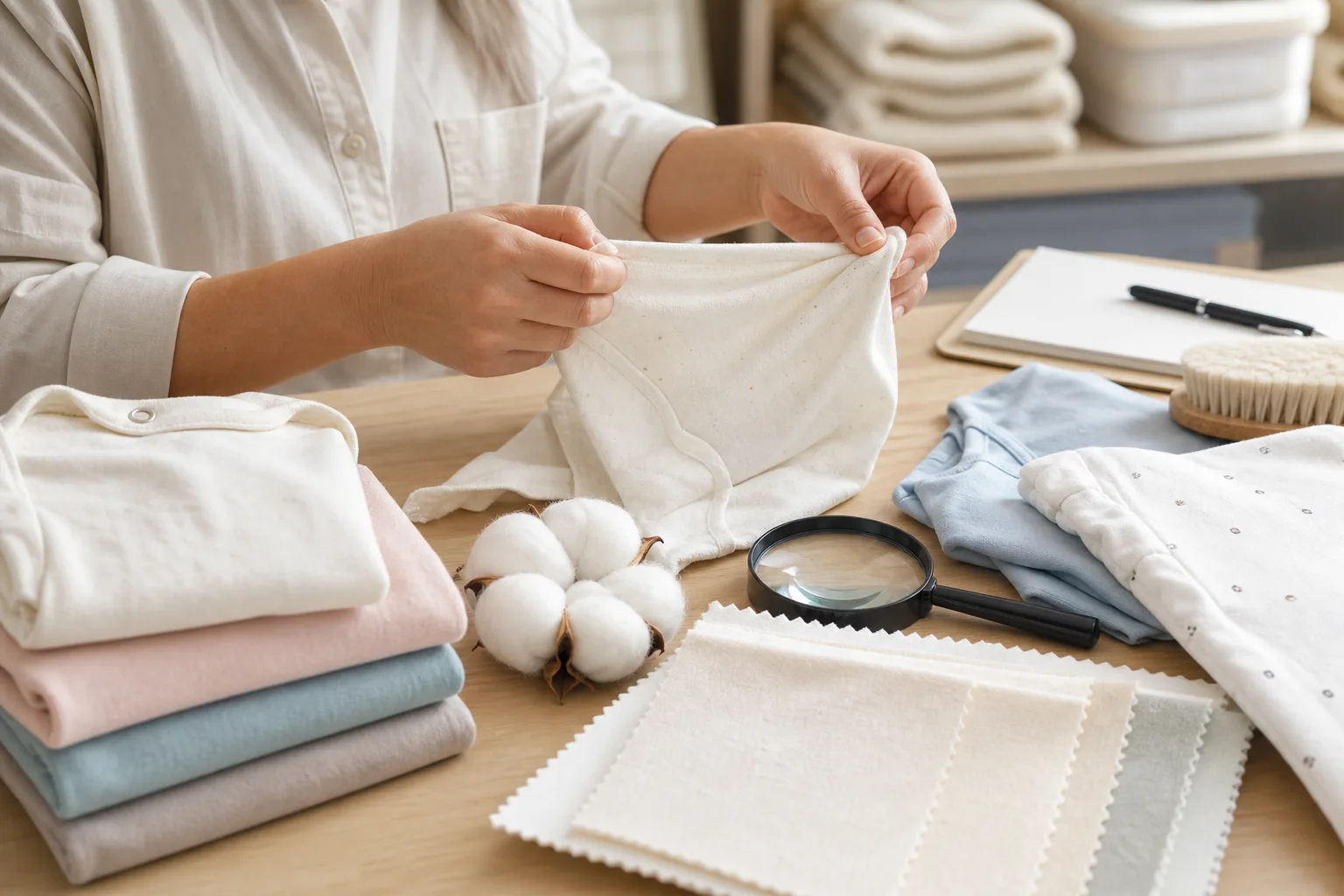
The best cotton for baby clothes is not automatically the cotton with the most prestigious name. For everyday bodysuits, tops and one-pieces, a well-made fabric using combed cotton yarn is a strong starting point: choose stable interlock when you want a smooth, substantial fabric, jersey for lighter clothing, or rib where stretch is useful. Then check the complete garment—fiber percentage, seams, finishing, care instructions and credible certification. Fiber type matters, but it cannot guarantee softness, durability or shrinkage performance by itself.
The quick answer: prioritize the finished garment
Most shoppers cannot see the bale-level fiber measurements available to a textile mill. The practical task is therefore to look for evidence that the manufacturer has converted cotton into an appropriate yarn, fabric and garment.
A useful order of priority is:
- Confirm the fiber content. Decide whether you want 100% cotton or a cotton-rich blend with a small amount of another fiber for a stated purpose, such as stretch.
- Choose the construction for the use. Interlock, jersey, rib and woven gauze do not feel or behave alike.
- Look for yarn information. “Combed cotton” is more informative than an unsupported word such as “premium.”
- Inspect garment workmanship. Check seams, bindings, fastenings and areas likely to receive repeated washing or abrasion.
- Read the care label before buying. A soft garment is not convenient if its required care does not fit the household routine.
- Interpret certification narrowly. A verified organic or sustainability label can address defined sourcing or processing criteria, but it does not automatically prove superior softness, fit or durability.
This guide concerns textile selection and care. It does not assess a specific garment's regulatory safety compliance, fit for an individual child or medical suitability.
Why the cotton name is only the beginning
Fiber quality affects yarn-making
Cotton is a natural material with measurable variation. USDA classing instruments measure properties including fiber length, length uniformity, strength, micronaire, color and trash. Micronaire combines information related to fiber fineness and maturity. These measurements help mills buy and manage cotton for spinning; they are not usually printed on a consumer garment label. USDA Agricultural Marketing Service explains the official classing measurements.
Longer, more uniform and suitably strong fibers can help a spinner produce even, strong yarn. CottonWorks notes that staple length and length uniformity affect yarn strength, evenness and spinning efficiency. However, the outcome still depends on how fibers are blended, prepared and spun, followed by the fabric construction and finishing process. Learn more in Cotton Good's guides to cotton quality, staple length and micronaire.
Upland, Pima and other names are not performance grades
Upland cotton can be used to make excellent baby clothing, while longer-staple cottons such as Pima may support fine, smooth yarns when properly selected and processed. Neither name guarantees the quality of the finished garment. A poorly engineered fabric does not become durable merely because its fiber has a premium-sounding origin or type.
In the United States, a named cotton type must be represented accurately. The FTC states that if a product containing multiple kinds of cotton names one type, its labeling must disclose the relevant percentage and make clear that other cotton was used. “100% cotton” describes generic fiber content; it does not establish that the product is 100% of a particular named cotton. FTC cotton-labeling guidance provides examples.
Yarn and construction shape comfort and durability
Why combed cotton is a useful clue
Combing removes short fibers during yarn preparation. According to CottonWorks, combed yarn can support finer yarns and tends to produce fabrics with improved hand, softness and durability. It is a real manufacturing description, although it remains only one part of the specification. Ring-spun yarn may also offer a smooth, soft hand, but the term alone does not reveal the yarn count, twist, evenness or fabric weight.
If an online listing says only “luxury cotton” or “buttery cotton,” treat that wording as a sensory or marketing claim. Ask whether the seller can identify the fiber percentage, yarn process, fabric construction and care requirements.
Match the fabric to the garment
| Construction | Typical character | Useful applications | What to check |
|---|---|---|---|
| Interlock knit | Smooth on both sides, stable and generally more substantial than basic jersey | Bodysuits, tops, pants and close-to-body layers | Recovery at openings, seam bulk and post-wash dimensions |
| Jersey knit | Light, flexible and commonly used for T-shirts | Warm-weather tops, rompers and layering pieces | Excessive thinness, edge curling, twisting and transparency when stretched |
| Rib knit | Highly extensible across the width | Cuffs, neckbands, leggings and garments designed for easy movement | Whether stretched areas return toward their original shape |
| Woven gauze or muslin | Open, light woven structure with limited knit-like stretch | Loose shirts, dresses and warm-weather separates | Seam security, opacity and whether the cut allows movement |
| Brushed knit or fleece | Raised surface and greater warmth | Cool-weather layers | Surface shedding, pilling and whether the care instructions preserve the finish |
CottonWorks describes interlock as a stable double-knit construction that does not curl and can be very soft when made with combed cotton yarn, including for baby clothes. Its knit-construction guide also distinguishes interlock from jersey and rib. Explore Cotton Good's broader guide to cotton fabrics for additional construction details.
Finishing can change how cotton feels and washes
Initial softness may come from more than the fiber
The hand felt in a shop is the result of fiber, yarn, fabric structure, dyeing, washing and finishing. Mechanical finishing can alter surface character, while chemical finishes may be used for effects such as softness, dimensional stability, wrinkle resistance or water repellency. Therefore, touching an unworn garment does not show how it will feel after repeated laundering.
Terms such as “prewashed,” “garment washed” and “preshrunk” may describe processing, but they do not mean that no further dimensional change is possible. CottonWorks identifies fiber, yarn, knit structure, wet processing, finishing, cut-and-sew techniques and garment care as factors affecting shrinkage. Knits are generally more prone to dimensional change than wovens because their looped structures are more open and mobile. CottonWorks' shrinkage guidance explains why performance must be engineered throughout production.
Questions for brands and suppliers
- Has the fabric or garment been assessed for dimensional change under the labeled wash and dry procedure?
- Does the product specification set limits for shrinkage, spirality, pilling, colorfastness and seam performance?
- Is the soft hand expected to remain after laundering, or is it mainly an initial finish?
- Are special finishes present, and what performance claim are they intended to support?
- Is a “sensitive,” “gentle,” “clean” or “non-toxic” claim tied to a named standard or defined test scope?
A lack of disclosed finish information does not prove that a garment is untreated. Likewise, a “natural” claim is not a measurable result for softness, skin response or chemical content.
How to read cotton and organic labels
Start with the required fiber statement
Most textile products sold in the United States must identify their fiber content. “100% cotton” means the textile fiber is cotton, apart from permitted exclusions such as certain trim; a label such as “95% cotton, 5% spandex” identifies a blend. A small elastane or spandex content may improve stretch and recovery, but it also means the garment is not all cotton. Choose according to the intended performance rather than assuming either composition is universally better.
Organic describes a defined claim, not automatic softness
Organic cotton concerns how the agricultural fiber was produced and certified. It does not, by itself, specify staple length, yarn quality, fabric weight, sewing quality or wash durability. Those properties must be evaluated separately.
For a broader textile-processing certification, check the exact label rather than accepting a product-page reference to a certified company. Under GOTS Version 8.0, the “Organic” label grade requires at least 95% certified fiber content, excluding accessories; the “Made with (x%) organic materials” grade requires at least 70%. GOTS covers defined stages including processing, manufacturing, packaging, labeling, trading and distribution, together with applicable environmental, chemical and social criteria. The label should include the GOTS logo, label grade, approved certification body and certification number. GOTS Version 8.0 sets out those requirements.
Certification should be interpreted within its stated scope. It is not proof that one garment is softer, stronger or better fitting than an uncertified garment. Similarly, broad words such as “eco-friendly” should not substitute for a specific, substantiated benefit. See Cotton Good's guides to cotton sustainability and cotton types.
A practical buying and care checklist
Before purchase
- Read the complete fiber percentage, not just the product name.
- Prefer a construction suited to the garment: stable interlock, light jersey, extensible rib or an appropriately cut woven.
- Give useful weight to specific yarn terms such as “combed,” but do not treat them as a complete quality guarantee.
- Inspect inside seams for rough edges, loose thread ends and unnecessary bulk.
- Gently stretch the fabric and openings. Look for reasonable recovery rather than permanent rippling.
- Hold lightweight fabric up to the light and check whether it becomes overly transparent or opens sharply at seams.
- Check fastenings and applied decorations for secure attachment as part of a broader garment inspection.
- Read the care label and decide whether the required washing and drying procedure is realistic.
- For certification claims, look for the complete label details and verify what the standard actually covers.
- Do not pay more solely for words such as “premium,” “pure,” “luxury,” “natural” or “Egyptian-style.”
After purchase
Follow the sewn-in care instructions because they apply to the whole garment, including fabric, thread, prints, elastic, trims and fastenings. The FTC Care Labeling Rule requires covered manufacturers and importers to provide regular care instructions and to have a reasonable basis for them. That makes the care label more useful than a generic rule for all cotton clothing.
Washing at the permitted lower temperature and avoiding unnecessary high dryer heat may reduce stress on many garments, but the product label takes priority. Recheck dimensions, seam shape and fastening security after the first few washes. Retire or repair an item if its structure or components become unsuitable for continued use.
What “best” should mean
For consumers, the best cotton baby clothes are those that deliver the needed comfort, fit, washability and durability at the garment level. For brands and sourcing teams, that means writing specifications that connect bale and yarn choices to measurable fabric and garment requirements. A cotton type or certification can provide useful information, but neither replaces construction standards, finishing controls, care validation and quality assurance.
A practical default is combed cotton interlock for a smooth, stable everyday knit, with lighter jersey for warm conditions and rib where extra extensibility is needed. Treat that as a starting specification, not a universal winner. Compare the actual product, its intended use and its care demands through Cotton Good's cotton buying guides, cotton science and care guidance.
Frequently asked questions
Is Pima cotton always best for baby clothes?
No. Pima's longer fibers may support fine, smooth yarns, but the finished result also depends on spinning, fabric construction, finishing, sewing and care. Well-made Upland cotton clothing can outperform a poorly constructed garment carrying a premium cotton name.
Is 100% cotton better than a cotton blend for babies?
It depends on the garment. One hundred percent cotton provides a clear all-cotton composition, while a small amount of spandex may improve stretch and recovery in fitted clothing. Check the full fiber percentage and choose according to the intended use.
Does organic cotton feel softer than conventional cotton?
Not necessarily. Organic describes certified agricultural production, not a softness grade. Fiber quality, combing, yarn structure, fabric construction and finishing have more direct effects on how a particular garment feels.
Which cotton knit is a good choice for baby bodysuits?
Combed cotton interlock is a useful starting point because it can provide a smooth surface and stable construction. Jersey is lighter, while rib offers more widthwise stretch. No construction is automatically best without considering fabric weight, seams, finishing and care.
How this guide was prepared
This guide is based on desk research completed on September 15, 2026, using USDA cotton-classing information, FTC textile-labeling guidance, the current GOTS standard and CottonWorks technical material on fiber quality, yarn, knit construction and dimensional stability. It does not rely on product trials, laboratory testing, medical assessment, factory visits or first-hand use.
Review status: Publishable quality advisory.
Sources and scope
- Cotton Classing ServicesUSDA Agricultural Marketing Service
Official definitions of instrument-measured cotton properties, including fiber length, uniformity, strength, micronaire, color and trash.
Accessed 2026-09-15 - Cotton Fiber QualityCottonWorks
How staple length, length uniformity, strength, micronaire, color and trash influence yarn processing and textile quality.
Accessed 2026-09-15 - Single & Double KnitsCottonWorks
Construction characteristics of jersey, rib and interlock, including interlock's stability and use with combed cotton in baby clothing.
Accessed 2026-09-15 - Shrinkage & SkewingCottonWorks
The combined effects of fiber, yarn, construction, processing, finishing, manufacturing and care on cotton garment shrinkage.
Accessed 2026-09-15 - Calling It Cotton: Labeling and Advertising Cotton ProductsFederal Trade Commission
U.S. fiber-content labeling requirements and rules for claims naming particular types of cotton.
Accessed 2026-09-15 - Global Organic Textile Standard Version 8.0Global Organic Textile Standard
Current GOTS scope, certified-fiber thresholds, label grades and required labeling elements.
Accessed 2026-09-15