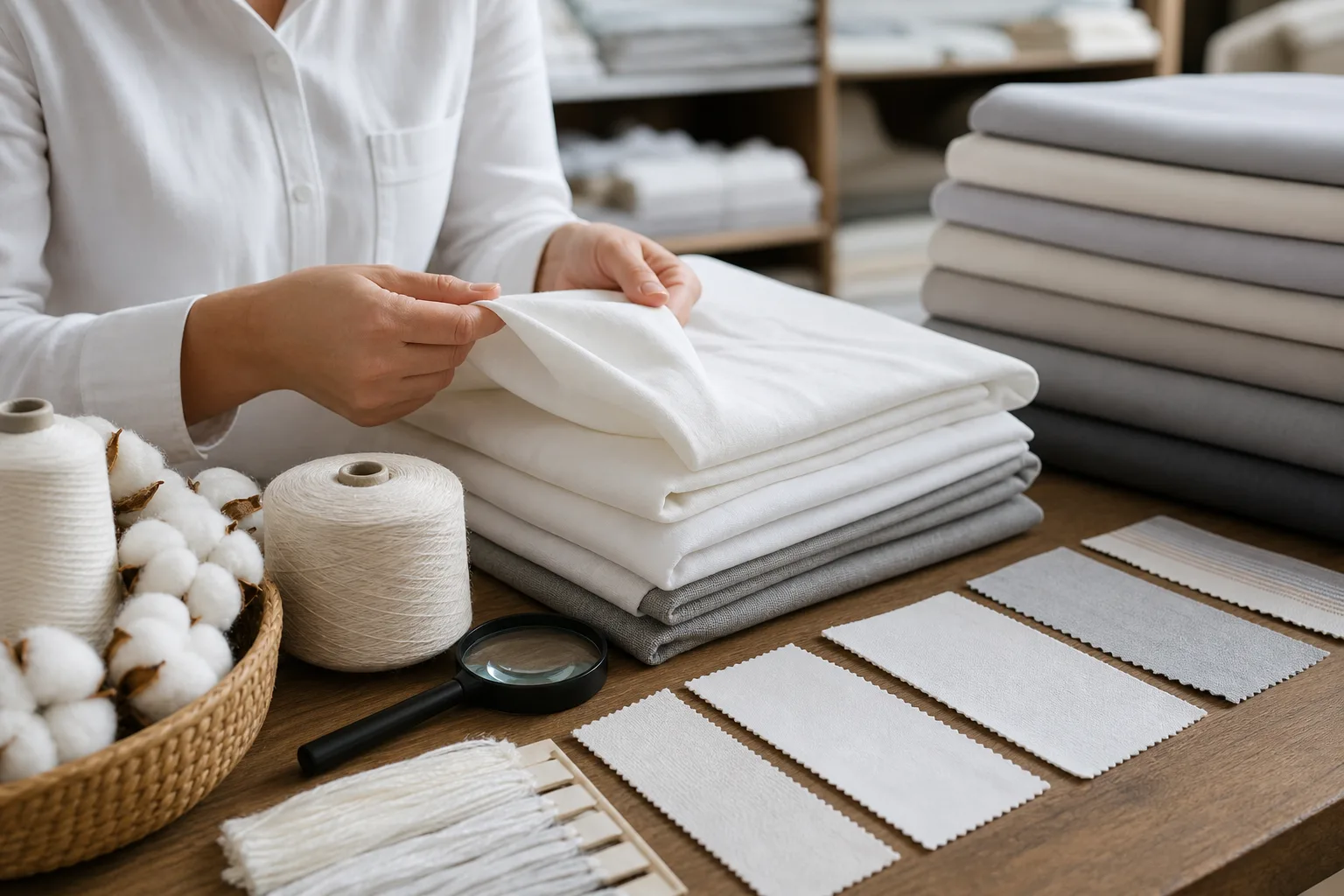
The best cotton for bed sheets is generally a well-specified long-staple or extra-long-staple cotton made into even yarns and an appropriate fabric construction. However, fiber name alone does not guarantee a better sheet. High-quality Upland cotton can outperform poorly spun or heavily finished premium cotton, while an extreme thread-count claim may tell you less than the weave, yarn construction and fabric weight. For most buyers, the sound approach is to confirm the fiber content, choose a weave that suits the desired feel, look for credible yarn and construction details, and treat softness or sustainability language as a claim to investigate rather than proof of performance.
Which cotton is best for bed sheets?
Longer fibers offer useful manufacturing options
Cotton fiber length is called staple length. Longer fibers can be spun into finer yarns and tend to support better yarn strength and evenness. Length uniformity also matters: a cotton sample containing fibers of widely varying lengths can be more difficult to process into consistent yarn. CottonWorks identifies staple length and length uniformity as important influences on yarn strength, evenness and spinning efficiency. ([cottonworks.com](https://cottonworks.com/fiber/fiber-science/cotton-fiber-quality/))
Extra-long-staple cotton, often abbreviated ELS, includes American Pima cotton. Its long fibers can be useful for fine, smooth sheeting, especially when combined with combed yarn and controlled fabric construction. USDA describes Pima as extra-long-staple cotton, and CottonWorks lists both Upland and ELS cotton as viable inputs for sheets. ([ams.usda.gov](https://www.ams.usda.gov/services/warehouse/cotton-program?utm_source=openai))
That does not make ELS cotton an automatic winner. Fiber selection creates manufacturing potential; it does not determine the final result. Spinning, yarn size, weave density, preparation, dyeing and finishing can preserve or undermine that potential.
Upland cotton can make very good sheets
Upland is the principal cotton used in everyday sheeting and is not synonymous with low quality. CottonWorks notes that percale and knitted sheets are commonly made with Upland cotton, with ELS cotton sometimes used to optimize particular properties. ([cottonworks.com](https://cottonworks.com/wp-content/uploads/2021/03/Cotton-Sheets-Buying-Guide_Spreads.pdf)) A well-made Upland percale may be a better purchase than a sheet carrying a premium cotton name but offering no useful information about yarn, weave or construction.
For more background, see the guides to Upland cotton, cotton types and staple length.
Fiber quality is only the first layer
What mills can measure
USDA cotton classification uses electronic instruments to measure fiber length, length uniformity, strength, micronaire, color and trash. Micronaire reflects a combination of fiber fineness and maturity rather than softness by itself. Fiber strength is measured as the force required to break a bundle of fibers, while length describes the upper-half mean of the sample. ([ams.usda.gov](https://www.ams.usda.gov/services/grading/cotton-classing))
These measurements are meaningful upstream because they help merchants and manufacturers select cotton for processing. They are not normally a consumer score for a finished sheet. Once fiber has been converted into yarn and fabric, sheet performance also depends on yarn quality, weave, weight, finishing, sewing and laundering.
- Staple length: influences the ability to make fine, even and strong yarns.
- Length uniformity: indicates how consistent the fiber-length distribution is.
- Fiber strength: contributes to yarn-making potential but is not the same as finished-fabric durability.
- Micronaire: combines information about fineness and maturity and can affect processing and dye uniformity.
- Color and trash: matter to cleaning, preparation and appearance before dyeing or finishing.
Explore these measurements through cotton quality, fiber strength, length uniformity, micronaire and HVI testing.
Yarn construction connects fiber to fabric
Look for information such as “combed cotton,” “ring-spun” or “single-ply,” but do not read any one term as a complete quality grade. Combing is an additional yarn-preparation step intended to remove shorter fibers and improve consistency. Ring spinning can produce fine, strong yarns, while other spinning systems can also be engineered successfully for specific price and performance targets. What matters is whether the fiber, yarn size and spinning method work together in the finished construction.
Choose the weave before chasing a cotton name
The weave or knit usually has a more immediate effect on how sheets feel in bed than the geographic name attached to the cotton. CottonWorks emphasizes that fiber type, spinning system, yarn count, fabric weight, construction and finishing collectively determine sheet performance. ([cottonworks.com](https://cottonworks.com/wp-content/uploads/2021/03/Cotton-Sheets-Buying-Guide_Spreads.pdf))
| Construction | Typical feel | Useful for | What to check |
|---|---|---|---|
| Percale | Crisp, matte and relatively airy | Warm sleepers, year-round use and buyers who like a freshly laundered feel | Even surface, balanced construction and no reliance on an extreme thread count |
| Sateen | Smooth, draping and more lustrous | Buyers who prefer a silkier hand and less crispness | Snagging or picking risk, yarn quality and whether density makes the sheet feel heavy |
| Flannel | Brushed, warm and soft | Cold rooms and winter bedding | Fabric weight and brushing quality; thread count is not the main comparison |
| Jersey knit | Stretchy, relaxed and similar to a soft T-shirt | Buyers who prefer flexibility over woven crispness | Fabric weight, recovery, shrinkage instructions and resistance to distortion |
Percale and sateen are genuinely different constructions, not quality levels. Percale uses a plain weave and generally feels crisper. Sateen uses longer yarn floats at the surface, creating a smoother appearance and hand but changing how the fabric responds to friction and snagging. Flannel obtains much of its character from brushing, while jersey is knitted rather than woven. See the cotton fabric guide for more construction detail.
Thread count is a specification, not a verdict
Thread count is the number of warp and filling yarns in one square inch of woven fabric. It is relevant, but only when the counting method, yarn fineness and construction are understood. CottonWorks cautions that buyers often equate a higher number with better quality even though fiber type, yarn system, yarn count, fabric weight, construction and finishing also matter. It also notes that very dense fabrics can become stiffer, less breathable and less drapable. ([cottonworks.com](https://cottonworks.com/wp-content/uploads/2021/03/Cotton-Sheets-Buying-Guide_Spreads.pdf))
Why very high numbers require questions
A manufacturer can raise a reported number through finer yarns, multiple yarn insertions or questionable treatment of plied yarn. A two-ply yarn consists of two strands twisted together, but that does not necessarily mean each strand should be presented as a separate woven thread. A large number on the package therefore cannot establish softness, durability or breathability on its own.
Instead of seeking the highest figure, compare thread count only among sheets with similar constructions. A moderate percale made from even combed yarns may be crisp and durable, while a sateen usually needs a denser construction to produce its characteristic smooth surface. CottonWorks provides different practical ranges for percale and sateen, reinforcing that there is no universal ideal number for every sheet. ([cottonworks.com](https://cottonworks.com/wp-content/uploads/2021/03/Cotton-Sheets-Buying-Guide_Spreads.pdf))
- Ask whether the stated count refers to actual warp and filling yarns.
- Check whether the yarn is single-ply or multi-ply when that information is available.
- Do not compare the thread count of woven sheets with jersey knits or flannel.
- Consider fabric weight and airflow if a very dense sheet feels heavy or stiff.
Read labels and marketing claims precisely
Pima and Egyptian cotton are not performance scores
A named cotton can be useful sourcing information, but it is not a laboratory result for the sheet. “Pima,” “Egyptian,” “premium,” “hotel quality” and “luxury” do not, by themselves, disclose yarn evenness, fabric strength, shrinkage, pilling resistance or colorfastness.
In the United States, the Federal Trade Commission says cotton products must accurately state fiber content. If a sheet contains more than one kind of cotton and the seller names a specialty cotton, the label must not falsely imply that the entire product consists of that type. For example, a blend of Pima and Upland cotton cannot truthfully be presented as 100% Pima cotton. ([ftc.gov](https://www.ftc.gov/business-guidance/resources/calling-it-cotton-labeling-advertising-cotton-products-0))
Check the sewn label or full online specification for:
- the percentage of cotton and any other fibers;
- whether a named cotton applies to all or only part of the cotton content;
- the weave or knit construction;
- country-of-origin information;
- dimensions and mattress-depth range;
- care instructions and any shrinkage qualification.
Finishing can change the showroom feel
Fabric finishing can alter softness, luster, wrinkle resistance, absorbency, shrinkage and surface appearance. CottonWorks explains that chemical finishing can change fabric hand and performance through treatments such as softeners and wrinkle-resistant resins. ([cottonworks.com](https://cottonworks.com/learning-hub/finishing/chemical-finishing/?utm_source=openai)) This means an unusually slick package feel may come partly from finishing rather than fiber quality. That is not inherently undesirable, but buyers should distinguish an applied effect from the underlying cotton, yarn and construction.
Evaluate sustainability separately from comfort
Organic, recycled and responsible-sourcing claims address material origin or supply-chain practices; they do not automatically demonstrate that a sheet will feel softer or last longer. Textile Exchange describes its Organic Content Standard as a voluntary standard that verifies organically grown material and tracks it through a chain of custody. ([textileexchange.org](https://textileexchange.org/organic-content-standard/)) Such verification can support a content claim, but it should not be treated as a finished-performance test.
Be cautious with broad words such as “green,” “eco-friendly” or “sustainable” when no specific basis is supplied. FTC guidance advises marketers to qualify general environmental claims with clear, prominent and specific benefits. It also warns that a certification or seal does not remove the need to substantiate the claims being made. ([ftc.gov](https://www.ftc.gov/business-guidance/resources/environmental-claims-summary-green-guides?utm_source=openai))
A useful sustainability check asks:
- What exact material or process does the claim cover?
- Is the percentage of claimed cotton disclosed?
- Does a named standard verify content, processing, chain of custody or several of these?
- Can the seller identify the certification body or certified product record?
- Is a durability claim supported separately rather than inferred from the sustainability label?
See cotton sustainability for help interpreting sourcing and certification language.
A practical bed-sheet buying checklist
- Start with use: choose crisp percale, smooth sateen, warm flannel or flexible jersey according to the sleeper and climate.
- Confirm fiber content: decide whether you want 100% cotton or a blend, then verify the full label rather than relying on the product name.
- Prefer meaningful detail: long-staple or ELS cotton, combed yarn and a clearly identified construction are more informative together than “luxury cotton.”
- Use thread count in context: compare similar woven constructions and question unusually large numbers.
- Inspect construction: look for even fabric, secure hems, straight stitching, sound elastic and fitted-sheet dimensions that match the mattress.
- Check finishing claims: determine whether wrinkle-free, easy-care, cooling or antimicrobial performance comes from an applied treatment and whether the seller explains it.
- Verify sustainability language: look for the scope, percentage and chain-of-custody basis of a claim.
- Read care instructions before buying: a sheet is not a good practical choice if its required care does not suit your household.
Care for the construction you bought
Follow the product’s instructions because dyes, finishes, elastic and sewing components may impose limits that cannot be inferred from “100% cotton.” Washing with excessive heat and overdrying can place unnecessary thermal and mechanical stress on a sheet. Prompt removal from the dryer can reduce wrinkling, while rotating between sets spreads wear across more than one fitted sheet. Consult the cotton care guide for a fuller laundering approach.
Bottom line: long-staple and extra-long-staple cotton provide valuable potential for fine, smooth and even yarns, but the best cotton sheet is the one in which fiber, yarn, construction, finishing and care requirements form a credible specification. Buy the sheet as a textile system—not as a cotton name or thread-count number.
Frequently asked questions
Is Pima cotton better than Upland cotton for sheets?
Pima’s extra-long fibers can support fine, strong and even yarns, but that advantage depends on spinning, weave and finishing. A well-constructed Upland cotton sheet can be a better purchase than a poorly specified Pima sheet.
What thread count is best for cotton sheets?
There is no universal best number. Thread count should be evaluated within the same construction: percale can perform well at a lower count than sateen, while flannel and jersey are better compared by fabric weight and construction.
Are Egyptian cotton sheets always extra-long staple?
No. Egyptian is not, by itself, a finished-sheet quality measurement, and cotton grown in Egypt can vary. Verify the fiber-content statement and any specific long-staple or extra-long-staple claim rather than relying on the name alone.
Does organic cotton make softer sheets?
Not necessarily. Organic standards can verify agricultural origin and chain of custody, but softness depends on fiber properties, yarn, construction and finishing. Evaluate organic content and sheet performance as separate questions.
Which cotton weave is best for hot sleepers?
Percale is often the most suitable starting point because its plain-weave construction generally feels crisp and relatively airy. Actual comfort will still vary with yarn size, fabric density, finishing and bedroom conditions.
How this guide was prepared
This guide is based on desk research conducted through September 13, 2026, using technical material from CottonWorks and official guidance from USDA, the Federal Trade Commission and Textile Exchange. It translates published fiber, construction, labeling and chain-of-custody information into buying guidance. No products were purchased or tested, and no laboratory work, supplier audits, farm visits or first-hand performance trials were conducted.
Review status: Publishable quality advisory.
Sources and scope
- A Practitioner’s Guide to Cotton SheetingCottonWorks / Cotton Incorporated
Sheet-construction guidance covering cotton type, yarn systems, thread count, fabric weight, percale, sateen, flannel and jersey.
Accessed 2026-09-13 - Cotton Fiber QualityCottonWorks / Cotton Incorporated
Definitions and manufacturing significance of staple length, length uniformity, fiber strength, micronaire, color and trash.
Accessed 2026-09-13 - Cotton Classing ServicesUSDA Agricultural Marketing Service
Official description of instrument measurements used in U.S. cotton classification, including length, strength, uniformity and micronaire.
Accessed 2026-09-13 - Calling It Cotton: Labeling and Advertising Cotton ProductsFederal Trade Commission
U.S. fiber-content labeling requirements and guidance for truthful Pima, Egyptian and mixed-cotton claims.
Accessed 2026-09-13 - Organic Content StandardTextile Exchange
Scope of organic-material verification and chain-of-custody documentation under the Organic Content Standard.
Accessed 2026-09-13 - Environmental Claims: Summary of the Green GuidesFederal Trade Commission
Guidance on qualified environmental claims, certifications, seals and substantiation.
Accessed 2026-09-13