
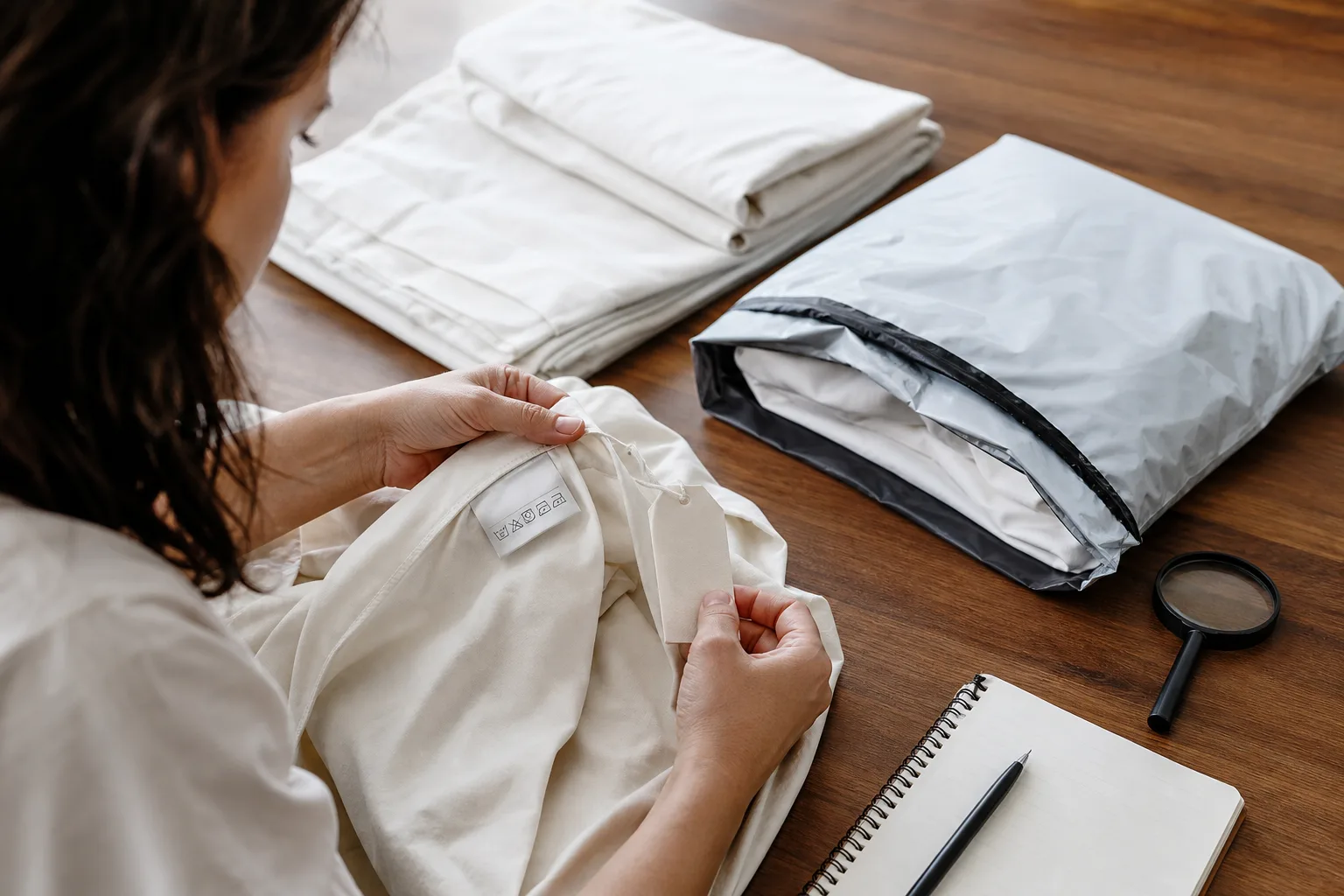
Treat “100% cotton,” “Egyptian” and “1000 thread count” as claims to investigate, not quality verdicts. At a Canton Fair home-textiles booth or on an online listing, check the same five things: fiber content, thread-count method, named-cotton evidence, organic certification and fabric weight. Use these checks to compare everyday sheets and towels wherever you shop.
The organizer’s attendance guide lists the 140th Canton Fair’s Phase 3 for October 31–November 4, 2026. This is desk research, not a report from the exhibition; we have not visited booths or tested products for this guide.
Claim 1 — “100% cotton”
At the booth, read the sewn-in label on the item. Online, request a clear label photograph for the exact variant. A headline may emphasize cotton while the detailed composition reveals another fiber. Read the percentages and their order, then check whether they describe the whole product or only its face, cover or loops.
The FTC’s cotton-label guidance explains US disclosures for cotton and blends. Other markets have their own rules. A seller’s declaration is useful evidence of what is promised, not independent fiber analysis.
If the title, label and specification disagree, ask for a consistent written answer before paying. Our 100% cotton label decoder explains what composition leaves unknown; the sheet-label checklist helps you compare those details.
Claim 2 — Thread count
Ask a booth representative or online seller: “Is this single-ply or multi-ply yarn, and how was thread count calculated?” Counting the component strands of plied yarn as separate woven threads can inflate the advertised figure. Multi-ply yarn itself is not evidence of poor quality.
Thread count describes woven construction; it is not yarn count, which describes yarn size. Nor does a larger number prove cooler sleep or longer life. Cotton Incorporated’s sheet guide puts thread count alongside yarn, weave and finishing.
Compare like constructions and ask for the counting basis in writing. If the answer is only “more is better,” leave the quality advantage unproven. Read our thread-count guide before paying a premium for the headline number.
Claim 3 — “Egyptian” / “Pima”
These names are not interchangeable quality grades. Egyptian describes origin; Pima identifies an extra-long-staple cotton type. Neither tells you how well the finished sheet was spun, woven or finished.
At a booth or on a listing, ask what percentage is the named cotton and what documentation connects it to that item. For a specific long-fiber claim, request the staple-length value, unit and measurement method, plus its connection to the relevant material or batch. USDA cotton classing measures length alongside other raw-fiber properties; a length number alone cannot authenticate origin.
Retailers may not hold that level of detail. Missing evidence means the premium claim remains unverified, not that fraud is established. Compare Pima and Egyptian cotton and learn what staple length can support.
Claim 4 — “Organic”
Ask the booth seller or online shop to name the standard, certification body and certificate or licence number. Then check the scope: raw fiber, fabric or finished item? A company’s ability to supply certified goods does not establish that every product it sells is certified.
For GOTS claims, the official labelling guidance identifies the certification information shoppers should receive. Use the certified-suppliers database to investigate the entity and scope; contact the certifier when details are unclear. Match the documentation to the actual product.
Without usable certification evidence, “organic” is an unsupported claim to you. That does not establish the fiber’s actual farming history. Certification also does not promise softer fabric. Our certification decoder and organic-versus-regular comparison explain the distinction.
Claim 5 — Weight by GSM, not by hand-feel
GSM means grams per square metre: fabric mass per area. Request it for the booth sample or exact online variant, and ask whether it describes the fabric, whole towel or another component. Packaged shipping weight is not fabric GSM.
Compare sheets with similar sheets and towels with similar towels. Their constructions serve different purposes, so there is no shared “best GSM.” The CottonWorks home buyer’s guide discusses weight alongside construction and finishing.
Touch still helps you judge preference, but finishing can change initial softness. A plush sample does not prove lasting absorbency; more weight does not automatically mean better performance. Use our GSM guide to interpret the number in context.
Five claims, one comparison sheet
This original editorial table checks the evidence offered, not whether a product has passed laboratory testing. Use every row at a booth or on a product page.
| Claim | Booth / listing check | Evidence worth accepting | Red flag |
|---|---|---|---|
| 100% cotton | Read the exact item’s full composition label | Consistent percentages and component scope | Headline and label conflict |
| Thread count | Ask about ply and counting method | Written construction and counting basis | Quality promised solely by a large number |
| Egyptian / Pima | Check named-cotton share and supporting records | Item-linked identity evidence; measured length for length claims | Generic origin story offered as proof |
| Organic | Check standard, certifier, number and scope | Verifiable documentation covering the claimed product | Unrelated certificate or unverifiable logo |
| GSM | Request mass per area and component basis | Comparable specifications for the exact variant | Parcel weight substituted for fabric weight |
What a booth visit can’t tell you
Neither touching a display sample nor reading a listing establishes wash durability, shrinkage or pilling resistance. Those need relevant laundering or performance tests with stated conditions. A report for another fabric or batch may not describe your purchase.
Before washing a trial purchase, check the return terms and care instructions. Record dimensions and surface condition, then compare after laundering as directed. That is a useful household observation, not a standardized laboratory test. See our cotton-sheet wash-test guide and shrinkage-prevention advice.
Over to you
Which label claim do you trust least? Vote by emailing your choice: 100% cotton / Egyptian / Thread count / Organic.
Your email app opens; nothing is sent until you send it. Replies are private correspondence, with no live totals or representative survey results.
Next steps
Use the everyday cotton-quality buying checklist to connect label evidence with construction, care and the way you will use the item.
Questions & discussion
Share a question or a useful experience about this guide. Comments appear immediately. Your name and comment are public. Email is optional and stays private; reply emails are not enabled yet. Comment privacy.