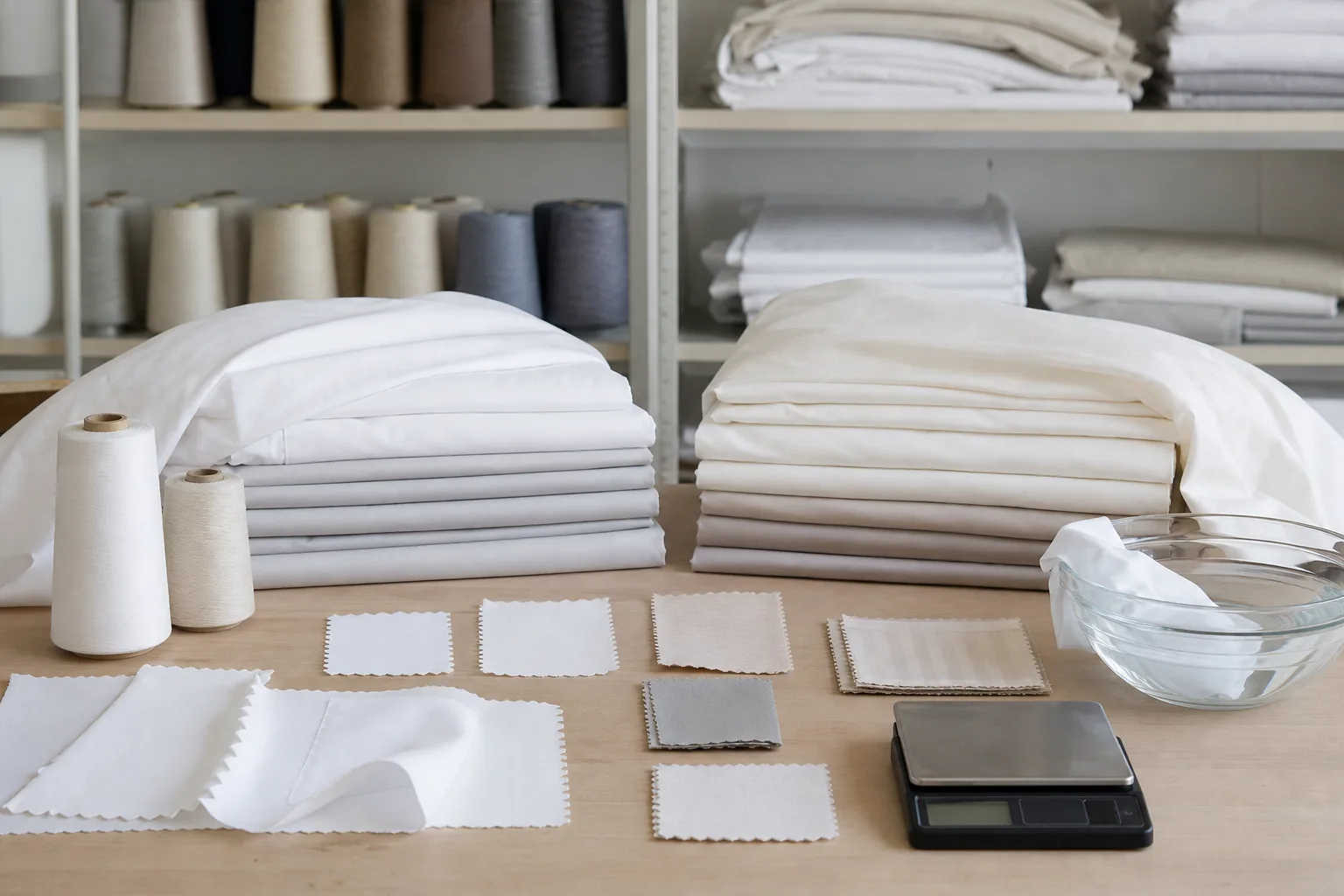
The best starting point when buying cotton sheets for hot sleepers is a relatively light, unbrushed percale made from clearly labeled cotton. Percale’s plain-weave construction commonly produces a crisp, breathable fabric, while a lighter weight reduces the amount of material around the sleeper. Sateen can still be comfortable, especially for people who value smoothness, but its construction and typically higher yarn density may feel warmer. Do not judge either weave by fiber name or thread count alone: yarn, fabric weight and finishing also matter.
Choose the fabric, not just the fiber
Cotton is the raw material. A finished sheet is a system made from fibers spun into yarns, yarns arranged in a woven or knitted construction, and fabric that may be softened, brushed, calendared, wrinkle-treated or given another performance finish. Two products labeled “100% cotton” can therefore feel and perform very differently.
Cotton can absorb moisture, while a suitably constructed cotton fabric can allow heat and humidity to move away from the skin. CottonWorks describes cotton bedding as capable of transferring heat and allowing moisture to evaporate, but this should not be interpreted as a guarantee that every cotton sheet will sleep equally cool. Fabric density, thickness and surface treatment can support or restrict that movement. CottonWorks’ home-textile overview explains cotton’s heat and moisture behavior.
What the cotton type can change
Longer cotton fibers can be spun into finer yarns, potentially helping a manufacturer create a smooth fabric without relying on bulky yarns. That may improve hand and construction options, but “long staple,” “Pima” or “Egyptian” is not a measurable cooling result. Fiber length does not tell you the finished fabric’s weight, air permeability, weave density or finish.
Why yarn information is useful
Finer, well-made yarns can produce a light sheet with good coverage. Coarser or fuzzy yarns may feel rougher, while brushing deliberately raises fibers from the surface to create warmth and softness. Terms such as “combed” and “ring-spun” describe preparation or spinning choices; they may help explain feel and durability, but they do not replace construction data.
Percale, sateen, jersey and flannel compared
Weave or knit structure is usually more useful to a hot sleeper than a premium-sounding cotton name. The following comparison describes common tendencies, not guaranteed outcomes. A lightweight sateen may feel cooler than an unusually heavy, densely woven percale.
| Construction | Typical surface and structure | Likely fit for a hot sleeper | What to verify |
|---|---|---|---|
| Percale | Plain weave with a crisp, matte surface | Usually the strongest starting choice because it commonly combines moderate weight with good breathability | Fabric weight, thread count method and whether the sheet is brushed or heavily finished |
| Sateen | Satin weave with longer yarn floats and a smooth, lustrous face | Useful when smoothness matters more than maximum crispness; denser or heavier versions may feel warmer | Weight, density and whether a very high thread count has produced a stiff or compact fabric |
| Jersey | Knitted rather than woven; soft and stretchy | Can breathe well, but its close, draping contact may feel warmer to some sleepers | Fabric weight, stretch recovery and whether the surface is brushed |
| Flannel | Woven fabric with a raised, brushed surface | Generally a poor match for consistently hot sleepers because the raised surface and higher weights are designed for warmth | Weight and whether the product is described for cold-weather use |
Cotton Incorporated’s technical buying guide characterizes percale as crisp and breathable and notes that heavier flannel provides additional warmth and may be less breathable. It also shows why construction, weight, yarn and finish should be evaluated together. See the CottonWorks buying guide for cotton sheets. For a direct construction comparison, read percale versus sateen and the percale feel guide.
Weight and thread count need context
Use fabric weight when it is available
Fabric weight, commonly expressed in grams per square meter or GSM, indicates how much material occupies a given area. It does not measure cooling directly, but within comparable cotton constructions, a lighter sheet generally places less textile mass over the sleeper. That makes weight a useful question when choosing between otherwise similar products.
The CottonWorks guide lists approximately 100–140 GSM for common percale constructions and approximately 120–155 GSM for sateen examples. These are industry guide ranges, not universal pass-or-fail standards. A buyer should not reject a sheet solely because it falls outside them; yarn fineness, weave geometry and finishing can change the result. Learn how to interpret GSM and fabric weight.
Do not use the highest thread count as a quality shortcut
Thread count normally adds the warp and filling yarns in one square inch of woven fabric. When yarn size is comparable, increasing the count places more yarn into the area and increases cover. That may produce smoothness, but an excessively compact construction can also become stiff and less breathable.
The CottonWorks guide notes that high counts may be created with finer yarns, multiple yarn insertion or plied yarns, and warns that extremely high sateen counts can reduce breathability. The number is therefore incomplete unless the seller also explains the yarn and counting method. Compare the evidence behind cotton sheet thread count instead of assuming that the largest figure is best.
- Treat a moderate thread count in a well-specified fabric as more informative than an unexplained four-digit claim.
- Ask whether plied yarn components were counted separately.
- Compare thread count only between similar weaves and yarn systems.
- If possible, consider GSM, weave and finish before using thread count as a tiebreaker.
Finishing can change the sleep experience
Finishing is not automatically good or bad. It can improve softness, wrinkle resistance, appearance, moisture handling or durability. It can also make it difficult to predict performance from the fiber label alone.
Soft, wrinkle-free and brushed are not equivalent
A softener changes surface feel. A wrinkle-resistant treatment aims to help the fabric retain a smoother appearance. Brushing mechanically raises the surface fibers, increasing softness and insulation. None of these descriptions independently reports air permeability, drying time or thermal resistance.
If a sheet is promoted as “cooling,” “temperature regulating” or “moisture wicking,” look for a precise explanation. Is the claim based on the cotton fiber, a fabric construction, a topical finish or treated yarns? Was the finished sheet tested, which method was used, and does the brand provide a result after repeated laundering? Without that information, “cooling” remains a marketing description rather than a comparable performance grade.
Some finishes are designed specifically for moisture management
Engineered finishes can alter how cotton absorbs, spreads or releases moisture. Their performance cannot be inferred from a standard “100% cotton” declaration, and different technologies work in different ways. Buyers should seek test-method details and durability information rather than assuming every treated cotton product performs alike.
Read the label and product page critically
In the United States, covered textile products must generally disclose constituent fiber percentages, country of origin and the identity of the manufacturer or another responsible business. The Federal Trade Commission also explains that fiber-related advertising must not be false or misleading. Review the FTC’s textile-labeling guidance.
A fiber-content label can confirm whether a sheet is all cotton or a blend, but it does not certify the weave, thread count, fabric weight, staple length or cooling performance. Check the sewn-in label as well as the front of the package, and use the following hierarchy:
- Fiber content: Confirm whether the fabric is 100% cotton or a blend.
- Construction: Look for percale, sateen, jersey or flannel.
- Weight and density: Prefer disclosed GSM and a credible thread-count explanation.
- Finish: Identify brushing, wrinkle resistance or moisture-management treatment.
- Evidence: For a performance claim, look for the test method, comparison material, laundering condition and measured result.
For more label checks, see how to verify cotton sheet labels and the broader cotton bed-sheet buying guide.
A practical hot-sleeper buying checklist
- Start with percale: Choose an unbrushed plain weave if crispness is acceptable.
- Favor moderate weight: Ask for GSM when comparing products within the same construction.
- Be skeptical of extreme thread counts: A larger number does not automatically mean better airflow, comfort or durability.
- Separate smoothness from coolness: Sateen may feel smoother against the skin, but it is not necessarily the cooler option.
- Avoid flannel for warm rooms: Its raised surface is intended to add warmth.
- Check for hidden blends: Read the percentage label rather than relying on a product name containing the word cotton.
- Question cooling claims: Ask what was tested, against what reference fabric and after how many washes.
- Check fit after laundering: An undersized fitted sheet stretched tightly over a mattress may wear prematurely and become uncomfortable.
- Use the return policy: Personal comfort also depends on room conditions, mattress protectors, blankets, sleepwear and individual perspiration.
Care and sustainability claims answer different questions
Care can preserve the intended feel
Follow the product’s care instructions because finishes and constructions do not all respond identically to heat and detergent. Wash new sheets before evaluating their final hand, since some temporary processing residues may be removed. Avoid unnecessary high dryer heat, remove sheets promptly and ensure they are fully dry before storage. A breathable sheet cannot compensate for a thick waterproof mattress protector or a heavy duvet, so assess the complete bedding system. See the guides to washing cotton and drying cotton.
Organic and sourcing labels do not measure coolness
Sustainability certifications and sourcing programs address defined environmental, social, organic-content or chain-of-custody requirements. They should not be presented as proof that a sheet is cooler, softer or more breathable unless those performance properties have been evaluated separately. For example, GOTS covers organic-fiber inputs and textile processing, manufacturing and labeling requirements; it is not a thermal-comfort rating. The GOTS standard defines its certification scope.
The most defensible purchase decision therefore combines two separate evaluations: select the sourcing or processing standard that matches your priorities, then assess weave, weight, yarn, finish and evidence for sleep comfort. For many hot sleepers, that process leads to a light, unbrushed cotton percale with a credible label and moderate construction—not simply the sheet with the highest thread count or the most prominent cooling language.
Frequently asked questions
Is cotton percale always cooler than cotton sateen?
Not always, but percale is usually the better starting point for a hot sleeper because its plain weave commonly produces a crisp, breathable sheet. A lightweight sateen may still feel cooler than a heavy or unusually dense percale, so compare weight, yarn density and finish.
What thread count is best for a hot sleeper?
There is no universal best number. Favor a credible, moderate count in a light fabric over an unexplained extreme count. Thread count should be assessed with weave, GSM, yarn fineness and the manufacturer’s counting method.
Does 100% cotton mean the sheets will sleep cool?
No. The label identifies fiber content, not thermal performance. A 100% cotton sheet may be light percale, dense sateen, stretchy jersey or warm brushed flannel, each with a different feel.
Do organic cotton sheets feel cooler?
Organic status addresses how the cotton was produced, while certifications may also cover processing requirements. It does not by itself measure airflow, drying time or thermal resistance. Evaluate construction and weight separately.
How this guide was prepared
This page is based on desk research of Cotton Incorporated technical guidance, United States Federal Trade Commission textile-labeling guidance and the published GOTS standard. It translates those sources into a consumer buying framework. No products were purchased or tested, and no laboratory work, supplier visits, certifications, customer interviews or first-hand sleep trials were conducted.
Review status: Publishable quality advisory.
Sources and scope
- A Buying Guide for Cotton SheetsCottonWorks, Cotton Incorporated
Technical distinctions among percale, sateen, flannel and jersey; indicative fabric-weight ranges; thread-count limitations; and the combined importance of fiber, yarn, construction, weight and finishing.
Accessed 2026-10-08 - Cotton Home Textiles: Cotton Sheets and BeyondCottonWorks, Cotton Incorporated
General explanation of cotton bedding’s heat transfer, breathability and moisture-evaporation properties.
Accessed 2026-10-08 - Threading Your Way Through the Labeling Requirements Under the Textile and Wool ActsFederal Trade Commission
United States requirements and guidance concerning fiber-content, country-of-origin and responsible-business identification on textile labels and in advertising.
Accessed 2026-10-08 - Global Organic Textile Standard, Version 7.0Global Organic Textile Standard
Scope of GOTS requirements for organic fibers, textile processing, manufacturing, labeling and certification; used to distinguish sustainability certification from thermal-performance evidence.
Accessed 2026-10-08