
Start with what will be visible on the bed
Imagine choosing navy sheets to match a duvet, then finding that pale hair, lint or pillow marks create more contrast than you want. The practical choice is whether dark, middle-tone, pale or patterned bedding best fits the residue and maintenance routine in your home. Fiber content alone cannot settle the question: “A fiber-content label tells the buyer what fibers are present by weight; it does not describe dye class, penetration or fastness.” The guide to cotton dye absorption explains why the finished product and exact colorway matter.
In the r/Bedding discussion, the poster had bought dark navy and emerald cotton percale sheets to match a new duvet. After a night, the poster said dust, lint, pet hair, human hair and saliva marks near the pillow were extremely conspicuous. The poster asked dark-sheet users who had not encountered the problem to name specific products or brands. A later update said the same visible-mess problem had appeared on cotton sateen as well as percale. Other participants reported similar contrast with pale lint or hair, but some emerald- and black-sheet users said they had not noticed or could manage the problem. The discussion therefore did not show that every dark sheet behaves alike.
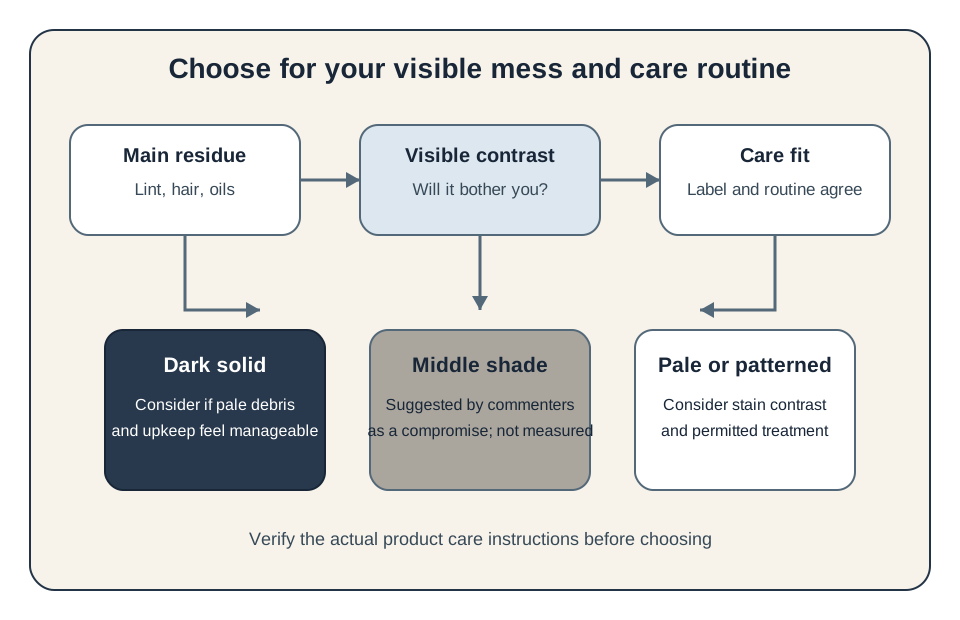
Match the color to the residue commenters described
A prominent cluster of commenters said very dark surfaces made pale lint, human hair, pet hair and saliva marks conspicuous. Shedding pets featured repeatedly in reports that dark bedding looked messy soon after cleaning. Commenters also described dark sets fading or developing a worn appearance after sunlight and repeated washing, but these were household anecdotes rather than matched tests of every dark textile.
White bedding drew a different set of complaints. Participants said it revealed yellow-toned marks associated with sweat, body oils and hair products. Several valued being able to locate stains and other problems, and some associated white sheets with bleaching or hotter washing. The thread did not establish that those treatments were permitted for every white set.
A commenter preferred dark bedding because a cohabitant’s work brought oil residue home and pale fabric developed an oily-looking haze. Gray, dove gray, beige and patterned sheets were repeatedly suggested as compromises for beds receiving mixed marks. Those were commenter preferences, not measured findings that a particular middle shade or pattern hides a defined amount of lint or staining.
Will the permitted care handle the marks you expect?
The cleaning debate left further questions open. Participants disagreed about the sequence for treating yellowed white sheets, the role of brightening products, and whether intensive soaking treatments helped or damaged the cloth. Some household claims concerned bleach and oily or sweat-related yellowing, but the discussion did not establish a reliable treatment order. Those reports were not a tested care protocol for either the poster’s sheets or every white cotton set.
Color loss from acne-related skincare was another unresolved issue. The thread described dark fabric becoming blotchy and treated the loss as irreversible, yet it did not supply a reliable restoration method. That was a reported problem and an unanswered request for a remedy, rather than proof that a particular stain treatment could repair removed color. Across the cleaning replies, advice about making marks less visible was therefore distinct from evidence that the fabric or dye would tolerate the proposed treatment.
Use those reports as contrast questions, not as permission to intensify laundering. Choose pale bedding when seeing stains matters only if the actual set supports your intended care. “White color and cotton content do not prove that chlorine bleach is safe.” Check the maker’s instructions before relying on bleach, heat or another treatment; the cotton-sheet washing guide explains why dyes, finishes, elastic and construction can alter the limits. Before choosing white as a lower-maintenance replacement, write down which treatment you expect to use when a mark appears. Compare that treatment with the exact care information. A preference for pale bedding does not make a prohibited bleach or drying process suitable. If the attraction of white depends entirely on washing it more aggressively, resolve that mismatch before buying. Likewise, choose a dark color only if its permitted care can coexist with the way the rest of your bedding is sorted and dried.
Decide whether dark-sheet upkeep fits your habits
Commenters disagreed over whether dark sheets were necessarily difficult to maintain. The majority cluster discouraged them because pale debris stayed visible and because users had seen dark sets fade or look worn. A minority reported using black sheets for long periods without obvious fading or unacceptable maintenance. Some of those users kept a large lint roller available for routine removal, while an emerald-sheet user said the reported visible-mess problem had not attracted their attention.
Pet-hair volume, willingness to use a lint roller and washing frequency appeared as points behind the disagreement. The reports also involved different fabrics, residues and care habits, so they were not matched product tests. The sampled majority remained cautious, but the minority experiences prevented the conversation from establishing that dark sheets are always unmanageable.
Also screen products used on skin that may contact a dark pillowcase or top sheet. The American Academy of Dermatology states that benzoyl peroxide “will bleach clothing, sheets, pillow cases, and towels.” Check the ingredient list rather than assuming every acne treatment contains it. The AAD guidance confirms the bleaching risk but does not provide a reliable method for restoring removed textile color. If even color matters, reserve a lower-contrast pillowcase for treatment nights and follow the skincare product’s directions.
Do not buy a weave solely because it is claimed to hide hair
Material differences appeared repeatedly in the anecdotes, but no agreed ranking emerged. Several commenters considered dark linen, products described as bamboo and jersey knit less revealing of hair than dark cotton percale. Other reports involving cotton blends or particular percale products served as counterexamples. The poster also reported conspicuous debris on both cotton percale and sateen rather than finding that switching between those constructions solved the problem.
The unanswered question was which material or weave, in the same dark color, quantitatively showed the least hair. The discussion supplied no consistent numerical comparison. Product suggestions remained scattered brand anecdotes, and no named construction was established as reliably overriding the contrast between pale debris and a dark surface.
The original r/Bedding discussion had 212 comments. About 100 were read across prominent discussions and nested replies, including the principal disagreement threads. A substantial portion therefore remained unread; the coverage notes described some unreviewed material as repeated anecdotes or jokes. Within the sample, caution about visible pale debris and fading was dominant, while long-term dark-sheet users supplied minority counterexamples.
The poster’s request for a dark sheet that did not look conspicuously messy received scattered product anecdotes rather than an accepted answer. The discussion also did not quantify which dark weave showed the least hair. Its useful evidence was consequently conditional: experiences varied with pets, occupational residue, fabric, lint-roller tolerance, washing frequency, care habits and concern about fading.
Treat weave and fiber names as reasons to inspect a product, not as guarantees. “A cotton label does not predict colorfastness.” Ask the seller for product-specific fastness evidence, including the tested exposure, method or conditions, result and exact colorway to which it applies. The cotton dye guide explains that dye selection, fixation, wash-off, construction, finishing and care can change performance. If the seller supplies only “fade resistant,” treat durability as unverified and rely on a usable return policy, swatch or returnable trial rather than paying more for an unsupported promise.
How cotton absorbs dye · How to wash cotton sheets
Your pre-order decision checklist
Reject a set if its required sorting, washing, treatment or drying conflicts with your normal laundry process. “Cotton fiber content alone does not establish a safe temperature, cycle, bleach treatment or dryer setting.” Use the exact listing, maker instructions and the sheet-care guide to complete this pre-order sequence:
- Identify the dominant residue: pale lint, pet hair, oily transfer, yellow-toned marks or skincare contact.
- Check skincare ingredient lists for benzoyl peroxide wherever treated skin may touch the bedding.
- Compare the proposed color with that residue under lighting similar to the bedroom.
- Decide whether frequent lint rolling or visibly accumulating pale debris is acceptable.
- Obtain the exact set’s washing, treatment and drying instructions; reject it if they do not fit your sorting or appliance habits.
- Request product-specific colorfastness evidence and confirm that it applies to the exact colorway.
- Verify whether opened or washed bedding can be returned.
- Obtain a swatch or buy a returnable trial set when surface texture, visible lint or shade stability could be a deal-breaker.
- Buy dark if its contrast and care demands are acceptable; switch to a middle shade or pattern if mixed marks make either extreme unattractive; reject the product if its care or performance remains unverified and the return terms do not protect the trial.
Questions & discussion
Share a question or a useful experience about this guide. Comments appear immediately. Your name and comment are public. Email is optional and stays private; reply emails are not enabled yet. Comment privacy.