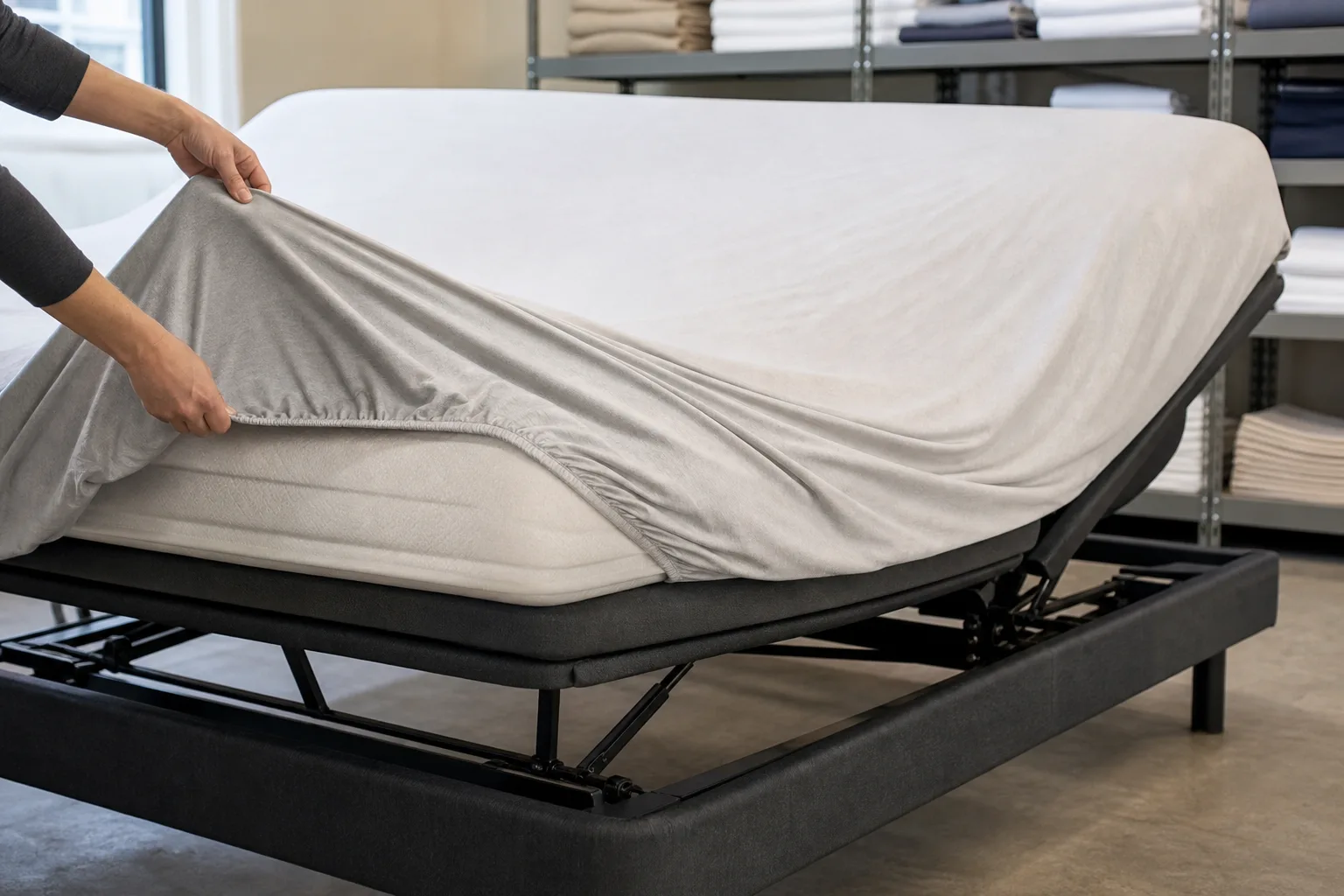
Fitted sheets pop off adjustable beds because raising the head or foot changes the mattress geometry and concentrates tension around the corners. The best solution is usually a correctly sized sheet with strong 360-degree elastic, a pocket depth matched to the entire mattress stack and, when necessary, adjustable corner straps. Extra-deep pockets alone are not a guarantee: excess fabric can bunch, migrate and allow the elastic edge to climb above the mattress.
Why an adjustable base makes sheet fit harder
On a flat bed, a fitted sheet mainly has to resist sleepers turning, getting in and out, and pulling against the top panel. An adjustable base adds repeated bending. As the mattress articulates, its upper surface, sidewalls and corners move through different paths. A sheet that fits adequately while flat may become highly tensioned at one corner and loose along another edge.
The problem often involves several interacting factors rather than a single defect:
- The pocket is too shallow. The elastic edge cannot stay below the mattress corner when the bed bends.
- The pocket is much too deep. Loose side fabric can fold under the mattress, shift during articulation and reduce useful elastic tension.
- Elastic is limited to the corners. Four short elastic sections provide less continuous control than elastic around the full perimeter.
- The mattress stack was measured incorrectly. A topper or thick protector increases the height the sheet must enclose.
- The sheet changed after laundering. Dimensional change may shorten the top panel or reduce pocket depth.
- The fabric cannot accommodate repeated bending. A stable woven panel may fit well when accurately sized but offer less mechanical give than a knit construction.
Also check whether the mattress itself is shifting on the base. A sheet cannot correct a missing retainer bar, an incorrectly positioned mattress or excessive movement between the mattress and frame.
Start with the finished mattress stack, not the product name
Measure everything enclosed by the sheet
Measure the mattress width, length and height with the protector and topper installed. At several points around the bed, measure vertically from the bottom edge of the mattress stack to its highest point. Pillow tops and toppers can produce different readings at the center and corners.
Do not assume that labels such as “deep pocket” or “extra deep” describe a common dimension. They are marketing categories, not universal fit standards. Use the manufacturer’s stated finished dimensions and pocket range. Our guide to fitted-sheet pocket depth after washing explains why the post-laundering measurement matters.
Allow working room without creating a loose skirt
A fitted sheet needs enough pocket depth for the elastic edge to wrap below the mattress, but more depth is not automatically better. If a 12-inch mattress stack is placed inside a loosely cut 18-inch pocket, the unused fabric may gather underneath rather than maintaining even tension.
Look for a pocket range that includes your measured stack without placing it at either extreme. Because brands use different patterns, seam positions and elastic tensions, no single allowance works for every product. If exact finished measurements are unavailable, a return option is more meaningful than a broad “fits most mattresses” promise.
Compare the features that actually control retention
| Feature | How it may help | What to verify |
|---|---|---|
| 360-degree elastic | Distributes grip around the whole perimeter instead of relying only on four corners. | Whether elastic truly runs continuously around the sheet, plus its width, firmness and attachment quality. |
| Corner straps | Add diagonal restraint where articulation places high loads on the corners. | Adjustability, secure stitching, buckle placement and whether straps can be replaced. |
| Correct pocket depth | Lets the elastic edge sit below the complete mattress stack. | The stated pocket range and, ideally, dimensions after recommended laundering. |
| Fitted or shaped skirt | Reduces loose fabric that can fold or migrate under the mattress. | Actual finished dimensions rather than terms such as “tailored fit.” |
| Knit construction | Can provide greater fabric-level stretch while the mattress bends. | Recovery after stretching; excessive give can lead to bagging or wrinkles. |
| Woven construction | Can provide a smooth, stable sleeping surface when accurately sized. | Enough pocket room and retention hardware to compensate for limited mechanical stretch. |
360-degree elastic is usually the best starting point
Continuous perimeter elastic can spread tension along the sides and ends instead of concentrating it in short corner sections. However, “360-degree elastic” does not define elastic width, recovery, force or durability. Two sheets carrying the same phrase may perform differently. Examine construction details and user-accessible specifications rather than treating the term as a measured quality grade.
Corner straps are support, not a substitute for fit
Built-in diagonal straps can be useful on mattresses that flex sharply, especially if individual corners repeatedly release. Separate sheet suspenders may offer a similar function, but installation can be awkward on a heavy mattress. Clips or buckles should not sit where they can press through the sleep surface, damage fabric or interfere with moving parts.
A very deep pocket can make slipping worse
Deep pockets solve a real problem when the mattress stack is tall. They do not solve incorrect width, length, elastic tension or panel dimensions. If the sheet can be pulled several inches away from the sidewall after installation, there may be too much unused fabric for the elastic system to control.
Where cotton fiber matters—and where it does not
Cotton can contribute softness, moisture absorption and comfort, but fiber content alone does not determine whether a fitted sheet stays attached. Cotton sheet performance also depends on yarn, fabric construction, fabric weight, finishing and product design. CottonWorks identifies fiber type, spinning system, yarn count, fabric weight, construction and finishing as separate considerations in cotton sheeting. Cotton Sheets Buying Guide, CottonWorks
Woven and knit cotton do not behave identically
Most cotton sheets are woven, although sheets can also be knitted. A woven percale or sateen top panel is generally dimensionally stable and does not need to stretch substantially when its pattern fits the mattress. Jersey knit gains flexibility from looped construction, which can help it follow articulation, but stretch without adequate recovery may produce looseness. Neither category guarantees retention.
Thread count is likewise not a stay-on specification. It describes aspects of woven construction, not pocket dimensions, elastic coverage or corner security. For a broader explanation of separating measurable attributes from marketing language, see how to tell cotton quality and the main bed-sheet buying guide.
Check whether the skirt differs from the sleeping surface
Some products combine a cotton sleeping panel with a knit or synthetic-blend skirt designed for stretch. Read the full fiber disclosure instead of assuming that a prominent cotton claim describes every component. In the United States, covered textile products must disclose constituent fibers and percentages by weight, along with origin and responsible business information. Specific cotton-type claims must also be truthful and non-deceptive. Calling It Cotton, Federal Trade Commission
A small amount of elastane or another resilient fiber may serve a functional purpose in a fitted skirt, but the label tells you composition—not how securely the finished sheet will fit. Ask for construction and dimension details in addition to fiber percentages.
Laundering can change an initially good fit
If a sheet stayed on when new but began releasing after several washes, compare its current dimensions with the mattress. Dimensional stability depends on more than the presence of cotton. CottonWorks notes that fiber, yarn, construction, wet processing, finishing, cut-and-sew methods and care can all affect shrinkage, while finishing may improve dimensional stability. Shrinkage & Skewing, CottonWorks
- Follow the product’s washing and drying instructions rather than applying one routine to every cotton sheet.
- Avoid using more heat or drying time than the instructions recommend.
- Remove the sheet when dry instead of repeatedly exposing it to extended heat.
- Re-measure the top panel and pocket if the corners become difficult to pull below the mattress.
- Do not assume that stretching a damp, undersized sheet over the bed will provide a lasting correction.
Prewashed, preshrunk or shrink-resistant language may indicate processing intended to control dimensional change, but it does not establish zero shrinkage. A more useful supplier specification states the test method, wash and dry conditions, number of cycles, and observed dimensional change. For routine maintenance guidance, visit cotton care.
A practical buying checklist
Before ordering
- Measure width, length and height with every topper and protector installed.
- Confirm that the listed size matches the actual mattress dimensions, not just the nominal size name.
- Choose a pocket range that contains the measured height without leaving a large uncontrolled surplus.
- Prefer continuous perimeter elastic over corner-only elastic when other specifications are comparable.
- Consider adjustable corner straps if your bed has sharp articulation or a history of releasing individual corners.
- Check whether the product description distinguishes the sleeping panel from the skirt.
- Read the complete fiber-content disclosure; do not infer composition from “cotton-rich,” “luxury” or similar language.
- Look for finished dimensions and dimensional-change information after laundering.
- Confirm that the return policy permits a careful fit check consistent with the seller’s conditions.
After installation
Fit the sheet with the bed flat. Make sure every pocket seam reaches a similar position at each corner and that the elastic edge sits fully below the mattress. Slowly raise the head and foot while watching which area tightens first. If one corner lifts immediately, the sheet may be too short, too narrow, too shallow or unevenly installed. If the sides become loose and form folds, the pocket or skirt may be oversized.
Test several normal bed positions before laundering or discarding packaging. A sheet that stays attached during one full articulation cycle is not necessarily proven durable, but this check can reveal an obvious dimensional mismatch.
What manufacturers and buyers should specify
“Adjustable-bed compatible” should be treated as a design claim requiring supporting detail, not as a standardized result. Product specifications are more useful when they include finished top-panel length and width, usable pocket depth, mattress-height range, elastic placement, skirt construction and dimensional change under a stated laundering procedure.
For development and quality assurance, assess the complete sheet on representative mattress stacks through repeated bed articulation and laundering. Report the conditions and pass criteria rather than making an unqualified “stays on” claim. The result applies only to the tested sheet size, mattress geometry, base movement, wash procedure and acceptance threshold; it should not be generalized to every adjustable bed.
For most shoppers, the decision order is straightforward: correct dimensions first, controlled pocket depth second, continuous elastic third and corner straps when additional restraint is needed. Cotton fiber and fabric construction influence comfort and how the sheet responds to use and care, but secure fit ultimately depends on the engineering of the whole fitted sheet.
Frequently asked questions
Are extra-deep fitted sheets better for adjustable beds?
Only when the full mattress stack needs the added depth. A pocket that is much deeper than the mattress can leave loose fabric underneath, reducing tension and allowing the sheet to migrate. Match the stated pocket range to the mattress, protector and topper together.
Do 360-degree elastic sheets stay on better?
Continuous perimeter elastic generally distributes restraint more evenly than elastic used only at the corners. Performance still depends on elastic strength, recovery, attachment, sheet dimensions and pocket fit, so the phrase alone is not a quality standard.
Are corner straps necessary on an adjustable bed?
Not always. A properly sized sheet with secure perimeter elastic may stay in place without them. Adjustable corner straps can provide useful secondary restraint when a specific corner repeatedly releases or the mattress bends sharply.
Is cotton or microfiber better for a fitted sheet that stays on?
Fiber content does not determine retention by itself. Staying on depends primarily on finished dimensions, pocket design, elastic coverage, skirt construction and dimensional stability. Cotton may be used in woven or knit sheets, and each construction behaves differently during articulation.
How this guide was prepared
This page is based on desk research of CottonWorks technical guidance on cotton sheeting and dimensional stability, plus Federal Trade Commission textile-labeling guidance. The fit recommendations apply dimensional and construction principles to adjustable-bed use. No fitted sheets or adjustable bases were personally tested, and no laboratory testing, product trial, supplier inspection or certification review was conducted.
Review status: Publishable quality advisory.
Sources and scope
- Cotton Sheets Buying GuideCottonWorks, Cotton Incorporated
Supports the distinction among cotton fiber type, yarn spinning, yarn count, fabric weight, fabric construction and finishing, and confirms that cotton sheets may be woven or knitted.
Accessed 2026-09-28 - Shrinkage & SkewingCottonWorks, Cotton Incorporated
Supports the explanation that dimensional change depends on fiber, yarn, construction, processing, finishing, product assembly and care rather than fiber name alone.
Accessed 2026-09-28 - Calling It Cotton: Labeling and Advertising Cotton ProductsFederal Trade Commission
Supports guidance on accurate cotton fiber-content disclosures and truthful claims involving specific cotton types.
Accessed 2026-09-28