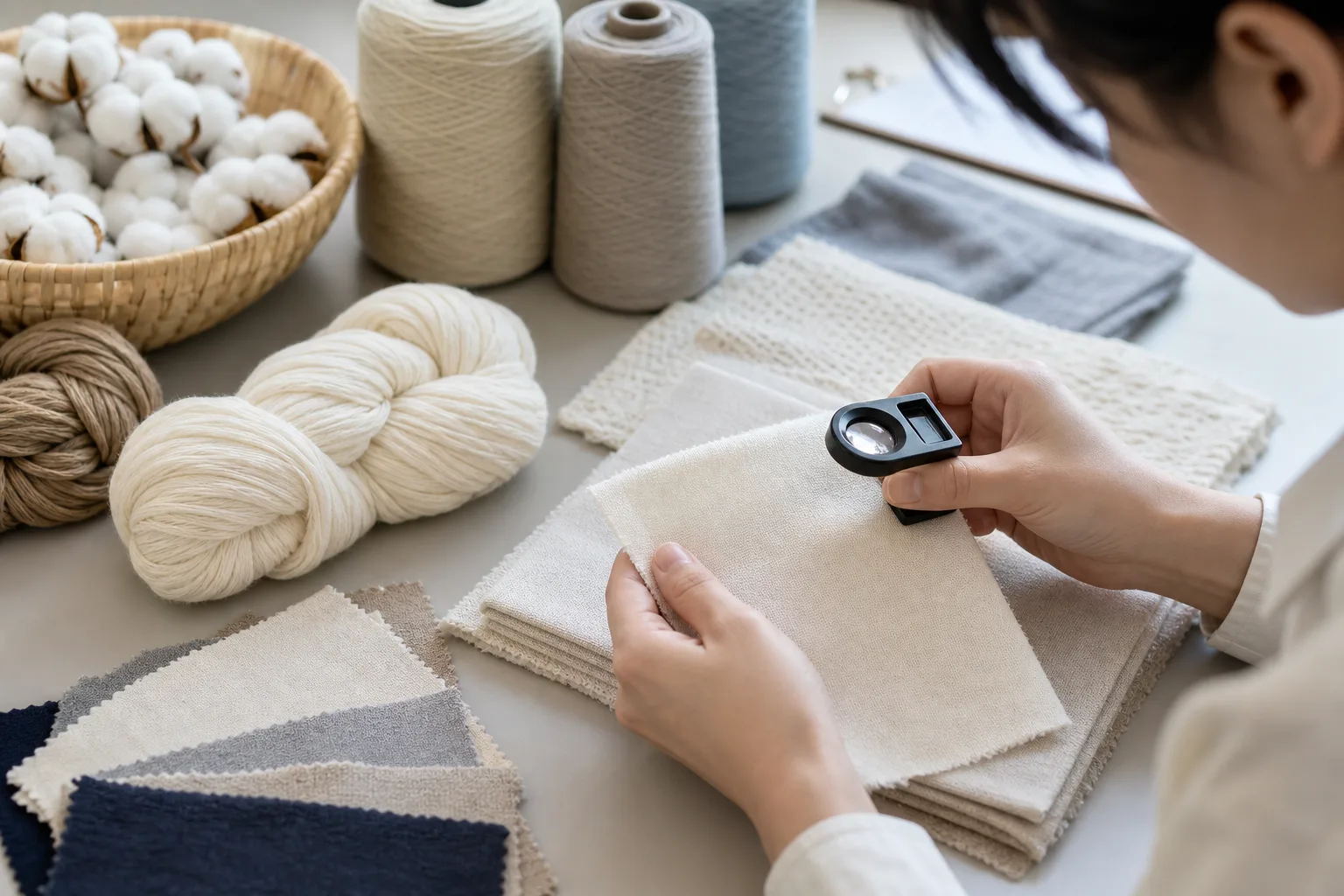
To tell if cotton is good quality, look beyond immediate softness. Check the fiber-content label, examine whether the fabric is even and appropriately substantial, inspect seams and edges, and ask for measurable performance information such as shrinkage, pilling and colorfastness results. Fiber length and strength matter, but yarn quality, fabric construction, finishing and workmanship ultimately determine how a finished product feels, wears and washes. The best choice is therefore cotton engineered for its intended use—not simply the item with the most impressive cotton name, highest thread count or strongest marketing language.
The fast answer: judge the whole product
Cotton quality has several layers. Raw fiber is the first, but a strong fiber can still become a disappointing product if it is spun unevenly, placed in an unsuitable construction, overprocessed or poorly sewn. Conversely, well-controlled manufacturing can turn widely available cotton into dependable everyday clothing and household textiles.
A practical buying decision should consider six questions:
- Fiber: Is the cotton sufficiently long, uniform, mature, clean and strong for the product?
- Yarn: Is it even and appropriately fine, strong and twisted?
- Construction: Does the weave or knit suit the intended comfort, appearance and durability?
- Finishing: Has the fabric been treated to control shrinkage, change its hand or add performance?
- Workmanship: Are seams, hems, edges and attachments secure and consistent?
- Evidence: Do specific labels, specifications or test results support the claims?
No single shop-floor observation proves laboratory quality. A visual and tactile inspection is useful for screening products, while repeatable measurements are needed to substantiate technical performance.
Understand what fiber quality can—and cannot—tell you
Length, uniformity and strength affect spinning potential
At the raw-cotton stage, manufacturers work with measurable properties rather than impressions such as “luxurious.” The USDA classification system measures fiber length, length uniformity, strength, micronaire, color and trash, among other characteristics. These measurements help manufacturers select cotton for particular yarns and end products. See the USDA overview of cotton classing.
Longer fibers can support finer, more even yarns because there is more fiber overlap within the yarn structure. Greater length uniformity also helps spinning consistency, while fiber strength contributes to yarn-making potential. The CottonWorks fiber-quality guide explains how length and uniformity influence yarn strength, evenness and processing efficiency.
These relationships are important, but they are not guarantees. A “long-staple” statement does not reveal the actual fiber distribution, yarn specifications, fabric construction or finished-product performance. Unless a seller provides traceable specifications or test data, treat the phrase as descriptive rather than as a complete quality result. Learn more about staple length, length uniformity and fiber strength.
Micronaire is not a simple higher-is-better score
Micronaire reflects the combined effects of cotton fiber fineness and maturity. Its suitability depends on the yarn and manufacturing process, so the largest or smallest number is not automatically best. Color grade and levels of leaf or other non-lint material also matter during raw-fiber trading and processing, but consumers usually cannot determine these properties accurately from a finished garment. Our guides to micronaire, color grade and leaf and trash explain their roles.
Yarn and fabric construction often matter more in the store
Look for even yarns and a construction suited to the job
Yarn properties include size, structure, strength, twist and evenness. Fabric performance then depends on how those yarns are assembled. CottonWorks notes that fibers, yarns, fabrics and garments must meet specifications appropriate to the product; construction and care-performance testing may cover durability, appearance and dimensional stability. Its quality-testing overview provides the technical context.
In a basic fabric, unexplained thick and thin areas, gaps, distorted rows or irregular texture can indicate inconsistent yarn or construction. This does not apply to deliberate slub, dobby, jacquard or other textured designs. Judge consistency against the intended appearance, not against the assumption that every quality fabric must be perfectly smooth.
- Woven fabrics: Check that warp and filling yarns look evenly spaced and that the fabric is not visibly skewed. Hold lightweight fabric up to diffuse light to reveal unintended gaps.
- Knitted fabrics: Look for regular loops, balanced stretch and recovery, and no obvious runs or dropped stitches.
- Towels: Look for secure, reasonably even loops and a stable ground fabric. Excessively loose loops may snag more readily.
- Garments: Check seam alignment, stitch consistency, reinforced stress points and enough seam allowance for the product’s use.
Thread count is only one construction measurement
Thread count describes the number of warp and filling yarns in a square inch of woven fabric. It does not independently measure softness, strength, breathability or useful life. Plied yarns should count as single yarns when thread count is determined, and very high figures may involve fine yarns or multiple filling insertions. CottonWorks’ cotton sheets buying guide advises considering fiber, yarn, fabric weight, construction and finishing alongside thread count.
For sheets, choose between constructions according to preference: percale generally has a crisper feel, while sateen generally feels smoother and has more surface luster. Neither weave is inherently superior. Compare products within the same construction and intended price or performance category. See our detailed cotton sheet buying guide.
Use this practical quality checklist
The following checks are useful before purchase when a product can be handled. They are screening tools, not substitutes for controlled testing.
| Check | Positive sign | What it does not prove |
|---|---|---|
| Fiber label | Clear percentages that match the product description | Durability, softness or cotton grade |
| Surface | Consistent with the intended smooth, brushed or textured design | Resistance to future pilling |
| Fabric structure | Even yarn spacing or loops without unintended gaps | Exact yarn count or tensile strength |
| Gentle stretch | Fabric returns reasonably well for its construction | Long-term recovery after wear and washing |
| Seams and hems | Straight, secure stitching with no skipped stitches or loose ends | Fiber quality inside the yarn |
| Color | Even shade unless variation is intentional | Colorfastness to washing, rubbing or light |
| Care label | Specific, realistic instructions suitable for normal use | That the item will never shrink or fade |
| Performance claims | A defined test method, result and number of wash cycles | Performance outside the stated conditions |
Be cautious with informal “tests” such as burning threads, rubbing the fabric aggressively or assuming heavier always means better. They can damage merchandise, create safety risks or produce misleading results. Fabric weight should be interpreted by use: a lightweight summer shirt and a heavy work garment require different constructions.
Match quality to the product’s intended use
Sheets and clothing need different balances
For sheets, consider weave, yarn quality, breathability, seam finishing and expected shrinkage—not just thread count. For T-shirts and underwear, examine knit recovery, side-seam alignment, neckline construction and whether the fabric becomes transparent when lightly stretched. Product-specific guidance is available in our guides to cotton T-shirts and cotton underwear.
For baby clothing or items intended for sensitive skin, prioritize appropriate fit, smooth seams, manageable care and clear material information. Softness alone does not establish safety or skin compatibility, and individual sensitivities vary. See buying cotton baby clothes and choosing cotton for sensitive skin.
Towels require both absorbent loops and a stable base
A plush hand can be appealing, but towel quality also depends on loop security, ground construction, edge finishing, drying time and performance after laundering. Compare towel weight only among products of similar size and purpose. A very dense towel may feel substantial but take longer to dry. Review the construction factors in our cotton towel guide.
Read labels without confusing identity with performance
In the United States, covered textile products generally must disclose fiber content accurately. The FTC states that a product should not be labeled “100% cotton” unless it contains only cotton, apart from qualifying trim, and that named cotton types must not be presented deceptively. For example, naming Pima cotton does not permit a seller to imply that all cotton in a mixed-cotton product is Pima. See the FTC’s cotton labeling guidance.
A truthful fiber name answers what is in the product. It does not automatically answer how well the yarn was spun, whether the fabric will pill, how much the item will shrink or how securely it was sewn. Terms such as “premium,” “hotel quality,” “luxury,” “buttery soft” and “heritage” have no value as technical measurements unless accompanied by a defined specification.
The same distinction applies to sustainability information. Organic or responsible-sourcing claims may address agricultural practices, certified fiber content or chain of custody; they do not by themselves certify softness, seam strength or wash durability. USDA guidance explains the conditions under which finished textiles or specific fibers may be described as organic. Environmental seals should also make their basis clear, and the FTC says third-party certification does not remove the need to substantiate express and implied claims. Consult the USDA organic textiles guidance and the FTC’s summary of the Green Guides.
Ask for evidence when performance matters
Retail shoppers may have only labels, return policies and physical inspection. Commercial buyers can request substantially more: fiber and yarn specifications, fabric weight and construction, tolerance ranges, lot consistency information and results from recognized test methods.
Useful questions include:
- What is the fiber composition, and does it apply to the whole product or only one component?
- Is a named cotton type supported by chain-of-custody or supplier documentation?
- What are the dimensional-change results after the stated number of wash and dry cycles?
- Were pilling, abrasion, tearing, bursting or tensile properties tested as relevant to the construction?
- How were colorfastness to laundering and rubbing assessed?
- What tolerances apply to fabric weight, width, shade and finished measurements?
A result is meaningful only when the test method, specimen preparation, care cycle, acceptance limit and tested production stage are identified. A brand’s internal pass statement cannot be compared confidently with another supplier’s result if their methods differ. For an introduction to instrument-based raw-fiber assessment, see HVI testing; for finished-product evaluation, browse our cotton testing guides.
Care is part of long-term quality
Even well-made cotton changes with wear and laundering. Heat, agitation, detergents, drying conditions and abrasion can affect dimensions, color and surface appearance. Follow the permanent care label, avoid using more heat than necessary and compare the item’s actual behavior with any stated performance claim. Our cotton care guidance covers routine washing, drying and storage.
The most reliable buying rule is simple: define the performance you need, then look for evidence at every level—from accurate fiber content to suitable construction and realistic care. Good-quality cotton is not one universal grade. It is a well-specified, consistently manufactured cotton product that continues to serve its intended purpose after normal use and care.
Frequently asked questions
Does high-quality cotton always feel very soft when new?
No. Initial softness can come from fiber and yarn choices, brushing, washing or chemical and mechanical finishes. It does not by itself prove strength, low shrinkage or resistance to pilling. Judge softness alongside construction, workmanship, care requirements and evidence of performance after laundering.
Is long-staple cotton always better?
Longer fibers can support finer, smoother and more even yarns, but the finished result also depends on fiber uniformity and strength, spinning, fabric construction, finishing and sewing. A long-staple claim is therefore useful information, not a complete product-quality rating.
Does a higher thread count mean better cotton sheets?
Not necessarily. Thread count is a construction measurement, and it should be considered with yarn fineness, yarn quality, weave, fabric weight and finishing. Very high advertised figures do not independently prove softness, breathability or durability.
Does organic certification mean cotton is higher quality?
Organic claims generally concern agricultural production, certified fiber content or processing and chain-of-custody requirements, depending on the standard. They do not automatically demonstrate greater softness, strength, colorfastness or durability. Assess physical quality and sustainability evidence separately.
What should a commercial buyer request from a cotton supplier?
Request relevant fiber, yarn and fabric specifications; construction and weight tolerances; dimensional-change results; colorfastness data; and durability tests appropriate to the product. Each result should identify the test method, care cycles, sample stage and acceptance limit.
How this guide was prepared
This guide is based on desk research conducted on September 16, 2026 using USDA cotton classification and organic-textile guidance, FTC textile-labeling and environmental-claims guidance, and CottonWorks technical material on fiber properties, construction and quality testing. It translates those sources into consumer and commercial-buyer checks. No products were purchased or tested, and no laboratory work, factory assessment, farm visit, supplier audit or first-hand product trial was performed.
Review status: Publishable quality advisory.
Sources and scope
- Cotton Classing ServicesUSDA Agricultural Marketing Service
Official raw-cotton measurements, including fiber length, length uniformity, strength, micronaire, color and trash.
Accessed 2026-09-16 - Cotton Fiber QualityCottonWorks
How staple length, uniformity, strength and micronaire relate to processing and yarn quality.
Accessed 2026-09-16 - Quality TestingCottonWorks
The roles of fiber, yarn and fabric specifications and the importance of durability, appearance and dimensional-stability testing.
Accessed 2026-09-16 - A Buying Guide for Cotton SheetsCottonWorks
Thread-count interpretation and the combined influence of fiber, yarn, weight, construction and finishing on sheeting.
Accessed 2026-09-16 - Calling It Cotton: Labeling and Advertising Cotton ProductsFederal Trade Commission
U.S. fiber-content disclosures and truthful use of named cotton types in labels and advertising.
Accessed 2026-09-16 - Environmental Claims: Summary of the Green GuidesFederal Trade Commission
Guidance on substantiating environmental claims and clearly explaining the basis of certifications and seals.
Accessed 2026-09-16 - Organic TextilesUSDA Agricultural Marketing Service
Conditions governing organic claims for finished textiles and specific textile fibers in the United States.
Accessed 2026-09-16