
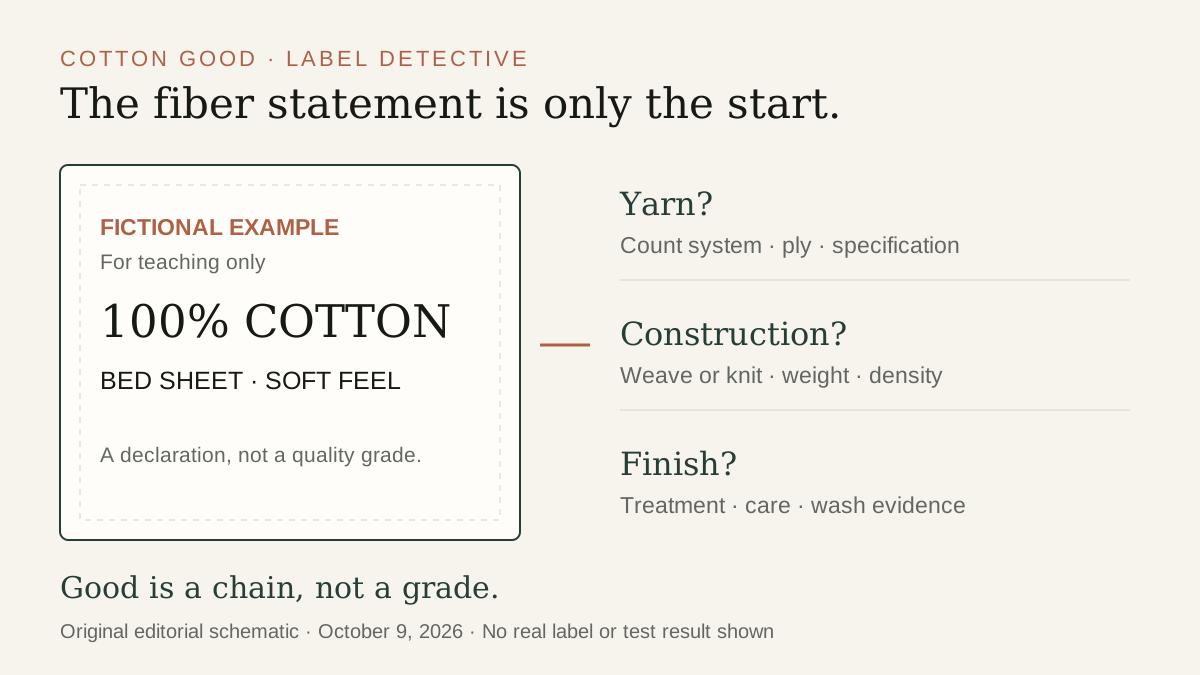
“100% cotton” declares fiber composition. It does not describe the yarn, the fabric construction, or the finish. Those are the missing pieces—not evidence of dishonesty or an unlawful label. Here, “hides” means information absent from that statement. Follow the chain fiber → yarn → construction → finish, then check care and performance evidence. Good is a chain, not a grade. The percentage in this article belongs to a fictional teaching label; no real product has been sampled or verified.
Thing 1 — the yarn it doesn’t mention
Fiber is the ingredient; yarn is how that ingredient becomes a strand. Yarn count describes size within a specified numbering system, while ply describes yarns combined together. Neither is revealed by the fiber statement. Yarn size can influence fabric weight, stiffness and hand (Cotton Incorporated, Textile Yarns, accessed October 9, 2026).
Ask for the yarn count and its unit/system, the ply, and whether the description covers the warp and filling or the knitting yarn. Do not confuse yarn count with woven thread count. Missing information is a reason to ask, not a reason to award or remove a quality grade. A specification still cannot predict your preference or prove the delivered yarn matches it.
Thing 2 — the construction it doesn’t mention
Percale is a plain-weave construction; sateen uses a satin weave. Jersey is knitted. These names describe assembly, while cotton describes fiber. Percale can feel crisp and sateen smoother, but yarn, fabric weight, density and finishing also affect the result (Cotton Incorporated, cotton-sheets buying guide, accessed October 9, 2026).
Ask which structure you are comparing and request a fabric-weight specification on the same basis. For hotel purchasing, compare samples under the intended laundry process. A weave name alone cannot establish breathability, comfort or service life; we have not tested a specimen here.
Thing 3 — the finish it doesn’t mention
Softening and wrinkle-resistant treatments address different properties. Cotton Incorporated describes softeners used to alter hand, and resin treatments that can change wrinkle recovery, dimensional stability and strength in knitted cotton (technical bulletin on cotton-knit processing, accessed October 9, 2026).
That is processing context, not proof about a particular sheet. Ask what finish was applied and what evidence supports its claimed durability. An initially soft surface does not establish how it will feel after laundering. Finish is part of the chain; fabric construction, care and use also matter. We cannot infer the chemistry or wash behavior from touch or the fiber wording.
A fictional label, decoded line by line
Fictional example label — for teaching only. This invented excerpt is an editorial teaching asset dated October 9, 2026, not a complete retail label or compliance model.
BED SHEET — TEACHING SAMPLE
100% COTTON
SOFT FEEL
| Example line | What it tells you | What remains unknown |
|---|---|---|
| BED SHEET — TEACHING SAMPLE | Intended product category in this example | Fabric structure and weight |
| 100% COTTON | Declared fiber composition in this fictional excerpt | Yarn count, ply, weave/knit and finish |
| SOFT FEEL | A subjective description | Treatment, measurement method and lasting softness |
Do not fill those gaps with assumptions. No certification, origin or test result is implied.
The 30-second label read
Use “30 seconds” as a memory aid, not a measured reading speed. Copy this checklist:
- Read the declaration: Record the stated fiber and which component it covers. Do not treat it as independent verification.
- Connect yarn and construction: Record yarn size/system, ply and weave or knit. Mark missing details “unknown.”
- Check finish and care: Record disclosed treatments and care instructions; ask for relevant wash-performance evidence before assuming durability.
Limits
This is document-reading guidance, not fiber analysis, product testing or legal advice. Confirm the exact item, the scope of its label and any supporting specification with the seller. Our fictional excerpt cannot settle a real product’s quality.
Over to you
Photograph your bedding label and email it to the Cotton Good editorial team for a possible future Label Detective feature. Send only the label; crop out names, addresses, order numbers and other personal information. This is private reader correspondence, not a public upload. Publication or a reply is not guaranteed.
Next steps
Read next: Cotton Quality Guide · What Percale Really Feels Like: Crisp, Cool—or Too Scratchy?.
Copy the label-reading checklist above to review your next bedding purchase.
Questions & discussion
Share a question or a useful experience about this guide. Comments appear immediately. Your name and comment are public. Email is optional and stays private; reply emails are not enabled yet. Comment privacy.