
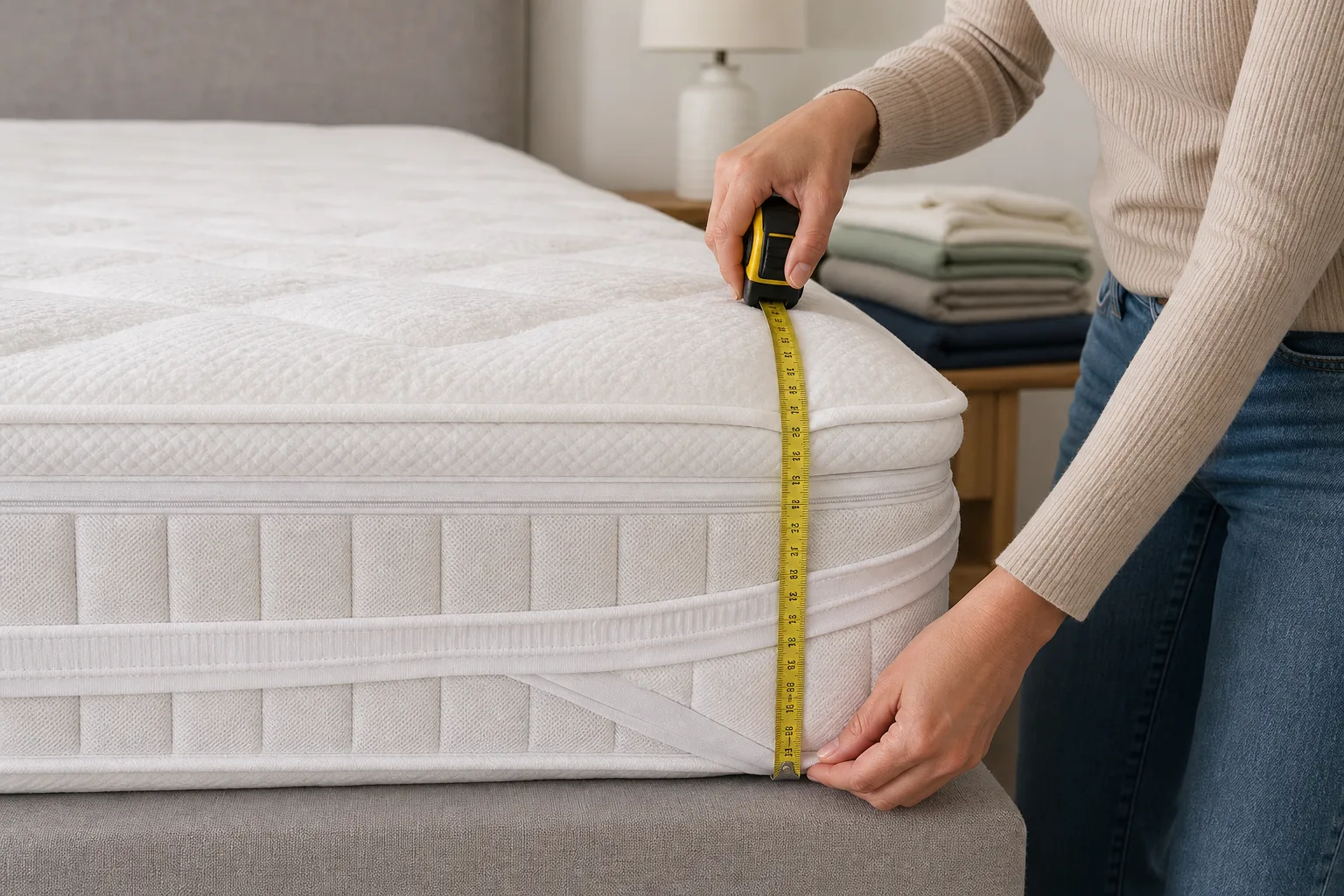
To measure a mattress for a fitted sheet, record its actual width, length and total dressed depth. The depth must include every layer that will remain under the sheet, such as a topper, mattress pad and protector. Then compare those measurements with the sheet’s stated mattress dimensions and maximum pocket depth. Do not choose a pocket whose advertised limit merely equals your measured depth: allow room for the sheet to pass under the mattress, for normal measurement variation and for any documented dimensional change after washing.
The three measurements you need
A mattress size name such as queen or king is only a starting point. The sheet has to fit the bed in front of you, including any accessories added after the mattress was manufactured. Use a firm tape measure, record measurements to the nearest quarter inch or half centimeter, and measure without compressing foam or padded layers.
1. Width
Measure straight across the widest part of the mattress from left edge to right edge. Keep the tape horizontal rather than following the curved surface or piping. If the mattress has bowed sides, measure at more than one point and retain the largest result.
2. Length
Measure from the outer edge at the head to the outer edge at the foot. Again, keep the tape straight and level. Measure each component separately on a split king or another divided sleep system; do not assume that both halves are identical.
3. Total dressed depth
Measure from the top of the highest layer to the bottom edge of the mattress. Include the mattress, topper, mattress pad and any protector that will stay on the bed beneath the fitted sheet. A thick topper can change the required pocket more than the mattress size name does.
Do not include a box spring, foundation or bed frame. A fitted sheet normally wraps around the mattress stack, not the support underneath it.
| Component | What to measure | Include in fitted-sheet depth? |
|---|---|---|
| Mattress | Width, length and top-to-bottom depth | Yes |
| Foam, fiber or feather topper | Thickness while lying naturally on the bed | Yes |
| Quilted mattress pad | Added thickness after it is fitted | Yes |
| Mattress protector or encasement | Any meaningful added thickness, especially at padded seams | Yes |
| Foundation or box spring | Not required for a standard fitted sheet | No |
How to measure the complete mattress stack
- Assemble the bed as it is normally used. Put the topper, pad and protector in place. Smooth them without pulling them unusually tight.
- Remove pillows and loose bedding. A bare, fully dressed mattress stack is easier to measure accurately.
- Measure width at the head, middle and foot. Record the largest measurement if the figures differ.
- Measure length along both sides. Use the longer result if the mattress is not perfectly square.
- Measure depth at all four corners and near the middle of each side. Keep the ruler or tape vertical. A rigid ruler laid across the top can help identify the true upper surface.
- Use the largest depth. The fitted sheet must accommodate the thickest part of the stack, not an average.
- Write down the date and layers measured. This helps if you later replace a topper or add a padded protector.
For a rounded pillow-top edge, place a straight ruler across the top and measure vertically down from it. Do not press the ruler into the cushioning. If one layer overhangs the mattress, record the maximum assembled width and length as well as the mattress dimensions; severe overhang may require a different topper size rather than a larger sheet.
Convert total depth into a practical pocket requirement
“Pocket depth” is not always presented consistently. One seller may give the sheet panel’s sewn depth, while another gives a maximum mattress depth. Those figures are not necessarily interchangeable because part of the pocket must turn under the mattress and the elastic has to hold it there.
Start with the fitted stack
Add the layers only if you measured them separately:
Total dressed depth = mattress depth + topper thickness + pad or protector thickness
For example, a 12-inch mattress, 2-inch topper and quarter-inch protector produce a dressed depth of 14.25 inches.
Add a handling margin
The sheet needs enough material to round the lower edge and remain under the mattress. There is no universal consumer allowance that works for every pocket shape, seam position, fabric and elastic system. As a practical buying rule, avoid a stated maximum that exactly matches the measured stack. Seek a clearly larger capacity and ask the seller whether its number means sewn pocket depth or supported mattress depth.
If you choose a numerical handling margin for comparison, identify it as your own risk buffer rather than an industry standard. A person using a heavy adjustable mattress, for example, may want more margin because repeatedly lifting the corners is difficult. Extra-deep sheets can also fit poorly when the excess fabric cannot be tensioned securely.
Account for expected shrinkage
Dimensional change depends on more than cotton fiber content. Yarn structure, woven or knitted construction, fabric density, wet processing, finishing, sewing and laundering conditions can all affect the result. CottonWorks notes that construction and processing influence shrinkage and that dimensional stability must be engineered through the product rather than inferred from the fiber name alone. CottonWorks: Shrinkage & Skewing
Use a seller’s product-specific after-wash measurement or shrinkage limit when available. If the seller states an expected depth-direction change, a conservative planning calculation is:
Minimum stated prewash capacity = (measured stack + chosen handling margin) ÷ (1 − expected shrinkage rate)
Suppose the measured stack is 14.25 inches, you choose a 0.75-inch handling margin, and the seller reports 3% dimensional shrinkage in the relevant direction. The estimate is 15 ÷ 0.97, or about 15.46 inches. You would look for a supported mattress-depth rating clearly above 15.5 inches rather than treating that calculated boundary as a guaranteed fit.
This calculation is only a screening tool. A fitted sheet is a three-dimensional sewn product: elastic recovery, corner seams and shrinkage in both fabric directions also affect fit. If no product-specific dimensional-change information is supplied, do not invent a percentage based only on a “100% cotton,” “prewashed” or “preshrunk” description. Read more about fitted-sheet pocket depth after washing and ways to reduce avoidable cotton shrinkage.
Read the sheet specifications, not just the marketing name
The 2026 edition of NIST Handbook 130 says the quantity statement for fitted sheets under its model packaging regulation should state the length and width of the mattress for which the product is designed, along with the size designation when applicable. That makes stated mattress dimensions more useful than a size name alone, but depth and post-wash performance still require separate attention. NIST Handbook 130, Uniform Packaging and Labeling Regulation
Look for these measurable details
- The mattress width and length the sheet is designed to fit
- A numerical maximum mattress depth, not only “deep pocket”
- Whether the depth refers to the sewn pocket or the supported mattress
- Dimensions stated before or after laundering
- A product-specific shrinkage limit or dimensional-change result
- Elastic around the full perimeter or only at selected sections
- Care instructions associated with the claimed fit
Terms such as “deep pocket,” “hotel quality,” “luxury” and “premium” do not define a measurable fit result. Even “360-degree elastic” describes elastic placement, not its recovery force, durability or ability to hold a particular mattress depth. Compare the construction in our guide to full-perimeter elastic and corner straps.
What a cotton label tells you—and what it does not
The FTC identifies sheets as bedding covered by U.S. textile fiber labeling requirements, and covered products must disclose their constituent fibers by generic name and percentage. Fiber content can tell you whether the sheet fabric is cotton, a blend or another material. It does not, by itself, disclose pocket capacity, weave, yarn quality, finishing, elastic performance or dimensional stability. FTC: Threading Your Way Through the Labeling Requirements
A cotton fitted sheet may be woven or knitted, densely or openly constructed, mechanically stabilized or left with more residual shrinkage. Finishing can improve dimensional stability, while laundering conditions can influence how much latent stress is released. Choose by measured specifications and care requirements, not by assuming that one fiber name guarantees a result. For broader buying criteria, see the Cotton Good bed-sheet guide and how to verify cotton sheet labels.
Check the fit before and after the first wash
Before laundering, place the fitted sheet on the dressed mattress without overstretching it. Each corner seam should sit close to the mattress corner, the top should lie reasonably smooth, and elastic should turn beneath the lower edge. If fitting requires extreme force before washing, the sheet has little reserve for dimensional change.
Record a simple baseline
- Photograph one corner and one long side after fitting.
- Note whether the corners align with the seams.
- Check whether the elastic remains under the mattress overnight.
- Record the wash and drying settings you intend to use.
Wash and dry according to the product instructions. Higher heat is not automatically appropriate simply because the sheet is cotton. After laundering, let the sheet cool and relax before judging it, then fit it to the same stack and compare the corner position, tension and tuck-under. Guidance on routine care is available in how to wash cotton sheets.
If the sheet repeatedly comes off, first identify the failure. Corners that cannot reach usually indicate insufficient length, width or depth. Corners that reach but slip off can point to inadequate tuck-under, elastic recovery or incompatibility with movement. Loose fabric on top may mean the pocket is oversized or the elastic cannot tension the surplus. Adjustable beds add repeated flexing and should be assessed separately; see fitted sheets for adjustable beds.
Fitted-sheet measurement checklist
- Measure the real mattress rather than relying only on its size name.
- Use the largest width, length and depth found at multiple points.
- Include every topper, pad and protector beneath the sheet.
- Exclude the foundation, box spring and frame.
- Compare your figures with supported mattress dimensions, not vague pocket terminology.
- Confirm whether specifications apply before or after washing.
- Use product-specific dimensional-change information when available.
- Allow a deliberate margin instead of buying at the exact stated limit.
- Treat cotton content as a fiber disclosure, not a fit guarantee.
- Follow the supplied care instructions and reassess fit after laundering.
The most reliable purchase decision combines physical mattress measurements with transparent sheet specifications. If a listing gives only a bed-size name and an undefined “deep pocket” claim, there is not enough measurable information to predict fit after washing. Ask for the intended mattress depth, the basis of that rating and any product-specific dimensional-change data before buying.
Frequently asked questions
How deep should a fitted-sheet pocket be for my mattress?
Measure the combined depth of the mattress, topper, pad and protector. Choose a stated supported mattress depth greater than that total, with enough margin for tuck-under and any documented wash shrinkage. Ask whether the seller’s figure means sewn pocket depth or maximum mattress depth.
Should I include a mattress topper when measuring for fitted sheets?
Yes. Include every layer that remains beneath the fitted sheet, including foam, fiber or feather toppers, quilted pads and padded protectors. Do not include the foundation, box spring or bed frame.
Does a 16-inch pocket fit a 16-inch mattress?
Not necessarily. The sheet may need material to turn under the mattress, and the meaning of a 16-inch pocket varies by seller. A sheet rated for a maximum 16-inch mattress is more informative than one described only as having a 16-inch sewn pocket, but buying exactly at the limit still leaves little allowance.
How much will a cotton fitted sheet shrink?
There is no reliable universal percentage for all cotton sheets. Dimensional change depends on yarn, construction, processing, finishing, sewing and laundering. Use product-specific after-wash dimensions or a stated shrinkage limit rather than estimating from cotton content alone.
How this guide was prepared
This guide is based on desk research conducted on October 15, 2026, using current NIST model packaging guidance, FTC textile-labeling guidance and CottonWorks technical material on dimensional change. The measurement procedure and calculation are practical interpretations of those sources; no mattress, fitted sheet, laboratory test or wash trial was performed.
Sources and scope
- Shrinkage & SkewingCottonWorks
Explains dimensional change and how fiber, yarn, construction, wet processing, finishing, manufacturing and laundering influence textile shrinkage and fit.
Accessed 2026-10-15 - NIST Handbook 130—2026: Uniform Packaging and Labeling RegulationNational Institute of Standards and Technology
Provides the current model packaging provision stating that fitted-sheet quantity declarations identify the mattress length and width and applicable size designation.
Accessed 2026-10-15 - Threading Your Way Through the Labeling Requirements Under the Textile and Wool ActsFederal Trade Commission
Confirms that sheets are covered bedding products and explains required fiber-content disclosures, supporting the distinction between fiber identification and fit performance.
Accessed 2026-10-15
Questions & discussion
Share a question or a useful experience about this guide. Comments appear immediately. Your name and comment are public. Email is optional and stays private; reply emails are not enabled yet. Comment privacy.