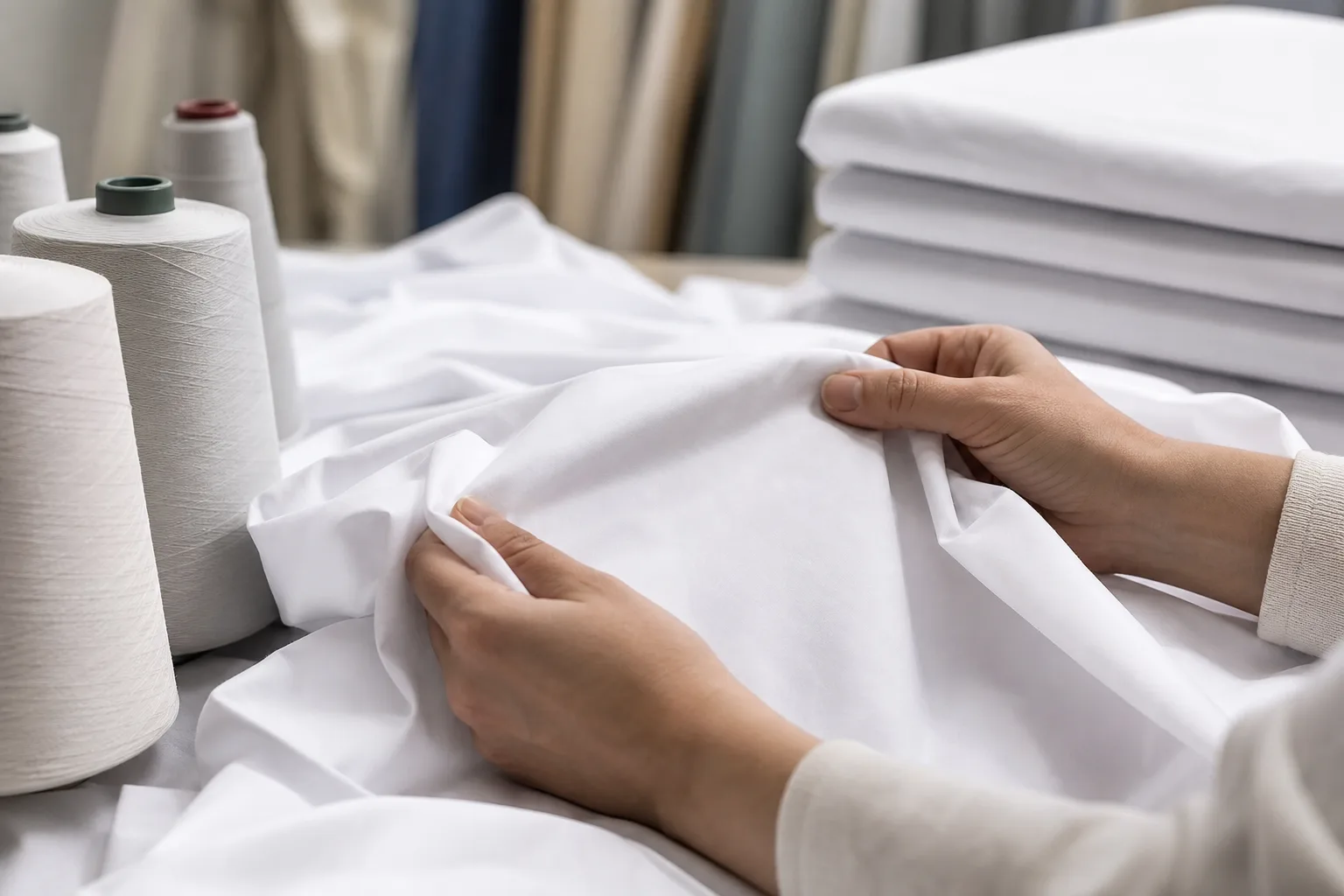
What does percale feel like? In a well-made cotton sheet, percale usually feels crisp, smooth, matte and relatively light, with a dry hand rather than a silky or slippery surface. It may rustle when moved and can feel cool when you first get into bed. Some people interpret that structure as fresh and airy; others experience it as stiff or slightly scratchy. Neither reaction defines every percale because the final feel depends on the cotton, yarn, fabric construction, finishing and laundering—not the weave name alone.
The short sensory description of percale
Percale is generally a plain-woven fabric. In a plain weave, yarns interlace in a regular over-one, under-one pattern. CottonWorks describes percale as a smooth, slightly crisp fabric commonly made with combed yarns and identifies thread counts from 160 to 300 for percale bedding. That is a useful technical description, not a promise that every product marketed as percale will feel identical. CottonWorks: Percale
What “crisp” means in practice
Crisp does not necessarily mean rough. It usually describes a fabric that holds its shape around the body instead of immediately draping and clinging. Freshly laundered percale may feel similar to a clean, pressed cotton shirt: dry, structured and smooth, with a noticeable rustle. Compared with a more fluid sheet, it tends to form small folds rather than flowing heavily across the bed.
Why people call it cool
“Cool” can describe an immediate touch sensation, a less-clingy sleep surface or the way a relatively light fabric handles heat and humidity. It should not be treated as a guaranteed body-temperature result. Fabric weight, yarn density, finishing, mattress protectors, blankets, room conditions and the sleeper's physiology all matter. CottonWorks distinguishes crisp, cool percale from silky, lustrous sateen while also emphasizing that fiber, yarn and construction influence sheet comfort. CottonWorks: Cotton Home Buyer's Guide
What percale usually does not feel like
- It is not normally glossy, slippery or fluid like sateen.
- It is not fuzzy or insulating like flannel.
- It is not stretchy unless another material or unusual construction adds stretch.
- It is not automatically soft in the plush, brushed or heavily finished sense.
Why two percale sheets can feel completely different
Percale identifies a construction category, not a measurable grade of softness. A product can meet a seller's use of the term and still feel papery, polished, dense, airy, smooth or textured. Buyers should separate six variables that are often compressed into one marketing description.
1. Fiber content
“Percale” does not mean “100% cotton.” Cotton, cotton-rich blends and other fibers can be woven in a plain-weave construction and sold with percale terminology. Read the sewn-in fiber label rather than relying on a product title. In the United States, covered textile products must disclose fiber content, and a product should not be described as 100% cotton unless it contains only cotton apart from permitted exclusions such as trim. Federal Trade Commission: Calling It Cotton
2. Fiber quality and preparation
Fiber length, fineness, maturity and uniformity affect what a mill can spin, but consumers rarely receive enough verified data to rank finished sheets by raw fiber alone. Combing is a more useful disclosed clue: it removes short fibers from the yarn-making process and can support finer yarns with improved hand. Ring-spun yarn can also produce a softer hand than some higher-output spinning systems. These features influence feel, but they do not override poor construction or an unsuitable finish.
3. Yarn size, twist and uniformity
Fine, even yarns can create a smoother surface than coarse or irregular yarns. Twist also matters: adding twist can increase firmness, while too little twist may compromise other performance characteristics. A premium cotton name by itself does not reveal yarn size, twist, spinning method or uniformity, so it cannot predict the finished hand with certainty.
4. Fabric density and weight
A relatively open, light percale may feel airy and flexible. A dense construction can feel more substantial and initially stiffer. Thread count offers partial information, but it does not describe fabric weight, yarn fineness, yarn quality, ply, finishing or verified airflow. CottonWorks notes that a well-made 300-thread-count cotton percale may be preferable to a much higher-count sheet made with a heavier or less breathable construction. Thread count therefore should be treated as one specification, not a quality score.
5. Finishing
Finishing can change the hand substantially. Softeners may make cotton feel pliable, slick or silky, while hand-building treatments can make a fabric firmer and less flexible. Mechanical processes such as calendering can add smoothness or luster. The finish encountered in a package may also change after laundering, making an unwashed showroom touch an imperfect forecast of long-term feel. CottonWorks: Chemical Finishing
6. Product condition
New sheets may retain fold compression, packaging odors or a temporary surface treatment. Used sheets can feel different because of laundering, detergent accumulation, fabric softener, drying conditions and gradual surface wear. That is why comparisons are most useful when products are assessed in a similar washed condition.
Is percale supposed to feel scratchy?
No: scratchiness is not a required characteristic of percale. A slight dry texture or fresh stiffness can be normal, especially in an unwashed sheet. Persistent abrasion, prickling or skin discomfort is different and should not be dismissed as proof of quality.
Possible reasons for a rough hand
- Coarse or uneven yarn: A thicker yarn can create a more pronounced surface texture.
- Exposed fiber ends: Yarn preparation and surface processing influence how much fuzz or hairiness is present.
- Dense construction: A firm, tightly packed fabric may resist bending and feel harder against the skin.
- Hand-building or easy-care finishes: Treatments designed for firmness, shape retention or wrinkle control can alter pliability.
- Laundry residue: If roughness appears after washing, detergent dosage, rinsing and water conditions are reasonable variables to investigate.
- Overdrying: A sheet that feels unusually dry and rigid after a hot cycle may feel different when dried according to the manufacturer's instructions.
Do not assume a rough sheet will inevitably become soft. Some cotton percale relaxes with washing, but the amount of change depends on its yarn, construction and finish. If possible, buy from a seller that states whether washed products may be returned, and test one set before purchasing multiples.
Percale versus sateen: choose by sensation, not status
Percale and sateen are genuinely different weave constructions. Neither is automatically better. The useful question is which surface and drape match the sleeper's preferences.
| Sensory factor | Percale | Sateen |
|---|---|---|
| Surface character | Matte and dry | Smoother, often more lustrous |
| Initial impression | Crisp and fresh | Silky and fluid |
| Drape | More structured | More body-following |
| Sound | May have an audible rustle | Usually quieter and less papery |
| Common preference | People who dislike cling or want a clean-shirt feel | People who prioritize smoothness and a softer-feeling glide |
| Possible drawback | Can seem stiff or dry to softness-first shoppers | Can seem heavier or more enveloping to crispness-first shoppers |
These are directional differences, not guaranteed performance results. A lightweight sateen may feel cooler than a dense, heavily finished percale, while a fine-yarn percale may feel smoother than an inexpensive sateen. See the detailed percale versus sateen comparison for construction differences.
A practical percale buying checklist
Use specifications to narrow the field, then use a sample, swatch or returnable single set to judge the final sensory result. No label can fully replace touch.
| If you want... | Look for... | Ask or verify... |
|---|---|---|
| A classic crisp feel | Plain-weave cotton percale with a matte description | Whether the product has been garment washed or heavily softened |
| A smoother percale | Combed cotton, fine yarns and a smooth surface | Yarn preparation and whether a swatch is available |
| Less cling | A relatively light, structured sheet | Fabric weight and construction rather than thread count alone |
| Minimal chemical finishing | A specific disclosure such as “no added softener” or “untreated,” if substantiated | What finish was applied; do not infer this from “natural” |
| Verified cotton content | A clear sewn-in fiber label | Whether named cotton types make up all or only part of the fiber content |
| Lower fit risk | Published dimensions and shrinkage information | Pocket depth and dimensions after washing, not only before washing |
Questions worth asking the seller
- What is the exact fiber composition?
- Is the cotton carded or combed?
- Are the yarns single-ply or multi-ply, and how was thread count calculated?
- What softening, wrinkle-resistant or easy-care finish is applied?
- What are the finished fabric weight and expected dimensions after laundering?
- Can washed bedding be returned if the hand is unsuitable?
Thread count is not required information under federal textile labeling rules, but a voluntary claim still must not be deceptive. The Federal Trade Commission has advised that thread-count representations for bedding should reflect the number of yarns rather than inflate the figure by counting the individual plies within a yarn as separate threads. FTC staff opinion on bedding thread count For more label checks, use Cotton Good's guide to verifying cotton sheet labels and its explanation of thread count.
Care, comfort and sustainability claims
Evaluate the feel after careful laundering
Follow the product's instructions for the first wash and dry, particularly where shrinkage or specialized finishes may be involved. If a sheet feels coated, stiff or rough, change one care variable at a time: confirm the detergent dose, try an additional rinse or reduce drying intensity within the label's limits. Avoid aggressive “softening” treatments until you know whether they are compatible with the product and your comfort priorities. The cotton washing guide, drying guide and cotton softening guide provide further care options.
Do not read sustainability into the word percale
Percale describes fabric construction; it does not establish farming practices, chemical inputs, labor conditions, traceability, durability or recyclability. Likewise, “organic cotton” refers to fiber production and does not automatically describe every processing stage unless the finished product carries an applicable certification or verified claim. USDA guidance states that specific fibers may be identified as organic when all instances of those fibers are certified organic, while finished-product use of the USDA organic seal has additional requirements. USDA Agricultural Marketing Service: Organic Textiles
Assess sustainability claims separately from feel. Look for the exact certification scope, certified organization, chain-of-custody model and percentage of claimed material. Then evaluate practical longevity: whether the sheet remains comfortable, fits after washing and can withstand the intended care routine. A crisp hand, high thread count or premium cotton name cannot answer those questions by itself.
Bottom line: Choose percale if you enjoy a matte, dry, clean and structured sleep surface. If you want immediate silkiness, quiet drape or a sheet that hugs the body, sateen may be the better starting point. If roughness is your concern, prioritize verified fiber content, combed or fine yarns, transparent finishing information and a realistic return policy rather than relying on “luxury,” “hotel quality” or thread count alone.
Frequently asked questions
Does percale feel rough?
Percale should not inherently feel rough. It normally has a dry, crisp and structured hand, which some shoppers perceive as less soft than sateen. Persistent scratching can reflect coarse yarn, a dense construction, surface fibers, finishing or laundering conditions.
Does cotton percale get softer after washing?
It may relax and feel more pliable after laundering, but the amount of change is product-specific. Fiber preparation, yarn, weave density, finishing and the washing and drying process all affect the result, so softness should not be promised without product-level evidence.
Is percale good for hot sleepers?
Many hot sleepers prefer percale because it is commonly light, crisp and less clingy than sateen. However, the weave name alone does not guarantee cooling; fabric weight, density, fiber content, finishes, other bedding and room conditions also matter.
Is a higher thread count percale softer?
Not necessarily. Thread count does not reveal yarn quality, fineness, ply, fabric weight or finishing. A well-constructed moderate-count percale can feel smoother and less dense than a sheet carrying a much higher number.
How this guide was prepared
This guide is based on desk research of CottonWorks technical textile guidance, Federal Trade Commission labeling guidance and USDA organic textile guidance, accessed October 7, 2026. It translates documented information about weave, yarn, finishing and labels into buying criteria. No product trial, laboratory test, factory visit, farm visit or first-hand sensory assessment was conducted.
Review status: Publishable quality advisory.
Sources and scope
- PercaleCottonWorks
Technical definition of percale as a smooth, slightly crisp plain-woven fabric and the stated thread-count range for percale bedding.
Accessed 2026-10-07 - Cotton Home Buyer's GuideCottonWorks
How fiber, yarn, construction and weave affect sheet feel; the sensory distinction between percale and sateen; limitations of thread count as a quality indicator.
Accessed 2026-10-07 - Chemical FinishingCottonWorks
How softeners, hand builders and other finishing processes can change fabric hand, pliability and surface character.
Accessed 2026-10-07 - Calling It Cotton: Labeling and Advertising Cotton ProductsFederal Trade Commission
U.S. requirements for truthful cotton fiber-content disclosures and claims involving named cotton types.
Accessed 2026-10-07 - Organic TextilesUSDA Agricultural Marketing Service
The distinction between certified organic fibers and claims or seals applying to an entire finished textile product.
Accessed 2026-10-07