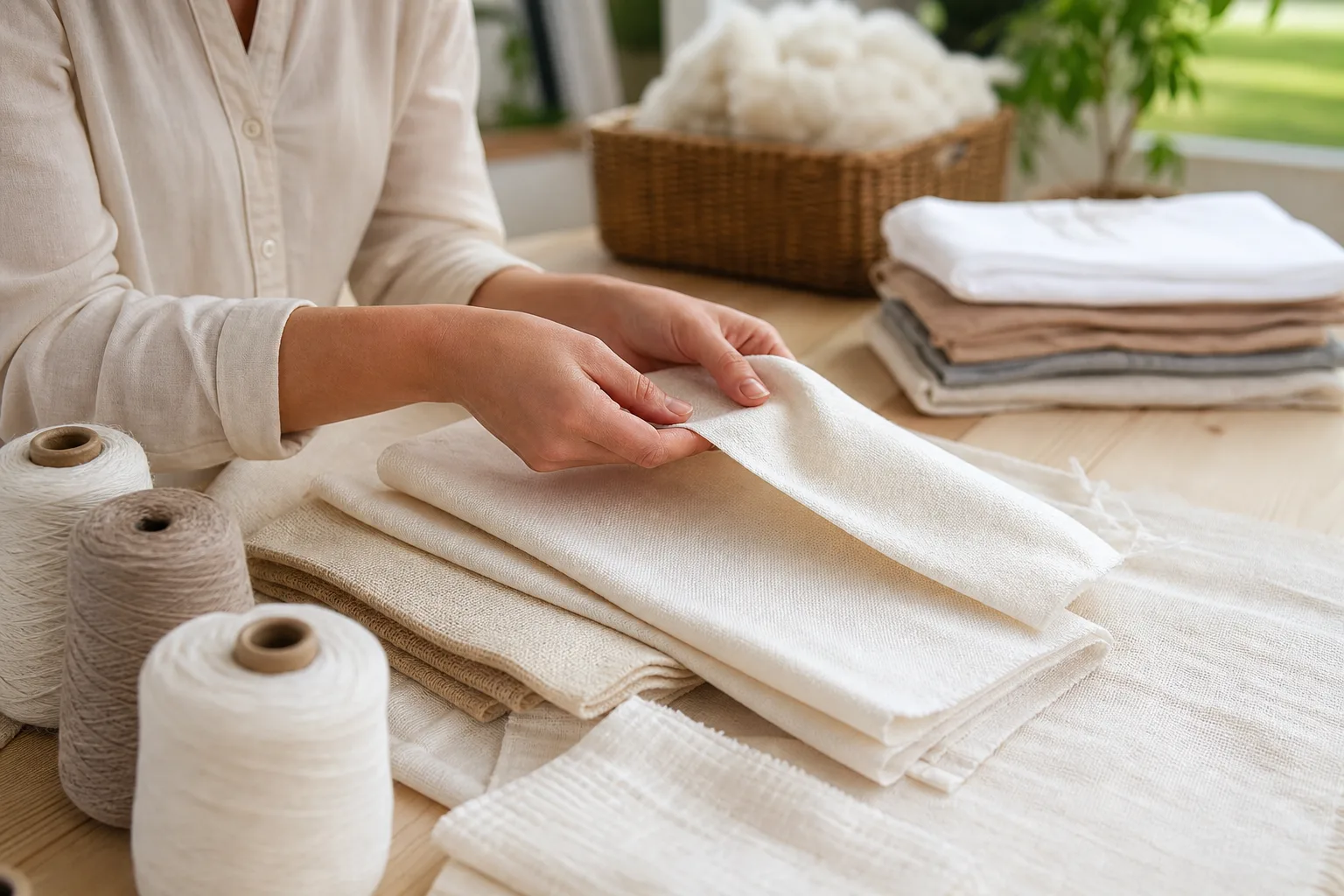
The best cotton for sensitive skin is usually a soft, smooth, washable fabric with accurate fiber labeling, comfortable construction and as much transparency as possible about dyes and finishes. No cotton variety can guarantee that a garment or sheet will not irritate an individual. Terms such as “hypoallergenic,” “natural” and “premium” are not substitutes for product-specific evidence. For most buyers, the practical priority is the finished textile—not simply whether the raw fiber is Upland, Pima, extra-long staple or organic.
The quick answer: choose the finished product, not just a cotton name
A strong starting choice is a product with a high cotton percentage, a smooth and flexible surface, flat or covered seams, removable or printed labels, and care instructions that permit regular washing. If available, look for clear information about yarn type, fabric construction, applied finishes and independently certified processing.
Longer, more uniform cotton fibers can help a mill spin strong, even yarn with fewer irregularities. Ring-spun yarn can also produce a notably soft fabric hand. These are useful quality signals, but neither one measures dermatological response. USDA cotton classification measures properties such as length, uniformity, strength, micronaire, color and trash for cotton marketing and manufacturing; it does not assign a sensitive-skin grade. USDA cotton classing information and CottonWorks fiber-quality guidance explain the scope of these measurements.
- Prioritize: a smooth hand, low-friction construction, accurate content label and practical washability.
- Consider: long-staple or ring-spun cotton when the product provides credible details.
- Verify: what a certification or marketing claim actually covers.
- Do not assume: organic, Egyptian, Pima, natural or hypoallergenic automatically means non-irritating.
Why cotton type alone does not determine comfort
Fiber properties influence yarn, not the entire skin experience
Cotton fiber is the starting material. Staple length describes fiber length, while length uniformity indicates how consistent those lengths are within a sample. CottonWorks notes that both affect yarn strength and evenness; USDA also measures them as part of instrument classification. Micronaire combines aspects of fineness and maturity, while strength measures the force needed to break a fiber bundle. These properties help mills manage spinning and product performance, but shoppers rarely receive bale-level data. CottonWorks’ fiber-quality overview provides the manufacturing context.
Long-staple cotton may support a smoother, finer yarn because longer fibers can overlap more effectively during spinning. That can be helpful where surface roughness is a concern, but the result still depends on yarn twist, spinning method, knitting or weaving, finishing and garment assembly. A poorly constructed product made with a prestigious cotton name can feel rougher than a well-made product using conventional Upland cotton.
“Egyptian,” “Pima” and “extra-long staple” are not sensitivity ratings
Named cotton types can communicate origin or fiber characteristics when the claims are accurate. In the United States, the Federal Trade Commission says that if a marketer names a cotton type in a fiber-content statement, the disclosure must be truthful and must correctly account for other fibers or cotton types in the product. A product containing multiple cotton types cannot be labeled as though it contains only the premium-named type. FTC guidance on cotton labeling explains these requirements.
Read the sewn-in content label rather than relying on the largest words on the package. “Pima cotton comfort” on the front does not necessarily mean the entire item is 100% Pima cotton. Likewise, “cotton rich” does not disclose the exact percentage. Blends may be appropriate for stretch or durability, but they are genuinely different materials from 100% cotton and should be evaluated as such.
Yarn and construction often matter more at the skin
Look for an even, low-friction surface
The skin contacts yarns, seams, prints and trims—not an isolated fiber. CottonWorks describes ring spinning, rotor spinning and air-jet spinning as methods that create different yarn structures, and identifies ring-spun yarn fabrics as especially soft in hand. Yarn twist also affects softness, stiffness, strength and surface character. CottonWorks’ yarn-spinning guide provides a technical introduction.
When shopping in person, gently move the fabric across the inside of your forearm without stretching it aggressively. Check both faces of the material. A brushed outer surface may feel soft while the inner surface, print or backing feels noticeably rougher. Online, useful descriptions include “ring-spun,” “combed,” “smooth jersey” or a clearly identified woven construction, but these words still do not guarantee a particular result.
Inspect seams, tags, elastic and prints
Construction details can create concentrated rubbing even when the main fabric feels comfortable. Examine necklines, waistbands, cuffs, side seams and embroidered areas. For close-fitting products such as underwear and T-shirts, look for flat seams, soft thread, covered elastic and labels that will not leave a hard edge if removed.
Knitted fabrics are formed from intermeshing loops and generally conform more readily to the body than rigid woven structures. However, knit density, stitch length, yarn and finishing all change the result. A loose, uneven knit may distort or develop a rough surface, while a stable fine-gauge knit may remain smooth. Learn more about how textile structure changes performance in the cotton fabrics guide.
Finishes, dyes and labels require careful interpretation
A soft finish is not the same as an inherently soft fiber
Textile finishing can alter hand, appearance, wrinkle resistance, moisture behavior and durability. CottonWorks defines finishing as processing that imparts desired properties to a fiber, yarn, fabric or garment, commonly near the end of production. A product may therefore feel exceptionally soft because of its yarn and construction, an applied softener, mechanical treatment or a combination of these factors. CottonWorks’ chemical-finishing reference describes this distinction.
Finishes are not automatically undesirable, and an “unfinished” claim does not automatically indicate better comfort. The important questions are what was applied, what performance it creates, whether the claim is substantiated and whether the brand can provide meaningful documentation. Be cautious with vague phrases such as “chemical-free”: cotton textiles undergo agricultural, cleaning, preparation and manufacturing processes, and the phrase does not identify a measurable product specification.
“Hypoallergenic” needs product-specific support
Hypoallergenic is not one of USDA’s cotton fiber grades. Treat it as a health-related marketing claim rather than proof that a product will suit every person. FTC advertising guidance says objective health or safety claims require appropriate substantiation, with the necessary evidence depending on the claim being made. FTC advertising substantiation guidance outlines this principle. Ask what was tested, which finished product was evaluated, what outcome was measured and whether the result applies to the exact item being sold.
Organic content and processing standards answer different questions
Organic cotton identifies cotton grown under an applicable organic agricultural standard. It does not, by itself, describe every subsequent dyeing, finishing or sewing process, nor does it certify a medical outcome. Textile Exchange explains that its Organic Content Standard supports verification and chain of custody for organically grown material, while GOTS includes additional processing requirements. Textile Exchange’s organic cotton certification guide clarifies this difference.
GOTS version 8.0 covers certified organic fibers as well as environmental, chemical-input and social criteria through textile processing. Its “organic” label grade requires at least 95% certified organic fibers, while “made with organic materials” requires at least 70%. This can provide more processing information than an unsupported organic claim, but GOTS certification should not be represented as proof of dermatological suitability. GOTS certification and labeling guidance defines the label grades and required certification details.
Practical shopping checklist
Use this table to separate useful evidence from terms that need more investigation.
| What to check | Why it matters | What to look for | What it does not prove |
|---|---|---|---|
| Fiber-content label | Identifies the fibers by weight | Exact cotton percentage and any functional blend fibers | Softness, finish chemistry or skin compatibility |
| Surface and reverse side | These areas contact the body | Smooth, even fabric without stiff print deposits or loose abrasive fibers | Performance after repeated washing |
| Yarn description | Spinning and twist influence fabric hand | Credible details such as ring-spun or combed yarn | A guaranteed reaction-free product |
| Construction | Density, loops, seams and trims affect friction | Flexible fabric, flat seams, soft thread and covered elastic | That one construction is best for every use |
| Finish disclosure | Finishes can alter softness and performance | A specific finish name, purpose and supporting documentation | That “natural” or “pure” means untreated |
| Organic certification | Can verify agricultural origin or broader processing criteria | Standard name, label grade, certifier and license or certification details | Medical safety or universal comfort |
| Care label | Shows how the item can be cleaned without substantial damage | Instructions compatible with regular home care | That all finishes or substances will wash out |
| Return policy | Individual comfort cannot be predicted from specifications alone | A clear policy that permits a reasonable assessment | Permission to return washed goods unless stated |
For online purchases, save the product description and label photographs. If an important claim appears only in advertising and not in the item specifications, ask the seller to confirm it in writing. FTC guidance requires cotton content claims to be accurate, but it remains important to distinguish mandatory fiber disclosures from optional promotional language.
Wash and care without undermining the fabric
Follow the permanent care label, especially where heat, bleach or drying restrictions are stated. The FTC Care Labeling Rule requires covered apparel manufacturers and importers to provide regular care instructions and have a reasonable basis for them. The FTC Care Labeling Rule explains the requirement and scope.
Washing a new washable item before prolonged skin contact is a reasonable practical step because it can remove loose lint, handling soils and some non-durable processing residues. It cannot guarantee removal of every dye or finish. Use the least complicated laundering routine that works for the wearer and the item: follow the stated temperature, avoid adding optional fragrance if fragrance is already a known concern, rinse thoroughly and dry as directed. More detailed fiber-conscious instructions are available in the cotton care guide.
Reassess the fabric after laundering. A product that becomes stiff, heavily wrinkled at seams, fuzzy or distorted may create more friction than it did in the package. For bedding, also consider whether seams, decorative stitching or raised patterns will remain beneath the body; see the separate guide to buying cotton bed sheets.
Guidance for brands, sourcing teams and product developers
“Suitable for sensitive skin” should be treated as a defined product claim, not inferred from cotton content or staple length. A responsible specification separates raw-fiber data from yarn, fabric and finished-product requirements. Fiber length, uniformity, strength, micronaire, color and trash are legitimate quality variables, but they are not direct measures of irritation. Explore these distinctions through the cotton quality hub, staple length guide and HVI testing overview.
A useful sourcing brief can specify the cotton percentage, acceptable blend fibers, yarn system, fabric construction, weight range, seam design, trim placement, preparation route, finish disclosure, care performance and certification requirements. Any health-related wording should be reviewed against evidence for the finished product and the exact consumer interpretation likely to result. Supplier declarations, fiber classing data and organic transaction records can support their respective claims, but none should be stretched beyond its actual scope.
The final buying decision is therefore less about finding a universally superior cotton and more about assembling credible evidence. Choose a product that feels smooth, minimizes rubbing, states what it contains, explains relevant processing and can be cared for consistently. That is a more dependable approach than relying on a single premium cotton name.
Frequently asked questions
Is organic cotton always better for sensitive skin?
No. Organic certification addresses how the cotton was grown, while some standards also cover later processing. It does not guarantee that a finished textile will suit every person. Check the fabric surface, construction, finishes, complete fiber content and certification scope.
Is Pima cotton better than Upland cotton for sensitive skin?
Pima cotton generally offers longer fibers that can support smooth, fine yarn, but the name alone does not determine comfort. A well-spun and well-finished Upland cotton fabric may feel smoother than a poorly constructed Pima product.
Does 100% cotton mean a product is hypoallergenic?
No. The label describes fiber content, not a dermatological result. Dyes, finishes, seams, prints, elastic, laundering products and individual sensitivities can all affect the experience of wearing or using the item.
Should new cotton clothing be washed before wearing?
If the care label permits washing, a pre-wash can remove loose lint, handling soils and some non-durable residues. It cannot guarantee removal of every dye or finish, so follow the stated care instructions and assess the item after washing.
What cotton fabric features should I check first?
Start with a smooth inner surface, flexible construction, flat seams, soft thread, covered elastic, accurate fiber labeling and practical washability. Treat premium cotton names and claims such as natural or hypoallergenic as secondary information requiring context.
How this guide was prepared
This guide is based on desk research completed on September 16, 2026 using USDA cotton classification information, CottonWorks textile engineering guidance, Federal Trade Commission labeling and advertising rules, Textile Exchange organic chain-of-custody guidance and current GOTS certification information. No products were purchased, worn, laboratory tested or medically evaluated, and no farms, mills, brands or certification bodies were visited or interviewed.
Review status: Publishable quality advisory.
Sources and scope
- Cotton Classing ServicesUSDA Agricultural Marketing Service
Defines the instrument-measured cotton properties used in USDA classification, including length, uniformity, strength, micronaire, color and trash.
Accessed 2026-09-16 - Cotton Fiber QualityCottonWorks
Explains how staple length, length uniformity and other raw-fiber properties affect spinning, yarn strength and yarn evenness.
Accessed 2026-09-16 - Yarn SpinningCottonWorks
Describes major cotton spinning systems and the relationship between yarn structure and the hand of finished fabric.
Accessed 2026-09-16 - Chemical FinishingCottonWorks
Establishes that textile finishes can change fabric hand, appearance, performance and serviceability after fabric formation.
Accessed 2026-09-16 - Calling It Cotton: Labeling and Advertising Cotton ProductsFederal Trade Commission
Provides U.S. requirements and examples for truthful cotton fiber-content and named-cotton claims.
Accessed 2026-09-16 - Advertising FAQs: A Guide for Small BusinessFederal Trade Commission
Explains that objective advertising claims need a reasonable basis and that health or safety claims generally require appropriate scientific evidence.
Accessed 2026-09-16 - How Organic Cotton Certification WorksTextile Exchange
Distinguishes farm-level organic status from voluntary chain-of-custody and textile-processing standards.
Accessed 2026-09-16 - Certification and LabellingGlobal Organic Textile Standard
Defines GOTS label grades, minimum certified organic fiber percentages and required certification information.
Accessed 2026-09-16 - Care Labeling of Textile Wearing Apparel and Certain Piece GoodsFederal Trade Commission
Sets out U.S. care-label requirements and the need for manufacturers and importers to have a reasonable basis for care instructions.
Accessed 2026-09-16