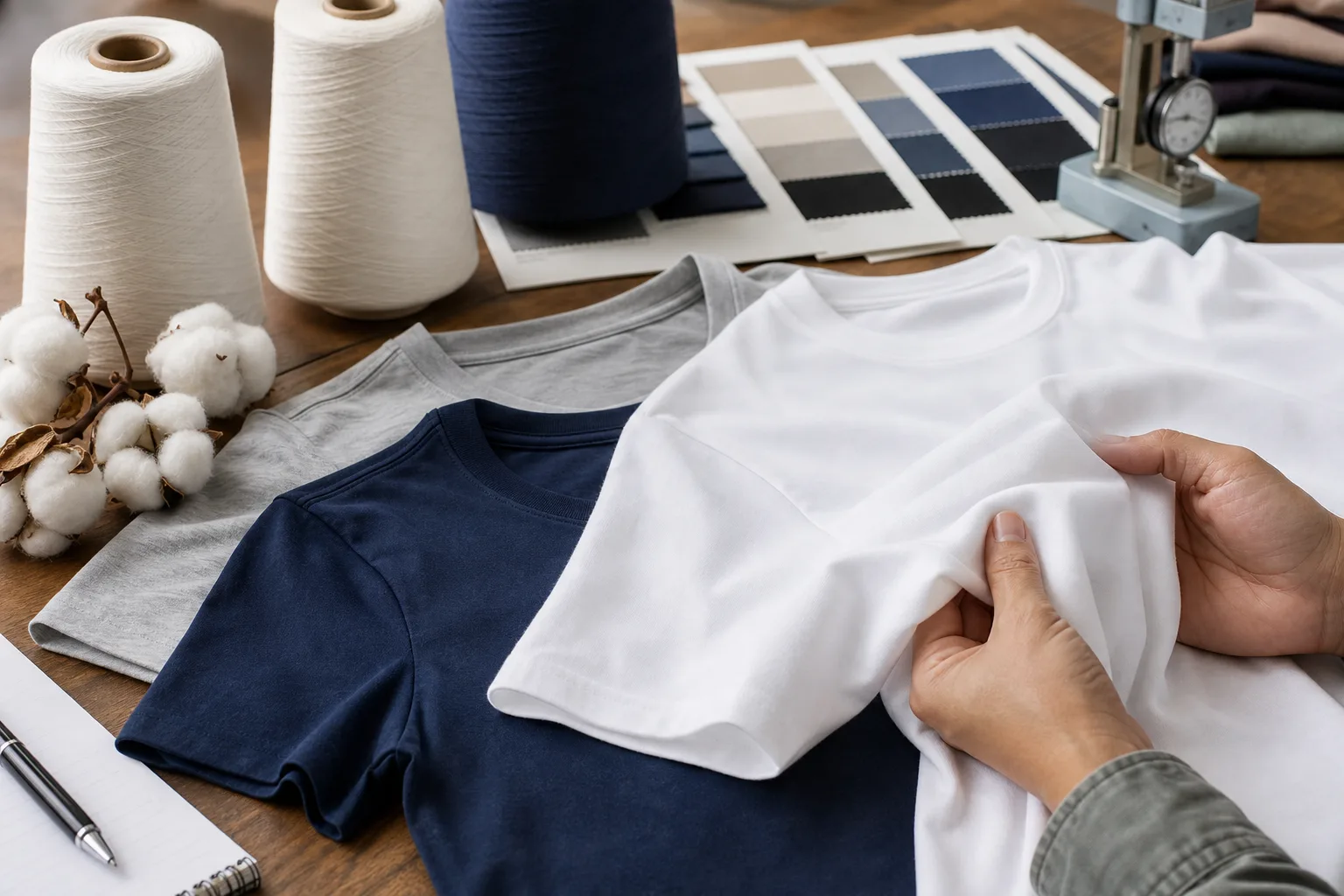
The best cotton for T-shirts depends on the result you want. For a smooth, soft premium tee, look for appropriately long and uniform cotton fibers processed into combed, ring-spun yarn and knitted into a balanced fabric. For a hard-wearing work or everyday shirt, fabric density, yarn strength, seam construction and dimensional stability may matter more than whether the label names Pima, Egyptian or another cotton type. In short, cotton variety can influence quality, but it does not determine the finished result by itself.
The short answer: buy the whole T-shirt, not just the cotton name
A useful buying decision separates six variables that marketing often compresses into one word: fiber properties, yarn preparation, spinning method, knit construction, finishing and garment assembly. Each stage can improve or undermine the stage before it.
Longer, stronger and more uniform fibers can support fine, even yarns, but a good raw material still has to be spun, knitted, dyed, finished and sewn appropriately. Conversely, widely available Upland cotton can make an excellent everyday T-shirt when the manufacturer controls those processes well.
- For softness: prioritize combed yarn, a smooth surface and an appropriate fabric weight.
- For durability: inspect fabric density, seam quality, neckband recovery and care requirements.
- For printing: look for a smooth, even knit with limited visible hairiness or irregularity.
- For hot conditions: choose a lighter, less bulky construction, while checking that it is not excessively transparent.
- For structure: choose a denser or heavier jersey, or consider a more stable double-knit construction.
No single marketing phrase proves all of these outcomes. “Premium cotton,” “luxury cotton” and “buttery soft” are descriptions, not standardized performance measurements.
What cotton fiber quality can—and cannot—tell you
Raw cotton is assessed through measurable properties including fiber length, length uniformity, strength, micronaire, color and non-lint content. USDA cotton classification uses instrument testing to generate bale-level data that manufacturers can use when sourcing fiber for particular products.[1] CottonWorks likewise identifies staple length, uniformity, strength, micronaire, color and trash among the principal cotton quality factors.[2]
Length, uniformity and strength
Staple length describes fiber length, while length uniformity indicates how consistent the lengths are within a sample. These properties affect spinning efficiency and the strength and evenness of yarn. Fiber strength is separately measured as the force required to break a bundle of fibers.[1]
In practical terms, longer and more uniform fibers give a spinner more scope to make fine, even yarn. That can contribute to a smoother T-shirt, but it is not a consumer guarantee. Most retail labels do not disclose bale-level test values, and the finished garment may combine cotton from multiple bales or origins.
Micronaire is not a softness score
Micronaire is an air-permeability measurement influenced by both fiber fineness and maturity. It is not a direct softness rating. Micronaire consistency matters in manufacturing because uneven fiber characteristics can contribute to dye variation, including streaks or barré.[2]
Consumers should therefore be cautious when a seller presents a technical fiber term as proof that a shirt will feel soft or last longer. Those outcomes require evaluation of the finished fabric and garment, not just a raw-fiber attribute. See the broader guide to cotton quality and HVI testing for more detail.
Why yarn often matters more than the cotton name
A T-shirt is made from yarn, not loose fiber. The way cotton is cleaned, aligned, combed and spun changes the yarn’s surface, strength, evenness and cost.
Carded versus combed cotton
Carding opens and aligns cotton into a continuous strand for further processing. Combing adds another step that removes short fibers. According to CottonWorks, combed cotton can support finer yarn and tends to produce fabrics with improved hand, drape, sheen and durability, although combing may be a performance requirement in one product and a price-positioning choice in another.[3]
For a smooth close-to-skin tee, “combed cotton” is generally a useful specification. It still does not reveal the fabric weight, knit balance, dyeing quality or shrinkage performance.
Ring-spun versus rotor-spun yarn
Ring spinning and rotor, or open-end, spinning create genuinely different yarn structures. CottonWorks describes ring spinning as suitable for a wide yarn-count range, including fine counts, and notes the soft hand associated with ring-spun fabrics. Rotor spinning is faster and can produce economical yarn efficiently, particularly in coarser ranges.[4]
Ring-spun is therefore a sensible signal when shopping for a soft, refined T-shirt, but it is not an automatic grade. A poorly controlled ring-spun yarn or loosely constructed fabric can perform worse than a well-engineered rotor-spun product. Yarn twist, count, evenness and preparation remain relevant.
What “ringspun,” “airlume” and similar terms prove
“Ring-spun” identifies a spinning method. Proprietary phrases may describe a brand’s selected processing route, but their meaning depends on the company’s own specification. Unless a term is tied to disclosed measurements or a recognized standard, do not treat it as a universal quality grade.
Fabric construction determines how the shirt behaves
Most classic T-shirts use single jersey, a weft-knit fabric formed from intermeshing yarn loops. Knits naturally conform and stretch more readily than typical woven fabrics. Single jersey has visibly different face and back surfaces and can curl or distort if yarn, knitting and finishing variables are not well controlled.[5]
Weight and density are not the same as quality
Fabric weight is often reported in grams per square meter, or GSM. A lighter shirt can feel cool and fluid; a heavier one can feel more substantial and opaque. Neither is inherently better. Density, stitch length, yarn size and finishing affect whether a given weight feels firm, loose, smooth or bulky.
When comparing products, ask for the fabric weight if it is available, but use it to identify the intended style—not as a stand-alone quality score. Hold a light-colored sample against a bright background to check transparency, and gently stretch it to see whether the loops recover without leaving obvious ripples.
Single jersey versus interlock
Single jersey is common for everyday tees because it is flexible and relatively economical. Interlock is a double-knit fabric with a similar appearance on both sides. It uses more yarn, is generally heavier and more stable, and curls less than single jersey.[6] Interlock can suit structured or close-to-body garments, but shoppers seeking a classic lightweight T-shirt may prefer single jersey.
Finishing and garment construction
Knitted cotton is more prone to dimensional change than a comparable woven construction. Shrinkage is influenced by fiber, yarn, stitch structure, wet processing, finishing, sewing and subsequent care. Relaxation and compaction during finishing can reduce residual shrinkage, but “pre-shrunk” should not be interpreted as “cannot shrink.”[7]
Inspect the completed garment for:
- a neckband that lies flat without waviness;
- straight side seams, unless the body is intentionally tubular;
- even stitches without skipped areas or loose thread ends;
- reinforcement at high-stress points;
- balanced hems that do not twist before washing;
- care instructions compatible with how you actually launder clothes.
These checks often predict satisfaction better than a prominent cotton name on the hang tag. Explore related material structures in the cotton fabrics guide.
How to read cotton labels and sustainability claims
Fiber content is not a quality grade
In the United States, covered textile labels must identify fiber content accurately. A product described as “100% cotton” should contain only cotton apart from permitted trim, but the statement does not specify staple length, yarn method, knit density, finish or durability. If a particular cotton type is named, the claim must truthfully represent its share of the product’s fiber content.[8]
A small percentage of elastane can improve stretch and recovery in a fitted tee, while polyester may change drying speed, drape, pilling behavior and moisture handling. A blend is not automatically inferior; it is a different material system. Read the percentages rather than relying on a large cotton-related phrase elsewhere on the label.
Organic describes a production and certification attribute
Organic status does not, by itself, measure softness, fiber length, colorfastness, seam strength or shrinkage. Those are separate questions. If a finished product claims GOTS certification, look for complete labeling that includes the GOTS logo, the applicable label grade, the approved certification body and the certified entity’s number. Under GOTS Version 8.0, the “Organic” grade requires at least 95% certified organic fiber content, while a “Made with” grade requires at least 70%.[9]
Broad words such as “green,” “eco-friendly” or “sustainable” should not substitute for a specific claim. FTC guidance advises marketers against broad, unqualified environmental-benefit claims and calls for clear, supportable qualifications.[10] For purchasing decisions, identify exactly what is certified, what percentage is covered and whether the claim applies to the fiber, fabric, finished shirt or packaging. Learn more in the cotton sustainability hub.
Practical T-shirt buying checklist
| Check | Useful evidence | What it does not prove |
|---|---|---|
| Fiber label | Exact percentages of cotton and other fibers | Softness, durability or fabric density |
| Named cotton type | Potential information about the cotton used, if accurately disclosed | That every fiber has exceptional length or strength |
| Combed cotton | Short fibers were removed during yarn preparation | Low shrinkage or strong seams |
| Ring-spun yarn | A spinning route often selected for fine, soft yarns | A standardized finished-garment grade |
| Fabric weight | Whether the shirt is relatively light or substantial | Quality without density and construction context |
| Pre-shrunk claim | The fabric or garment received a shrinkage-control process | Zero dimensional change |
| Certification | Compliance with the stated certification’s defined scope | Every comfort or durability outcome |
| Physical inspection | Initial evidence of opacity, sewing, recovery and visible defects | Long-term performance without repeat-wash testing |
Questions for brands and suppliers
- What is the full fiber composition?
- Is the yarn carded or combed, and which spinning system is used?
- What knit construction and fabric weight are specified?
- Are finished-garment shrinkage, colorfastness and pilling results available, and which test methods were used?
- Does the neckband contain a recovery fiber or use a different knit construction?
- What does each environmental claim cover, and can the certification be verified?
Industry buyers should request measurable finished-product requirements rather than specifying “premium cotton” alone. A useful specification may address fiber composition, yarn and fabric construction, dimensional change, appearance after laundering, colorfastness, pilling, seam performance and tolerances. Test requirements should identify an established method and acceptance level; the cotton name should not be used as a substitute for performance testing. See the testing overview and industry resources.
Care can preserve the qualities you paid for
Follow the permanent care label first. FTC rules require covered manufacturers and importers to provide regular care instructions and to possess a reasonable basis for those instructions.[11] Where the label allows it, washing in cooler water, avoiding unnecessary high dryer heat and removing the shirt promptly can reduce avoidable stress on the fabric, color and printed decoration.
Turn printed tees inside out, wash similar colors together and avoid assuming that every white cotton shirt tolerates chlorine bleach. Drying method and temperature can influence dimensional change, so compare the care burden as well as the purchase price. Visit the cotton care guide for practical laundering advice.
The most dependable choice is therefore not simply “the longest cotton” or the most prestigious name. Select a shirt whose fiber content, yarn, construction, finish, assembly and care requirements fit its intended use—and treat unsupported marketing language as a prompt to ask for better evidence.
Frequently asked questions
What type of cotton is best for a soft T-shirt?
An appropriately long and uniform cotton fiber processed into combed, ring-spun yarn is a useful starting point for a smooth, soft T-shirt. Fabric density, knitting, finishing and garment construction still determine the final feel.
Is Pima cotton always better for T-shirts?
No. Pima can provide long fibers suitable for fine yarn, but the name alone does not guarantee softness, durability, shrinkage control or good sewing. A well-made Upland cotton shirt may outperform a poorly manufactured Pima shirt.
Is ring-spun cotton the same as combed cotton?
No. Combing is a fiber-preparation step that removes short fibers. Ring spinning is a method of turning prepared fiber into yarn. A T-shirt can use yarn that is both combed and ring-spun.
Does organic cotton make a higher-quality T-shirt?
Organic describes the cotton’s production and certification status, not a measured comfort or durability level. Evaluate organic T-shirts using the same yarn, fabric, construction, finishing and care criteria as other shirts.
Does 100% cotton mean a T-shirt will not pill or shrink?
No. The statement describes fiber composition. Pilling and shrinkage also depend on fiber dimensions, yarn structure, knit construction, finishing, garment assembly and laundering.
How this guide was prepared
This guide is based on desk research completed on 2026-09-14 using USDA cotton-classing information, CottonWorks technical education, FTC textile and environmental-labeling guidance, and GOTS Version 8.0. It translates raw-fiber and textile-manufacturing concepts into purchasing criteria. No garments were purchased, worn, washed, laboratory-tested or inspected, and no mills, farms, suppliers or certification sites were visited.
Review status: Publishable quality advisory.
Sources and scope
- Cotton Classing ServicesUSDA Agricultural Marketing Service
USDA instrument classification measurements, including cotton length, length uniformity, strength, micronaire, color and non-lint content.
Accessed 2026-09-14 - Cotton Fiber QualityCottonWorks
Relationships among fiber length, uniformity, strength, micronaire, yarn evenness, processing and dye uniformity.
Accessed 2026-09-14 - Fiber Preparation for SpinningCottonWorks
Carding and combing processes and the potential effects of combed cotton on yarn fineness, hand, drape and durability.
Accessed 2026-09-14 - Yarn SpinningCottonWorks
Technical differences among ring, rotor and air-jet spinning, including yarn structure, count range, production and hand.
Accessed 2026-09-14 - Knit BasicsCottonWorks
How knitted loops produce stretch and conformability, and the basic structure and behavior of single jersey.
Accessed 2026-09-14 - Single & Double KnitsCottonWorks
Differences between single knits, rib and interlock, including stability, weight, curl and end-use considerations.
Accessed 2026-09-14 - Shrinkage & SkewingCottonWorks
The influence of yarn, knit construction, wet processing, finishing, sewing and care on dimensional stability.
Accessed 2026-09-14 - Calling It Cotton: Labeling and Advertising Cotton ProductsFederal Trade Commission
U.S. fiber-content labeling requirements and conditions for naming particular cotton types in labels and advertising.
Accessed 2026-09-14 - Global Organic Textile Standard Version 8.0Global Organic Textile Standard
GOTS label elements and minimum certified fiber percentages for Organic and Made with label grades.
Accessed 2026-09-14 - Environmental Claims: Summary of the Green GuidesFederal Trade Commission
Guidance against broad, unqualified environmental-benefit claims and the need for specific, substantiated qualifications.
Accessed 2026-09-14 - Care Labeling of Textile Wearing Apparel and Certain Piece GoodsFederal Trade Commission
Requirements for regular garment care instructions and a reasonable evidentiary basis for those instructions.
Accessed 2026-09-14