
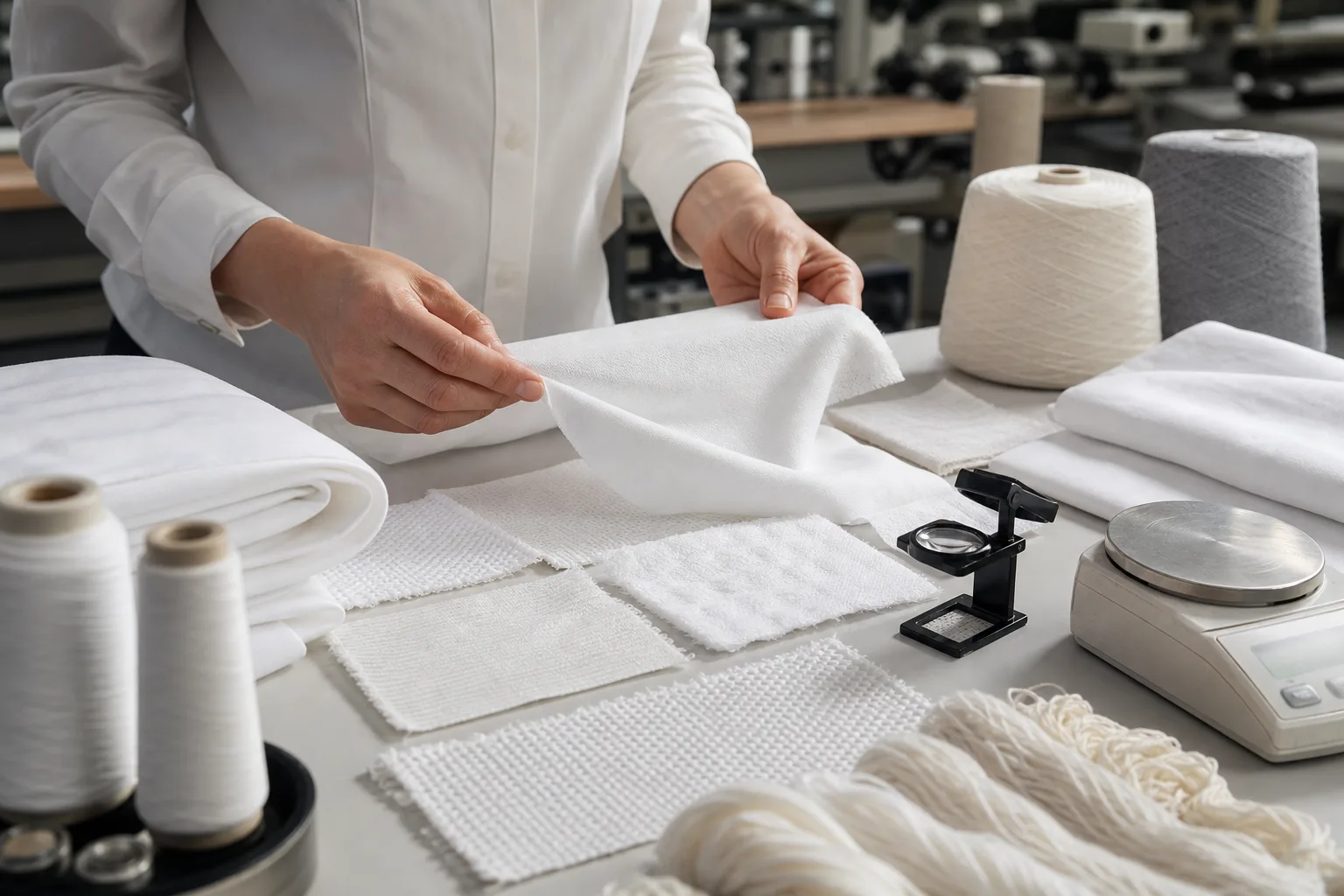
Thread count cannot predict sheet durability by itself. It tells you how many warp and filling yarns are present in a square inch of woven fabric, but it does not reveal the quality of the cotton, the strength and structure of those yarns, the weave, fabric weight, finishing chemistry or performance after repeated laundering. When comparing thread count vs sheet durability, treat the number as one construction detail—not as a grade, test result or guarantee of service life.
What thread count measures—and what it leaves out
A measure of woven density
In a woven sheet, lengthwise warp yarns cross widthwise filling yarns. Thread count is normally calculated by adding the number of warp ends and filling picks in a square inch. If yarn size, fiber, weave and finishing remain comparable, changing that density can alter cover, hand, drape and breathability. In real products, however, those other variables rarely remain identical.
Cotton Incorporated's sheeting guide identifies fiber type, spinning system, yarn count, fabric weight, construction and finishing as factors that work alongside thread count. It also notes that a high cover factor can produce a stiffer fabric and lower tear strength in some constructions. This is why a larger number is not automatically evidence of a stronger sheet.[1]
Thread count is not a durability test
Durability includes several distinct forms of performance: resistance to tearing, tensile failure, abrasion, pilling, snagging, seam damage and unacceptable change during washing and drying. A single thread-count figure measures none of these outcomes. CottonWorks describes textile durability testing in terms of strength, abrasion resistance and pilling, with suitable performance levels determined for the product and intended use.[2]
That distinction matters because two 400-thread-count sheets can behave very differently. One may use even, well-spun yarns and a balanced construction; another may use weaker yarns, an unstable construction or a finish that initially creates an appealing hand but changes substantially in laundering.
Be cautious with inflated counts
Yarn ply and thread count are different facts. A two-ply yarn consists of component strands twisted together, but that does not necessarily make each component a separate woven thread. In a 2005 staff opinion, the US Federal Trade Commission said consumers could be misled when marketers multiply the actual woven count by the number of plies. Its example distinguished a disclosure of “300 thread count, 2 ply yarn” from calling the same fabric “600 thread count.” The document is a staff opinion rather than a durability standard, but it remains useful guidance on transparent count claims.[3]
The material chain behind a durable sheet
Cotton fiber properties
A sheet begins with fibers, not with a thread-count label. Cotton staple length and length uniformity affect yarn strength and evenness. Fiber strength also affects the yarn's performance during textile processing. Cotton fiber evaluation therefore measures properties such as length, uniformity, strength and micronaire before the material becomes yarn or fabric.[4]
Long or extra-long staple descriptions may indicate the potential to spin finer, smoother yarns, but the name alone does not prove the durability of a finished sheet. The fiber must still be properly selected, prepared, spun, woven, finished and sewn. Regional terms such as “Egyptian” also identify an origin claim rather than a complete performance specification. Buyers seeking more detail can review how staple length and fiber strength affect later manufacturing stages.
Yarn preparation and spinning
Yarn converts many short fibers into a continuous strand. Its strength, evenness, twist, hairiness and size can influence abrasion, pilling, surface smoothness and fabric strength. Combing can remove more short fibers and improve yarn uniformity, while the choice among ring, rotor and air-jet spinning creates different yarn structures. None of these methods is universally best for every price, feel or end use, but they help explain why equal thread counts are not equal products.
Consumers will not always find spinning details on a package. When they are disclosed, interpret them as manufacturing information rather than a stand-alone promise. See combed vs carded cotton and ring-spun vs open-end yarn for the relevant trade-offs.
Construction, weight and finishing change the result
Percale and sateen expose yarns differently
Percale is normally a plain-weave construction with frequent interlacing. Sateen uses longer surface floats to create a smoother, more lustrous face. Those structures change drape, airflow, surface exposure and snag behavior. A well-engineered sateen may be durable, and a poorly made percale may wear quickly; the weave name does not override fiber, yarn, density, weight or finishing.
For sateen, enough constructional support is needed to limit picking and snagging. Percale is often selected for a crisper hand and breathability, but simply forcing more yarns into the construction can make it stiff. Compare the structures on their full specifications rather than assuming that either percale or sateen always lasts longer.
Fabric weight adds context
Fabric weight indicates how much material is present over a given area, commonly expressed in grams per square meter. It can help distinguish a very light sheet from a more substantial one, particularly when the fiber and construction are comparable. Weight still cannot prove durability: a heavier fabric can contain coarse or irregular yarns, while a lighter fabric can use strong, fine yarns made from well-controlled cotton.
The most useful evaluation combines weight with yarn size, weave and thread count. A high count achieved with exceptionally fine yarns may not be heavy, while a lower-count flannel can be comparatively heavy. This is why GSM and fabric weight answer a different question from thread count.
Finishing can improve one property while changing another
Finishing controls properties such as softness, smoothness, shrinkage, wrinkle resistance and abrasion behavior. Mechanical and chemical processes can make a new sheet feel unusually soft or polished, but initial hand is not proof that the result will survive laundering. Some finishing systems are designed to preserve strength or improve abrasion resistance; other combinations may create trade-offs among softness, strength, absorbency and wrinkle recovery.
Claims such as “easy care,” “wrinkle resistant” or “performance finish” should therefore be supported by a named test method, comparison and number of laundering cycles. Without that context, the claim describes an intended feature rather than a demonstrated useful life.
Wash behavior is stronger evidence than a showroom feel
Sheets experience repeated wetting, detergent exposure, agitation, tumbling, body friction and tension around mattress corners. These stresses can reveal pilling, fuzzing, shrinkage, seam distortion, elastic failure and progressive loss of strength. CottonWorks notes that pilling often appears in laundering and is influenced by fiber dimensions, yarn and fabric construction, finishing and end use.[2]
For consumers, verified wash-test information is more meaningful than an unsupported claim that a sheet is “hotel quality” or “luxury.” Look for disclosure of the washing and drying procedure, number of cycles and measured result. A statement such as “tested after 20 home-laundering cycles” is still incomplete unless the seller explains what was evaluated and what constituted a passing result.
At home, follow the care label and avoid assuming that aggressive washing can be offset by a high thread count. Compare changes in fit, surface, seams and hand over time. The cotton sheet wash-test guide provides a repeatable way to document those observations, while washing guidance for cotton sheets covers routine care.
A practical sheet-durability buying checklist
| Information available | What it can tell you | What it cannot prove | Useful follow-up question |
|---|---|---|---|
| Thread count | Approximate woven yarn density when counted consistently | Strength, abrasion resistance, pilling or wash life | Are plies counted separately, and what are the warp and filling counts? |
| Fiber-content label | The fibers present by weight | Cotton staple length, yarn quality or finished durability | Is the sheet 100% cotton, a blend or a product with separate components? |
| Named cotton type | A claimed variety, class or origin | That every fiber has premium length or strength | Is the claim independently verified and applicable to the entire cotton content? |
| Percale or sateen | The basic weave family and likely feel | Which sheet will last longer without other specifications | What are the yarn type, fabric weight and performance requirements? |
| Fabric weight | Material mass per unit area | Fiber quality, yarn evenness or resistance to pilling | Is the weight reported for the finished fabric? |
| Durability claim | A performance target if adequately substantiated | A result without a test method and acceptance level | Which strength, abrasion, pilling or laundering method was used? |
| Customer reviews | Possible patterns in fit, pilling, tearing or shrinkage | A controlled comparison between products | Do repeated reports identify the same failure after similar use? |
Also inspect practical details that thread count ignores:
- Dense, even fabric without obvious thin bands or irregular picks
- Secure hems and consistent stitching without skipped stitches
- Enough fitted-sheet depth for the mattress, including expected shrinkage
- Elastic and seam construction appropriate for repeated stretching
- Clear fiber, care and country-of-origin labels
- Specific performance language rather than unexplained premium terminology
The FTC's Textile Fiber Rule requires covered US textile products to disclose fiber percentages, marketer or manufacturer identity and processing or manufacturing origin. Those disclosures help verify what the sheet is made from, but they are not durability grades.[5] For a closer label review, use the guide to verifying cotton sheet labels.
What retailers and sourcing teams should specify
Commercial buyers should move beyond a thread-count minimum and define performance for the intended product. A useful specification may identify fiber content, acceptable yarn and construction parameters, finished weight, dimensional stability, seam requirements, tensile or tear strength, abrasion resistance, pilling resistance and appearance after an agreed laundering procedure. Requirements should state the test method, conditioning, number of cycles, direction tested and pass/fail level.
Comparisons must also use equivalent products. A 300-count percale should not be presented as outperforming a 500-count sateen because of thread count alone when weave, yarn size, weight and finish differ. If a supplier claims improved durability, request results against a clearly identified control fabric rather than accepting a percentage without its baseline.
Thread count is equally unsuitable as a sustainability score. A higher or lower count does not establish farming practices, chemical management, water use, emissions, worker conditions, recyclability or actual product lifetime. Greater verified durability may support longer use, but that conclusion requires performance evidence and realistic care assumptions. Sustainability certifications and life-cycle claims should be checked for their stated scope rather than inferred from density or softness.
Bottom line: use thread count to understand one aspect of woven construction. Use fiber information, yarn and weave details, finished weight, manufacturing quality and repeated-wash performance to judge probable durability. When those details are missing, the thread-count number cannot fill the evidence gap.
Frequently asked questions
Does a higher thread count mean sheets will last longer?
No. A higher count describes greater woven yarn density when counts are calculated consistently. Durability also depends on cotton fiber properties, yarn strength and evenness, weave, fabric weight, finishing, sewing and performance through repeated washing.
What thread count is best for durable cotton sheets?
There is no universal best number. A balanced, well-made percale with a moderate count can outlast a higher-count sheet made with weak or irregular yarns. Compare products within the same weave and consider fabric weight, yarn information and wash-test evidence.
Are percale sheets more durable than sateen sheets?
Not automatically. Percale's plain weave has frequent interlacings, while sateen has longer surface floats and a smoother hand. These structures create different wear and snagging risks, but fiber, yarn, density, weight and finishing can matter as much as the weave name.
Can a 100% cotton label prove sheet quality?
No. It identifies fiber content, not staple length, yarn quality, weave stability, finishing or durability. It is an important label fact, but it should be evaluated alongside construction details and verified performance claims.
What evidence should support a durable-sheet claim?
Look for named methods covering relevant properties such as tensile or tear strength, abrasion, pilling, shrinkage and appearance after laundering. The seller should identify the test conditions, number of wash cycles, comparison fabric and passing requirement.
How this guide was prepared
This page is based on desk research of Cotton Incorporated technical guidance and US Federal Trade Commission labeling materials accessed on October 16, 2026. It translates published fiber, yarn, construction, durability-testing and labeling information into buying and sourcing guidance. No products were purchased, laboratory tested or used, and no mill, farm or supplier visits were conducted.
Sources and scope
- A Buying Guide for Cotton SheetsCottonWorks, Cotton Incorporated
Defines thread count and explains how fiber type, yarn spinning, yarn count, fabric weight, construction, cover factor and finishing affect sheet performance.
Accessed 2026-10-16 - Garment DurabilityCottonWorks, Cotton Incorporated
Describes durability in terms of strength, abrasion resistance and pilling, including the influence of laundering, construction and finishing.
Accessed 2026-10-16 - FTC Staff Opinion Regarding Disclosure of Fabric Thread CountFederal Trade Commission
Explains why multiplying thread count by yarn ply may mislead consumers and gives an example of separate thread-count and ply disclosure.
Accessed 2026-10-16 - Cotton Fiber QualityCottonWorks, Cotton Incorporated
Explains cotton fiber length, length uniformity, strength and micronaire and their effects on spinning and yarn quality.
Accessed 2026-10-16 - Textile Fiber RuleFederal Trade Commission
Summarizes required US disclosures for constituent fibers, marketer or manufacturer identity and processing or manufacturing origin.
Accessed 2026-10-16
Questions & discussion
Share a question or a useful experience about this guide. Comments appear immediately. Your name and comment are public. Email is optional and stays private; reply emails are not enabled yet. Comment privacy.