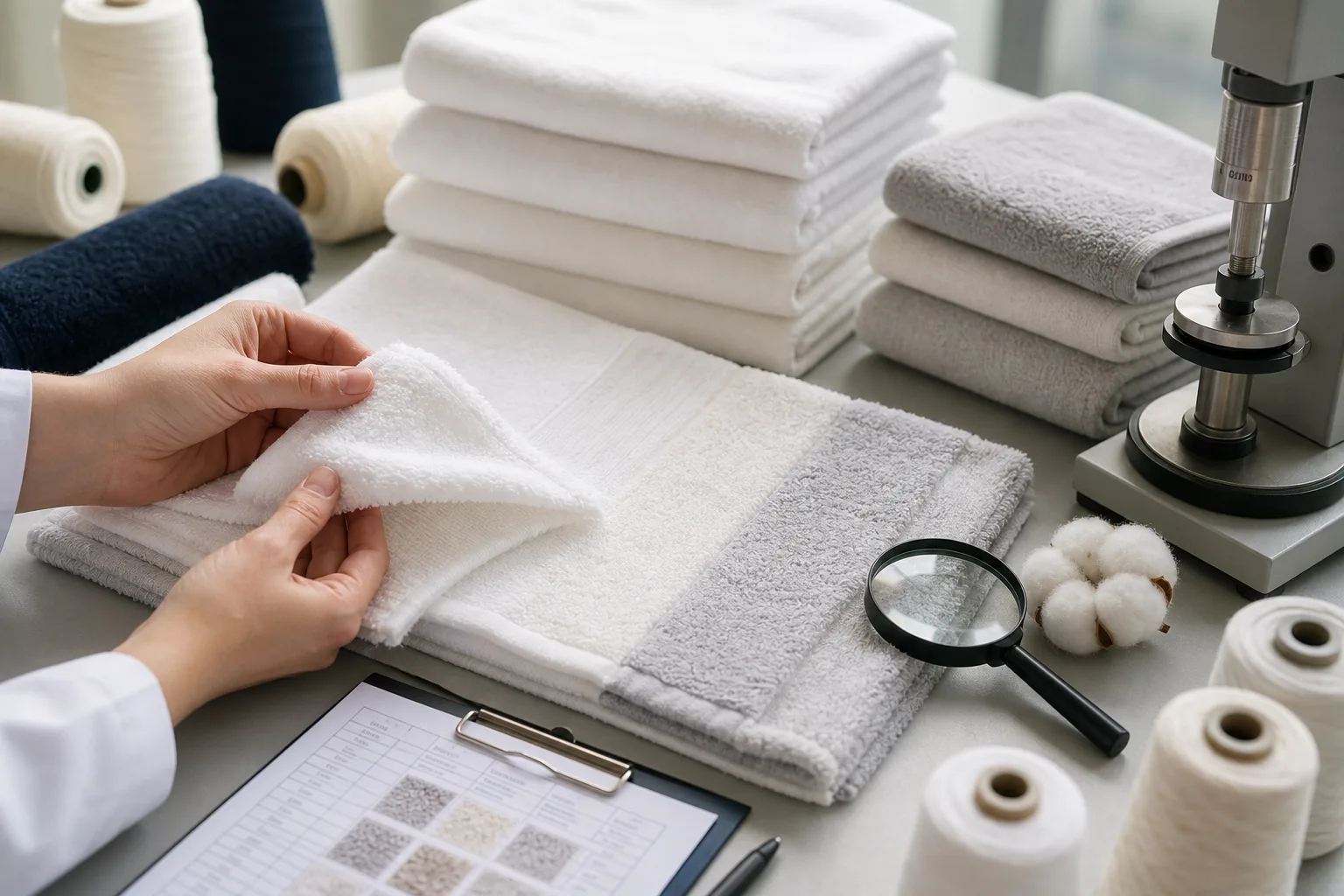
The best cotton for towels is usually 100% cotton in the absorbent loops, supported by a stable ground fabric and a construction suited to how the towel will be used. For everyday bath towels, look for looped terry, a clearly stated fiber composition and a moderate-to-high fabric weight. Long-staple or extra-long-staple cotton can support smoother, stronger yarns, but names such as Pima, Egyptian or Turkish cotton do not guarantee absorbency, durability or drying speed. Those results also depend on yarn twist, pile geometry, fabric density, preparation and finishing.
The short answer: choose the whole towel, not just a cotton name
There is no single cotton variety that is automatically best for every towel. A lightweight gym towel and a dense hotel-style bath sheet require different balances of absorbency, drying time, bulk and durability.
For a dependable bath towel, prioritize these specifications in order:
- Accurate fiber content: Prefer 100% cotton loops when absorbency is the main goal. Check whether the ground fabric contains another fiber.
- Looped terry construction: Loops create pile and increase the amount of exposed yarn available to take up water.
- Suitable GSM: About 400–600 GSM generally favors lower weight and quicker drying, while 600–800 GSM produces a denser, plusher towel, according to the CottonWorks home buyer's guide.
- Balanced yarn design: Combed or ring-spun yarns may improve smoothness. Plied yarns can support strength, while very low-twist yarns trade some durability for a softer, bulkier hand.
- Sound manufacturing: Inspect loop coverage, hems, seams, shape and finishing instead of relying on words such as “luxury” or “hotel quality.”
A useful buying rule is to select for the intended use first, then consider premium cotton types. See the broader cotton buying guide for the same specification-led approach across product categories.
What cotton fiber quality can—and cannot—tell you
Upland, Pima and extra-long-staple cotton
Upland cotton is widely used in practical, everyday towels and can perform well when the yarn and fabric are properly engineered. Pima and other extra-long-staple cottons have longer fibers that can be spun into smooth, relatively fine yarns. This may support a refined hand and good yarn integrity, but it does not establish the towel's pile density, absorbent surface area or resistance to loop pulls.
“Egyptian” and “Turkish” primarily identify geographic associations rather than one uniform performance grade. CottonWorks notes that cotton sold under either name may be Upland or extra-long-staple cotton. Consequently, the name should be considered alongside measurable or inspectable specifications, not used as a substitute for them.
How mills assess raw cotton
Raw cotton is evaluated using properties including staple length, length uniformity, strength, micronaire, color and foreign matter. USDA classing instrumentation measures these bale-level characteristics, while trained classers also inspect samples for extraneous matter. The resulting data helps manufacturers select cotton for specific processing and end uses. USDA Cotton Classing Services describes the measurements and their role in sourcing.
These properties matter because fiber length and uniformity affect yarn evenness and spinning performance, strength indicates the force needed to break a fiber bundle, and micronaire reflects a combination of fineness and maturity. The CottonWorks fiber-quality reference explains these relationships in detail.
Most retail towel labels do not provide bale-level test data. A shopper therefore should not assume that a premium cotton name proves a particular staple length, fiber strength or HVI result. Learn how these measurements are used in the HVI testing guide, while recognizing that finished-towel performance requires separate product testing.
Yarn and terry construction often matter more than the headline fiber
Combed, ring-spun and plied yarns
Combing removes a portion of the shorter fibers and impurities from prepared cotton, enabling more even yarns and a smoother surface. Ring spinning creates a yarn structure commonly selected when softness and fine yarn capability are priorities. These terms can be useful sourcing clues, but neither is a finished-product performance rating.
A plied yarn combines two or more yarns, generally increasing cohesion and helping the pile withstand use. By contrast, zero-twist and low-twist pile yarns are designed to open into a soft, bulky structure. CottonWorks cautions that low- or zero-twist towels can be less durable. Buyers choosing them should examine loop security, laundering requirements and replacement expectations rather than treating extra softness as evidence of longer life.
Loop pile, cut pile and the ground fabric
Traditional terry has loops projecting from one or both surfaces. Longer or denser loops can increase bulk and the amount of yarn available for water uptake, although poorly secured long loops may snag more readily. Cut-pile or velour surfaces are made by shearing loop tips, changing the feel and appearance. A smooth velour face may be desirable for decoration or beach use, but its appearance alone does not establish absorbency.
The ground is the woven base that holds the loops. It influences dimensional stability, strength and how securely the pile remains attached. Check for even loop coverage, straight edges, substantial hems and no visibly thin channels. For more on pile and woven structures, visit the cotton fabrics guide.
Choose GSM for the intended use
GSM means grams per square meter and describes fabric mass per unit area. It is useful for comparing towels of similar size and construction, but it is not an absorbency test. Two towels with the same GSM can differ because of yarn twist, loop height, ground density and finishing.
| Intended use | Practical GSM range | Likely advantages | What to check |
|---|---|---|---|
| Gym, travel or humid bathroom | About 400–500 GSM | Lower bulk, easier handling and generally faster drying | Enough loop coverage to dry effectively; secure hems |
| Everyday household bath towel | About 500–600 GSM | Balance of absorbent pile, weight and drying time | Even terry loops, stable ground and suitable size |
| Plush bath or hospitality feel | About 600–800 GSM | Dense hand and greater material mass | Laundry capacity, drying time and replacement cost |
| GSM not disclosed | Unknown | No reliable weight comparison | Ask for product weight and dimensions; do not infer GSM from “luxury” wording |
These ranges are selection guides rather than standardized quality grades. Heavier is not always better: a very dense towel may remain damp longer in a poorly ventilated room, while a lighter, well-constructed towel may be more practical for frequent laundering.
Read the complete label and question finishing claims
Fiber content must describe more than the premium loops
In the United States, a towel promoted with a specific cotton type must not imply that the entire product uses that cotton when only one component does. The Federal Trade Commission gives the example that a towel with Pima cotton loops and an Upland cotton ground cannot simply be labeled “100% Pima Cotton.” The complete composition must be represented accurately. See the FTC's Calling It Cotton guidance.
Read the sewn-in label rather than relying only on a front-of-pack badge. If the towel is a cotton blend, check the percentage by total product weight and whether the seller separately identifies the loops and ground. Polyester in the ground may be used for stability or drying considerations, but “cotton loops” is not equivalent to an all-cotton towel.
Softness at first touch may come from construction or finishing
A new towel's hand reflects fiber, yarn, pile and applied finishes. Preparation is also important: scouring removes natural waxes and other impurities and improves uniform absorbency, as explained in the CottonWorks dyeing-preparation guide. Consumers usually cannot identify a finishing recipe by touch, so an unusually slick or fluffy store feel should not be treated as proof of lasting performance.
For commercial sourcing, ask suppliers for the test method and acceptance limit behind claims such as “high absorbency,” “quick dry,” “low lint” or “colorfast.” A marketing adjective without a method, conditioning protocol, number of wash cycles and pass/fail criterion is not a measurable specification.
Keep sustainability claims separate from towel performance
Organic, traceable and responsibly sourced cotton claims address production or chain-of-custody attributes. They do not by themselves prove that a towel is softer, stronger or more absorbent. Quality and sustainability can both be purchasing priorities, but they answer different questions.
For products sold in the United States, USDA guidance states that specific fibers may be identified as organic when the claim is supported, while the finished product must not be represented as USDA organic or display the USDA organic seal unless the finished product complies with the applicable requirements. Review USDA's organic textiles guidance.
Under GOTS Version 8.0, the “Organic” label grade requires at least 95% certified fiber content, while “Made with organic materials” requires at least 70%. Correct retail labeling also includes the label grade, approved certification body and certified entity's certification number. A logo or the word “organic” without enough identifying information deserves verification against the scheme's requirements. See the Global Organic Textile Standard Version 8.0.
Broad words such as “green,” “eco-friendly” and “sustainable” are not towel-quality measurements. The FTC advises marketers to qualify environmental claims with specific, supportable benefits and warns that a certification seal does not remove the duty to substantiate express or implied claims. Consumers and buyers should ask what attribute was assessed, which organization verified it and whether the claim applies to the fiber, processing, whole product or packaging.
A practical towel-buying checklist
- Confirm the use: quick-drying gym towel, everyday bath towel, plush bath sheet, hand towel or decorative towel.
- Read the full fiber label: distinguish an all-cotton towel from cotton loops on a blended ground.
- Check the construction: look for even pile, consistent coverage, straight grain, secure borders and well-sewn hems.
- Use GSM appropriately: compare weight only with similar towel types and sizes.
- Evaluate yarn terms cautiously: combed, ring-spun, plied and low-twist describe processing choices, not guaranteed results.
- Do not overvalue origin names: Pima or extra-long-staple cotton may support smoother yarn, while Egyptian or Turkish wording alone does not disclose fiber measurements.
- Ask for evidence: commercial buyers should request test methods, tolerances and wash-cycle conditions for absorbency, lint, shrinkage and colorfastness claims.
- Verify sustainability labels: identify the standard, certification body, certificate or license number, scope and applicable product.
- Follow the supplied care instructions: launder before making a final judgment about absorbency, dry the towel fully between uses and address loose hems before they spread. More guidance is available in the cotton care hub.
Bottom line: The best cotton for towels is cotton matched to a sound yarn and terry construction. Choose 100% cotton loops, an appropriate GSM and durable workmanship before paying extra for a variety or origin name. Premium fiber can improve the raw material available to the spinner, but only the complete product specification—and, where supplied, credible finished-towel test data—can support a performance claim.
Frequently asked questions
Is Egyptian cotton or Turkish cotton better for towels?
Neither name guarantees a better towel. Egyptian and Turkish identify geographic associations, and cotton sold under either name may have different staple lengths and quality levels. Compare the complete fiber label, yarn type, looped terry construction, GSM, finishing and workmanship.
What GSM is best for a cotton bath towel?
About 500–600 GSM is a practical starting range for an everyday bath towel. Towels around 400–500 GSM are generally lighter and easier to dry, while 600–800 GSM towels provide a denser, plusher feel. GSM measures mass, not absorbency or durability directly.
Are zero-twist cotton towels better?
Zero-twist and low-twist yarns can produce a soft, bulky pile, but softness involves a durability tradeoff. They are not automatically better than conventional or plied yarns. Inspect loop security and consider laundering frequency before choosing them.
Does organic cotton make a more absorbent towel?
Organic certification concerns how cotton is grown and, depending on the standard, how it is processed and tracked. It is not an absorbency grade. Towel performance still depends on fiber quality, yarn, pile construction, GSM, preparation and finishing.
Does 100% cotton mean the loops and ground are both cotton?
A correctly labeled 100% cotton towel should contain only cotton apart from permitted trim. If only the loops are cotton and the ground is polyester, the full fiber composition must account for both components by weight.
How this guide was prepared
This guide is based on desk research completed on September 14, 2026 using official USDA and FTC guidance, the current GOTS standard, and technical fiber, yarn, construction and preparation resources from CottonWorks. It does not claim product testing, laboratory analysis, factory or farm visits, supplier verification or first-hand towel trials.
Review status: Publishable quality advisory.
Sources and scope
- Cotton Home Buyer's GuideCottonWorks, Cotton Incorporated
Towel GSM ranges, distinctions among Upland, extra-long-staple, Egyptian and Turkish cotton, and the effects of yarn and terry construction.
Accessed 2026-09-14 - Cotton Fiber QualityCottonWorks, Cotton Incorporated
Definitions and manufacturing relevance of staple length, length uniformity, strength, micronaire, color and foreign matter.
Accessed 2026-09-14 - Cotton Classing ServicesUSDA Agricultural Marketing Service
Official description of USDA cotton classing, instrument measurements and visual inspection of bale samples.
Accessed 2026-09-14 - Calling It Cotton: Labeling and Advertising Cotton ProductsFederal Trade Commission
U.S. fiber-content disclosures and the correct treatment of premium cotton loops, ground fabrics and cotton-type claims on towels.
Accessed 2026-09-14 - Dyeing PreparationCottonWorks, Cotton Incorporated
The role of scouring in removing impurities and improving uniform cotton absorbency.
Accessed 2026-09-14 - Organic TextilesUSDA Agricultural Marketing Service
Conditions for organic fiber claims and use of the USDA organic seal on finished textile products.
Accessed 2026-09-14 - Global Organic Textile Standard Version 8.0Global Organic Textile Standard
Current GOTS label grades, minimum certified fiber percentages and mandatory labeling elements.
Accessed 2026-09-14 - Environmental Claims: Summary of the Green GuidesFederal Trade Commission
Guidance on substantiating environmental claims and qualifying broad claims, certifications and seals.
Accessed 2026-09-14