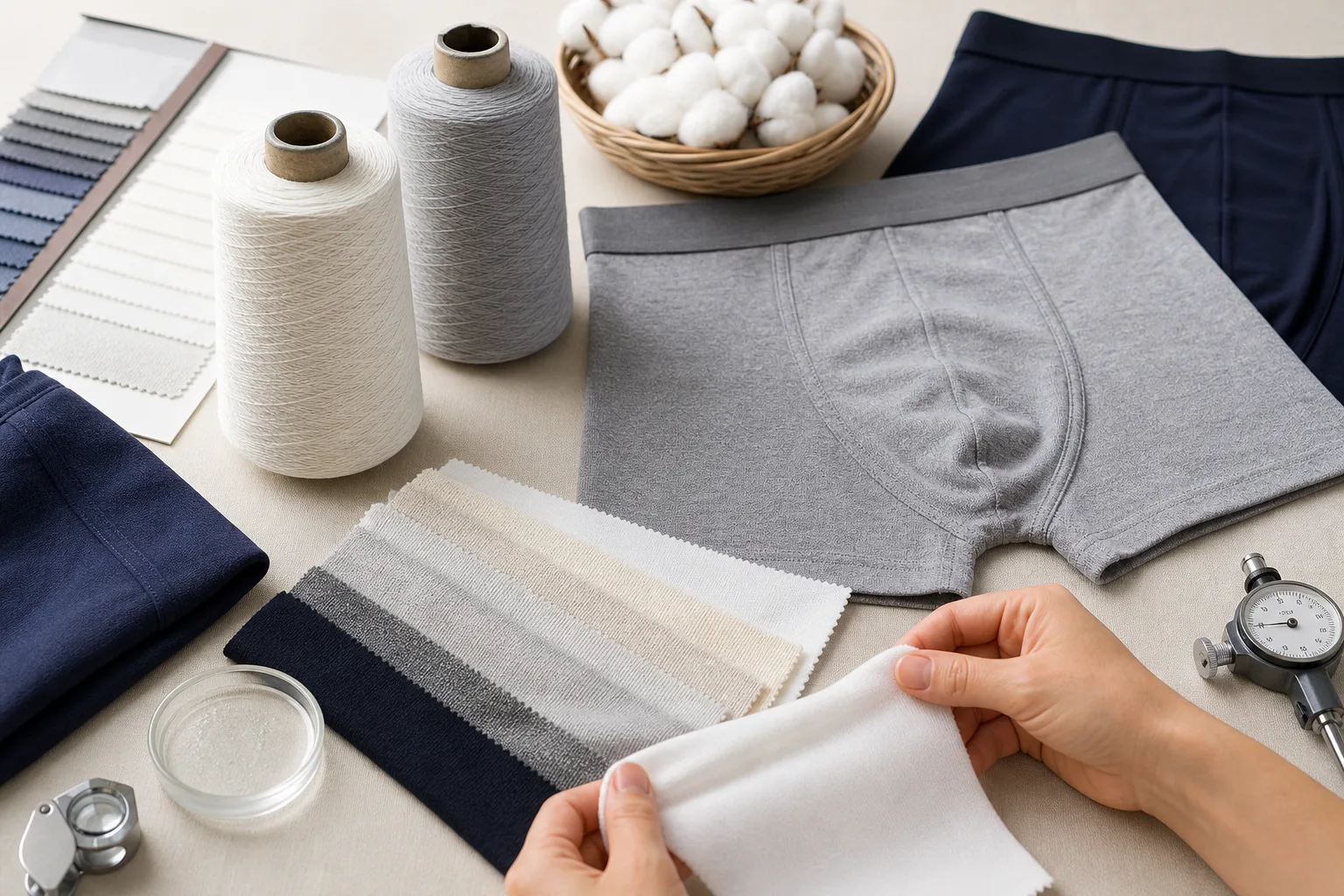
The best cotton for underwear is not defined by one cotton name. For most close-fitting briefs, trunks and boxer briefs, a well-made cotton-rich jersey or rib knit with a small percentage of elastane offers a useful balance of softness, flexibility and shape retention. Combed cotton can provide a cleaner, smoother yarn, while long-staple or extra-long-staple cotton may support finer, smoother fabrics. However, Upland cotton can also make excellent underwear when the yarn, construction, finishing and sewing are well controlled.
For looser underwear, 100% cotton may be entirely suitable. For garments that must stretch repeatedly around the hips and legs, a cotton-elastane blend is usually more practical. Treat terms such as “premium,” “luxury,” “Pima” or “organic” as information to investigate—not as proof that the finished garment will fit well, resist shrinkage or remain smooth after laundering.
Start with the intended fit and use
Underwear places unusual demands on fabric. It remains close to the body, experiences repeated stretching and friction, and is washed frequently. The best material therefore depends on the garment rather than on a universal fiber ranking.
Close-fitting briefs, trunks and boxer briefs
A cotton-rich knit containing elastane is a sensible starting point. Commercial products often use a modest elastane percentage, but there is no single ideal ratio: stretch performance also depends on yarn design, stitch construction, fabric weight, finishing and how the elastic fiber is incorporated. Read the complete fiber label instead of assuming that “cotton underwear” means 100% cotton.
Loose boxers and relaxed styles
These garments need less recovery from the main fabric, so 100% cotton jersey or a lightweight woven cotton can work well. Woven fabric tends to have less natural stretch than knit fabric, making garment cut and ease especially important.
High-activity or hot conditions
Cotton readily takes up moisture, which can feel comfortable during ordinary use but may leave a fabric wet for longer during intense activity. Fabric weight, openness and finishing affect the result. A moisture-management claim should be supported by product-specific evidence; cotton content alone does not establish wicking or fast-drying performance.
Understand what cotton fiber quality can—and cannot—tell you
USDA cotton classification measures raw-fiber properties including length, length uniformity, strength and micronaire, as well as color and non-lint content. Micronaire combines information related to fiber fineness and maturity. These measurements help cotton buyers and mills select material for spinning and manufacturing.[1]
They are not normally shown on an underwear label. Even when high-quality fiber is used, the finished garment can disappoint if it has an unsuitable yarn, loose construction, unstable finish, weak seams or poor sizing. See the broader guide to cotton quality and the explanations of staple length, micronaire and fiber strength.
Long-staple and extra-long-staple cotton
Longer fibers can be spun into fine, relatively smooth yarns with fewer fiber ends at the surface. This makes long-staple and extra-long-staple cotton useful for lightweight, smooth underwear fabrics. It does not automatically make every garment softer or more durable. CottonWorks notes that fiber length, uniformity, strength and micronaire each affect processing and yarn or fabric outcomes, so no single measurement defines overall quality.[2]
Upland cotton
Upland cotton is not inherently a low-quality underwear choice. Appropriate Upland fiber can be combed, spun and knitted into comfortable everyday fabrics. A specific cotton type may influence the available yarn qualities, but construction and processing often matter more to the consumer than the variety name printed on a hangtag.
Look beyond fiber to yarn and knit construction
Combed versus carded cotton
Combing removes short fibers and helps align the remaining fibers. CottonWorks explains that combed material can support finer yarns and fabrics with improved hand, while the resulting yarns and fabrics tend to be softer and more durable. This is a useful quality indicator, but it remains only one part of the product specification.[3]
“Ring-spun” describes a spinning method, not a cotton species. Ring-spun yarn can provide a smooth apparel fabric, especially when paired with combed fiber, but the term does not disclose fabric weight, stitch density, shrinkage control or garment workmanship.
Jersey, rib and interlock
- Single jersey: lightweight, flexible and widely used for underwear. It can curl at cut edges and may twist if yarn, processing and garment construction are not well controlled.
- Rib knit: naturally extensible across the width and useful where the fabric must follow the body. Recovery still depends on construction and any elastane content.
- Interlock: a double-knit structure with similar-looking faces, good stability and no edge curling. It is generally fuller and less airy than a comparable lightweight jersey.
CottonWorks identifies jersey as a common underwear fabric and describes rib as more extensible than basic single knits. It also notes that interlock is stable and can be very soft when made with combed cotton yarns.[4] Explore more garment structures in the cotton fabrics guide.
Fabric weight and density
A light fabric may feel cool and unobtrusive but can become transparent or wear quickly if it is too open. A heavier fabric can feel supportive and durable but may retain more moisture and feel bulky. Because brands rarely publish full construction specifications, examine the fabric in person where possible: stretch it gently, check whether it returns to shape and look for unusually open areas or visible distortion.
Use this practical buying table
| Priority | Useful starting point | What to check | Do not assume |
|---|---|---|---|
| Everyday close fit | Cotton-rich jersey or rib with elastane | Smooth recovery, stable leg openings and flat seams | A higher cotton percentage always gives a better fit |
| Loose, relaxed fit | 100% cotton knit or lightweight woven cotton | Enough garment ease and a non-restrictive waistband | Woven cotton will stretch like a knit |
| Soft surface | Combed cotton; long-staple yarn where specified accurately | Surface smoothness, seam finish and absence of harsh printing | “Luxury cotton” is a measurable grade |
| Shape retention | Stable rib or jersey with suitable elastane | Recovery after gentle stretching and care instructions compatible with elastane | Fiber content alone predicts recovery |
| Frequent washing | Well-compacted knit with reinforced seams | Shrinkage information, stitching and waistband attachment | “Preshrunk” means zero future shrinkage |
| Lower-impact preference | Clearly identified certified or traceable material | Certification body, number, scope and exact content claim | “Natural,” “green” or “conscious” proves lower overall impact |
Read labels and marketing claims precisely
In the United States, covered textile products generally must disclose constituent fibers by generic name and percentage by weight. The FTC states that an item should not be labeled “100% cotton” unless it contains only cotton, apart from qualifying trim. A small amount of elastane with functional significance may be named—for example, “96% cotton, 4% spandex.”[5]
Cotton type claims
If a label names Pima, Egyptian, Sea Island or another cotton type, the claim should be accurate about the amount present. Even an accurate fiber-origin claim does not establish yarn quality or garment performance. “Supima” and similar names may involve trademark requirements, but they should still be separated conceptually from measurable results such as shrinkage, pilling resistance and stretch recovery.
Finishes and treatment claims
Terms such as “moisture-wicking,” “odor-resistant,” “easy-care” and “stay-cool” describe intended outcomes, not the underlying fiber. Ask whether the seller identifies a test method, performance threshold and durability after laundering. A treatment may change how cotton handles water or how the fabric feels, so “100% cotton” does not necessarily mean untreated cotton.
For people who prefer fewer treatments, a clearly described, minimally finished product may be appealing, but “chemical-free” is not a technically meaningful description of a textile. Dyes, washing processes and finishing agents can all be part of manufacturing. Individual skin reactions are also product- and person-specific; cotton content is not a medical guarantee.
Evaluate sustainability claims separately from comfort
Organic certification concerns how fiber is produced and, depending on the certification, how later textile stages are controlled. It does not by itself prove that underwear is softer, stronger, longer lasting or better fitting.
For example, the Global Organic Textile Standard provides an “Organic” label grade for products with at least 95% certified organic fiber content and a “Made with organic materials” grade beginning at 70%. A valid retail claim requires complete labeling information, including the certification body and certification number.[6]
Broad terms such as “eco-friendly” should be approached cautiously. The FTC advises marketers to qualify environmental claims with clear, specific benefits rather than implying an unsubstantiated overall environmental advantage.[7] Read more about evaluating evidence on the cotton sustainability page.
Check care, shrinkage and workmanship before buying
Cotton knit shrinkage is influenced by fiber, yarn, stitch construction, processing tension, wet processing, finishing, sewing and laundering. CottonWorks notes that compaction is used particularly for knits such as underwear fabrics to reduce residual shrinkage. A “preshrunk” statement therefore indicates an attempt to control dimensional change, not a promise that dimensions cannot change.[8]
Follow the sewn-in care label. The FTC Care Labeling Rule requires manufacturers and importers of covered apparel to provide a regular care procedure and to have a reasonable basis for those instructions.[9] Excessive heat can encourage cotton shrinkage and may also shorten the useful life of elastane and waistbands. See the complete cotton care guide.
Final in-store or online checklist
- Confirm the exact cotton and elastane percentages.
- Choose knit construction according to fit: jersey for lightness, rib for extensibility or interlock for stability.
- Prefer specific yarn information such as “combed cotton” over undefined praise such as “ultra-premium.”
- Check seam bulk, waistband attachment and leg-opening recovery.
- Look for clear washing and drying instructions before purchase.
- Treat softness at first touch cautiously; softeners and surface finishes can change after washing.
- For performance claims, look for product-specific testing rather than fiber-level generalizations.
- For sustainability claims, verify what is certified, the percentage covered and whether the final product is included.
The most reliable purchase decision combines label reading with a physical assessment and a realistic view of the garment’s intended use. Start with the cotton buying hub for other product categories, or compare the related construction considerations in the cotton T-shirt guide.
Frequently asked questions
Is 100% cotton best for underwear?
It can be an excellent choice for loose or relaxed underwear. Close-fitting briefs and boxer briefs often benefit from a small amount of elastane because cotton alone does not provide the same stretch recovery.
Is Pima cotton better than regular cotton for underwear?
Pima cotton has long fibers that can support fine, smooth yarns, but the name alone does not guarantee a superior garment. Yarn preparation, knit construction, finishing, seams and shrinkage control also determine performance.
What does combed cotton mean on an underwear label?
Combing is a yarn-preparation step that removes short fibers and further aligns the remaining material. It can produce cleaner, finer and smoother yarn, but it does not disclose the garment's construction or tested durability.
Does organic cotton make underwear softer?
Not necessarily. Organic describes an agricultural or certification attribute rather than a softness grade. Fiber length, yarn type, knit construction, finishing and laundering have more direct effects on how underwear feels.
How this guide was prepared
This guide is based on desk research of USDA cotton-classing information, CottonWorks technical material on fiber, yarn, knitting and shrinkage, FTC textile-labeling and environmental-claims guidance, and the Global Organic Textile Standard. No garments were purchased, worn, laundered or laboratory-tested, and no factories, farms, retailers or certification bodies were visited or interviewed.
Review status: Publishable quality advisory.
Sources and scope
- Cotton Classing ServicesUSDA Agricultural Marketing Service
Definitions of instrument-measured cotton properties, including fiber length, uniformity, strength and micronaire.
Accessed 2026-09-15 - Cotton Fiber QualityCottonWorks
How multiple raw-fiber properties influence cotton processing, yarn quality and fabric outcomes.
Accessed 2026-09-15 - Fiber Preparation for SpinningCottonWorks
The purpose of combing and its effects on short-fiber removal, yarn fineness, hand and durability.
Accessed 2026-09-15 - Single & Double KnitsCottonWorks
Characteristics and common applications of jersey, rib and interlock knit constructions.
Accessed 2026-09-15 - Calling It Cotton: Labeling and Advertising Cotton ProductsFederal Trade Commission
U.S. requirements for cotton fiber-content statements and truthful claims about named cotton types.
Accessed 2026-09-15 - Global Organic Textile Standard Version 8.0Global Standard
GOTS organic-content label grades and mandatory certification information for retail goods.
Accessed 2026-09-15 - Environmental Claims: Summary of the Green GuidesFederal Trade Commission
Guidance on qualifying broad environmental claims and explaining the basis of certifications or seals.
Accessed 2026-09-15 - Shrinkage & SkewingCottonWorks
Factors affecting cotton-knit dimensional stability and the use of compaction for underwear fabrics.
Accessed 2026-09-15 - Care Labeling of Textile Wearing Apparel and Certain Piece GoodsFederal Trade Commission
Requirements for regular care instructions and a reasonable basis for apparel care information.
Accessed 2026-09-15