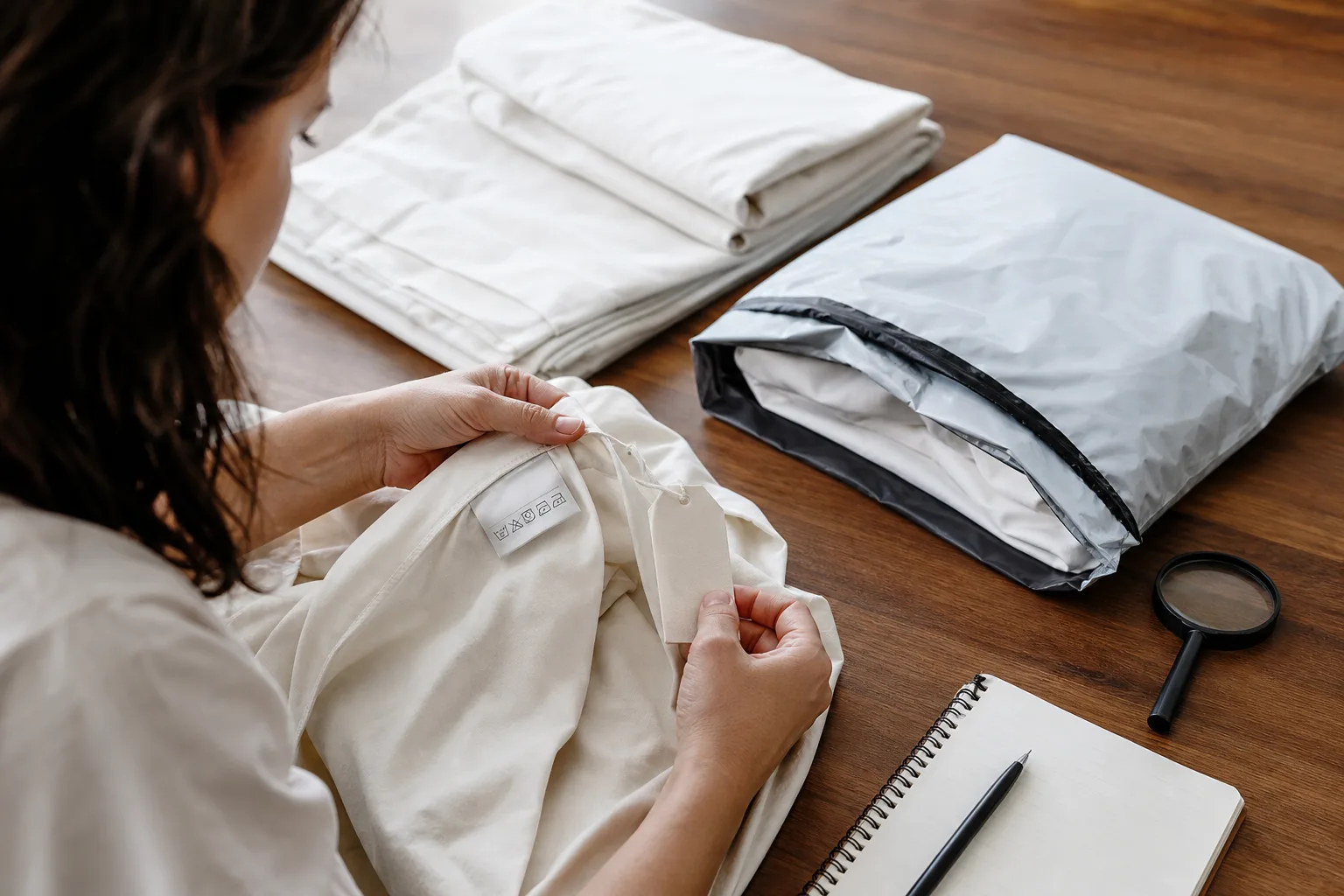
To verify cotton sheets before you keep them, compare three records: the online or shelf listing, the outer retail package, and the label attached to the sheets. All three should identify the same product and make compatible fiber claims. Then inspect the set for substituted components, unexplained wording and missing seller information. These checks can reveal a labeling problem, but touch, appearance and household experiments cannot conclusively prove fiber composition. If the evidence conflicts, preserve the item in returnable condition and ask the seller for clarification or a return.
The five-minute keep-or-return check
Do this review before washing, because laundering may affect your ability to document the product as received and may change its return eligibility. Return rules vary, so check the seller’s policy rather than assuming washed bedding can be returned.
- Confirm the exact product. Match the brand, collection, size, color, weave and product or style number across the order confirmation, package and attached label.
- Find the fiber statement. Look for wording such as “100% cotton,” “all cotton,” or a percentage blend such as “60% cotton, 40% polyester.” Do not substitute a front-panel slogan for the actual fiber disclosure.
- Check every component named in the set. A fitted sheet, flat sheet and pillowcases may share one disclosure when their fiber content is the same. If components differ, the label should identify them separately.
- Compare all claims word for word. Treat “cotton rich,” “cotton feel,” “microfiber,” “Egyptian cotton blend” and “100% cotton” as different statements.
- Identify the responsible business. Look for a full company name or an FTC Registered Identification Number, commonly written as “RN” followed by digits, plus country-of-origin information.
- Document contradictions. Photograph the front and back of the package, the attached label, the full sheet set and the product listing before requesting a resolution.
In the United States, bedding including sheets is covered by federal textile-labeling requirements. Covered products generally must disclose fiber percentages by weight, country of origin, and the manufacturer or another responsible business. Required information must be legible, conspicuous and accessible. FTC textile-labeling guidance explains these requirements in detail.
Compare the listing, package and attached label
1. Save the listing you actually purchased
Save screenshots or a PDF of the product page and order confirmation. Include the selected size and color, because online marketplaces sometimes combine several materials or constructions in one listing. A title that says “cotton sheets” may sit above a variation menu containing both cotton and polyester options.
Read beyond the title. Check the specifications, materials section, description and variant name. A fiber statement buried in the specifications should not contradict a prominent “100% cotton” claim. Thread count, softness, cooling language and weave names do not replace a fiber disclosure.
2. Read the outer retail package
The package or cardboard shell should identify what is inside. Under the Textile Fiber Products Identification Act, a consumer package generally must carry the required information unless it is transparent enough for the product label to be read clearly without opening it. An exception applies to packaging used solely for mail-order shipment. See the FTC’s Textile Products Identification Act text.
Inspect stickers applied over printed information, especially if a sticker changes the fiber, size, color, country of origin or product number. A legitimate correction is possible, but an unexplained mismatch deserves clarification before you keep the set.
3. Find the label attached to the product
Open the package carefully and locate the product label without removing it. It may be sewn into a hem, attached at one end or otherwise secured to the product. Federal textile rules require the label to remain securely attached until delivery to the consumer, but the fiber label does not always have to be permanently sewn in. A sheet set whose pieces have the same fiber content may have the required label on only one component.
If the package says “100% cotton” but the attached label says “100% polyester,” “microfiber,” or a cotton-polyester blend, the records are materially inconsistent. The attached label should not be dismissed as generic packaging without evidence from the responsible company.
| Record | What to match | Warning signs |
|---|---|---|
| Product listing | Fiber, size, color, weave, item number and included pieces | Different fibers assigned to unclear variants; title conflicts with specifications |
| Retail package or shell | Fiber statement, component count, responsible company and origin | Over-labeling, missing fiber information or a product number that does not match |
| Attached product label | Fiber percentages, company name or RN, and origin | Polyester or blend disclosure where the package says 100% cotton |
| Set contents | Same appearance, construction and labeling across fitted sheet, flat sheet and cases | One component has a different label, fabric or product code |
Understand what “100% cotton” actually proves
“100% cotton” is a fiber-content statement. It means the textile fiber weight is represented as cotton, apart from limited exclusions allowed under labeling rules, such as certain structural threads or minor ornamentation. The FTC does not allow the ordinary three-percentage-point manufacturing tolerance to turn an intentionally blended product into a “100%” single-fiber product.
The statement does not establish the sheet’s thread count, yarn quality, staple length, weave, fabric weight, finishing treatment, shrinkage, dimensions after laundering, durability or comfort. Learn how those variables differ in the guides to telling cotton quality, buying cotton bed sheets and cotton staple length.
Premium cotton names need their own support
A sheet can truthfully be labeled “100% cotton” when it contains more than one type of cotton. But if a marketer names Pima, Egyptian, Sea Island or another particular cotton type, that more specific representation must be accurate. For example, the FTC says a sheet containing equal amounts of Egyptian and Upland cotton cannot be labeled “100% Egyptian Cotton.” FTC guidance on cotton advertising gives acceptable ways to disclose mixtures of cotton types.
Do not interpret “long-staple,” “hotel quality,” “luxury,” “premium” or a high thread count as proof of a named cotton type. These terms do not independently verify fiber origin or measurable sheet performance.
Softness is not an identification test
Fabric feel reflects more than fiber. Yarn spinning, yarn size, weave, brushing, calendaring, washing and chemical softeners can all change the hand of a sheet. CottonWorks notes that fiber type, yarn system, yarn count, fabric weight, construction and finishing all influence cotton sheets. Its technical overview also explains that finishing can alter appearance, serviceability and hand. See the CottonWorks cotton sheets guide.
A slick sheet is not automatically polyester, and a crisp sheet is not automatically cotton. Percale and sateen also feel different despite both being capable of using cotton yarns. Use hand feel to decide whether you like the product, not to certify its composition.
Inspect the sheets without damaging the evidence
Check construction and component consistency
- Lay the pieces together in strong neutral light and compare color, sheen, opacity and surface texture.
- Look for a different fabric on borders, fitted-sheet panels, decorative sections or pillowcase closures.
- Compare hems, stitching, elastic placement and printed product codes.
- Check that every promised component is present and that dimensions broadly correspond to the labeled size.
- Photograph anything inconsistent before removing tags or laundering.
Different sheen or texture does not by itself prove different fiber content. Sateen construction, mechanical finishing and softeners can create substantial visual and tactile differences. The purpose of this inspection is to locate contradictions that the seller can investigate, not to conduct a laboratory analysis at home.
Avoid improvised fiber tests
Do not rely on burn tests, bleach tests, water-drop demonstrations or melting loose threads. These methods may damage the product, create safety risks and produce ambiguous results because dyes, finishes, yarn blends and fabric construction affect what you observe. A sewing thread pulled from a hem may also be excluded from the main fabric’s fiber disclosure and therefore may not represent the sheet body.
Definitive fiber identification uses controlled methods and reference data. NIST describes near-infrared spectroscopy as a technique that obtains characteristic signals from textiles and supports classification of cotton, polyester and blends. It also notes that similar fibers and blends can be difficult to distinguish, which is why validated data and methods matter. See the NIST NIR-SORT textile resource.
Verify company and sustainability claims separately
Look up an RN, but understand its limits
If the label uses an RN, search the digits in the FTC RN database. The result can identify the U.S. business associated with the number. It does not certify the fiber content, product quality or sustainability of the sheets, and the FTC cautions that RN records depend on information being kept current by the submitter.
Do not treat “100% cotton” as an organic claim
Conventional and organically grown cotton are both cotton. A basic fiber label cannot establish farming practices or certify the finished textile. USDA guidance says a textile may identify specific fibers as organic when all instances of those fibers are certified organic and the percentage is stated. A finished product should not imply that it is USDA organic or display the USDA seal unless the finished product meets the applicable certification requirements. See USDA guidance on organic textiles.
For a GOTS claim, look for the GOTS logo together with the applicable label grade, the approved certification body and the certified entity’s license number. Search that number in the GOTS certified-suppliers database, while remembering that a certified company may also make non-certified products. The product still needs complete, correct labeling. GOTS database guidance explains these limits.
Use this decision checklist before the return window closes
| Finding | Practical response |
|---|---|
| Listing, package and attached label all say 100% cotton | The documentary check passes. Evaluate size, weave, workmanship and care requirements separately. |
| Listing says cotton, but package or label states a blend | Do not assume the title overrides the disclosure. Save evidence and ask for a return or written explanation. |
| Package says 100% cotton, but attached label says polyester | Treat this as a major contradiction. Keep the item unwashed and contact the seller promptly. |
| No attached label can be found | Check every component and both sides of detachable tags. Photograph the set and ask the seller where the required information appears. |
| RN belongs to an unfamiliar importer or distributor | This is not automatically suspicious; an RN may identify a responsible marketer rather than the consumer-facing brand. Check whether the product details still align. |
| “Organic” or certification language lacks verifiable details | Request the certification body, license number and product-specific basis for the claim before relying on it. |
When contacting the seller, state the exact conflict rather than making a fiber conclusion you cannot prove: for example, “The listing and package say 100% cotton, while the attached label says 100% polyester.” Include the order number, item number and clear photographs. Ask whether the wrong product, package or label was supplied and request the available remedy.
If the records agree but you still suspect mislabeling, ordinary visual inspection reaches its limit. A retailer or brand may be able to review lot records or commission professional testing. Consumers should weigh the cost of independent analysis against the value of the purchase. For most individual orders, a timely return based on contradictory documentation is more practical than trying to identify fibers at home.
Frequently asked questions
Can I tell whether sheets are cotton just by touching them?
No. Fiber, yarn, weave and finishing all affect hand feel. Cotton may feel crisp, brushed, silky or heavily softened, while synthetic sheets can be finished to imitate some of those sensations. Touch is useful for judging preference, not proving composition.
Does 100% cotton mean the sheets are high quality?
No. It describes fiber content, not yarn quality, staple length, thread count accuracy, weave, fabric weight, finishing, shrinkage or durability. Those factors must be evaluated separately.
What should I do if the package says cotton but the sewn label says polyester?
Keep the sheets unwashed, photograph both claims and the item number, save the listing, and contact the seller within the return period. State the contradiction directly and ask whether the product, package or label is incorrect.
Is an FTC RN proof that the sheets are really cotton?
No. An RN identifies a U.S. business responsible for manufacturing, importing, distributing or marketing the textile. The database can help trace the company, but it does not certify fiber content or quality.
Does an organic cotton claim prove the finished sheets are certified?
Not by itself. Check what is claimed, the stated organic-fiber percentage and any certification details. A GOTS-labeled product should display the label grade, approved certification body and license number, which can be checked against GOTS records.
How this guide was prepared
This page is based on desk research of current U.S. Federal Trade Commission textile-labeling guidance and statutory text, CottonWorks technical material on sheet construction and finishing, NIST information on instrument-based textile identification, USDA organic-textile guidance, and GOTS labeling and database instructions. No sheets were purchased, handled, laundered or laboratory-tested, and no manufacturers, retailers or certification bodies were interviewed.
Review status: Publishable quality advisory.
Sources and scope
- Threading Your Way Through the Labeling Requirements Under the Textile and Wool ActsFederal Trade Commission
Coverage of bedding, required fiber disclosures, company or RN identification, country of origin, package labeling, set labeling, attachment rules and single-fiber tolerances.
Accessed 2026-09-29 - Calling It Cotton: Labeling and Advertising Cotton ProductsFederal Trade Commission
Requirements for truthful cotton-type claims, including Egyptian, Pima and Upland cotton mixtures.
Accessed 2026-09-29 - Cotton Sheets Buying GuideCottonWorks
Technical context showing that fiber, yarn, fabric construction, weight and finishing all affect sheet properties.
Accessed 2026-09-29 - Near Infrared Spectra of Origin-defined and Real-world TextilesNational Institute of Standards and Technology
Use and limitations of instrument-based near-infrared methods for classifying cotton, polyester and textile blends.
Accessed 2026-09-29 - Organic TextilesUSDA Agricultural Marketing Service
Scope and labeling limits for organic-fiber and finished organic-textile claims in the United States.
Accessed 2026-09-29 - Certified Suppliers DatabaseGlobal Organic Textile Standard
How to search GOTS license information and why company certification alone does not prove every product is certified.
Accessed 2026-09-29