
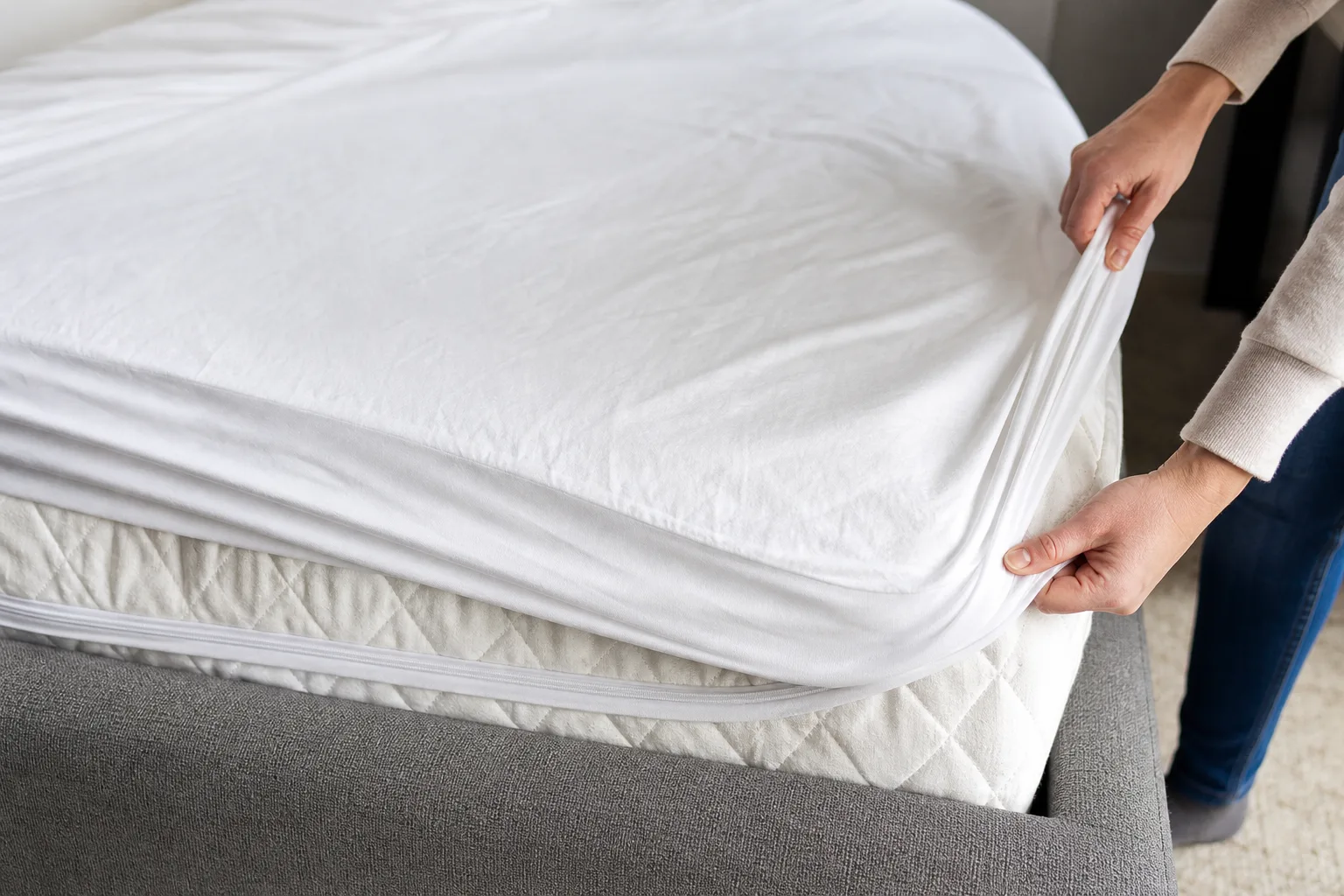
If your waterproof mattress protector makes your fitted sheet slip, the most likely causes are a smooth contact surface, the wrong fitted-sheet pocket depth, loose fabric or weak elastic. Start by identifying whether the protector is moving on the mattress, the sheet is moving over the protector, or the sheet corners are being pulled off. The right fix depends on that distinction; adding clips or buying a deeper sheet without diagnosing the movement can make the problem worse.
Why a waterproof protector can change sheet fit
A fitted sheet stays in place through a combination of surface friction, fabric tension, elastic recovery and sufficient fabric tucked beneath the mattress edge. Adding a protector changes that system. It may introduce a smoother surface, increase the height of the sleep stack or create loose folds that travel as the sleeper turns.
Surface friction depends on more than fiber content
“Cotton,” “waterproof” and “soft touch” do not provide measurable information about grip. Fabric friction can vary with fiber, yarn construction, weave or knit structure, surface texture and finish. Historical laboratory work from the National Bureau of Standards, now NIST, demonstrated that smoothness and finishing treatments can alter fabric friction. That research was not a test of modern mattress protectors, but it supports the practical point that two products labeled with the same principal fiber can behave differently against a sheet. NIST fabric-friction research
A cotton-faced protector is therefore not automatically grippy. The face may be woven, knitted, brushed, printed, softened or mechanically smoothed. CottonWorks notes that finishing can change a textile’s hand, appearance and performance, while mechanical processes such as calendering can create a smoother surface. CottonWorks on chemical finishing A cotton face also does not itself explain the waterproof function, which may be supplied by a separate coating or laminated layer described in the product specifications.
The protector adds depth to the bed
A protector may add only modest thickness when lying flat, but quilted padding, thick seams and wrinkles can increase the effective depth around the corners. A fitted sheet that previously fit the bare mattress may then have too little fabric beneath the lower edge. Sleeper movement pulls the shallowest corner upward until the elastic clears the mattress.
An excessively deep sheet can also move. Instead of maintaining even tension, it may leave slack under the mattress or across the sleep surface. That slack can bunch and migrate even though the corners do not immediately pop off.
Loose layers transmit movement
If the protector’s skirt is oversized, its elastic is tired or the protector has not been centered, it can slide independently of the mattress. The fitted sheet may appear to be the problem while actually following a moving protector. A smooth mattress cover beneath the protector can contribute to the same layered movement.
First identify which layer is slipping
Strip the bed and rebuild it one layer at a time. This takes a few minutes and is more informative than judging the bedding after a full night of movement.
Test the protector by itself
- Center the protector on the bare mattress and align all four corners.
- Smooth the top without stretching it sharply.
- Press a flat hand near the center and push sideways with moderate pressure.
- Repeat near each corner and edge.
If the protector shifts, wrinkles or pulls its skirt upward, correct that layer before evaluating the sheet. Check for an oversized skirt, damaged elastic, uneven corner placement or a protector that no longer matches the mattress depth.
Add the fitted sheet
Fit opposite corners rather than working around the bed in a circle. Smooth the sheet, then inspect the amount tucked below each mattress edge. The tension should feel reasonably even. A corner that barely reaches underneath suggests insufficient depth; large folds beneath the mattress suggest excessive depth or an oversized sheet.
Mark the problem corner temporarily with a removable fabric clip placed away from the sleep surface. If the same corner repeatedly releases, inspect that corner’s elastic, seam and mattress geometry. If the problem moves from side to side, general slack or low surface friction is more likely.
Diagnostic checklist
| What you observe | Likely issue | First action |
|---|---|---|
| One corner repeatedly pops off | Shallow pocket, weak local elastic or poor corner alignment | Measure the full mattress stack and inspect that corner seam |
| All corners stay on, but the center bunches | Excess sheet fabric or low friction at the contact surface | Retension the sheet and check whether its pocket is too deep |
| Protector and sheet move together | The protector is shifting on the mattress | Refit or replace the loose protector before changing sheets |
| Sheet moves while protector stays flat | Sheet-to-protector friction or sheet sizing is the main issue | Correct pocket depth, then consider sheet-only suspenders |
| Slipping began after washing | Dimensional change, elastic damage or a changed surface finish | Compare present dimensions and follow both care labels |
| Fabric gathers mainly at the sides | Sheet width, protector width or skirt tension is mismatched | Recenter both layers and verify mattress width and depth |
Measure pocket depth instead of relying on mattress size
“Queen,” “king” or another nominal bed size describes length and width, not the complete depth that a fitted sheet must cover. Measure after placing every layer that will remain on the bed, including the waterproof protector and any separate topper or pad.
- Lay a rigid ruler or straight object across the top at a mattress corner.
- Measure vertically from that top line to the bottom edge of the mattress.
- Repeat at several corners because toppers and protectors may not sit evenly.
- Compare the largest measurement with the fitted sheet maker’s stated pocket range.
The sheet needs enough fabric to wrap around the side and remain beneath the mattress edge, but the package’s maximum pocket depth does not tell you how tightly that particular sheet will fit your bed. Elastic strength, corner shape, fabric construction and dimensional change after laundering also matter. For a more detailed method, see how to measure a mattress for a fitted sheet and how pocket depth can change after washing.
Cotton textiles can change dimensions during laundering, but the result is not determined by fiber name alone. Yarn, construction, processing, finishing and care conditions all influence dimensional stability. CottonWorks identifies these as important variables and notes that fit can be affected when a home textile shrinks or grows. CottonWorks on shrinkage and dimensional stability
Renter-safe fixes that do not alter the mattress
Refit and retension both layers
Remove both pieces rather than pulling at a single loose corner. Center the protector, smooth out folds and place its corners evenly. Install the fitted sheet over diagonally opposite corners, followed by the remaining pair. Run your hands from the center toward the edges so excess fabric is distributed rather than trapped in one area.
Use the correct pocket range
Replace a sheet that barely reaches under the mattress with one designed for the measured stack depth. If the current sheet is much deeper than necessary, a closer-fitting pocket can provide more useful tension. Do not assume that the deepest available pocket offers the most secure fit.
Consider sheet suspenders carefully
Sheet suspenders or corner straps can add tension without adhesives, screws or changes to rental furniture. Attach them to the fitted sheet rather than clipping through a waterproof protector or its membrane. Sharp or highly concentrated clips may puncture fabric, damage elastic or compromise the protector, so follow the accessory and protector manufacturers’ instructions. Disconnect the straps before lifting or rotating the mattress.
For information about built-in retention systems, compare 360-degree elastic and corner straps. Built-in elastic around the full perimeter may distribute tension more evenly, but no retention design compensates for a badly mismatched size.
Avoid improvised adhesive and rubber layers
Do not apply carpet tape, hook-and-loop adhesive or spray adhesive to a mattress or protector. Adhesives can leave residue, affect finishes and create warranty or rental-deposit problems. Generic shelf liner and rubberized mats are also uncertain choices: composition, dye transfer, odor, heat response and compatibility with mattress foams may not be disclosed. If you use a purpose-made bedding gripper, confirm that its maker states compatibility with both surfaces and test it in a concealed area.
Follow the protector’s care instructions
Heat that is acceptable for a cotton sheet may not be appropriate for a waterproof laminate, elastic skirt or bonded seam. Wash and dry each item according to its own label. Do not copy the sheet’s hottest permitted setting to the protector. If the cotton sheet has tightened after laundering, consult ways to limit cotton-sheet shrinkage and cotton-sheet washing guidance.
What to check when buying a replacement
Look beyond broad claims such as “non-slip,” “premium cotton” or “deep pocket.” Unless the seller provides a defined method and result, those terms do not quantify friction, fit or durability.
- Actual dimensions: Match mattress length, width and the measured depth of the complete stack.
- Retention design: Check whether elastic runs around the entire skirt or only at selected areas.
- Face construction: A textured knit or terry-like face may behave differently from a smooth woven face, but texture alone does not guarantee grip.
- Component description: Distinguish the textile face, waterproof layer, padding, skirt and elastic instead of treating the protector as one uniform material.
- Care limits: Confirm washing and drying instructions that are practical for your household.
- Return terms: Fit and surface interaction are difficult to predict from fiber content alone, so check the seller’s applicable return conditions before use.
For covered textile products sold in the United States, FTC guidance explains that labels generally identify fiber content, country of origin and the responsible manufacturer or marketer. Fiber disclosure helps verify whether a textile component contains cotton, polyester or another named fiber, but it is not a friction rating or proof that a protector will hold a particular sheet in place. FTC textile-labeling guidance See also how to verify cotton sheet labels.
When replacement is more sensible than adjustment
Replace the problem layer if its elastic remains slack after correct fitting, its seams are separating, the waterproof layer is peeling or cracked, or its dimensions no longer match the mattress. A protector that shifts on the bare mattress will continue to undermine the fitted sheet above it. Likewise, a sheet with permanently stretched elastic cannot create reliable edge tension.
If both items are sound, prioritize dimensional compatibility before changing fiber type. Cotton fiber can contribute absorbency and familiar hand, but it does not independently determine stretch, grip, waterproofing or fitted-sheet retention. Those outcomes belong to the complete product: yarn, fabric structure, finish, waterproof layer, pattern dimensions, elastic design and care history.
Frequently asked questions
Why does my fitted sheet slide on a waterproof mattress protector?
The protector may create a smoother contact surface, add enough depth to reduce the sheet’s under-mattress grip or move because its own skirt is loose. Excessively deep sheets can also slide because they lack useful tension.
Will deeper-pocket sheets stop slipping?
Only if the current sheet is too shallow. A pocket that is much deeper than the complete mattress stack can leave excess fabric and make bunching worse. Measure the mattress with the protector and topper installed before choosing a depth.
Can I put a non-slip mat between the sheet and protector?
Avoid improvised shelf liner, rubber mats and adhesive products because their compatibility, dye transfer and heat behavior may be unknown. If necessary, use only a purpose-made bedding gripper whose maker confirms compatibility with the mattress and protector.
Does a cotton-topped protector grip better?
Not necessarily. Friction depends on the face fabric’s yarn, construction, texture and finish as well as the sheet touching it. A cotton label identifies fiber content; it does not provide a grip rating.
How this guide was prepared
This guide is based on desk research into textile friction, fabric finishing, dimensional stability and U.S. textile-labeling guidance from NIST, CottonWorks and the Federal Trade Commission. The practical diagnostic sequence is a reasoned application of those principles to layered bedding. No mattress protector, fitted sheet or accessory was purchased, laboratory-tested or used in a product trial.
Sources and scope
- Coefficient of Friction of FabricsNational Bureau of Standards, hosted by NIST
Explains that textile surface friction and creeping vary with material, yarn construction, weave and finish; used as foundational rather than product-specific evidence.
Accessed 2026-10-17 - Shrinkage & SkewingCottonWorks
Describes dimensional change and the influence of fiber, yarn, construction, processing, finishing and laundering on textile fit.
Accessed 2026-10-17 - Threading Your Way Through the Labeling Requirements Under the Textile and Wool ActsFederal Trade Commission
Provides U.S. guidance on fiber-content, country-of-origin and responsible-business disclosures for covered bedding and textile products.
Accessed 2026-10-17
Questions & discussion
Share a question or a useful experience about this guide. Comments appear immediately. Your name and comment are public. Email is optional and stays private; reply emails are not enabled yet. Comment privacy.