
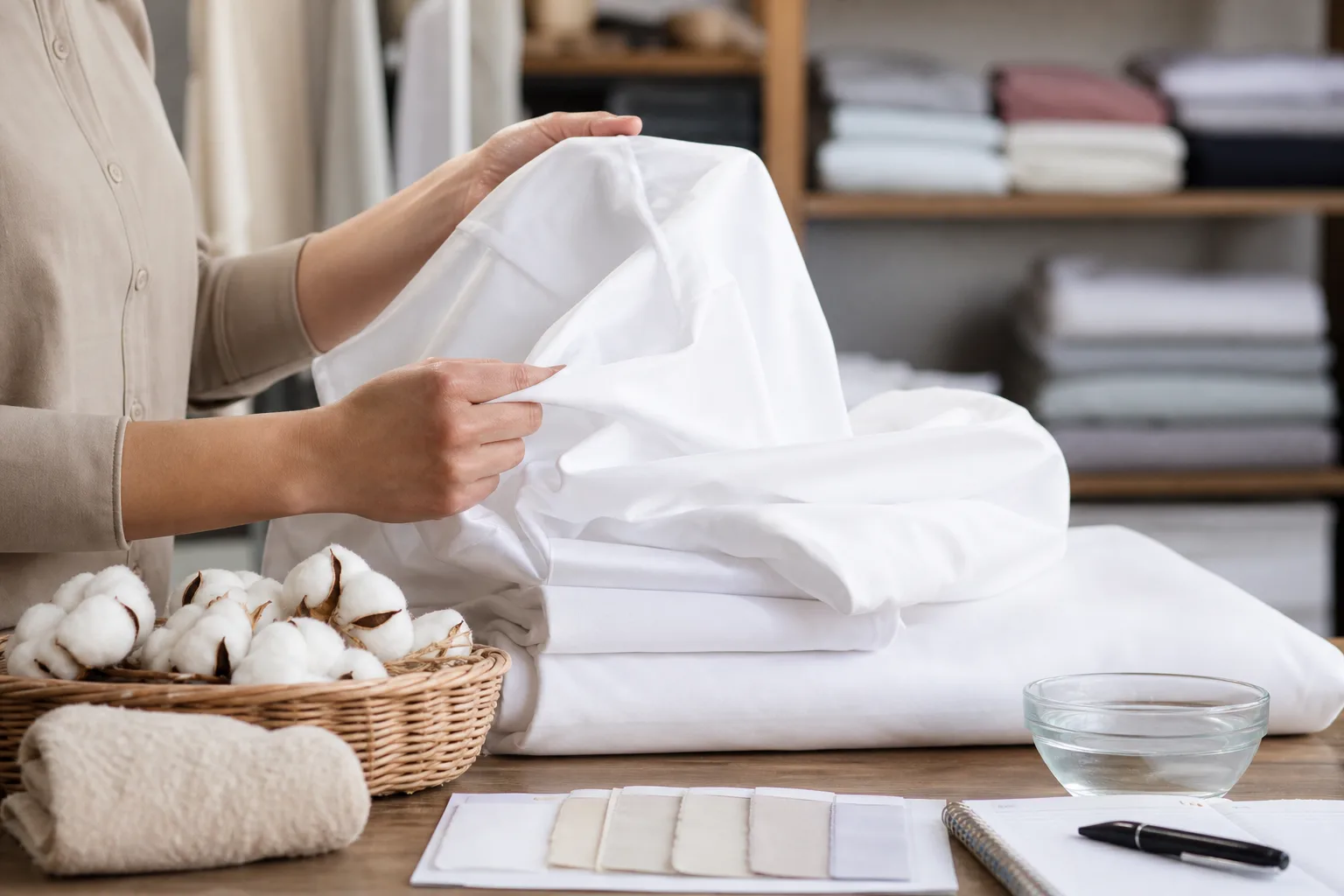
For cotton sateen sheets care, start with the instructions supplied for the specific product, then reduce avoidable rubbing and contact with zippers, hooks, burrs or other snag hazards. Do not apply a universal wash temperature, cycle or drying setting simply because a sheet is called sateen. Fiber content, yarn, fabric density, finishing, dyes and sewn components can all affect the permitted care procedure. The practical goal is to protect the smooth surface without treating the word sateen as proof of quality or guaranteed performance.
Quick Sateen Sheet Washing Checklist
- Read the product directions first. Gather the sewn label and supplied instructions; check the fiber declaration and the washing, bleaching, drying and ironing limits for each sheet or pillowcase.
- Build a compatible load. Keep exposed zippers, hooks, rough hardware and abrasive debris away from the sheets. Separate items with conflicting color-transfer requirements or care directions, and follow the appliance's load-size instructions.
- Remove avoidable friction and snag hazards. Check openings and corners for trapped objects. Do not drag wet sheets across rough surfaces; check the washer and dryer for rough edges or trapped objects if pulls recur.
- Wash within the supplied limits. Use a permitted cycle and temperature, compatible with the machine instructions. Treat stains only with an allowed method; do not assume a cotton-safe treatment suits every dye, print or finish.
- Dry only as permitted. Check for rough objects and entanglement before machine drying. If line drying is allowed, use a clean, smooth support. Cotton content alone does not justify the hottest or longest program.
Choose Settings From the Product Care Label
Choose among the product's permitted settings according to soil level, appliance instructions and the sheet's condition. Sateen is a weave name, not permission to use a universal temperature, spin speed or drying program. Follow the limits for the actual product.
Pause when directions are missing or conflict, or when surface damage keeps recurring. Do not escalate heat, chemicals or mechanical action to compensate. Recheck the label, appliance and load, and ask the seller or manufacturer for clarification. The checklist does not apply to a prohibited process; without reliable permission, do not use heat simply to restore sheen.
Identify sateen construction without turning it into a quality grade
Sateen describes a woven construction. CottonWorks explains that sateen uses a satin weave made with fibers other than silk. In a common filling-face sateen, longer sections of filling yarn appear on the fabric face before being interlaced again. These floats help create the smooth, light-reflective surface associated with sateen, but they can also present opportunities for picking or snagging. This is a structural distinction, not a verdict that every sateen sheet is delicate or that every percale sheet is more durable. CottonWorks describes satin and sateen weave structures and their surface characteristics.
The name alone does not disclose the complete specification. CottonWorks identifies fiber type, spinning system, yarn count, fabric weight, construction and finishing as interacting considerations in cotton sheeting. Its buying guide also notes that sufficient fabric construction is relevant to resistance to picking and snagging, while warning that thread count should not be treated as a stand-alone measure of quality. See the CottonWorks buying guide for cotton sheets.
Separate five kinds of product information
- Fiber: Check whether the sheet is 100% cotton or a blend. Fiber content does not identify the weave.
- Yarn: Staple length, spinning method, yarn size and ply may influence the fabric, but marketing language rarely supplies a complete yarn specification.
- Construction: Sateen identifies the weave arrangement. It does not establish a universal thread count, weight or service life.
- Finishing: Colorants and mechanical or chemical finishes may change appearance, hand and care limits.
- Claims: Words such as premium, luxury, cooling or hotel quality are not substitutes for measurable specifications or product-specific evidence.
If you are deciding between constructions rather than caring for sheets you already own, use the separate percale versus sateen comparison. The present guide is limited to observing and caring for a sateen surface.
Read the product limits before choosing a care action
Gather the sewn label, packaging, retailer instructions and manufacturer guidance that came with the sheets. Record the fiber declaration and every available instruction for washing, bleaching, drying and ironing. If sources conflict, do not silently choose the harsher method. Ask the responsible seller or manufacturer for clarification and preserve its response with the product record.
In the United States, Federal Trade Commission guidance lists bedding, including sheets and pillowcases, among household textile products covered by federal fiber-labeling requirements. The separate FTC Care Labeling Rule is directed to textile wearing apparel and certain piece goods, so it should not be cited as though it universally requires a permanent care label on every finished sheet. This distinction is important: fiber disclosure and care directions answer different questions. The FTC explains which household textiles are covered and what textile labels disclose.
Use the instruction as a boundary, not a performance promise
An allowed procedure means the supplier has represented that the procedure is suitable for the product. It does not promise that the surface will remain visually unchanged indefinitely. Conversely, the absence of a detailed instruction does not prove that every temperature, chemical or mechanical action is safe.
Avoid converting general cotton advice into a sateen prescription. “Wash cold,” “always use gentle,” “never tumble dry” and similar blanket rules may conflict with the actual product directions. Follow the stated limits and the operating instructions for your washer, dryer or iron. For general laundry sequencing rather than weave-specific precautions, see how to wash cotton.
Pre-care checklist
- Confirm the declared fiber content and that the product is described as sateen.
- Photograph or transcribe the instructions before they fade or become detached.
- Check whether the fitted sheet, flat sheet and pillowcases share the same directions.
- Note explicit prohibitions, including bleach or ironing warnings.
- Record whether decorative trims, elastic, prints or contrasting colors are present.
- Choose only a wash, dry or iron option permitted by the supplied instructions.
Reduce avoidable friction and snagging within those limits
Abrasion is surface loss caused by friction with the fabric itself or another material. CottonWorks notes that abrasion depends on factors including the contacting material, force, tension, direction and whether the textile is wet or dry. That does not establish a home-laundry guarantee, but it supports a sensible operating principle: remove obvious sources of unnecessary rubbing and catching when doing so remains compatible with the product and appliance instructions. CottonWorks summarizes abrasion, pilling and the interacting factors behind textile durability.
Build a compatible load
- Keep exposed zippers, hooks, hook-and-loop fasteners and rigid decorative hardware out of the load.
- Do not wash sateen sheets with items carrying abrasive debris, sharp fragments or rough attached parts.
- Close compatible fasteners on items that must share the load, provided their own instructions allow it.
- Use an appliance load size that allows operation according to the machine manual; do not force bulky sheets into an overloaded drum.
- Inspect the washer and dryer for a damaged drum, rough edge or trapped object if unexplained pulls repeatedly appear.
Sorting by snag risk is different from claiming that sateen must always be washed alone. A smooth, compatible textile may present less obvious snag risk than an item with metal hardware, but color-transfer requirements and the instructions for every item in the load still apply. When those requirements conflict, use separate loads rather than improvising an unsupported compromise.
Handle the surface deliberately
Before loading, remove objects that could catch the fabric and check pillowcase openings and fitted-sheet corners for trapped items. Avoid dragging wet sheets across rough floors, unfinished shelving or damaged baskets. During bed making, investigate recurring contact with sharp bed-frame edges, rough hardware, pet claws or broken nails if pulls appear in a consistent location.
These steps limit identifiable hazards; they do not prove that snagging will not occur. A sheet's response also depends on its yarns, density, finishing, prior damage and use history. Do not diagnose a manufacturing defect from a single loose yarn without inspecting the location and context.
Choose washing, drying and ironing actions without universal settings
Use the temperature, cycle, bleach, drying and ironing boundaries supplied for the particular sheet. If several permitted options are available, choose among them according to the soil level, appliance directions and the condition of the sheet. This guide does not rank detergents or prescribe an unverified “best” cycle for all cotton sateen.
Washing and stain treatment
Address stains using a method allowed by the product instructions. Do not assume that a fiber-safe product is automatically safe for every dye, print or finish. If the instructions recommend testing a treatment in an inconspicuous area, follow that direction and document the result. Keep concentrated laundry products from sitting directly on the fabric unless their directions specifically call for direct application.
Drying
Use only an allowed drying method and setting. Before machine drying, check that the drum is free of rough objects and that the sheet is not entangled around incompatible hardware from another item. If line drying is permitted, use a clean, smooth support rather than a rusty, splintered or sharp contact point. Do not infer that the hottest or longest available program is suitable merely because the fabric contains cotton.
Ironing
Iron only when the product instructions permit it, using no more than the stated temperature. Check the soleplate and ironing surface for residue or roughness before making contact. A smooth visual finish is an appearance preference, not evidence that ironing improves durability. If ironing is prohibited or no reliable instruction is available, do not use heat simply to restore the original sheen.
Observe surface appearance without inventing a test result
Home observation can identify when and where a change appeared, but it cannot by itself establish laboratory performance or assign a single cause. CottonWorks describes pilling as a complex property influenced by fiber or blend, fiber dimensions, yarn and fabric construction, finishing and end use. Pills may occur with fuzzing, color change or loss of cover, and should not automatically be classified as snag damage. Learn more about the distinction in the guide to cotton pilling.
Use repeatable descriptive language
- Pull or snag: A yarn or loop appears displaced after catching or concentrated contact.
- Fuzzing: Fine fiber ends become more visible across an area.
- Pilling: Small entangled fiber balls remain attached to the surface.
- Sheen change: Reflection looks more matte, uneven or polished in a defined area.
- Color change: A local or general difference appears, without assuming whether its cause is dye loss, residue, abrasion or lighting.
Inspect in similar lighting, from the same side of the sheet and at roughly the same distance. Record the date, location and preceding care action. A photograph can support comparison, but lighting and camera processing can alter apparent color and gloss. Do not label the record a test certificate, abrasion rating or professional inspection.
If a change repeats, stop escalating the care process. Recheck the label, appliance and load composition, then contact the seller or manufacturer when clarification is needed. Preserve receipts, instructions and dated photographs if you intend to make a product inquiry.
Copy the blank cotton sateen care record
Use this record to connect each decision to the product instruction and to document observations without filling gaps from memory. Leave a cell empty when information or evidence is unavailable.
| Care / observation | Product instruction | Friction/snag check | Chosen permitted action | Surface observation / date | Follow-up |
|---|---|---|---|---|---|
| Fiber/blend and weave declaration | |||||
| Compatible wash load | |||||
| Allowed wash cycle | |||||
| Allowed drying and ironing | |||||
| Surface changes / snag evidence |
Copy the blank record above and complete it with your own dated evidence. The template is an observation aid, not a laboratory protocol, certification, warranty decision or substitute for the manufacturer's instructions.
What this guidance can and cannot establish
This page translates published construction, labeling and textile-durability information into a cautious household workflow. No sheets were purchased, laundered or compared for this article. No laboratory abrasion, snagging, pilling, shrinkage or colorfastness testing was performed. The guidance therefore does not predict a product's service life, validate marketing claims or determine whether a specific surface change is a manufacturing defect.
Frequently asked questions
Should cotton sateen sheets always be washed on a gentle cycle?
No universal cycle applies to every cotton sateen sheet. Use a cycle permitted by the product instructions and compatible with the washer manual. Sateen identifies a weave, while yarn, density, finishing, dyes, elastic and other components can change the appropriate care limits.
Can cotton sateen sheets be washed with towels?
Do not decide by product category alone. Build a load around the instructions, color-transfer requirements and snag risks of every item. Separate the sheets when another item has exposed zippers, hooks, rough hardware, abrasive debris or conflicting care directions.
Does a snag mean the sheet is poor quality?
Not by itself. Record where the snag appeared and check for sharp hardware, appliance damage, rough storage surfaces or other contact hazards. Construction and processing also affect snagging, so one observation cannot establish product quality or assign a cause.
Are pills and snags the same surface problem?
No. A snag generally involves a displaced yarn or loop after catching, while a pill is a small ball of entangled fibers attached to the surface. Fuzzing, sheen changes and color changes are also distinct observations and may have multiple causes.
How can I track changes in a sateen sheet's surface?
Record the product instruction, load composition, permitted action, date and location of each change. Compare the same side of the sheet under similar lighting. Photographs can support a record, but they do not create a laboratory rating or prove why a change occurred.
How this guide was prepared
This article is based on desk research completed on 2026-10-09 using CottonWorks technical material on sateen construction, sheeting and textile durability, plus Federal Trade Commission guidance on United States textile labeling. No product trial, laundering cycle, laboratory test, factory visit, certification review or professional inspection was performed. Recommendations are limited to label-led care, removal of identifiable friction and snag hazards, and honest dated observation.
Sources and scope
- A Buying Guide for Cotton SheetsCottonWorks by Cotton Incorporated
Cotton sheeting construction context, the multiple factors that influence fabric performance, sateen surface considerations and limits of thread count as a stand-alone quality indicator.
Accessed 2026-10-09 - Basic Woven Fabric DesignsCottonWorks by Cotton Incorporated
Definition of sateen as a satin-design fabric made with fibers other than silk, filling-face floats, smooth surface characteristics and structural susceptibility to picking or snagging.
Accessed 2026-10-09 - Garment DurabilityCottonWorks by Cotton Incorporated
Definitions and limitations concerning abrasion, pilling, surface appearance and the interacting material and processing factors behind durability.
Accessed 2026-10-09 - Threading Your Way Through the Labeling Requirements Under the Textile and Wool ActsFederal Trade Commission
United States textile fiber-labeling context, including the inclusion of bedding and sheets among covered household textile products.
Accessed 2026-10-09
Questions & discussion
Share a question or a useful experience about this guide. Comments appear immediately. Your name and comment are public. Email is optional and stays private; reply emails are not enabled yet. Comment privacy.