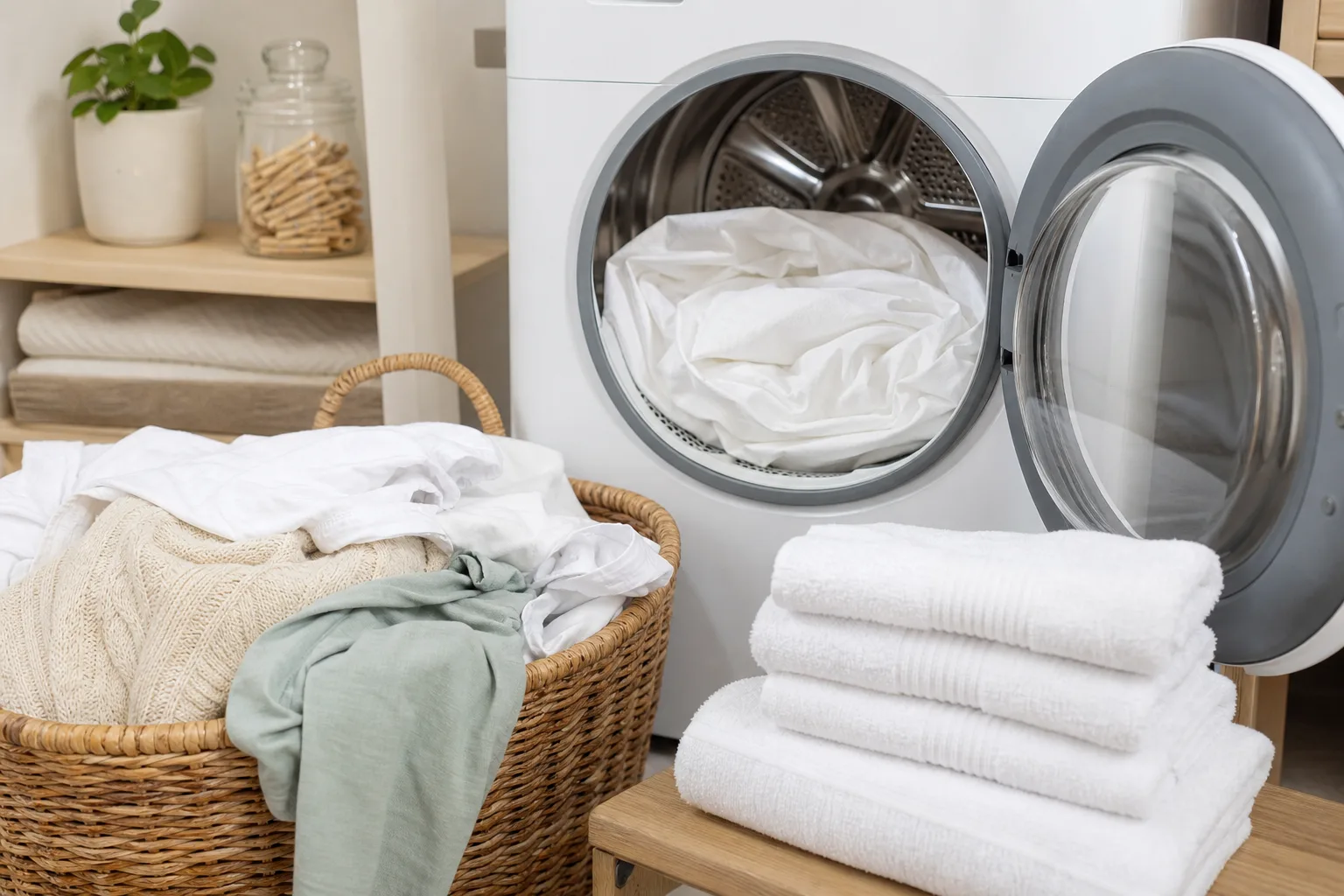
To dry cotton clothes safely, start with the care label, reshape the item while damp and use the lowest-impact method allowed by the manufacturer. Air drying is a cautious option for many everyday cotton garments, while tumble drying can be suitable when the label permits it. If you use a machine, select the stated cycle and temperature, avoid overdrying and remove the load promptly. Do not assume every product marked “100% cotton” should be dried the same way: yarn, fabric construction, applied finishes, elastic, trims and garment design can all change the correct method.
Quick method: how to dry cotton clothes
- Read the entire care label. Look for “tumble dry,” a temperature or cycle instruction, “line dry,” “drip dry,” “dry flat” or a prohibition such as “do not tumble dry.” In the United States, the FTC Care Labeling Rule requires covered apparel labels to identify machine drying or another drying method. If machine drying is specified, the label must state a safe temperature unless regular high-temperature drying will not harm the product.[1]
- Check the whole product, not only the fiber percentage. A cotton garment may include elastic, interfacing, printed decoration, coatings, padding, zippers or synthetic sewing thread. The safest instruction accounts for the assembled item.
- Remove excess water without aggressive wringing. Let the washer complete its approved spin cycle. For hand-washed items, press water out gently or roll the item in a clean towel if its construction is easily distorted.
- Reshape while damp. Smooth collars, cuffs, hems, seams and plackets. Bring a knit garment back toward its intended dimensions without pulling it beyond shape.
- Choose the label-approved method. Use a rack, line or flat surface for natural drying, or the specified tumble-dryer cycle and heat setting.
- Dry completely, but not longer than necessary. Remove machine-dried clothing promptly. Allow air-dried waistbands, seams, pockets and layered areas to become fully dry before folding or storage.
| Label direction | Practical action | Main caution |
|---|---|---|
| Tumble dry low | Use low heat and remove the item when dry | Do not substitute medium or high heat |
| Tumble dry medium | Use no more than medium heat | A lower setting may take longer but should still follow any cycle instruction |
| Line dry or hang to dry | Hang with enough space for air circulation | Support heavy items so they do not stretch |
| Dry flat | Lay the item on a clean, ventilated surface and reshape it | Do not hang a heavy knit unless another instruction permits it |
| Do not tumble dry | Use the natural-drying method indicated on the label | Do not use a short dryer cycle as a substitute |
Why cotton can change during drying
Cotton fiber absorbs water
Cotton is a cellulosic fiber with internal pores and capillary spaces that can take in moisture. During washing, absorbed water allows the fiber and yarn assembly to swell. As the material dries, the fibers deswell and the yarns and fabric structure can relax into different dimensions. Learn more about this behavior in our guides to cotton fiber structure and moisture absorption.
Tumbling adds mechanical action while the wet structure is relaxing. CottonWorks describes tumble drying under unrestricted conditions as a process that can allow available residual drying shrinkage to occur. Natural line or flat drying generally applies less tumbling action, although it cannot reverse shrinkage or dimensional instability already built into the product.[2]
Fiber content does not predict the complete result
“Cotton” identifies a fiber, not a guaranteed shrinkage percentage, drying speed or care method. Dimensional performance also depends on yarn type, knit or woven construction, processing tension, compaction, preshrinking, chemical finishing, garment pattern and laundering conditions. A loose cotton knit, a densely woven shirt and a loop-pile towel may therefore respond differently even when all three carry a 100% cotton label.
For manufacturers and buyers, drying performance should be assessed on representative finished products using the intended laundering procedure. Raw-fiber measurements or marketing expressions such as “premium cotton” do not establish the dimensional stability, surface appearance or drying requirements of a finished garment. CottonWorks notes that laundering and drying can affect shrinkage, smoothness, color, fuzzing and pilling, which are separate quality characteristics requiring appropriate evaluation.[3]
How to air-dry cotton safely
Air drying avoids machine tumbling and dryer heat for that load. It is often useful when you want a cautious method, but it is not automatically correct for every item. Follow a specific instruction such as “dry flat” rather than replacing it with ordinary hanging.
For woven shirts, pants and dresses
- Shake the item gently and smooth the seams before hanging.
- Use a shaped hanger for a shirt or dress if the label allows hanging.
- Align collars, button bands, cuffs and pocket flaps while damp.
- Hang pants evenly from the waistband or use a line arrangement that does not create a deep fold.
- Leave space between items so air can reach both sides.
For T-shirts and other knits
Wet knits can distort under their own weight. A lightweight, stable T-shirt may be hung over a rack, but a heavier or loosely knitted item is usually better supported flat when the label allows it. Smooth the body, square the side seams and return the neckline and sleeves toward their original shape. Do not pull the garment longer in an attempt to remove wrinkles. See our cotton T-shirt guide for construction factors that affect everyday performance.
For flat drying
Place the item on a clean mesh rack or a dry, colorfast towel on a ventilated surface. Arrange it without sharp folds, turn it if the underside remains damp and replace a saturated supporting towel when necessary. Flat drying is a method of supporting shape; it is not a claim that the product cannot shrink.
Outdoor drying
Use a clean line and secure items without stretching them. Turn printed or strongly colored garments inside out if permitted by the care instructions, and avoid leaving dry clothing exposed longer than necessary. Pollen, dust, weather and local air quality may make indoor rack drying more suitable for some households.
How to tumble-dry cotton safely
Use a tumble dryer only when the care label permits it. The exact wording matters: “tumble dry low,” “delicate,” “permanent press” and unrestricted “tumble dry” are not interchangeable instructions. Consult the appliance manual if cycle names do not clearly indicate their heat and mechanical-action settings.
Prepare the load
- Separate lightweight garments from heavy towels or bedding when practical. Mixed weights often finish drying at different times.
- Close zippers and fastenings when directed, and turn decorated garments inside out if their instructions recommend it.
- Do not pack the drum so tightly that items cannot move and release moisture.
- Clean the lint filter according to the dryer manufacturer’s instructions.
Select heat and cycle
Never exceed the labeled temperature. If low heat is specified, high heat is not a faster equivalent. Where the label allows a choice, a lower-temperature cycle offers a cautious starting point, but it may require more time. Cycle choice also matters because tumbling contributes mechanical action; heat alone is not the only factor involved in dimensional change.
Stop at the right time
Check the load near the end of the expected cycle. Remove items when dry rather than repeatedly extending the cycle. Prompt removal also gives you an opportunity to shake out garments, smooth seams and hang or fold them before deep wrinkles set. If thick seams or pockets remain damp, continue with a label-approved low-impact method instead of exposing the entire load to unnecessary additional drying.
People particularly concerned about fit can combine methods when the label permits both: use a brief approved tumble cycle to remove part of the moisture, then reshape and finish on a rack or hanger. This is a practical compromise, not a guarantee against shrinkage. For a fuller explanation of dimensional change, visit how to prevent cotton shrinkage.
Adjust the method to the product
| Product | Suggested approach when the label allows it | What to watch |
|---|---|---|
| Cotton T-shirts | Low-heat tumble drying or supported air drying | Neckline distortion, side-seam twisting and changes in length |
| Woven shirts | Remove promptly and hang after tumble drying, or hang while damp | Wrinkles at collars, cuffs and plackets |
| Jeans and heavy pants | Air dry with the waistband supported, or use the approved machine setting | Slow-drying pockets, waistbands and heavy seams |
| Towels | Use the labeled tumble cycle or hang with ample airflow | Heavy loads, uneven drying and overdrying lighter pieces |
| Sheets | Use an adequately sized dryer or line arrangement with room to unfold | Twisting, trapped damp areas and excessive wrinkling |
| Baby clothes | Follow the label for the complete item and dry fully before storage | Elastic, prints, snaps, layered sections and flame-resistant sleepwear instructions |
| Embellished garments | Prefer the method and temperature specified for the decoration and garment | Prints, adhesives, sequins, coatings and non-cotton trims |
Product-specific guidance can help you interpret construction differences. See our buying pages for cotton towels, cotton bed sheets and cotton baby clothes. These categories should not be assigned one universal dryer setting: labels and product design remain decisive.
Common drying mistakes
Assuming high heat is always safe for cotton
Cotton fiber does not melt like a thermoplastic fiber, but that does not make high heat safe for every cotton product. Heat-sensitive elastic, finishes, prints and trims may be present, and mechanical relaxation can change garment dimensions. Use the product instruction rather than a rule based only on fiber content.
Treating “preshrunk” as “shrink-proof”
Preshrinking or compaction can reduce residual dimensional change, but the term does not promise zero change under every washing and drying condition. Compare the label with fit requirements and any substantiated dimensional specification provided by the seller.
Hanging heavy knits from narrow points
A wet sweater or dense knit can lengthen where it is supported. If flat drying is allowed, distribute its weight over a broad surface. If hanging is required, use support that does not concentrate the load at the shoulders or hem.
Folding before thick areas are dry
Waistbands, hems, pockets, hoods and multilayer seams may retain moisture after the main fabric feels dry. Check these areas before placing the item in a drawer or closed container.
Using sustainability language as a performance guarantee
A lower-impact care choice and a durable product are worthwhile goals, but terms such as “eco,” “natural” or “sustainable cotton” do not specify a safe drying temperature or prove shrinkage resistance. Air drying eliminates machine-dryer use for that load; however, the best practical routine should also respect the care label and preserve the item’s usability. Avoid unsupported claims about energy savings or garment life unless the relevant conditions and evidence are stated.
A final drying checklist
- Have you read the drying instruction and warning symbols?
- Does the item contain elastic, decoration, lining or other non-cotton components?
- Have you reshaped seams, collars and hems while damp?
- Are you using no more heat or mechanical action than the label allows?
- Can air circulate around the whole item?
- Have you checked thick and layered areas for retained moisture?
- Did you remove the item promptly when drying finished?
The central rule is simple: treat the care label as the product-specific instruction and cotton fiber science as the explanation, not as a substitute. For more guidance, visit the cotton care hub or learn how to assess cotton product quality without relying on marketing language alone.
Frequently asked questions
Is it better to air-dry or tumble-dry cotton clothes?
Use the method stated on the care label. Air drying avoids dryer heat and tumbling, while machine drying may be appropriate for products engineered and labeled for it. Construction, finishing and garment components matter as much as the cotton fiber content.
What dryer setting should I use for cotton?
Use the cycle and temperature printed on the care label. If it says tumble dry low, do not substitute medium or high heat. An unrestricted tumble-dry instruction has a different meaning from a temperature-limited instruction.
Does low heat prevent cotton from shrinking?
Low heat can be a cautious choice when permitted, but it cannot guarantee zero shrinkage. Moisture, tumbling, fabric relaxation, construction and previous finishing can all influence dimensional change.
Can I hang every cotton garment to dry?
No. Heavy or loosely constructed knits may stretch when hung and may need to dry flat. Follow any specific line-dry, hang-dry or flat-dry instruction and support the item without distorting it.
Does 100% cotton mean an item can be tumble-dried?
No. A 100% cotton fiber-content label does not establish the drying method. The finished product may have heat-sensitive finishes, prints, elastic or trims, so its care label remains the controlling instruction.
How this guide was prepared
This page is based on desk research of the current FTC Care Labeling Rule and CottonWorks technical material about cotton shrinkage, dimensional stability and appearance testing. The guidance translates those sources into cautious consumer and industry steps. No garments were purchased, laboratory-tested, tumble-dried or air-dried for this article, and no first-hand product trials, factory visits or certification assessments are claimed.
Review status: Publishable quality advisory.
Sources and scope
- Care Labeling of Textile Wearing Apparel and Certain Piece Goods, 16 CFR Part 423Federal Trade Commission
Current U.S. requirements for drying instructions, machine-drying temperatures, warnings and evidence supporting care labels.
Accessed 2026-10-04 - A Guide to Improved Shrinkage Performance of Cotton FabricsCottonWorks
Technical explanation of cotton swelling, deswelling, mechanical action, drying shrinkage and the influence of tumble, line and flat drying.
Accessed 2026-10-04 - Quality Testing: Care and AppearanceCottonWorks
Industry context for assessing dimensional stability, smoothness, color change, fuzzing and pilling after laundering and drying.
Accessed 2026-10-04