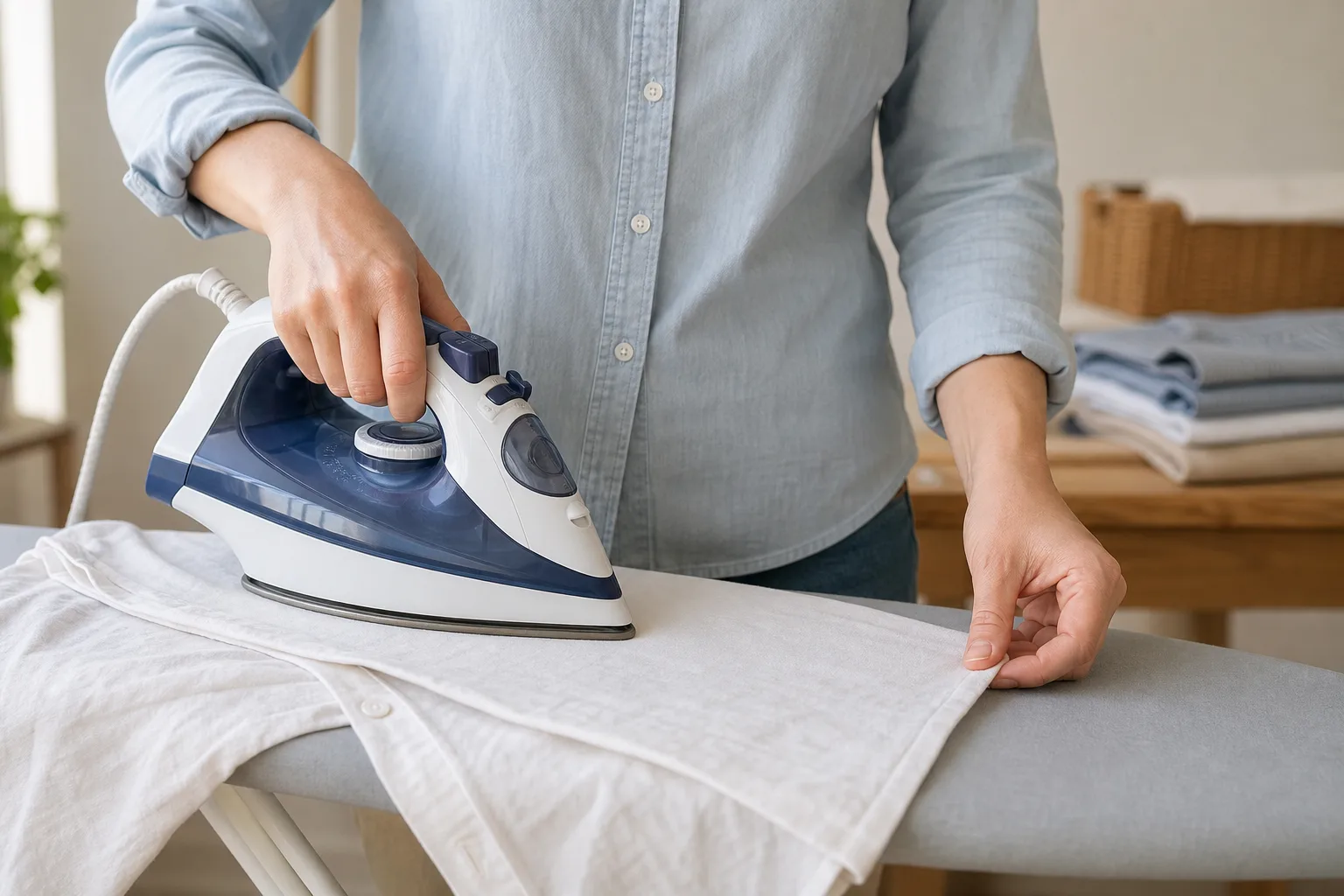
To iron cotton safely, check the care label, turn the item inside out when its color or surface needs protection, and iron while the fabric is slightly damp. Use the labeled temperature, beginning below the maximum if you are uncertain, and increase the heat only when wrinkles remain. Plain, uncoated 100% cotton often tolerates a hot iron, but blends, prints, wrinkle-resistant finishes, interlinings and decorative components may require less heat or no ironing at all.
Check the cotton item before switching on the iron
A fiber-content label stating “100% cotton” describes the fiber, not the complete performance of the product. The yarn, woven or knitted construction, dye, print, finish, seams, elastic, interfacing and decoration can all affect how an item responds to heat, steam and pressure.
Read the permanent care label first. In the United States, the Federal Trade Commission requires covered apparel manufacturers and importers to provide regular care instructions and warnings supported by a reasonable basis. If ironing is specified, the label must communicate a usable temperature unless regular use of a hot iron will not harm the product. A warning such as “Do not iron,” “No steam” or “Iron wrong side only” overrides general advice for cotton fiber. [1]
Inspect more than the main fabric
- Fiber composition: A cotton-polyester, cotton-elastane or other blend should be treated according to the care label and the most heat-sensitive component.
- Prints and transfers: Screen prints, heat transfers, metallic effects and surface coatings may soften, shine, stick or distort under direct heat.
- Structure: Collars, cuffs, waistbands and tailored areas may contain synthetic interfacings even when the outer fabric is cotton.
- Finish: Easy-care, wrinkle-resistant, water-repellent and other finishes can change the appropriate care procedure. A marketing term does not establish a measurable ironing temperature.
- Condition: Do not iron over stains. Heat can make some residues more difficult to remove. Use the appropriate stain-removal method first.
Choose the right temperature and moisture
Cotton has relatively low elastic recovery, which helps explain why many cotton products retain creases after wear or laundering. Moisture and heat make it easier to reshape the fabric, while cooling allows the pressed area to settle. CottonWorks technical material reports that cotton can be ironed at high temperatures, but also notes that prolonged exposure to dry heat above 150°C or 300°F gradually decomposes the fiber. This is why controlled contact, movement and attention to the finished product matter more than simply selecting the hottest setting. [2]
The FTC’s care-symbol chart associates one dot with a maximum of 110°C or 230°F, two dots with 150°C or 300°F, and three dots with 200°C or 390°F. These are maximum temperatures, not targets that every iron reaches with equal accuracy. Thermostat behavior, soleplate design and setting names vary, so follow the appliance instructions as well as the textile label. [3]
| Care instruction | Maximum indicated temperature | Practical approach |
|---|---|---|
| Do not iron | None | Do not use contact heat. Try hanging the item promptly after washing if its other care instructions permit. |
| Cool iron or one dot | 110°C / 230°F | Use low heat, brief contact and no steam if the label also prohibits steam. |
| Warm iron or two dots | 150°C / 300°F | Use medium heat. Iron on the reverse where shine, print damage or color change is a concern. |
| Hot iron or three dots | 200°C / 390°F | Use high heat only when the entire item and its label permit it. Keep the iron moving. |
| Iron with no temperature stated | Check the applicable label wording | Under the FTC glossary, “Iron” without a temperature means the highest setting may regularly be used. If the item is unfamiliar or has special details, begin lower and test an inconspicuous area. |
Why slightly damp cotton is easier to iron
Cotton absorbs moisture, so a small amount of water can help relax a stubborn crease and reduce the time spent applying dry heat. For more detail, see how cotton’s structure relates to moisture absorption. Iron the item before it is completely dry, use the iron’s steam function when permitted, or lightly mist a small area and distribute the moisture evenly. The fabric should feel damp rather than saturated.
How to iron cotton step by step
- Read the full label. Confirm the fiber content, ironing instruction and any warnings concerning steam, the reverse side or direct contact.
- Prepare a stable surface. Use a padded ironing board or another firm, heat-safe surface. Arrange the cord so it cannot catch the item or pull the iron.
- Check the soleplate. It should be clean. Residue can transfer to pale fabric or drag across a print.
- Sort by temperature. If ironing several items, begin with low-temperature fabrics and progress to hotter settings. An iron takes longer to cool than to heat.
- Turn vulnerable surfaces inward. Iron dark colors, printed areas, embroidery and fabrics prone to shine from the wrong side. Where necessary, place a clean cotton pressing cloth between the iron and the item.
- Add controlled moisture. Use steam or a fine mist only if permitted. Allow sprayed water to spread through the fabric before pressing to avoid localized wet marks.
- Work in sections. Smooth each area by hand, then move the iron steadily in the direction of the fabric rather than scrubbing rapidly back and forth.
- Use pressure selectively. Press seams, hems and collars without leaving the soleplate stationary. Lift and reposition the iron around pleats or shaped sections instead of dragging them out of alignment.
- Let the item cool. Place a garment on a hanger or lay household textiles flat for a few minutes. Folding warm fabric can create new creases.
A useful order for cotton shirts
For a button-front shirt, start with the inside and outside of the collar, followed by the cuffs and sleeves. Continue with the shoulder area, front panels and back. Iron around buttons from the reverse rather than placing the soleplate directly over them. This sequence handles small, structured parts before the larger panels become re-creased.
Adjust the technique for different cotton products
There is no single setting for every cotton item because fabric construction and finishing influence wrinkle behavior. Raw cotton measurements such as staple length, length uniformity, strength and micronaire help mills manage processing and yarn quality, but they do not serve as consumer ironing instructions. CottonWorks and USDA classing resources describe these as properties of raw cotton used in marketing and manufacturing—not as a substitute for the finished product’s care label. [4] [5]
Woven shirts, dresses and trousers
Poplin, broadcloth, oxford cloth and twill commonly respond well to moisture and firm pressing, provided the label allows it. Iron around seams rather than stretching across them. Dark trousers and other smooth fabrics may develop visible shine under excess heat or pressure, so work from the reverse or use a pressing cloth.
Cotton T-shirts and other knits
Many knits need little or no ironing if they are reshaped and dried promptly. If ironing is needed, avoid pulling the fabric lengthwise or sideways because this can distort the garment. Press rather than stretch, and never place the iron directly on a graphic unless its instructions expressly allow contact heat. Product construction and finishing can matter as much as the cotton percentage when choosing cotton T-shirts.
Denim, canvas and heavy twill
Thick fabrics may need more moisture, pressure or passes rather than a long stationary application of heat. Work on small sections and pay attention to raised seams, which can leave impressions on the opposite face. Turn dark or coated denim inside out to reduce surface marking.
Cotton sheets and pillowcases
Iron sheets while slightly damp, folding or arranging them into manageable panels without pressing permanent creases where they are not wanted. A smooth percale and a lustrous sateen can respond differently because their weave structures are different; learn more in the guide to percale versus sateen. The weave name alone still does not replace the care label. For broader purchase considerations, see the cotton bed-sheet guide.
Avoid common ironing damage
- Scorching or yellowing: Reduce the temperature, shorten contact time and keep the iron moving. A maximum fiber temperature is not permission to hold a hot soleplate in one place.
- Shine: Iron from the reverse, reduce pressure and use a pressing cloth on dark, smooth or raised surfaces.
- Flattened texture: Do not press directly onto embroidery, seersucker, corded fabrics or textured decoration. Use a padded surface and work from the reverse when appropriate.
- Water spots: Test misting on an inconspicuous area and avoid uneven droplets. Follow the iron manufacturer’s instructions about suitable water.
- Distortion: Lift and place the iron instead of dragging knitted fabric or bias-cut sections.
- Print transfer: Keep the soleplate away from transfers, plasticized prints and coated surfaces. Use the reverse side and low heat only when the label permits ironing.
If you do not have the label, start with a clean, inconspicuous area on the reverse at a low or medium setting. Increase heat gradually only if needed. Stop if the fabric changes color, develops shine, sticks to the soleplate or produces an unusual odor. For an item with unknown coatings, bonded layers or sentimental value, professional advice is safer than experimentation.
Reduce wrinkles before ironing
Good washing and drying habits can reduce the amount of pressing required. Avoid overloading the washer, use a suitable spin and drying procedure, and remove cotton items promptly at the end of the cycle. Shake out garments, straighten seams and smooth large panels by hand before hanging or laying them flat. Consult the item’s instructions alongside the guides to washing cotton, drying cotton and preventing cotton shrinkage.
Iron only the areas that need it and group compatible items so the appliance does not have to heat repeatedly. These are practical resource-saving habits, not proof that a product is environmentally preferable. Sustainability claims require a defined comparison, evidence and scope; neither “natural” nor “easy care” by itself measures the total impact of a textile product.
The central rule is simple: treat the care label as the product-specific instruction and cotton fiber science as supporting context. High heat may be suitable for plain cotton, but safe ironing always depends on the complete item.
Frequently asked questions
What iron setting should I use for 100% cotton?
Use the setting stated on the care label. Plain, uncoated 100% cotton may permit a hot or three-dot setting, but prints, dyes, finishes, interfacing and decoration can lower the safe temperature. If the label is missing, test the reverse at medium heat and increase gradually only when necessary.
Should cotton be ironed wet or dry?
Cotton is generally easier to smooth while slightly damp. Use steam or a light, even mist if the label permits it. The fabric should not be saturated, and a no-steam instruction must always be followed.
Should I iron cotton inside out?
Ironing inside out is advisable for dark colors, prints, embroidery and surfaces prone to shine. Plain light-colored cotton may be ironed on the face when its label permits, although a pressing cloth provides additional protection.
Can I iron a cotton-polyester or cotton-elastane blend on high heat?
Not unless the product’s care label allows it. A blend is not equivalent to pure cotton, and its synthetic component, elastic, finish or decoration may be more sensitive to heat. Use the labeled setting rather than the cotton percentage alone.
Why does my cotton garment still wrinkle after ironing?
The fabric may be too dry, the temperature may be too low, or the item may be moved or folded before it cools. Apply permitted moisture, work in manageable sections and allow each area to cool while smooth. Construction and finishing also affect how readily a cotton product releases and retains creases.
How this guide was prepared
This guide is based on desk research of the FTC Care Labeling Rule and care-symbol guidance, CottonWorks technical material on cotton fiber properties, and USDA information about raw cotton classing. No garment trials, laboratory tests, product inspections, professional pressing services or first-hand manufacturing visits were conducted. Recommendations are therefore limited to evidence-based general guidance; the individual product label and appliance instructions remain controlling.
Review status: Publishable quality advisory.
Sources and scope
- Care Labeling of Textile Wearing Apparel and Certain Piece Goods, As AmendedFederal Trade Commission
U.S. requirements for product-specific care instructions, ironing temperatures, warnings, evidence supporting labels and standard ironing terminology.
Accessed 2026-10-04 - Textile FibersCottonWorks by Cotton Incorporated
Technical background on cotton moisture absorption, low resiliency, wrinkling and response to prolonged dry heat.
Accessed 2026-10-04 - ASTM Guide to Care SymbolsFederal Trade Commission
Maximum temperatures represented by one-dot, two-dot and three-dot ironing symbols and no-iron or no-steam warnings.
Accessed 2026-10-04 - Cotton Fiber QualityCottonWorks by Cotton Incorporated
Explanation of raw cotton quality factors and their roles in yarn production, textile processing and finished-product quality.
Accessed 2026-10-04 - Cotton Classing ServicesUSDA Agricultural Marketing Service
Official scope of cotton classing and instrument measurements used to evaluate raw fiber for marketing and manufacturing.
Accessed 2026-10-04