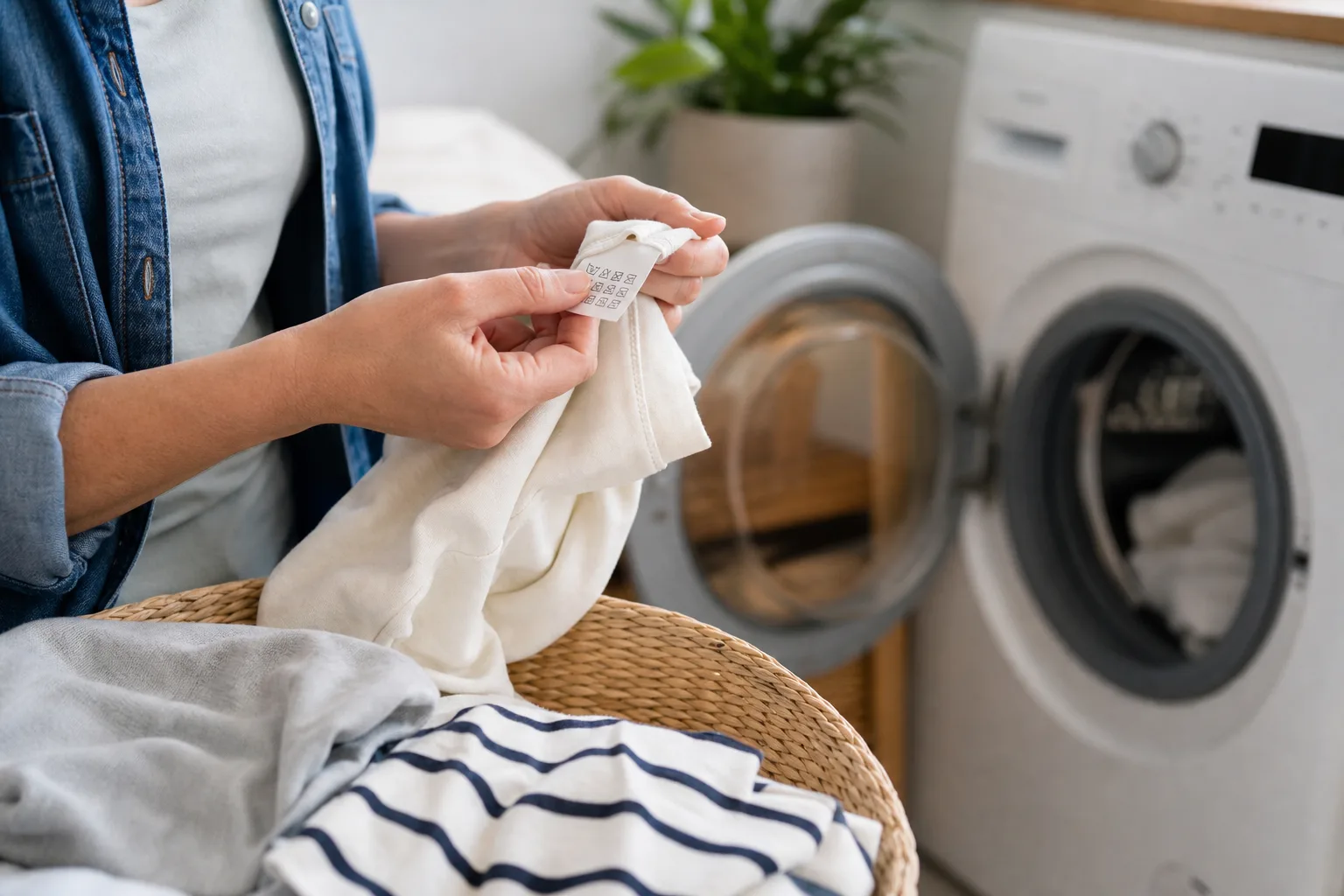
To prevent cotton shrinking, start with the care label, use the gentlest permitted wash cycle and avoid prolonged tumble drying. When the label allows it, reshape the item after washing and line-dry or dry it flat. If machine drying is required, use the stated setting and remove the item promptly rather than continuing to tumble it after it is dry. These steps can reduce avoidable dimensional change, but they cannot guarantee zero shrinkage because yarn, fabric construction, processing tension and finishing determine how much residual shrinkage remains in a product.
The safest routine at a glance
The following routine is a conservative starting point for washable cotton clothing and household textiles. A product-specific instruction always takes priority. Under the U.S. Federal Trade Commission’s Care Labeling Rule, covered garments must carry regular-care instructions supported by a reasonable basis, and warnings must identify expected procedures that could harm the product.[1]
- Read the complete label. Check the washing method, temperature, cycle, drying method and any warnings.
- Wash only when necessary. Each wetting and drying cycle gives the fabric another opportunity to relax toward its stable dimensions.
- Use the gentlest permitted cycle. Avoid choosing a more intensive cycle than the label recommends.
- Do not overload the washer. Give the item enough space to rinse without severe tangling or distortion.
- Remove it promptly. Untangle the item and smooth seams, hems, collars and plackets while damp.
- Air-dry when permitted. Hang stable woven items; support heavy, stretchy or loosely knitted items on a flat surface.
- If tumble drying is specified, follow the label. Stop the cycle promptly and avoid unnecessary additional tumbling.
Cold water is often chosen as a cautious default, but temperature alone does not control every form of cotton shrinkage. CottonWorks identifies swelling, deswelling, mechanical action and the relaxation of manufacturing stresses as important mechanisms. Tumble action can therefore matter even when dryer heat is low.[2]
Why cotton changes size
The fiber is only one part of the system
Cotton fibers absorb water and swell. At the same time, yarns and fabric structures can move as stresses introduced during knitting, weaving, dyeing, finishing, cutting and sewing are released. During drying, the structure deswells and may settle into a shorter or narrower arrangement. The visible result can be shrinkage, growth, twisting or puckering rather than an equal size reduction in every direction.
This is why “100% cotton” does not provide a shrinkage forecast. Fiber content identifies what the textile is made from; it does not state the yarn twist, stitch length, weave density, finishing process or residual dimensional change. CottonWorks lists fiber, yarn, construction, wet processing, finishing, garment manufacturing and care as interacting influences on shrinkage.[3]
Knits and wovens do not behave alike
Knitted fabrics are formed from intermeshing loops and are generally more open and extensible than woven fabrics. Those loops can change shape as tension is released, making many jersey T-shirts, rib garments and knit underwear more dimensionally sensitive than firmly woven shirts or sheets. This is a tendency, not a guarantee: finishing quality and construction specifications can make one knit more stable than another.
Dryer action can reveal residual shrinkage
Home tumble drying supplies unrestricted mechanical action while moisture leaves the textile. CottonWorks describes this process as allowing available drying shrinkage to develop; line or flat drying generally produces less consolidation because the fabric is not repeatedly tumbled.[2] Low heat may protect dyes, finishes, elastic fibers and trims where the label calls for it, but merely selecting low heat does not remove the mechanical action of the dryer.
Step-by-step washing and drying method
1. Inspect before washing
Confirm that the item is washable and note whether it must be hand-washed, machine-washed, line-dried, dried flat or tumble-dried. Treat a mixed-material garment as a complete product: thread, interfacing, elastic, printed decoration, lining and trim may set the care limit even when the main fabric is cotton. The FTC states that care instructions must account for the entire garment, including non-detachable components.[1]
2. Prepare the item
- Empty pockets and remove detachable accessories when instructed.
- Close zippers and secure hooks to reduce snagging and distortion.
- Turn printed or dark garments inside out when compatible with the label.
- Wash with similar colors and compatible care requirements.
- Use a mesh bag for small or delicate cotton knits if the label permits machine washing.
3. Select the wash
Use the labeled water temperature and cycle. If the label offers a range, a cooler, gentler option is a conservative choice for limiting unnecessary stress. Use an appropriate amount of detergent: extra detergent does not prevent shrinkage and may be difficult to rinse. Avoid chlorine or non-chlorine bleach unless the label permits it.
4. Reshape while damp
After washing, support the wet item rather than pulling it by one edge. Smooth it on a clean surface and align the side seams, sleeves, legs or sheet edges. Gently return it toward its intended dimensions without aggressive stretching. This step is especially useful for loosely constructed knits, but it cannot permanently reverse shrinkage that reflects the fabric’s relaxed state.
5. Choose the least disruptive permitted drying method
| Label permits | Practical method | Main caution |
|---|---|---|
| Line or hang drying | Smooth the item and distribute its weight across a suitable line or hanger. | Heavy knits can lengthen or develop hanger marks. |
| Drying flat | Place the reshaped item on a clean, ventilated drying surface. | Turn it if needed so both sides dry evenly. |
| Tumble drying | Use the cycle and temperature on the label; remove the load promptly. | Continued tumbling can add mechanical action and expose trims or blends to heat. |
| No tumble drying | Use the specified line, drip or flat-drying method. | Do not substitute a short dryer cycle unless the manufacturer permits it. |
| Dry-clean only | Use the stated professional process. | Do not assume cotton fiber content makes home washing safe. |
How to evaluate labels and product claims
“Pre-shrunk” is not the same as “will never shrink”
Pre-shrinking usually indicates that the fabric or garment underwent a process intended to remove part of its potential dimensional change before sale. Mechanical compaction and relaxation drying are among the processes manufacturers may use. The term does not, by itself, disclose a tested percentage of residual shrinkage, the number of laundering cycles evaluated or the exact care procedure used.
For a measurable comparison, look for a stated dimensional-change specification tied to a defined wash-and-dry procedure. A general phrase such as “premium cotton,” “long-staple cotton” or “soft-washed” is not a substitute for finished-product shrinkage data. Fiber quality can affect spinning and textile performance, but shrinkage must be evaluated at the fabric or garment level under relevant care conditions.
Read silence on a U.S. care label carefully
Under FTC guidance, a minimal instruction such as “Machine wash. Tumble dry.” has specific implications: absent limiting temperatures or warnings, the manufacturer is representing that the product can withstand the procedures covered by that wording. Consumers should nevertheless follow every printed qualifier, such as “cold,” “gentle,” “low,” “dry flat” or “do not tumble dry,” rather than relying on a routine used for another cotton item.[1]
Adjust the method to the product
T-shirts, underwear and other knits
Use the labeled gentle or normal cycle, untwist the garment after washing and reshape it before drying. Air drying is the cautious option when allowed. Rib cuffs, neckbands and stretch components may react differently from the cotton body, so judge the whole garment rather than the fiber percentage alone.
Sheets and woven shirts
Firmly woven products are often more stable than loose knits, but they can still lose length or width. Avoid cramming sheets into a small load, where they may form tight bundles. Smooth shirt plackets, collars and seams before air drying, or remove them promptly from an approved dryer cycle.
Towels
Towels need enough movement and airflow to wash and dry thoroughly. Air drying can reduce tumble action but may produce a firmer hand. If the label permits tumble drying, use the specified setting and stop when dry. Do not use an unapproved drying method solely to preserve softness.
Cotton blends and decorated garments
A blend is not automatically shrink-resistant. The cotton portion, synthetic component, elastic yarns, bonding materials and trims may each respond differently. Heat-sensitive stretch fibers can impose stricter limits than cotton itself. Printed, coated, pleated or structured products also require their own label-led care.
If the cotton item has already shrunk
There is no reliable universal method for permanently “unshrinking” cotton. While damp, some items can be eased gently toward their former measurements and dried in that position, but the result may be partial or temporary. Repeated wetting and tumble drying may return the textile toward its relaxed dimensions.
- Do not pull hard on one seam, sleeve or waistband; uneven force can distort the item.
- Do not apply hotter water or steam unless the label permits it.
- For valuable, tailored or structured items, consult a textile-care professional before experimenting.
- If a new product changes size despite exact compliance with its label, record the original and after-care measurements and contact the seller or manufacturer.
For future purchases, compare the care method with the way the item will actually be used. A product that requires flat drying may be unsuitable for a household that needs routine machine drying. Preventing cotton shrinkage begins not only in the laundry room but also with choosing a construction, finish and care requirement that match the intended use.
Frequently asked questions
Does washing cotton in cold water prevent all shrinkage?
No. A cooler wash is a cautious choice when the care label permits it, but cotton can also shrink as manufacturing stresses relax and the wet fabric is mechanically tumbled during drying. Follow the full washing and drying instruction rather than relying on water temperature alone.
Is low dryer heat enough to stop cotton from shrinking?
Not necessarily. Low heat may protect certain dyes, finishes, elastic fibers and trims, but tumble action also helps a wet cotton structure relax. Air drying usually limits that action when the care label allows it.
Can pre-shrunk cotton shrink again?
Yes. Pre-shrunk generally means that some potential shrinkage was removed during manufacturing, not that dimensional change is impossible. The remaining amount depends on the construction, finishing process and subsequent care.
Can a shrunken cotton garment be restored permanently?
There is no dependable universal method. Gentle reshaping while damp may recover some dimensions, but the change can be incomplete or temporary, especially if later laundering lets the fabric return to its relaxed state.
How this guide was prepared
This page is based on desk research conducted on October 2, 2026 using Federal Trade Commission care-label guidance and CottonWorks technical material on cotton dimensional stability, fabric construction, processing and drying. No first-hand laundering trials, laboratory tests, factory visits, product evaluations or certification reviews were performed. Recommendations are limited to conservative consumer practices supported by those sources, and product-specific care labels take priority.
Review status: Publishable quality advisory.
Sources and scope
- Clothes Captioning: Complying with the Care Labeling RuleFederal Trade Commission
Requirements for substantiated garment-care instructions, warnings, washing and drying directions, and consideration of all garment components.
Accessed 2026-10-02 - A Guide to Improved Shrinkage Performance of Cotton FabricsCottonWorks by Cotton Incorporated
Technical explanation of construction, processing and drying shrinkage; cotton swelling and deswelling; mechanical tumble action; and industrial methods for reducing residual shrinkage.
Accessed 2026-10-02 - Shrinkage & SkewingCottonWorks by Cotton Incorporated
Overview of dimensional stability and the effects of fiber, yarn, fabric construction, wet processing, finishing, garment manufacturing and care.
Accessed 2026-10-02