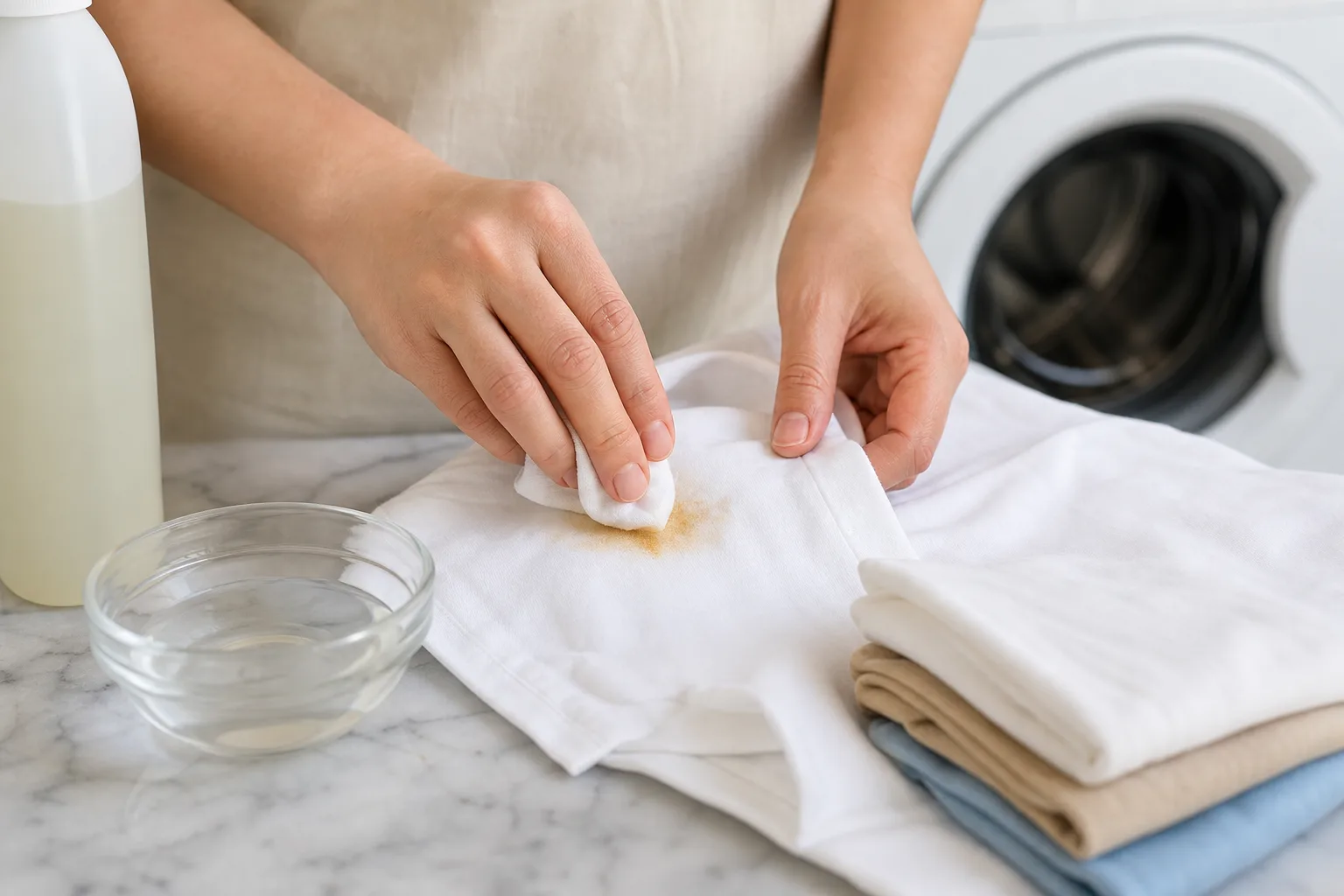
To remove stains from cotton safely, act promptly, lift off excess material, blot rather than rub, rinse or pretreat according to the stain type, and wash exactly as the care label permits. Inspect the item before drying because heat can make some remaining residues harder to remove. This process applies to washable cotton and cotton-rich products; a dry-clean-only label, unstable dye, special finish, bonded layer or delicate trim changes what is safe.
A safe stain-removal process for cotton
There is no universal treatment for every cotton product or stain. The fiber content is only one part of the decision. Dye chemistry, yarn, fabric construction, printing, finishes, seams, elastic, coatings and trims can all affect the result. In the United States, care instructions are intended to cover the complete product, including non-detachable components, not merely its main fabric. The Federal Trade Commission also requires qualifying instructions and warnings about washing, drying and bleach use. FTC guidance on the Care Labeling Rule explains those requirements.
Follow these steps in order
- Read the care label. Confirm whether the item is machine washable, hand washable or intended for professional cleaning. Note the permitted temperature, cycle, drying method and bleach warning.
- Check the whole product. Identify colored prints, embroidery, linings, foam, elastic, water-repellent treatments or decorative components that may be less tolerant than the cotton face fabric.
- Remove excess material. Lift solids with a spoon or dull edge. Blot liquids with a clean white cloth or unprinted paper towel. Work without spreading the stain.
- Identify the likely stain family. Water-based, protein, oil, particulate soil and ink-like stains respond differently. If the source is unknown, start conservatively.
- Test the treatment. Apply a small amount to a hidden area when colorfastness or finish compatibility is uncertain. Check for color transfer, lightening, texture change or a visible ring.
- Pretreat gently. Use a laundry product intended for the stain and material, following its dosage, contact-time and safety directions. Do not combine cleaning products unless their manufacturers explicitly permit it.
- Wash according to the label. Use the recommended cycle and no hotter than the permitted temperature. Wash separately if the label warns of color transfer.
- Air-dry for inspection. Check the stained area in good light before tumble drying or ironing. Repeat a safe treatment if residue remains.
Match the treatment to the stain
Start with the least aggressive method likely to work. Vigorous rubbing can spread soil, disturb a printed surface or raise fibers. A clean white cloth also makes it easier to see whether dye is transferring from the cotton product.
| Stain type | Examples | First response | Next step for washable cotton | Avoid |
|---|---|---|---|---|
| Water-based food and drink | Coffee, tea, juice, soft drinks, sauces | Blot promptly and rinse from the reverse with cool water when practical. | Pretreat with a suitable laundry detergent or stain remover, then wash as labeled. | Rubbing the spill outward or drying before inspection. |
| Protein-based | Blood, milk, egg, infant formula | Use cool water first and blot or rinse gently. | Apply a product labeled for protein stains and wash within the care instructions. | Starting with hot water or ironing the area. |
| Oil and grease | Cooking oil, butter, skin oil, oily cosmetics | Lift solids and blot without adding water immediately. | Work a small amount of compatible liquid laundry detergent into the stained area, then wash as labeled. | Heavy scrubbing, excessive product or machine drying while an oily shadow remains. |
| Loose particulate soil | Mud, clay, dust | Allow heavy mud to dry if brushing will remove it more cleanly, then brush outdoors. | Rinse remaining soil, pretreat and wash without overloading the machine. | Grinding wet mud deeper into the fabric. |
| Grass and mixed outdoor soil | Grass, soil and plant matter | Remove loose material and rinse the back of the stain. | Pretreat, allow only the product-directed contact time, and wash as labeled. | Assuming a strong bleach is safe because the fabric is cotton. |
| Ink, dye or unknown chemical | Pen ink, marker, transferred dye, paint | Blot and isolate the area from clean fabric. | Consult the product maker's directions or a professional cleaner, especially for valuable items. | Improvised solvents, spreading the stain or applying heat. |
These are conservative starting points, not guarantees. Old stains, mixed formulations and previous drying can change the result. A commercial stain remover may also affect a dye or finish even when the underlying cotton fiber tolerates washing.
Why cotton fiber content does not decide the method
Cotton is primarily a cellulosic fiber, but consumers clean finished textile products rather than isolated raw fibers. Two labels that both say “100% cotton” can describe a white towel, a dark garment-dyed T-shirt, a printed bedsheet, a wrinkle-resistant shirt or coated upholstery. Their safe treatments may differ substantially.
Color and finish usually set the practical limit
CottonWorks notes that colorfastness depends on multiple variables, including fiber quality, yarn formation, fabric construction, wet processing, dye selection and consumer laundering practices. Detergent selection and wash procedure can therefore affect color retention. Its technical bulletin on cotton colorfastness also reports that some dyes are sensitive to detergents containing activated bleaching agents. That is why a treatment described as “color safe” should not be interpreted as harmless to every colored cotton product.
Finishing matters as well. Some chemistries used to create smoothness or dimensional stability can influence the retention of oily soil. CottonWorks defines stain release as the ability of a fabric to release soil, oils or discoloration after laundering, while repellency concerns resistance to initial penetration. These are different performance attributes. CottonWorks quality-assurance guidance discusses stain release as a testable fabric and finish property.
Do not confuse marketing language with measured performance
Terms such as “easy care,” “performance cotton,” “stain resistant” and “soil release” do not by themselves tell a buyer how much stain protection a product provides. For an industry claim to be meaningful, it should identify the relevant test method, stain or soil type, laundering conditions, number of cycles and acceptance threshold. A repellency result should not be presented as proof that stains will wash out, and a stain-release result should not be presented as proof that liquid cannot enter the fabric.
Water temperature, detergent and bleach
Use temperature as a controlled variable
Cold water is a cautious starting point for rinsing an unidentified stain and is particularly appropriate for protein-based residue. The final wash temperature should still follow the care label. A CottonWorks laundry study found a tradeoff in the products and conditions evaluated: cold-water loads showed the lowest dimensional change, while warm-water loads produced better soil release when stains had not been pretreated. The Modern Consumer Laundry presentation also cautions that results depend on the product and laundering conditions. It should not be read as a rule that warm water is always better.
Pretreatment can reduce the need to rely on higher wash temperatures. Measure detergent rather than assuming more will clean better, and follow directions for concentrated products. Overloading the washer can reduce movement and rinsing, so leave enough space for the item to circulate as the machine manufacturer intends.
Bleach is a label decision, not a fiber decision
Never infer bleach tolerance solely from the word “cotton.” Under the FTC care-label framework, a label may permit all bleach, specify only non-chlorine bleach when needed, or state that no bleach may be used. These directions account for the finished product, including its dyes and components. Even white cotton may contain finishes, sewing thread, logos or elastic that require restrictions.
- If the label says do not bleach, do not use chlorine or non-chlorine laundry bleach.
- If it permits only non-chlorine bleach when needed, do not substitute chlorine bleach.
- If the label is missing or unreadable, begin with detergent-based treatment and seek manufacturer guidance before using bleach.
- Follow the cleaner's directions for dilution, contact time, protective measures and rinsing.
Protect color, shape and surface
Successful stain removal means more than making a mark disappear. A treatment has failed if it creates a pale spot, ring, rough patch, stretched neckline, damaged coating or shrunken product. The following checklist helps protect the complete textile:
- Blot from the outside toward the center to limit spreading.
- Support the stain with a clean absorbent layer and change that layer as soil transfers.
- Treat the reverse when appropriate so rinsing pushes residue back out rather than through more fabric.
- Avoid hard brushing on knits, brushed fabrics, printed surfaces and lightweight weaves.
- Keep treatment local unless the product directions call for soaking the whole item.
- Rinse pretreatment thoroughly when required before applying another product.
- Inspect while damp and again after air-drying. Wet fabric can temporarily hide oily shadows or rings.
Dark and saturated colors deserve particular caution. Turn washable garments inside out for the machine cycle, wash with similar colors when instructed and minimize unnecessary tumble-drying time. For more routine guidance, see the cotton care hub, cotton washing guide and shrinkage-prevention guide.
When to stop and use a professional cleaner
Home treatment is not always the lowest-risk option. Stop if a hidden-area test produces dye transfer, lightening, tackiness, surface distortion or a new ring. Professional help is also sensible for valuable items, structured garments, upholstery, dry-clean-only products, antique textiles and stains involving paint, adhesives, unknown chemicals or extensive dye transfer.
Tell the cleaner what caused the stain, when it happened, which treatments were attempted and whether the item has already been washed or dried. Do not conceal previous product use; that information can affect the cleaner's decision.
Quick final checklist
- Care label checked
- Stain source identified as closely as possible
- Excess material lifted or blotted
- Treatment tested on a hidden area
- Bleach restriction followed
- Wash temperature kept within the label limit
- Item inspected before dryer heat or ironing
Understanding cotton's fiber structure and relationship with dyes provides useful context, but the care label and the finished product's construction remain the practical authorities. For product-specific considerations, see the guides to cotton T-shirts, cotton towels, cotton bed sheets and cotton baby clothes.
Frequently asked questions
What is the safest first step for removing a stain from cotton?
Check the care label, remove excess material and blot the area with a clean white cloth. For an unknown washable stain, cool water and a detergent-based pretreatment are generally more cautious starting points than heat or bleach.
Can chlorine bleach be used on white cotton?
Only when the care label permits it. White cotton products may include finishes, elastic, logos, colored thread or other components that chlorine bleach can damage.
Should stained cotton be washed in hot or cold water?
Use cool water first for unknown or protein-based stains, then wash at a temperature allowed by the care label. Pretreatment and stain type matter, so hotter water is not automatically the safest or most effective choice.
Why should cotton be checked before tumble drying?
Dryer heat can make some remaining stain residues harder to remove. Air-drying first allows the area to be inspected and safely retreated if necessary.
Does 100% cotton mean a product is easy to stain-treat?
No. Dye, yarn, construction, printing, finish, trim and care instructions all influence safe cleaning. Fiber content alone does not establish bleach tolerance, colorfastness or stain-release performance.
How this guide was prepared
Desk research completed on October 3, 2026 using FTC care-label rules and CottonWorks technical material on colorfastness, laundering and stain-release performance. No laboratory testing, product trials, professional-cleaning work, farm visits or first-hand stain-removal experiments were conducted.
Review status: Publishable quality advisory.
Sources and scope
- Clothes Captioning: Complying with the Care Labeling RuleFederal Trade Commission
Care-label requirements for washing, drying, ironing, bleaching, warnings and consideration of all garment components.
Accessed 2026-10-03 - Quality Assurance BasicsCottonWorks by Cotton Incorporated
Distinction between stain-release performance, oily-soil behavior, fabric finishes and measurable quality-assurance attributes.
Accessed 2026-10-03 - Colorfastness of Cotton TextilesCottonWorks by Cotton Incorporated
Effects of dyes, wet processing, fabric variables, detergent selection and laundering practices on cotton color retention.
Accessed 2026-10-03 - Modern Consumer Laundry: Will Protecting the Environment Protect Our Clothes?CottonWorks by Cotton Incorporated
Conditional findings about cold-water dimensional change, warm-water soil release and the importance of stain pretreatment.
Accessed 2026-10-03