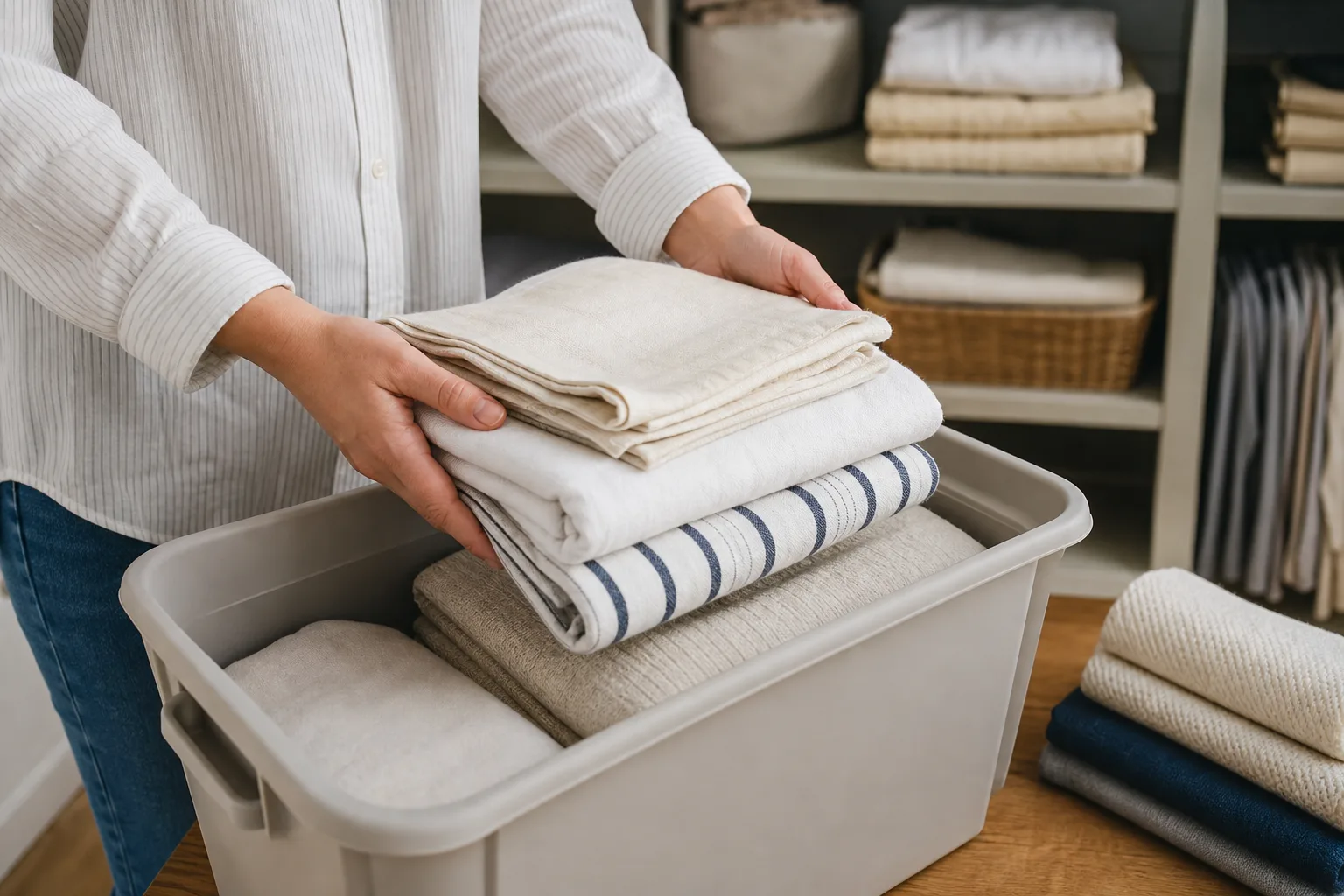
To store cotton textiles safely, make sure they are clean and completely dry, place them in a dry indoor location away from direct sunlight and leak risks, and fold or hang them according to their construction. Do not assume that every item labeled “cotton” should be stored in the same way: yarn type, fabric structure, dyes, finishes, seams, elastic and trims can change what the finished product needs.
Why cotton storage depends on more than the fiber
Cotton is a cellulose-based, moisture-absorbing fiber. Moisture can move between cotton and the surrounding air, so putting a damp textile into an enclosed container can create unfavorable storage conditions. CottonWorks also notes that high moisture and temperature can affect the shade of raw cotton during storage. That industrial observation supports the general need for moisture control, but it does not establish a universal household humidity limit for every finished textile. [1]
Raw-fiber quality is only the starting point. USDA cotton classification measures properties including fiber length, length uniformity, strength, micronaire, color and foreign material. These measurements help manufacturers select cotton for particular products, but they do not tell a consumer whether a finished shirt should be hung, whether a quilt may be compressed or whether a coated fabric belongs in a plastic bin. [2]
Finished-textile performance also reflects:
- Yarn: fine or coarse, single or plied, combed or carded, and ring-spun or open-end.
- Construction: woven, knitted, terry, quilted, brushed or pile-based.
- Finishing: dyes, prints, wrinkle-resistant treatments, coatings and softeners.
- Components: elastic, interfacing, embroidery, buttons, zippers, padding and non-cotton linings.
- Condition: existing stains, weakened folds, loose seams, abrasion or previous moisture damage.
For background on why cotton interacts with water, see cotton moisture absorption and cotton fiber structure.
Step 1: Read the labels and identify the whole product
Use the care label as the first instruction
Before storage, read the permanent care label and record it if fading or detachment is likely. For apparel covered by the U.S. Care Labeling Rule, manufacturers and importers must provide regular-care instructions supported by a reasonable basis. The FTC also emphasizes that instructions must account for the finished garment as a whole rather than only its individual components. [3]
This distinction matters because “100% cotton” describes fiber content, not the complete performance of a product. A cotton jacket may contain interfacing or structured shoulders. Cotton stretch jeans may include elastane. A printed cotton textile may have a finish with different heat or cleaning limits from the underlying fabric.
Marketing terms are not storage tests. Words such as “premium,” “luxury,” “Egyptian,” “Pima,” “organic” or “natural” do not by themselves demonstrate resistance to fading, mildew, creasing, dye transfer or compression. The FTC requires cotton fiber-content statements to be truthful and not deceptive, but a truthful fiber name still does not replace product-specific care evidence. [4]
Check for vulnerable components
Look over the entire item before choosing a storage method. Pay particular attention to elastic waistbands, bonded layers, foam, rubberized prints, metallic decoration, leather patches and dark dyes next to pale fabric. If the label conflicts with generic cotton advice, follow the product-specific instruction unless a qualified textile specialist has assessed the item.
Step 2: Clean and dry cotton completely
Store textiles in a clean condition whenever their care instructions permit cleaning. Body oils, cosmetic residues, food spills and detergent deposits may discolor fabric, create odors or become more difficult to remove over time. Treat visible stains before storage rather than assuming that a future wash will remove them.
- Empty pockets. Remove paper, food, pens and other objects.
- Repair or document damage. Secure loose fasteners and note weak seams so they are not overlooked later.
- Wash or professionally clean as directed. Use the attached instructions, including warnings about water temperature, bleach, drying and ironing.
- Rinse appropriately. Do not intentionally leave excess laundry product in the textile.
- Dry fully. Check thick hems, waistbands, quilted areas, towel borders and multilayer seams, which may remain damp after the main fabric feels dry.
- Cool before packing. Let recently dried or ironed items return to room temperature before enclosing them.
Do not add water, fragrance spray or fabric refresher immediately before storage. Scent does not confirm cleanliness or dryness. For routine preparation, consult the guides to washing cotton, removing stains and drying cotton.
Step 3: Choose a safe storage location and enclosure
Prefer a stable indoor space
A suitable location is dry, reasonably clean and protected from direct sunlight, plumbing leaks and large swings in heat or moisture. Interior closets and drawers are usually easier to monitor than damp basements, hot attics, exterior sheds or garages. Keep textiles off a floor where minor flooding or cleaning water could reach them.
Light can alter dyes and finishes, while uncontrolled moisture is a more immediate concern than whether a container is described as “natural” or “breathable.” No container can make a damp textile safe to store.
Choose containers for the actual risk
- Clean drawers or shelves: practical for frequently used clothing and linens in a controlled room.
- Fabric storage bags: useful for dust protection when the surrounding space is dry and clean.
- Plastic bins: may provide a barrier against dust and minor leaks, but they should contain only fully dry textiles and must not be treated as a cure for a damp room.
- Cardboard boxes: suitable only when clean, dry and structurally sound. Avoid boxes with food residue, strong odors or unknown contamination.
- Vacuum bags: space-saving for some replaceable household items, but sustained compression can create hard creases and is a poor default for tailored, padded, decorated, fragile or collectible textiles.
Do not place mothballs, perfumes, cedar oil or other strong chemicals directly against the fabric. If pest-control products are used, follow their safety labels and isolate them from textiles as instructed.
Step 4: Fold or hang according to construction
The word “cotton” does not determine whether an item should be folded or hung. Support the product so its own weight does not distort it, and avoid sharp pressure on prints, padding or fragile decoration.
| Textile | Usual starting method | Main checks |
|---|---|---|
| T-shirts and cotton knits | Fold on a clean shelf or in a drawer | Avoid narrow hangers that can stretch shoulders; do not trap damp underarm areas. |
| Woven shirts and light dresses | Fold or use a smooth, suitably sized hanger | Fasten enough buttons to maintain shape without placing seams under tension. |
| Heavy sweaters and dense knits | Fold | Do not stack so high that lower pieces remain heavily compressed. |
| Tailored cotton garments | Use a broad, supportive hanger when the construction permits | Protect structured shoulders, linings, lapels and embellishment. |
| Sheets and pillowcases | Fold loosely and store flat | Confirm elastic edges and deep fitted-sheet corners are dry. |
| Towels | Fold with space for air movement | Check dense hems and decorative borders for retained moisture. |
| Quilts and large textiles | Fold with broad, rounded folds or support flat where practical | Limit concentrated pressure and change fold positions periodically. |
| Historic or highly valuable textiles | Obtain conservation advice | Household guidance is not a substitute for an item-specific preservation plan. |
Avoid bare wire hangers, rough wood, sharp clips and overcrowded rails. Use clean supports that fit the garment. When folding a delicate piece, clean, colorfast interleaving material can soften a crease, but valuable textiles may require conservation-grade materials selected by a professional.
Product construction is especially important for cotton T-shirts, bed sheets and towels. Buying specifications such as thread count, fabric weight or a regional cotton name should not be converted into unsupported storage claims.
Step 5: Inspect stored textiles periodically
Storage is an ongoing condition, not a one-time task. Check household items at least when seasons change and inspect valuable or leak-exposed pieces more often. The appropriate schedule depends on the building, climate, enclosure and value of the item.
Storage inspection checklist
- Is the textile dry and free from a new musty odor?
- Are there water marks, condensation or damp surfaces nearby?
- Has a dark dye transferred onto an adjacent pale textile?
- Are elastic, coatings, prints or bonded layers becoming sticky, brittle or cracked?
- Are insects, shed skins, webbing or fresh holes present?
- Are hanger points stretching or leaving sharp impressions?
- Are folds becoming hard, deep or discolored?
- Is the care label still attached and legible?
If you find moisture, remove the item from the enclosure and identify the source before repacking it. Do not simply seal a damp or musty textile in a new container. Isolate suspected insect activity from unaffected textiles. For mold, severe dye transfer, fragile decoration or historically important material, seek qualified professional advice rather than testing aggressive home treatments.
Storage decisions for consumers and industry teams
Consumers can usually manage washable household cotton with label-led cleaning, complete drying, suitable support and regular inspection. Brands, retailers and institutional users need a more documented approach: identify the complete material system, retain approved care information, evaluate packaging and warehouse conditions, and substantiate any special storage instruction.
Do not infer finished-product behavior solely from USDA raw-cotton classing data or a named cotton type. Fiber length, strength and micronaire can affect manufacturing and yarn selection, but storage performance also depends on spinning, fabric formation, dyeing, finishing and assembly. Learn how these levels differ in the cotton quality hub and the guide to assessing cotton product quality.
The same caution applies to sustainability language. Organic, recycled, certified or responsibly sourced claims may describe cultivation, inputs, processing or chain-of-custody requirements; they do not automatically prove a textile can tolerate damp storage, compression or a particular cleaning method. Review what a certification actually covers through the guide to cotton certifications. Whatever the claim, sensible storage should aim to keep the product usable without inventing environmental benefits that have not been measured.
For more routine maintenance guidance, visit the cotton care hub.
Frequently asked questions
Should cotton textiles be stored in plastic containers?
A clean plastic bin can protect fully dry textiles from dust and minor leaks, but it cannot correct a damp storage environment. Never seal a wet, warm or musty item inside, and inspect the container periodically for condensation or odor.
Is it better to hang or fold cotton clothing?
Base the decision on construction rather than fiber content alone. Fold T-shirts, heavy knits and sweaters to limit stretching. Smooth woven garments and structured clothing may be hung on properly sized, supportive hangers if their labels and construction permit it.
Should cotton be washed before long-term storage?
Clean it according to the care label when possible, treat visible stains and make sure every layer is completely dry. Thick hems, elastic edges, towel borders and quilted areas can retain moisture after the main fabric feels dry.
Does organic or premium cotton require a special storage method?
Not automatically. Organic, Pima, Egyptian and similar terms do not establish resistance to moisture, fading, creasing or compression. Use the item’s care instructions and consider its yarn, construction, finish, dyes and non-cotton components.
How this guide was prepared
This guide is based on desk research completed on October 5, 2026 using FTC textile labeling guidance, USDA cotton classification information and CottonWorks fiber-science material. It translates documented fiber and labeling principles into cautious household and industry storage guidance. No laboratory testing, product trials, storage-facility inspections, conservation assessments, certifications or first-hand textile evaluations were performed.
Review status: Publishable quality advisory.
Sources and scope
- Cotton Fiber QualityCottonWorks by Cotton Incorporated
Explains measured raw-cotton properties and reports that high moisture and temperature during storage can affect cotton fiber shade.
Accessed 2026-10-05 - Cotton Classing ServicesUSDA Agricultural Marketing Service
Identifies the fiber properties measured in U.S. cotton classification and explains their role in marketing and manufacturing.
Accessed 2026-10-05 - Clothes Captioning: Complying with the Care Labeling RuleFederal Trade Commission
Explains that care instructions for covered apparel require a reasonable basis and must account for the finished garment and its components.
Accessed 2026-10-05 - Calling It Cotton: Labeling and Advertising Cotton ProductsFederal Trade Commission
Clarifies truthful cotton fiber-content labeling and the limits on names or marketing terms that imply a particular cotton content.
Accessed 2026-10-05