
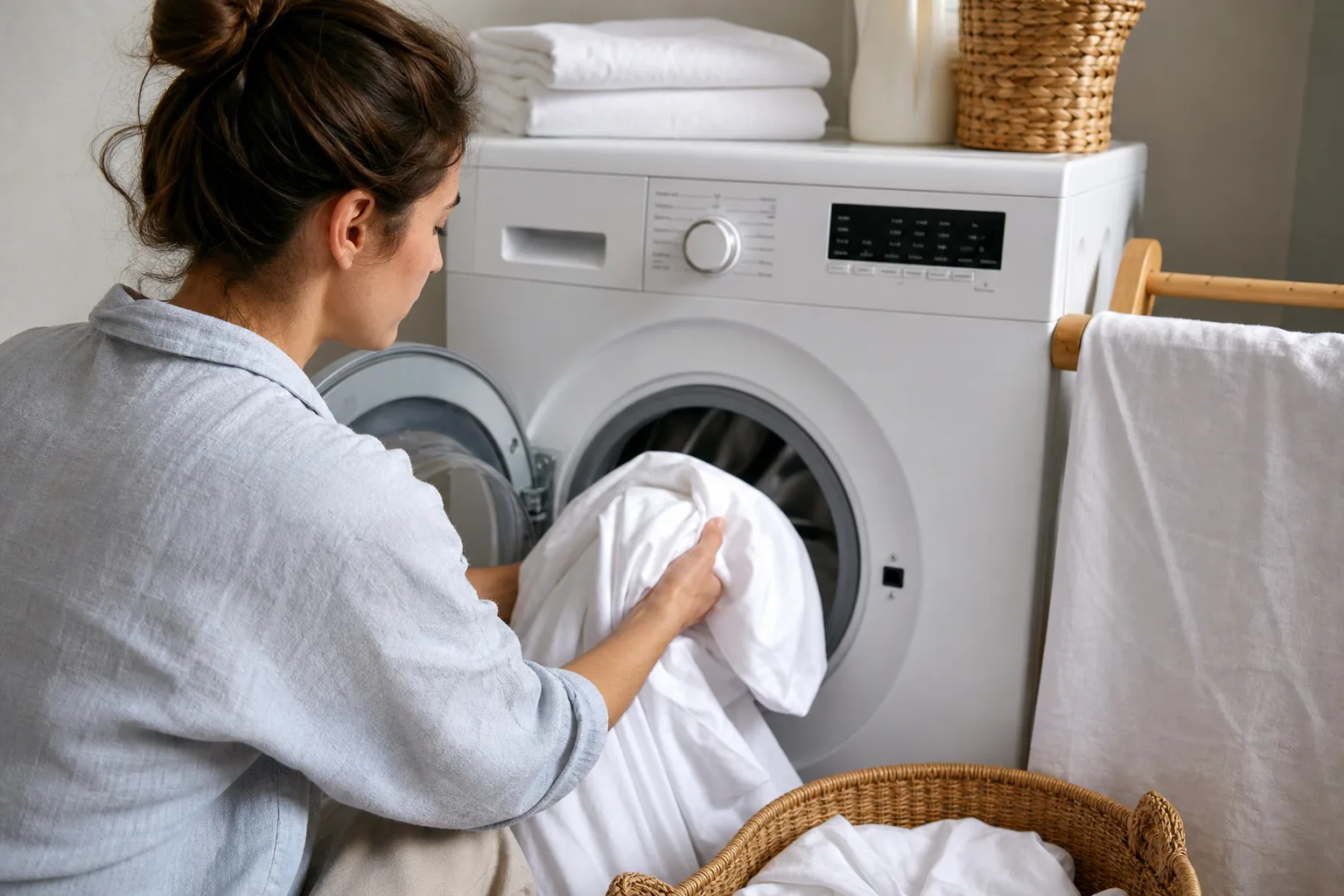
To wash cotton sheets without avoidable wear, begin with the sheet maker’s instructions, confirm that your washer and dryer can handle the load, separate items with incompatible care needs, and avoid packing the drum tightly. Use only the wash, treatment and drying options permitted for that specific sheet set. After laundering, check the sheets for tangling, visible change and fit, then record what you did. “Cotton” alone does not establish a safe temperature, cycle, bleach treatment or dryer setting.
1. Read the product and appliance instructions first
Find every source of product-specific information before selecting a cycle. Check the sewn-in label, packaging, retailer listing and manufacturer’s current care page if available. Photograph or transcribe the instructions because packaging and online listings can disappear. If different sources conflict, ask the manufacturer to clarify rather than choosing the more aggressive option.
Identify the complete product, not just the fiber
Record whether the sheets are labeled as 100% cotton or as a blend. Also note the brand, product line, size, color and any stated construction or finish. A fitted sheet may include elastic or other components whose care limits matter even when the main fabric is cotton.
Do not convert a marketing term into a laundering rule. Thread count, “premium cotton,” percale, sateen, long-staple claims and similar descriptions do not by themselves specify a safe wash temperature. Cotton Incorporated’s buying guide for cotton sheets explains that fiber type, yarn system, yarn count, fabric weight, construction and finishing can all affect how sheeting feels and performs. That combination of variables is why a generic cotton rule cannot replace product instructions.
Treat care instructions as product evidence, not a universal guarantee
A product instruction is the most relevant starting point available to its user, but it does not prove that every sheet carrying similar wording will produce the same result. The Federal Trade Commission’s Care Labeling Rule guidance discusses substantiated instructions for textile wearing apparel and certain apparel piece goods. That scope should not be misrepresented as a general U.S. legal requirement for bedding. For this guide, a sheet’s care information is used as product evidence rather than as proof that apparel-label law applies.
Also read the appliance manual. Capacity, cycle names, detergent compartments and drying controls differ among machines. A setting called “normal” on one model is not necessarily equivalent to the same word on another.
2. Prepare a compatible load without crowding
Remove the sheets from the bed and inspect them in good light. Look for stains, loose threads, torn hems, damaged elastic or areas that may need separate attention. Follow the product and treatment instructions before applying any stain remover. Do not assume that a product marketed for laundry is compatible with every dye, finish or elastic component.
Sort by instructions and practical risks
Group only items whose labels permit the settings you intend to use. Color, required cycle, treatment restrictions and drying method may all affect compatibility. Keep hooks, exposed zippers, abrasive fasteners and other snag-prone hardware out of the sheet load unless they are fully secured and the product instructions permit laundering together.
A sheet-focused load makes it easier to observe tangling and prevents a small, rough or fastened item from becoming hidden inside a fitted sheet. It does not mean every sheet in the home automatically belongs in one load. Separate sets when their instructions conflict, when colors require different handling, or when combining them would exceed the appliance limit.
Load sheets loosely
- Unfold each sheet instead of placing it in the washer as a compact bundle.
- Check that pillowcases or smaller pieces are not trapped inside a fitted sheet.
- Place sheets into the drum without winding them around an agitator or twisting them together.
- Stay within the washer manufacturer’s stated capacity and loading method.
- If the load must be forced into the drum or the door is difficult to close, divide it.
There is no reliable universal count such as “one set per load.” Sheet dimensions, fabric weight, washer design and capacity vary. Machine capacity is an operating limit, not an invitation to compress textiles until the rated weight fits.
3. Record the permitted washing and drying settings
Translate the product instructions into a short plan before starting the washer. This prevents decisions about temperature, bleach or drying from being made from memory halfway through the process. For broader laundering terminology, see Cotton Good’s general cotton washing guide; the product-specific limits still take priority.
Choose only supported wash options
Record whether machine washing is permitted, the stated temperature or range, and any required cycle. If the label gives words rather than a numerical temperature, use the corresponding control on your appliance rather than inventing a temperature. If the machine offers several cycles with similar names, consult its manual for agitation, spin and load guidance.
Follow the detergent maker’s dosing directions together with the washer instructions. More detergent is not automatically more effective, and this article cannot determine a dose without knowing the formula, water conditions, load size and machine. Place detergent in the specified dispenser or location.
Do not make bleach, sanitizer, fabric softener, scent booster, bluing agent or stain treatment part of a default cotton-sheet routine. First verify that the sheet instructions permit the product, then follow the treatment label and appliance directions. “White cotton” is not sufficient evidence that chlorine bleach or another oxidizing treatment is acceptable.
Set drying limits before the wash begins
Write down whether the sheets may be tumble dried, line dried or handled by another stated method. If tumble drying is allowed, record the permitted heat and cycle wording exactly. Do not substitute “high,” “low” or “air” based solely on fiber content.
Dimensional change is not controlled by cotton identity alone. CottonWorks’ technical overview of shrinkage and skewing identifies fiber, yarn, construction, wet processing, finishing and laundering practice among the relevant variables. It also describes dimensional change as including either shrinkage or growth. Consequently, no care guide can promise that an untested sheet will retain exact dimensions after a particular home cycle. For a focused explanation of risk reduction, read how to help prevent cotton shrinkage.
Pre-start checklist
- The exact sheet set and fiber or blend have been identified.
- All pieces in the load permit the selected wash and drying methods.
- Snag-prone or incompatible items have been removed.
- The washer is within its documented capacity.
- Detergent and any optional treatment are permitted and correctly dosed.
- The dryer or alternative drying method is available and suitable.
- Any unclear instruction has been recorded rather than guessed.
4. Check the sheets after washing and drying
When the wash finishes, remove the sheets carefully and separate pieces that have twisted together. Check the drum and the interior of fitted sheets for pillowcases or other trapped items. If a piece remains heavily folded or bundled, do not assume it received the same exposure as the rest of the load; record the uncertainty.
Observe before changing the routine
After using the permitted drying method, examine the sheets in consistent light. Look for dye transfer, streaking, residue, pulls, damaged seams, elastic distortion, localized abrasion or a change in surface appearance. An observation is not automatically a diagnosis: a visible change does not by itself reveal whether the cause was construction, finishing, chemistry, loading, abrasion, heat or another factor.
Check fit only after the product has completed its instructed drying process. Place a fitted sheet on the mattress without extreme stretching and note whether the corners seat normally and the pocket remains secure. If fit has changed, preserve the label, settings and date before contacting the seller or manufacturer. Cotton Good’s cotton-sheet wash-test framework explains how repeatable product testing differs from an informal household observation.
Keep the next cycle conservative and evidence-led
If the result is acceptable, retain the record for the next wash. If it is not, do not respond by adding hotter water, more detergent, bleach or longer drying without a supported reason. Recheck the instructions, appliance loading and dose first. A manufacturer may be able to clarify ambiguous wording or identify a product-specific restriction.
This routine does not constitute a laboratory test. No dimensional measurements, controlled laundering trials or comparisons were performed for this article, so it cannot assign a shrinkage percentage, service life or guaranteed outcome to any sheet.
5. Copy the blank cotton-sheet care record
Use one record for each sheet product whose instructions or observed behavior differ. Copy the exact wording rather than summarizing “wash normally,” and date each observation so later changes are not confused with the first laundering cycle.
| Step | Exact product instruction | Chosen setting / reason | Appliance limit | Observation / unresolved | Date / next action |
|---|---|---|---|---|---|
| Identify fiber/blend and product | |||||
| Sort and load | |||||
| Wash and detergent | |||||
| Bleach / treatment permission | |||||
| Dry / remove / store |
Next step: Copy the blank record above and complete it with your own dated evidence. Leave unresolved fields open until you can verify them from the product maker, treatment instructions or appliance manual.
Frequently asked questions
What temperature should cotton sheets be washed at?
Use the temperature stated by the sheet maker and supported by your washer. Cotton fiber content alone does not establish one safe temperature because construction, dyes, finishes, elastic and other components can alter the product's care limits.
Can cotton sheets be washed with towels or clothes?
Combine items only when their instructions, colors, treatments and appliance settings are compatible. Exclude exposed zippers, hooks and abrasive fasteners that could snag sheets, and do not crowd the washer.
Should bleach be used on white cotton sheets?
Not by default. Confirm that the sheet instructions permit the specific bleach or treatment, then follow its label and the appliance directions. White color and cotton content do not prove that chlorine bleach is safe.
How can I reduce the risk of cotton sheets shrinking?
Follow the product's wash and drying limits, avoid unsupported increases in heat or cycle severity, stay within appliance capacity and keep a dated record. These steps manage risk but cannot guarantee zero dimensional change.
How this guide was prepared
This guide is based on desk research completed on 2026-10-09 using Cotton Incorporated technical material and Federal Trade Commission guidance. It translates those sources into a label-led household procedure. No products were purchased or laundered, no dimensions were measured, and no laboratory tests, certifications, factory visits or first-hand performance trials were conducted.
Sources and scope
- Shrinkage & SkewingCottonWorks by Cotton Incorporated
Explains dimensional change and the roles of fiber, yarn, construction, processing, finishing and laundering in textile shrinkage and stability.
Accessed 2026-10-09 - A Buying Guide for Cotton SheetsCotton Incorporated
Provides cotton-sheet construction context and explains that fiber, yarn, weight, construction and finishing can affect performance.
Accessed 2026-10-09 - Clothes Captioning: Complying with the Care Labeling RuleFederal Trade Commission
Defines the U.S. Care Labeling Rule's scope as textile wearing apparel and certain piece goods, supporting the article's limitation against presenting it as a general bedding-label requirement.
Accessed 2026-10-09
Questions & discussion
Share a question or a useful experience about this guide. Comments appear immediately. Your name and comment are public. Email is optional and stays private; reply emails are not enabled yet. Comment privacy.