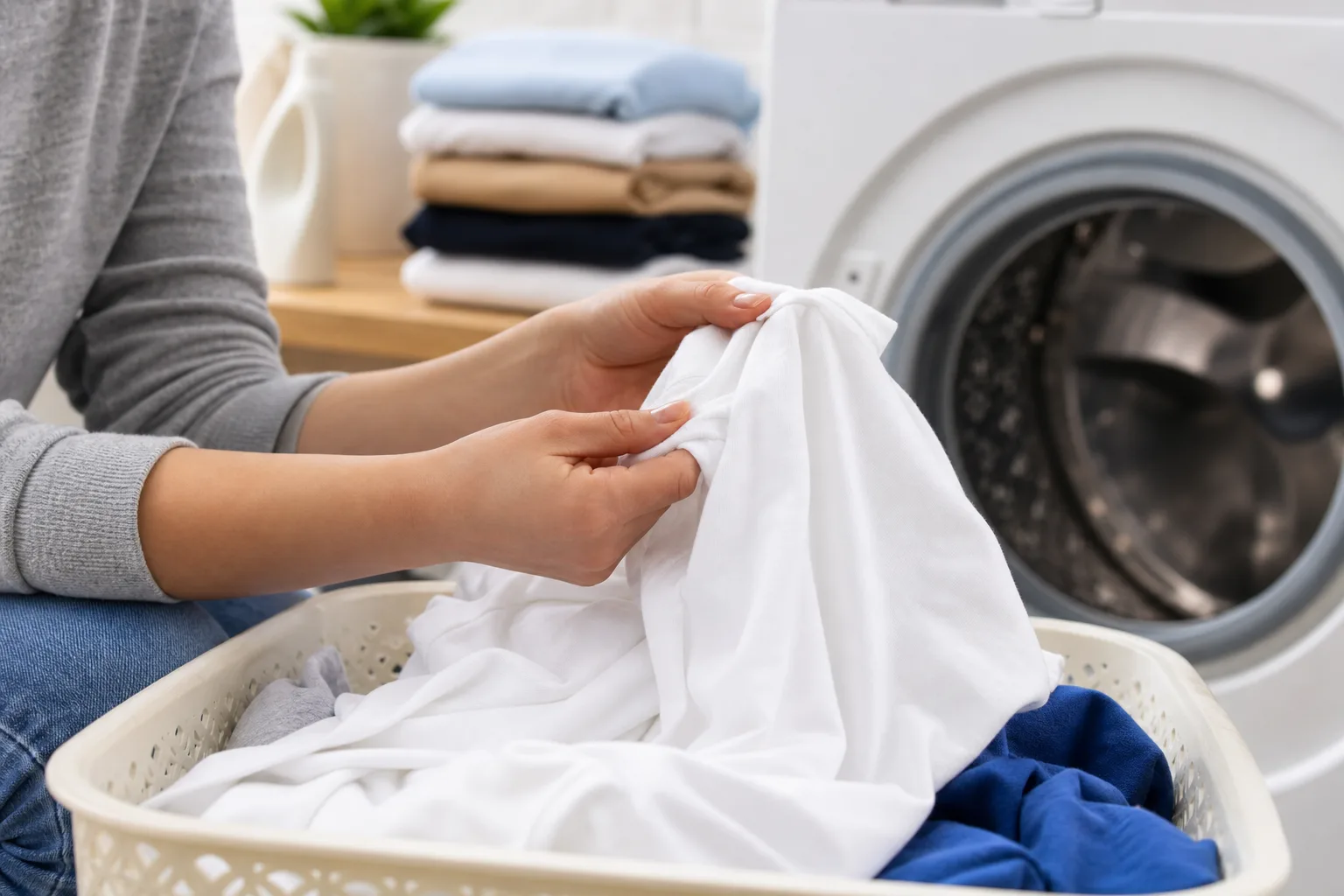
To wash cotton clothes safely, check the care label, sort by color and fabric weight, pretreat stains, use the coolest effective water temperature and dry with controlled heat. Cotton fiber is generally washable, but the word cotton does not tell you how the complete garment will react. Yarn type, knit or woven construction, dye, finishing treatments, sewing, elastic, prints and trims can all change the correct care procedure.
Quick steps for washing cotton clothes
- Read the complete care label. Note the washing method, temperature, bleach warning, drying method and ironing limit.
- Empty pockets and prepare the garment. Close zippers, release drawstrings and turn dark, printed or decorated items inside out.
- Sort the load. Separate whites, light colors and dark colors. Keep heavy towels and jeans away from lightweight shirts when practical.
- Pretreat visible stains. Follow the stain-remover directions and test products on a hidden area if colorfastness is uncertain.
- Select the cycle and temperature. Cold water is a practical default for many washable colored garments, but warm water may clean some soils more effectively when the label permits it.
- Add the correct amount of detergent. Follow the detergent and washing-machine instructions rather than estimating from the garment's fiber content.
- Dry at the label-approved temperature. Low heat or air drying reduces unnecessary heat exposure. Reshape items that must dry flat.
- Remove clothes promptly. Smooth seams, collars and hems before hanging, folding or ironing.
Start with the care label, not the fiber name
A garment labeled 100% cotton is not automatically safe for hot washing, chlorine bleach or high-temperature drying. The care instruction applies to the finished product, including its dyes, seams, interlinings, prints, buttons and other non-detachable components. In the United States, the Federal Trade Commission Care Labeling Rule requires covered manufacturers and importers to provide a regular care procedure and to have a reasonable basis for the instructions and warnings.
Read the instruction as a complete system
Washing, bleaching, drying and ironing are connected. Following the wash temperature while ignoring a low-heat drying instruction can still damage fit or appearance. Warnings such as wash separately, only non-chlorine bleach, dry flat or do not iron decoration address risks that the word cotton cannot reveal.
Under the FTC rule, a temperature may be omitted when regular hot washing will not harm the product, and a drying temperature may be omitted when high-temperature tumble drying is safe. Bleach wording also has defined significance. Consumers should therefore read the whole label rather than treating missing words as informal or accidental.
Fiber quality is not a household care rating
Raw-cotton properties such as length, strength, maturity and uniformity influence spinning and textile performance, but they do not independently determine the correct wash cycle. A lightweight cotton jersey, a dense woven work shirt and a wrinkle-resistant cotton trouser can require different care. Learn more about the distinction between the fiber and the finished material in cotton fiber structure and how to assess cotton product quality.
Choose the right temperature and wash cycle
Cold water is a sensible starting point for many everyday colored cotton clothes because it can limit dimensional change and reduce stress on color. It is not a universal rule. Research summarized by CottonWorks found interactions among garment type, water temperature, detergent and washer platform; cold water produced the lowest dimensional change across the studied load types, while warm water produced better soil release in that study. The researchers concluded that there was no single perfect scenario for every product and performance issue. See the Modern Consumer Laundry research summary.
| Item or condition | Practical starting point | What to verify |
|---|---|---|
| Everyday colored T-shirts and shirts | Cold water; normal or gentle cycle | Color warnings, print care and drying temperature |
| Dark denim | Turn inside out; cold water; wash with dark colors | Whether fading is expected and whether tumble drying is allowed |
| White towels or sheets | Cold or warm water; use hotter settings only when permitted and needed | Bleach instructions, finish and maximum drying temperature |
| Lightweight knits | Cold water; gentle cycle; low heat or reshape to air dry | Shrinkage, stretching and flat-dry instructions |
| Embroidered, printed or embellished cotton | Turn inside out; gentle action | Warnings for bleach, ironing, rubbing and tumble drying |
| Cotton blended with elastane or another fiber | Follow the garment label rather than pure-cotton guidance | Heat sensitivity and bleach restrictions of the complete blend |
Normal, gentle or hand wash?
A normal cycle may suit sturdy, plainly constructed garments. Use a gentle cycle when the label calls for it or when the item has an open knit, delicate trim or construction that may distort under stronger mechanical action. Hand washing is not automatically safer: twisting, wringing or leaving a garment unsupported while wet can alter its shape. If hand washing is specified, support the item, press out water without aggressive wringing and follow the drying instruction.
Prevent shrinkage, fading and surface wear
Cotton shrinkage is more complicated than fiber content alone. Fabric construction, yarn structure, manufacturing tension, wet processing, finishing, garment assembly and home care all contribute to dimensional change. CottonWorks notes that knits are generally more prone to instability than wovens because their looped structures are more open and easily distorted. Its technical overview of cotton shrinkage and skewing also explains that laundering and heat can allow stresses introduced during production to relax.
Control heat rather than relying on a “pre-shrunk” claim
A pre-shrunk or shrink-controlled description indicates that the manufacturer has taken steps to reduce residual dimensional change; it is not a promise of zero shrinkage under every wash and dry condition. Unless the label permits otherwise, avoid treating such wording as approval for repeated high-heat drying.
- Use the coolest effective wash setting permitted by the label.
- Choose low tumble heat when allowed, or air dry if practical and compatible with the care instruction.
- Remove an item when dry rather than continuing to heat it unnecessarily.
- Reshape knitwear and align side seams before flat drying.
- Measure fitted or size-critical items before the first wash if post-wash dimensions matter.
For sheets where fit is critical, see the guide to fitted-sheet pocket depth after washing. For construction differences that influence appearance and care, compare ring-spun and open-end yarn.
Reduce fading and abrasion
Turn dark or printed garments inside out, wash them with similar colors and avoid combining them with heavily soiled or abrasive items when practical. Do not assume that every cotton dye is equally colorfast. Dye selection, fixation and finishing affect whether color changes or transfers during laundering. If the label says wash separately or wash with like colors, follow that warning, especially during early washes.
Use detergent, bleach and fabric softener carefully
Detergent
Use a detergent suitable for the machine, water temperature and soil level. More detergent is not necessarily better: dosage should follow the product instructions, machine size and load conditions. Apply concentrated pretreatments only as directed, and check an inconspicuous area when the garment's colorfastness is unknown.
Bleach
Never select bleach solely because the fabric contains cotton. Chlorine bleach can damage some dyes, prints, finishes and non-cotton components. If the label says only non-chlorine bleach when needed, do not substitute chlorine bleach. If it says do not bleach, avoid both chlorine and non-chlorine laundry bleaches. Keep bleach products undiluted and away from fabric unless their directions specifically describe direct application.
Fabric softener
Fabric softener changes surface feel rather than improving intrinsic cotton-fiber quality. Its effect depends on the formulation and product. Follow the garment and softener directions, and consider avoiding it when maximum towel absorbency or the performance of a specialized finish is important. A soft hand is a sensory result, not proof of stronger fiber, better yarn or greater durability.
Dry, iron and store cotton without avoidable damage
Drying often determines the final size and smoothness of a cotton garment. If tumble drying is allowed, select the stated heat level and remove the load promptly. High heat may speed drying, but it can also increase dimensional change or affect elastic, prints and finishes. Air drying reduces dryer exposure, although hanging a heavy wet knit can stretch it; use flat drying when instructed.
Ironing cotton clothes
Check the label before ironing. Plain cotton may tolerate substantial heat, but a finished garment may include heat-sensitive decoration, synthetic thread, elastane or resin treatments. Iron inside out where appropriate, use the specified temperature and avoid direct heat on prints or coatings. If the label says do not iron, steaming is not automatically a safe substitute unless the manufacturer permits it.
Storage checklist
- Store garments only after they are clean and fully dry.
- Fold heavy knits to reduce stretching at the shoulders.
- Avoid pressing permanent creases into damp garments during storage.
- Keep white and light items away from surfaces or packaging that may transfer color.
- Repair loose trims or open seams before the next machine wash.
Match care to the actual cotton product
There is no single washing formula for all cotton goods. Towels are engineered for absorbency and repeated laundering; T-shirts may be lightweight knits vulnerable to distortion; denim is a dyed woven fabric whose appearance often changes with washing; underwear and baby clothes may include elastic, prints or product-specific hygiene requirements. Consult the label first, then adjust within its limits for soil, color and construction.
- Cotton T-shirts: consider knit stability, print care and collar distortion.
- Cotton towels: preserve absorbency and avoid unapproved bleach.
- Cotton bed sheets: balance soil removal, color care and fitted dimensions.
- Cotton underwear: follow the limits imposed by elastic and other blended components.
- Cotton baby clothes: use the product label and detergent directions rather than assuming cotton alone determines suitable care.
Good care can help a well-made garment remain wearable longer, but washing cannot correct weak seams, unstable construction, poor dye fixation or an unsuitable finish. Likewise, labels such as organic, premium, long-staple or wrinkle-free describe different attributes; none should be interpreted as a universal laundering instruction. For broader guidance, visit the cotton care hub.
Frequently asked questions
What is the best setting for washing cotton clothes?
Use the setting printed on the care label. For many everyday colored cotton garments, cold water with a normal or gentle cycle is a practical starting point. Sturdy whites may allow warmer settings, while delicate knits or decorated items may require gentler care.
Can cotton clothes go in the dryer?
Many can, but the garment label determines whether tumble drying is safe and which temperature to use. Low heat limits unnecessary heat exposure. Items labeled dry flat or line dry should not be tumble dried merely because their fiber content is cotton.
Does cotton shrink every time it is washed?
Not necessarily. Dimensional change depends on fabric construction, manufacturing tension, finishing and the wash-and-dry procedure. Repeated high heat can increase the risk, while label-compliant washing and controlled drying help protect fit.
Should cotton clothes be washed in cold or warm water?
Cold water suits many colored and lightly soiled cotton garments and can help limit dimensional change. Warm water may improve removal of some soils when the label permits it. There is no single ideal temperature for every cotton product.
Can bleach be used on white cotton?
Only when the care label permits it. White color and cotton content do not prove that chlorine bleach is safe because threads, finishes, prints or blended components may react differently. Follow any no-bleach or non-chlorine-only warning exactly.
How this guide was prepared
This guide is based on desk research completed on October 2, 2026 using the current FTC Care Labeling Rule and technical CottonWorks resources on cotton shrinkage, construction, finishing and consumer laundering. No garments were purchased, washed, laboratory-tested or evaluated through first-hand product trials.
Review status: Publishable quality advisory.
Sources and scope
- Care Labeling of Textile Wearing Apparel & Certain Piece GoodsFederal Trade Commission
U.S. requirements for garment care instructions, washing temperatures, drying directions, bleach warnings and the need for a reasonable basis for care claims.
Accessed 2026-10-02 - Shrinkage & SkewingCottonWorks by Cotton Incorporated
Technical explanation of how yarn, fabric construction, processing, finishing, garment manufacturing and laundering affect cotton dimensional stability.
Accessed 2026-10-02 - Modern Consumer Laundry — Will Protecting the Environment Protect Our Clothes?CottonWorks by Cotton Incorporated
Research summary comparing water temperature, detergent, washer platform and garment type, including findings on dimensional change and soil release.
Accessed 2026-10-02