
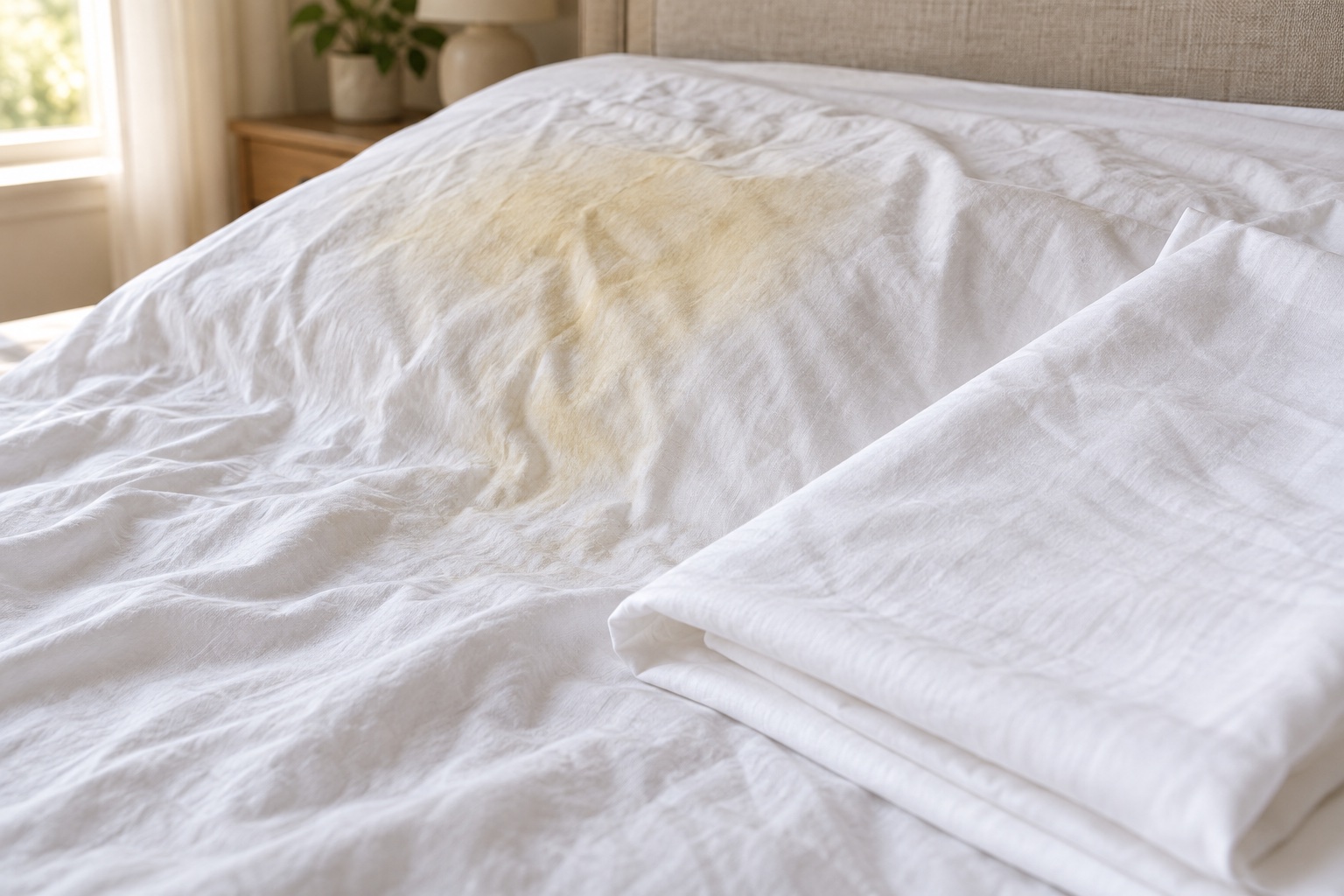
Yellowing on the side you sleep on calls for a different response from orange marks appearing across a freshly washed load. Before adding a whitener, check where the color sits, when it appeared and whether the cloth still feels sound. Cleaning may improve removable soil or deposits; it cannot rebuild damaged cotton. No treatment guarantees that an old sheet will return to its original white.
Match the yellowing to a likely cause
Use these observations to choose what to investigate. Several causes can coexist, and appearance alone cannot identify a chemical or prove what happened.
| What you notice | What to investigate first |
|---|---|
| Yellowing around the pillow area or mainly on the usual sleeping side | Body oils, perspiration and products transferred from skin |
| General dullness with a coated feel, powdery streaks or poor rinsing | Detergent residue, an overloaded washer or mineral deposits |
| Stiff fabric plus chalky deposits on taps or similar trouble with other laundry | Hard water; confirm with your water supplier rather than judging the sheet alone |
| Yellow-orange or brown marks, especially across a load or after bleach | Iron or rust in the water or equipment; this differs from ordinary water hardness |
| A new change immediately after bleaching | A bleach-sensitive fiber, finish or an iron-related reaction |
| Yellowing noticed after storage, especially at folds or the exposed surface | Old soiling, storage conditions and possible aging or light damage |
| A changed exposed face or yellowing after prolonged sun exposure or excessive heat | Light or heat damage; check for weakness before washing again |
The American Cleaning Institute’s troubleshooting guide separates body-soil yellowing, mineral residues and rust stains. Treat these as different branches, rather than assuming every yellow sheet needs stronger bleach.
Read the labels and test before treating
Check both the sheet’s care label and the cleaning product directions. White fabric is not automatically chlorine-bleach safe, particularly if it includes stretch fibers, trim or a sensitive finish. Test the intended treatment on an inconspicuous hem or inside corner using the product’s stated method. Stop if the area changes color or texture.
Never mix chlorine bleach with vinegar, acidic cleaners, rust removers or ammonia. Poison Control explains that bleach and acids can release dangerous chlorine gas. Do not combine stain-removal recipes or pour a new cleaner into an existing treatment bath. Use products only in the combinations their manufacturers explicitly permit, with the ventilation and protection specified on the label.
Choose the cleaning step that fits the problem
Yellowing follows body contact
First, pretreat the affected area with a laundry prewash product or liquid laundry detergent suitable for the sheet. Follow its application and contact-time directions; do not scrub aggressively. Next, wash with the detergent dose appropriate to the load and soil level, at a temperature permitted by the care label, leaving room for the sheet to move.
ACI’s laundry guidance supports pretreating greasy soils and inspecting wet laundry before drying. If yellowing remains, reassess it before using dryer heat, which can set some stains. The sheet-washing guide covers the normal wash routine; the stain-removal guide covers other localized marks.
The sheet feels coated or shows detergent streaks
First, check the detergent measurement and whether the drum was packed too tightly. Bosch identifies overdosing and overloading as causes of detergent left on laundry. More detergent is not the default solution to suspected detergent residue.
Then use the washer’s rinse function as directed in its manual, without adding another cleaner, and inspect the result. For subsequent washes, correct the dose and load size. If the washer is not rinsing or draining properly, address that problem before repeating stain treatments.
Hard water or iron is the stronger clue
For hard water, check your supplier’s water information and the detergent’s hardness-specific directions. A compatible laundry water conditioner may help where its label allows it; avoid an improvised acid soak as a universal answer. If the problem affects other items too, investigate the water and washer rather than repeatedly treating the same sheet.
For suspected rust, do not add chlorine bleach. University of Georgia Extension warns that chlorine can set rust stains. Use only a rust-removal product specifically intended for washable fabrics and compatible with the sheet, after a concealed-area test. If bleach has already been used, do not follow it with an acidic rust remover; obtain the product manufacturer’s instructions for safe handling first.
The yellowing appeared after bleaching
Stop bleaching and check the fiber, finish and product instructions. New Mexico State University explains that chlorine bleach can discolor incompatible materials, react with iron and damage fabric. Repeating the same treatment at a stronger concentration may make matters worse.
If the fabric remains sound and its label permits it, consider a suitable non-chlorine oxygen whitener. OxiClean’s bedding instructions explain why the specific product matters: dose, application method and fabric exclusions vary. Follow the product you actually have for dilution, soaking time and washing temperature. There is no single recipe established here for every yellow cotton sheet.
The sheet yellowed in storage or after drying
Unfold it and inspect for old stain patterns, dampness, thin spots and weakened folds. If the cloth is sound and washable, try a normal label-compliant wash first. For persistent marks, choose the matching branch above; do not assume the whole sheet needs a prolonged bleach bath.
The Canadian Conservation Institute describes yellowing and weakening caused by light and UV exposure, with heat and moisture accelerating some deterioration. Long sun exposure is therefore not a guaranteed whitening cure. If the fabric has scorched, become brittle or lost strength, further washing cannot restore the damaged fibers. For routine drying choices, see drying cotton safely.
Prevent the next round of yellowing
During washing
- Wash before body soil becomes heavily established, adjusting the routine to actual use.
- Measure detergent for the load, soil and water conditions; avoid packing the drum so tightly that sheets cannot move.
- Inspect stains before drying and correct recurring rinse or water problems instead of adding more products.
During drying
- Follow the sheet’s permitted drying method and heat setting.
- Remove it when dry rather than continuing unnecessary heat exposure.
- If line drying, bring it in once dry rather than leaving it in strong sunlight as a whitening treatment.
Before storage
- Put sheets away clean and completely dry.
- Choose a clean, dry cupboard protected from direct light; avoid hot, damp storage locations.
- Use a clean fabric cover where needed rather than enclosing damp cloth in a sealed bag. CCI’s basic textile-care guidance explains why moisture-trapping storage is a concern. The cotton storage guide covers everyday arrangements.
When to replace the sheet
A yellow tint alone does not require replacement if the fabric is otherwise clean, comfortable and sound. However, replace a sheet that has brittle patches, tears at weakened areas or has worn noticeably thin. Stop escalating treatment when a suitable wash and the appropriate stain treatment fail to produce useful improvement, especially if the cloth is weakening.
If permanent discoloration makes the sheet unsuitable for your bed, replacing it is reasonable. You do not need to keep trying stronger mixtures. Before buying the replacement, correct any recurring dosing, rinsing, water or storage problem so the new set does not face the same conditions.
How this guide was prepared
This guide draws on laundry, appliance and textile-care guidance consulted on October 26, 2026. No sheets or cleaning products were tested for this guide. Stain location and timing offer clues, not a confirmed diagnosis. Product directions and the sheet care label determine suitable treatments. Conservation sources explain deterioration and storage; their specialist washing procedures are not household laundry instructions.
Sources and scope
- Laundering Problems & SolutionsAmerican Cleaning Institute
Body-soil yellowing, inadequate washing, detergent/mineral residues and rust-related discoloration.
Accessed 2026-10-26 - Laundry BasicsAmerican Cleaning Institute
Pretreatment, inconspicuous-area testing, correct detergent dosing and checking stains before drying.
Accessed 2026-10-26 - My clothes are covered in detergentBosch
Excess detergent and overloading can leave residues because washing and rinsing are impaired.
Accessed 2026-10-26 - Getting Clothes CleanNew Mexico State University Cooperative Extension
Fabric and finish compatibility with chlorine bleach; iron-related rust staining and possible fabric damage.
Accessed 2026-10-26 - Remove Stains From Iron, RustUniversity of Georgia Cooperative Extension
Avoiding chlorine bleach on rust; concealed-area testing and following fabric rust-remover instructions.
Accessed 2026-10-26 - How to Wash White Clothes & BeddingOxiClean
Product-specific oxygen-whitener use, care-label temperature limits and excluded fabrics.
Accessed 2026-10-26 - No, vinegar is not always safeNational Capital Poison Center
The danger of mixing vinegar and chlorine bleach.
Accessed 2026-10-26 - Chlorine gas: Get the factsNational Capital Poison Center
Avoiding bleach mixed with acids or ammonia.
Accessed 2026-10-26 - Caring for textiles and costumesCanadian Conservation Institute
Light and UV can cause yellowing and fibre weakening; heat and moisture can accelerate deterioration.
Accessed 2026-10-26 - Basic care: TextilesCanadian Conservation Institute
Preventive textile storage, light protection and avoiding moisture-trapping storage materials.
Accessed 2026-10-26
Questions & discussion
Share a question or a useful experience about this guide. Comments appear immediately. Your name and comment are public. Email is optional and stays private; reply emails are not enabled yet. Comment privacy.