
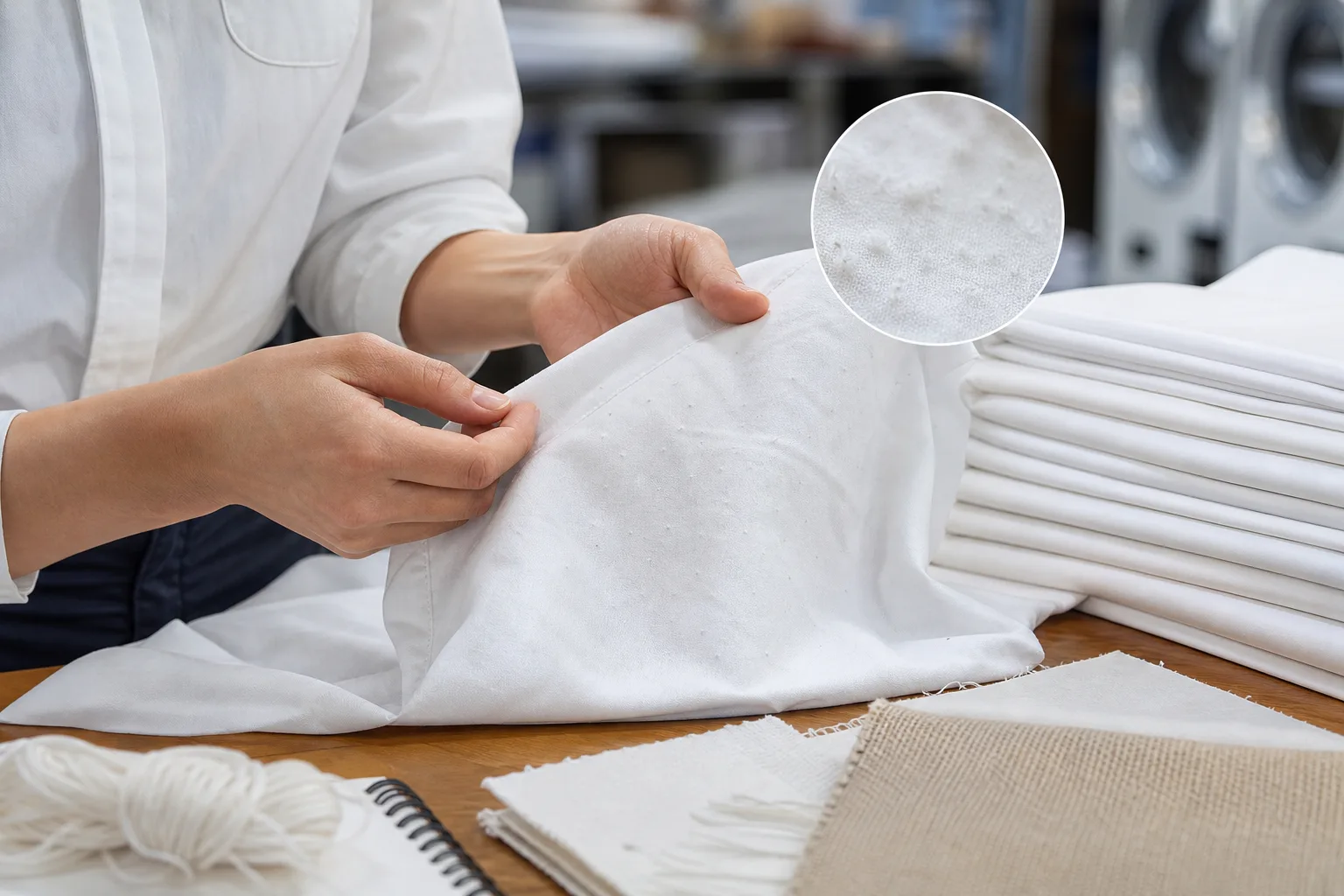
Cotton sheets pill when fibers protruding from the fabric surface become entangled and remain attached as small balls. Friction during sleeping, washing or drying can help those fibers work outward and tangle, but friction is only part of the explanation. Fiber dimensions, yarn structure, weave or knit construction, finishing and the sheet’s end use can all affect the result. A pill that appears after laundering therefore does not, by itself, prove that the wash caused a defect or that the user did something wrong. Start by distinguishing attached pills from loose lint and general fuzz, then document where and when the change appeared before altering care or contacting the seller.
1. Identify pills, loose lint and surface fuzz
These surface changes can look similar in a photograph, but they are not interchangeable. Correct identification makes a seller inquiry more useful and reduces the risk of trying an unsuitable treatment.
| What you see | Practical description | What to record |
|---|---|---|
| Attached pills | Small, compact balls or knots of entangled fiber that remain anchored to the sheet surface. | Size, density, color and whether they resist a light touch. |
| Loose lint | Detached fibers or soft debris that can usually be lifted, shaken or collected without pulling at the fabric. | Whether it appeared in the dryer filter, washer, packaging or on another item. |
| General fuzz | A raised or hairy surface without clearly defined balls. | Whether the fuzz is even across the sheet or concentrated in high-contact areas. |
| Snags or pulled yarns | Loops, lines or individual yarns projecting from the construction. | Nearby rough objects, sharp hardware and the exact damage location. |
CottonWorks defines pills as small balls of entangled fibers attached to a fabric surface and notes that pilling may occur alongside fuzzing, color change or other surface effects. Its technical discussion also describes pilling as a complex property rather than the result of one universally identifiable cause. See the CottonWorks garment durability and pilling overview for the underlying textile context.
Do not pull aggressively at an uncertain spot to test it. That can change the evidence or damage a yarn. Instead, inspect the sheet in bright, indirect light and take both a close photograph and a wider photograph showing the location.
2. Understand why cotton sheets can pill
Fiber properties influence the surface but do not guarantee the result
Cotton fibers are spun together to make yarn. Fiber length, fineness, strength, maturity and uniformity can influence how that yarn is made and how smooth its surface becomes. Longer fibers can support finer, smoother yarns under suitable manufacturing conditions, but a fiber name or origin claim is not a pill-free guarantee. “Long staple,” “extra-long staple,” “Egyptian,” “Pima” and similar marketing descriptions do not disclose every relevant feature of the finished fabric.
A label stating “100% cotton” identifies fiber content; it does not report yarn quality, surface hairiness, fabric specifications, finishing conditions or measured pilling resistance. For more detail on the mechanism, read how textile pilling develops.
Yarn structure affects how fibers are held
Sheets may use carded or combed cotton and yarns produced by ring, open-end or air-jet spinning, among other options. Combing removes some short fibers and impurities before spinning, while each spinning system creates a different yarn structure. These distinctions can influence smoothness and performance, but none should be treated as a standalone quality score. The complete yarn specification, fabric design, finishing and intended use still matter.
Construction and finishing also matter
Percale, sateen, flannel and jersey are different constructions, not grades of guaranteed durability. Percale is generally a plain weave, sateen uses a satin-type weave, flannel has a brushed surface and jersey is knitted. Their exposed surfaces and expected hand feel differ, so they may not develop or display fuzz in the same way.
The CottonWorks practitioner’s guide to cotton sheeting identifies fiber type, spinning system, yarn count, fabric weight, construction and finishing as interacting sheet specifications. The guide provides construction context; it does not establish that a particular weave, thread count or cotton name will resist pilling.
Finishing can alter initial smoothness, softness or appearance. Because finishes and mechanical treatments vary, a soft showroom hand is not proof of long-term surface performance. Likewise, a high thread-count number alone does not reveal the quality of the fibers, yarns or finish and should not be used to diagnose pilling.
3. Record the label, onset and damage location
Document the sheet before changing the routine or removing anything. A dated record helps separate observation from assumption and gives the seller information that can be compared with the product description, lot details and care instructions.
Capture the product information
- Photograph the fiber-content and care labels while they remain legible.
- Save the order confirmation, product listing, packaging and any fiber, weave, finish or certification claims.
- Record whether the item is a fitted sheet, flat sheet or pillowcase and whether matching pieces show the same change.
- Note the labeled construction, such as percale, sateen, flannel or jersey, without treating that term as a performance rating.
- Record the purchase and first-use dates if known, but do not estimate them as exact dates when you are uncertain.
Map where the change appears
Location can narrow the questions even when it cannot prove the cause. Record whether pills or fuzz are widespread or concentrated at the foot of the bed, torso area, edge, elasticized corner, underside or a single contact point. Also check whether the sheet has rubbed against a rough mattress cover, bed frame, zipper, hook-and-loop fastener, pet claw, laundry accessory or another coarse textile.
Compare the fitted sheet, flat sheet and pillowcases under the same light. If one component is affected more than the others, record that difference rather than assuming all pieces have identical construction or exposure.
4. Check avoidable friction within the permitted care
Friction is involved in the physical development of pills, but the visible outcome depends on the fabric’s existing susceptibility. Begin with the product’s own care instructions. Do not exceed a labeled temperature, use an unapproved bleach or substitute a drying method simply because general cotton advice recommends it.
Review washing conditions
- Check whether the sheets were washed with towels, denim, garments with zippers, hook-and-loop closures or other abrasive items.
- Record whether the machine was tightly packed, normally loaded or lightly loaded.
- Note the selected cycle, water temperature and detergent rather than describing the wash only as “normal.”
- Check pockets, fasteners and the washer drum for rough surfaces or trapped objects.
- Record whether the sheets were washed separately before first use and whether lint-producing items shared the load.
Review drying and bed contact
- Record the drying method, heat setting and approximate cycle duration.
- Note whether the sheets were repeatedly dried beyond the point at which they were dry.
- Check the dryer drum and lint screen for unusual debris or a rough area.
- Inspect mattress protectors, blankets, sleepwear and bed-frame contact points that repeatedly rub the affected location.
If the care label permits a less intensive option, a future wash with fewer abrasive items and no overloading may reduce avoidable mechanical contact. Make only one clearly recorded adjustment at a time. Changing detergent, cycle, temperature, load composition and drying method together makes the outcome difficult to interpret. General washing guidance is available in the cotton washing guide, but the sheet manufacturer’s instructions remain the product-specific reference.
5. Choose a bounded next step
When to contact the seller
Consider contacting the seller or manufacturer if attached pills appeared early, are extensive, recur after removal, affect only one item from a matching set or conflict with an explicit performance claim. Provide facts rather than assigning blame: identify the item, label, first observed date, affected locations and routine used. Ask whether the product has known care limitations, whether your photographs appear consistent with pilling and what remedy or inspection process is available.
A seller may have product-specific records that a consumer does not, but photographs alone may still be insufficient for a definitive technical diagnosis. Avoid claiming that fiber origin, thread count, a named weave or one wash setting conclusively caused the result unless supporting evidence exists.
If you consider removing pills
Use a removal device or method only when the product manufacturer approves it. Test cautiously on a small, inconspicuous area first and stop if yarns pull, the surface thins, color changes or the construction becomes distorted. Do not present removal as a permanent cure: it addresses existing pills but does not necessarily change the underlying tendency of fibers to work out of the fabric.
If the sheet is under a return period or warranty, ask the seller before altering it. Removing pills may erase useful evidence or affect the seller’s inspection process. A dated photograph taken before any action preserves the original condition.
Keep sustainability claims proportionate
Care that preserves usable bedding can help avoid unnecessary replacement, but one surface observation cannot establish a product’s overall environmental performance. Fiber content, durability, manufacturing, chemical processing, laundering, repair, disposal and actual service life are separate considerations. Do not assume that “natural,” “organic,” “premium” or “pill resistant” by itself proves a broad sustainability benefit.
6. Copy the observation and seller-contact record
Copy the blank record below and complete it with your own dated evidence. Keep photographs under your control and remove order numbers, addresses or other personal information before sharing them publicly. Leave uncertain fields marked as unknown rather than reconstructing details from memory.
| Check | Observed fact / photo reference | Care label / routine | Change attempted (if any) | Result / date | Unresolved / seller question |
|---|---|---|---|---|---|
| Attached pills versus loose lint | |||||
| Location and first observed date | |||||
| Fiber / weave label | |||||
| Load/friction and drying history | |||||
| Contact or cautious care adjustment |
This record is a troubleshooting aid, not a laboratory pilling score. Cotton Good has not inspected your sheets, performed laundering trials or verified a particular seller’s claims. If you want a structured example of how laundering observations can be documented without turning them into universal product conclusions, see the cotton sheet wash-test framework.
Frequently asked questions
Why do cotton sheets pill after washing?
Washing can supply friction that helps protruding fibers entangle, so pills often become visible during or after laundering. However, the result also depends on the sheet’s fibers, yarn structure, construction and finishing. Appearance after a wash does not prove that washing alone caused the problem.
Does pilling mean cotton sheets are low quality?
Not automatically. Pilling is influenced by several interacting textile and use factors, and a photograph cannot establish overall quality. Early or extensive pilling may justify a seller inquiry, especially when it conflicts with a specific product claim.
Can loose cotton lint be mistaken for pilling?
Yes. Lint consists of detached fibers or debris, while pills are compact fiber tangles that remain attached to the fabric. General fuzz is a raised surface without clearly defined balls. Record which condition you see before attempting removal.
Can I use a fabric shaver on cotton sheets?
Only if the sheet manufacturer approves the method. First photograph the original condition and test cautiously on a small, inconspicuous area. Stop if the device catches yarns, thins the surface or distorts the fabric.
How this guide was prepared
This guide is based on desk research of CottonWorks technical material about pilling, durability and cotton-sheet construction, accessed on 2026-10-09. No sheets were inspected, washed or tested; no laboratory scores, customer cases, seller records, certifications or first-hand product results were used.
Sources and scope
- Garment DurabilityCottonWorks, Cotton Incorporated
Defines attached pills and explains that pilling is affected by interacting factors including fiber type and dimensions, yarn and fabric construction, finishing and end use.
Accessed 2026-10-09 - A Practitioner’s Guide to Cotton SheetingCottonWorks, Cotton Incorporated
Provides cotton-sheet construction context, including the roles of fiber type, spinning system, yarn count, fabric weight, weave or knit construction and finishing.
Accessed 2026-10-09
Questions & discussion
Share a question or a useful experience about this guide. Comments appear immediately. Your name and comment are public. Email is optional and stays private; reply emails are not enabled yet. Comment privacy.