
If cotton sheets already work for you, is it worth trying a set advertised as bamboo? The answer depends on what is actually in the fabric and what you want to feel at night. Start with the fiber label, then compare the specific set’s feel, care and return terms. No sheets or products were tested for this guide.
First, identify the fiber
One recurring concern is that a product described simply as bamboo may lead a shopper to imagine the finished sheet is made from the plant in the same way that cotton comes from cotton fiber. Some buyers focus on that distinction because the name shapes what they expect to buy, even when they might otherwise enjoy the fabric.
Other sleepers place more weight on how the sheet feels than on the plant name. They may still prefer a soft set after learning that it uses a manufactured fiber. The useful question is therefore twofold: is the label clear, and does this particular fabric suit you?
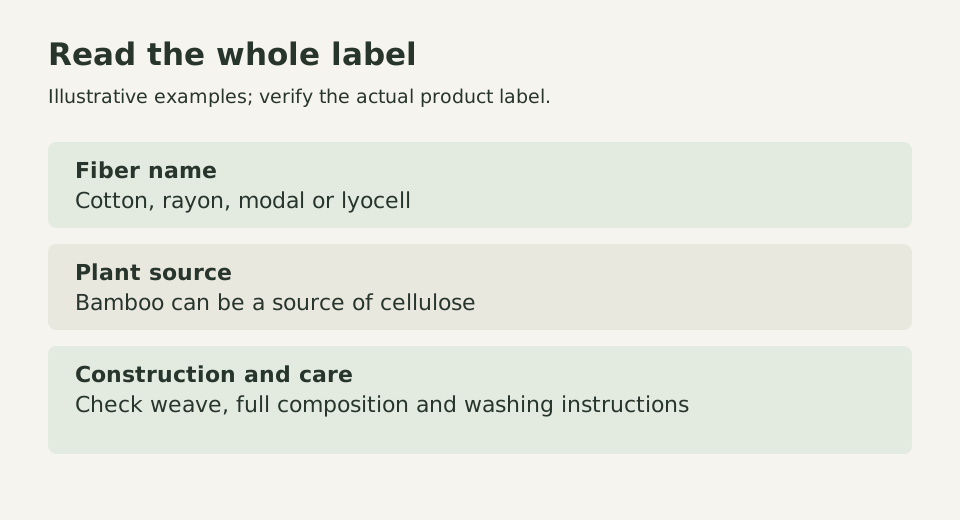
For US shoppers, the Federal Trade Commission says rayon made using bamboo as its plant source must be identified by the fiber name, such as “rayon made from bamboo.” A headline that says only bamboo does not give you enough information to identify the finished fiber. Labeling rules in other markets may differ.
Find the complete fiber composition on the product page or sewn-in label. Look for the generic fiber name, such as rayon, lyocell or modal, and then check any stated plant source. If the listing does not identify the fiber, ask the seller for the label rather than assuming which process was used. The cotton label guide explains other details to check.
TENCEL is a brand name, not a generic fiber name; its producer Lenzing makes both lyocell and modal fibers. Lenzing describes its lyocell process as a closed loop and says it recovers more than 99.8% of the solvent for reuse. The company describes its modal process as a modified viscose process. These are producer statements about its processes, not proof that every similarly named sheet was made in the same way.
Will it feel cool or hot?
Experiences run in opposite directions. Some sleepers say their bamboo-labeled sheets feel cool and soft, including in summer. Others describe their own sets as warm, close to the body or uncomfortable after sweating, and prefer the cotton sheets they already know. Both reports are useful clues about preferences, not a test result.
Those accounts do not control the weave, fabric weight, room temperature or brand, and often do not identify the finished fiber. They cannot tell you how much cooler one category is than the other. Even when a shopper reports a strong difference, several details of the two products may have changed at once.
A sheet can be pleasant to touch at bedtime and still feel different after a warm night. Some people welcome a smooth, body-following surface; others dislike a sensation of damp fabric against the skin. Neither experience predicts how another person will feel on a different set.
Compare weave and any disclosed fabric weight with a set you already like, and check whether a trial is returnable. If you sleep hot, pay attention to the sheet together with the room and other bedding. The breathability guide and hot sleeper guide offer more questions to ask. No reliable matched cooling ranking was established in the evidence used here.
Choose the feel you actually enjoy
Fans of bamboo-labeled sheets often value a smooth, soft feel and the way the fabric drapes. Some say that sensation is precisely why they would try such sheets again. A different group prefers the crisper, less body-hugging feel they associate with cotton, and finds a slicker surface less comfortable.
The preference is personal. A sleeper who likes a close, smooth surface may describe a sheet as soft; another may describe the same kind of contact as clingy. Cotton itself is sold in different weaves, and products using manufactured cellulosic fibers also vary, so neither broad label guarantees one hand or drape.
The original question was how large the comfort difference would be for someone already happy with cotton. The experiences do not give a numerical answer or a controlled side-by-side comparison. The accounts leave that comparison to each sleeper’s own experience.
Consider wear before choosing
Some owners report pilling or sheets wearing out sooner than expected. Others say their own bamboo-labeled sets remained comfortable and in good condition for years, and use that experience as a counterexample. These are individual reports about different products, not a matched comparison of the two fibers.
The disagreements leave practical questions unanswered: what exact fiber and weave were used, how often the sets were washed, and whether the fabric was treated in the same way? Without those details, a short-lived set does not establish that all such sheets wear quickly, and a durable set does not guarantee a long life for another purchase.
At the fiber level, standard viscose loses strength when wet, modal has higher wet strength than standard viscose, and lyocell has relatively high tenacity among cellulosic fibers. These are fiber-level descriptions, not a ranking of finished-sheet durability or pilling.
Make sure the care fits your routine
The conflicting wear reports also make care part of the buying decision. If one set needs gentler handling than you are prepared to give it, that practical mismatch matters regardless of how soft it feels. The accounts do not establish a universal washing recipe or explain every case of wear.
Read the actual product care label before ordering and follow it for washing and drying. For a viscose item, handle the wet fabric gently and avoid wringing; dry it as the label directs. The available evidence does not establish one water temperature, dryer setting or softener rule for every sheet.
If the care instructions and return policy allow, wash a new set once before judging its feel and fit. This is a practical way to assess the set under your own routine; it is not evidence that washing removes chemical residues or prevents a skin reaction. Keep the label and order details while you assess it.
Handle skin, odor and certification concerns
A few people report a rash or an unpleasant smell and suspect a connection with processing; others report no such problem. Those are individual experiences without enough product, washing or medical information to establish a cause. A favorable account cannot guarantee that someone else will have the same experience.
The disagreement also leaves a purchasing question: what can a label actually tell you, and does it cover the sheet you plan to use? The experiences do not establish what any particular certificate covers or what caused a reaction.
OEKO-TEX STANDARD 100 is an independent test for specified harmful substances in certified textile products. According to Hohenstein, all components of an eligible article must meet the applicable criteria; bedding belongs to Class II for direct skin contact. Check the certificate and its scope for the specific article. This certification is not an environmental assessment or proof that the material is organic.
GOTS addresses a different scope: its requirements cover the textile chain and include restrictions on chemical inputs, wastewater treatment and social criteria. Check what an individual certificate covers rather than treating the two labels as interchangeable. The certifications guide provides a starting point for checking claims.
Read environmental claims separately
Some shoppers are concerned that a plant name can make a manufactured fabric sound automatically natural or environmentally preferable. Others point to differences between manufacturing processes and do not accept that a fiber should be judged solely by whether its source is natural. Those positions use different criteria and do not settle the impact of a particular set.
The FTC has warned that rayon manufacturing typically uses environmentally toxic chemicals and can release hazardous air pollutants. Lenzing reports solvent recovery for its own lyocell process, as described above. Neither statement is a matched life-cycle comparison of a particular cotton set and a particular manufactured-fiber set; do not read an overall environmental winner into the fiber name alone.
A practical pre-order checklist
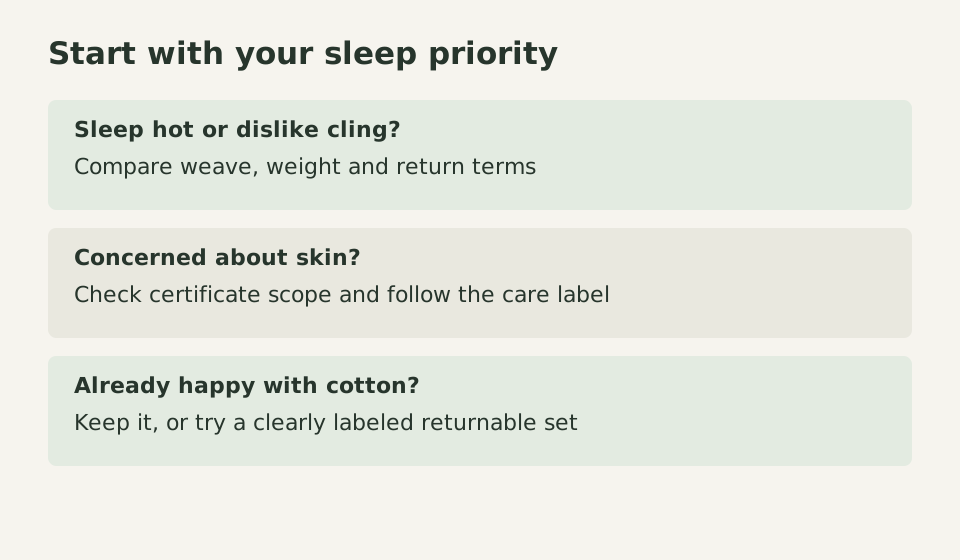
If your cotton set is comfortable and its care works for you, keeping it is a reasonable default. If a smooth, draping feel is appealing, a clearly labeled alternative may be worth trying. If the fiber name or return conditions are unclear, wait for the seller to clarify them before ordering.
Before buying: (1) check the fiber names and composition; (2) ask what plant source and process the seller claims; (3) compare weave and your own feel preferences; (4) check the exact care label and return conditions; (5) verify any certificate for the actual product; and (6) keep the listing and label, then wash once if permitted before assessing the set.
How this guide was prepared
This guide uses published guidance and individual sleep experiences; no sheets or products were tested. Individual reports do not establish comparative performance.
Sources and scope
- Reddit discussion · r/Bedding · 2024-07-28 · 124 comments
- Bamboozled by Bamboo Sheets · r/Bedding · 2022-09-16 · 101 comments
- FTC Warns 78 Retailers to Stop Labeling and Advertising Rayon Textile Products as BambooFederal Trade Commission
US naming context.
- How to Avoid Bamboozling Your CustomersFederal Trade Commission
Rayon labeling and manufacturing claims.
- OEKO-TEX STANDARD 100Hohenstein
Testing scope and bedding product class.
- GOTS: How It WorksGlobal Standard
Textile chain certification scope.
- TENCEL Lyocell and Modal FibersLenzing
Producer description of fiber processes and solvent recovery.
Questions & discussion
Share a question or a useful experience about this guide. Comments appear immediately. Your name and comment are public. Email is optional and stays private; reply emails are not enabled yet. Comment privacy.