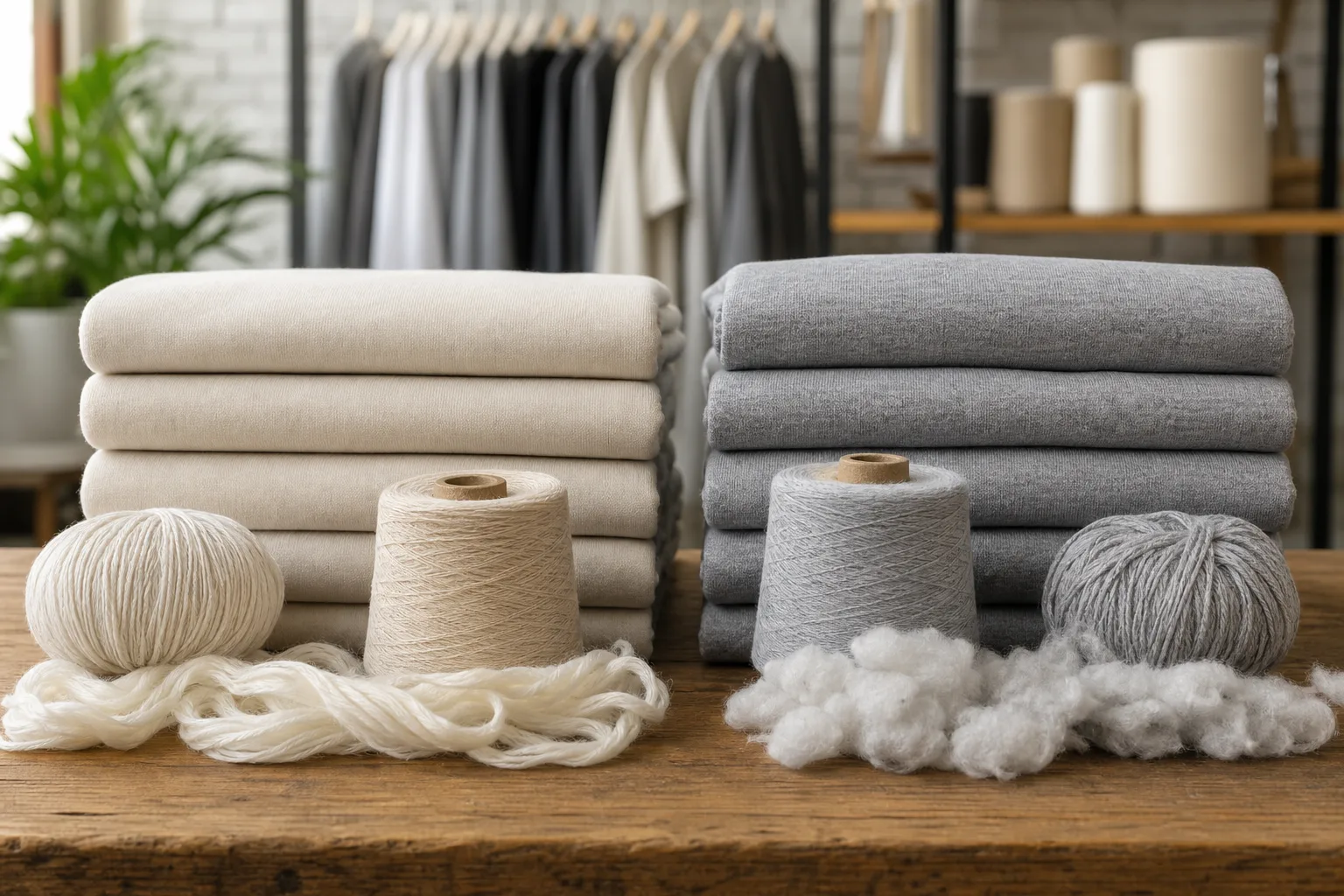
Combed cotton is usually the better choice when a smooth surface, fine yarn, soft hand and consistent appearance justify a higher cost. Carded cotton is often better value for heavier, less refined or price-sensitive products. The distinction describes yarn preparation, not a cotton species, fabric construction or verified level of finished-product performance. A well-engineered carded fabric can outperform a poorly constructed combed one, so buyers should treat “combed” as useful process information rather than a complete quality grade.
What separates combed cotton from carded cotton?
All conventionally spun cotton is carded first
Carding opens, cleans, separates and partially aligns cotton fibers, forming them into a continuous strand called sliver. It also removes dust, trash, neps—small fiber entanglements—and some short fibers. CottonWorks describes carding as the foundation of yarn manufacturing because this is the point at which loose cotton first takes on a textile form. Its fiber-preparation guide explains the process in detail.
A “carded cotton” yarn normally follows the required carding and drawing stages but does not receive the separate combing operation. The phrase does not mean the cotton was left dirty or unprocessed. Carded yarn can be used in dependable T-shirts, sweatshirts, denim, towels and many other textiles when its yarn size, spinning system and fabric construction suit the product.
Combed cotton receives an additional preparation step
For combed yarn, carded and drawn fibers are prepared as a lap and passed through a combing machine. The operation removes more short fibers, residual neps and unwanted matter while making the retained fibers more parallel. What counts as a short fiber depends on the raw cotton and machine settings; CottonWorks notes that the process commonly targets fibers around one-half inch or shorter.
The more uniform fiber assembly can be spun into finer yarn counts and tends to produce yarn and fabric with improved smoothness, drape and hand. Combing also adds processing and removes some usable mass from the main yarn stream. The removed material, known as comber noil, may be recovered for less demanding yarns or suitable nonwoven products rather than automatically being discarded.
Combed vs carded cotton at a glance
| Factor | Combed cotton | Carded cotton | Buying implication |
|---|---|---|---|
| Processing | Carded, then combed to remove additional short fibers and improve alignment | Carded and drawn without the extra combing stage | Combed yarn requires more processing and usually costs more when other variables are comparable |
| Typical surface | Smoother and more even, with fewer projecting short fibers | May appear fuzzier or more irregular | Combed yarn is useful for clean jersey surfaces, fine underwear and smooth bedding |
| Hand and drape | Often softer and more fluid, especially in finer yarns | Can feel fuller, more textured or slightly coarser | Finishing can substantially change either result, so assess the finished fabric |
| Yarn range | Supports finer yarn counts more readily | Common in medium and coarse yarns | Ask for yarn count rather than assuming every combed product is lightweight |
| Durability | Removal of short fibers can support stronger, more uniform yarn and a cleaner surface | Can still be highly durable in suitable yarn and fabric constructions | Request strength, abrasion and pilling results for the actual product |
| Value | Worth considering where next-to-skin comfort or refined appearance matters | Often economical for casual, heavyweight or utility products | Pay for a relevant performance benefit, not the word alone |
These are typical tendencies, not guaranteed outcomes. The comparison becomes unreliable if the products use different cotton grades, yarn counts, spinning systems, fabric weights, finishes or care treatments.
Why combing can improve feel and durability
Fiber length and uniformity affect yarn behavior
Short fibers have less length available for overlap and friction within a spun yarn. Removing a controlled portion can produce a more uniform fiber supply with fewer loose ends at the yarn surface. Better alignment also helps a spinner make a finer, more even strand.
The raw cotton still matters. USDA cotton classification measures properties including fiber length, length uniformity, strength, micronaire, color and trash. These measurements apply to baled fiber, not directly to a finished shirt or sheet, but they show why two batches described as combed cotton need not start with equal material. USDA defines length uniformity as the uniformity index of parallel fiber lengths in a sample and strength as the force required to break a fiber bundle. See USDA Cotton Classing Services and Cotton Good’s explainers on staple length, length uniformity and fiber strength.
A smoother yarn does not guarantee a pill-free fabric
Combed yarn often begins with fewer short fibers capable of protruding from the surface, which may help create a cleaner appearance. It is still inaccurate to promise that it will not fuzz or pill. CottonWorks identifies pilling as a complex result influenced by fiber dimensions, fiber or blend type, yarn structure, fabric construction, finishing and end use. Learn more in the cotton pilling guide.
Durability likewise depends on more than combing. Yarn twist holds staple fibers together, while yarn ply, spinning method, stitch or weave, fabric density and finishing affect strength and abrasion behavior. CottonWorks notes that there are no universal durability levels suitable for every textile product; buyers and suppliers need performance requirements appropriate to the end use. Its garment durability guidance covers strength, abrasion and pilling.
Construction and finishing can outweigh the yarn label
Compare the complete fabric specification
A lightweight combed jersey and a heavy carded sweatshirt fleece are not competing versions of the same material. Fabric mass, yarn count, stitch length, weave or knit structure and density can dominate how thick, warm, stable or resistant to wear a product feels. Ring, rotor and air-based spinning systems also create different yarn structures even when the same cotton preparation term is used.
For bedding, thread count should be read with yarn ply, weave, fabric weight and finishing rather than used as an isolated score. For T-shirts, examine fabric weight, stitch density, recovery, seam construction and dimensional stability. The relevant buying guides provide more context for cotton bed sheets and cotton T-shirts.
Finishing changes touch and laundering performance
Softeners, brushing, sanding, enzyme treatments, resin treatments and mechanical compaction can change the hand, surface and stability of both carded and combed fabrics. A carded fabric may be finished to feel very soft at purchase, while a combed fabric can feel firm because of high twist, dense construction or a particular finish.
Shrinkage is not determined by combing alone. CottonWorks attributes dimensional change to interacting variables that include fiber and yarn selection, fabric construction, wet processing, finishing, garment manufacture and care. Mechanical compaction, for example, can reduce residual length shrinkage by compressing the fabric structure. Follow the product’s care instructions and consult the cotton care hub rather than assuming “combed” means pre-shrunk or dimensionally stable.
How consumers should choose
Choose combed cotton when refinement matters
- Next-to-skin clothing: Fine T-shirts, underwear and baby garments may benefit from smoother yarn and fewer projecting fiber ends.
- Fine jersey and premium prints: A more even yarn surface can support a clean visual result, although printing quality still depends on preparation, colorants and process control.
- Smooth bedding: Combed yarn may contribute to an even surface in percale, sateen and fine knit bedding, but weave and finish remain essential.
- Products with demanding appearance standards: The process can be useful where surface fuzz, irregularity and yarn imperfections must be tightly controlled.
Choose carded cotton when function and price lead
- Heavy casualwear: Sweatshirts and substantial T-shirts may use carded yarn effectively where body and texture are desirable.
- Denim and utility fabrics: Durability can come from yarn size, twist, fabric density and weave without requiring combing.
- Price-sensitive basics: Avoid paying for additional preparation when the intended use does not benefit enough from a finer surface.
- Products judged by absorbency or bulk: In towels, pile construction, pile-yarn twist, density and finishing may be more useful buying information than a general combed-cotton claim.
Use this purchase checklist
- Confirm the fiber-content percentage and whether the product contains other fibers.
- Check whether “combed” describes all cotton yarns in the product or only selected components.
- Compare fabric weight, yarn count or ply, construction and finish where disclosed.
- Look for product-specific results for shrinkage, pilling, colorfastness, tensile or bursting strength, and abrasion where performance matters.
- Inspect seams, surface evenness, fabric density and recovery; use the cotton quality buying guide for practical checks.
- Judge value against the intended use. A higher price is not evidence that combing produced a meaningful benefit.
What labels and sustainability claims actually establish
“Combed” is not a fiber-content grade
In the United States, textile labeling rules focus on matters including fiber identity and percentage by weight. The FTC explains that a product should not be called “100% cotton” unless it contains only cotton apart from qualifying trim, and named cotton types must be represented truthfully. FTC guidance on labeling cotton products provides examples.
“Combed cotton” instead describes a manufacturing step. By itself, it does not disclose cotton species, staple class, organic status, yarn strength, fabric weight, thread count, shrinkage, pilling resistance or country of origin. It also does not show that the finished product passed any particular laboratory test. Industry buyers should define measurable acceptance criteria and use appropriate textile tests rather than converting the term into a pass-or-fail quality specification.
Combing does not prove a product is more sustainable
The extra operation uses equipment and removes material from the primary yarn stream, but the environmental significance depends on mill efficiency, energy sources, yield, noil recovery, product durability and the rest of the supply chain. Conversely, choosing carded yarn does not by itself establish a lower-impact product. Neither term verifies farming practices, chemical management, traceability or certification.
Broad claims such as “green” or “eco-friendly” require evidence beyond the presence or absence of combing. The FTC advises marketers to qualify environmental claims with clear, specific benefits and to hold competent, reliable evidence for those claims. The FTC’s Green Guides summary explains this substantiation principle. Buyers evaluating environmental performance should ask which product stage a claim covers, what comparison is being made and which records or certification support it; the cotton sustainability hub explains how to examine such claims.
For sourcing decisions, specify the required cotton content, yarn preparation, yarn count, spinning system, fabric construction, finish and tested performance separately. That prevents “combed cotton” from carrying more meaning than the process can support.
Frequently asked questions
Is combed cotton always softer than carded cotton?
It is often smoother and softer because more short fibers are removed and the remaining fibers are better aligned. The final feel also depends on staple length, yarn count, twist, fabric construction and finishing, so the term does not guarantee softness.
Does combed cotton last longer?
Combing can support a stronger, more uniform yarn and a cleaner surface, but finished durability depends on yarn structure, fabric density, knit or weave, finishing, sewing and care. Product-specific strength, abrasion and pilling tests provide better evidence.
Is carded cotton low quality?
No. Carded cotton is standard cotton prepared without the additional combing operation. It can be appropriate for durable denim, sweatshirts, substantial T-shirts, towels and utility fabrics when the yarn and construction are engineered for the intended use.
Is combed cotton more sustainable?
The term alone does not establish environmental performance. Combing adds processing and removes some material, although clean comber noil may be used elsewhere. A credible sustainability comparison requires defined boundaries and evidence covering factors such as energy, yield, waste recovery, farming, processing and product life.
How this guide was prepared
This comparison is based on desk research of CottonWorks textile-manufacturing and quality-assurance guidance, USDA cotton-classification information, and FTC textile-labeling and environmental-claim guidance accessed on September 21, 2026. No laboratory testing, product handling, mill inspection, supplier audit or first-hand wear trial was conducted.
Review status: Publishable quality advisory.
Sources and scope
- Fiber Preparation for SpinningCottonWorks
Explains carding, drawing and combing, including fiber alignment, short-fiber removal, finer yarn production and possible uses for removed fibers.
Accessed 2026-09-21 - Cotton Fiber QualityCottonWorks
Describes how staple length, length uniformity, strength, micronaire, color and trash influence cotton processing and yarn quality.
Accessed 2026-09-21 - Cotton Classing ServicesUSDA Agricultural Marketing Service
Defines the instrument measurements used in USDA cotton classification, including fiber length, uniformity, strength, micronaire, color and trash.
Accessed 2026-09-21 - Garment DurabilityCottonWorks
Explains that strength, abrasion resistance and pilling depend on multiple fiber, yarn, construction, finishing and end-use variables.
Accessed 2026-09-21 - Calling It Cotton: Labeling and Advertising Cotton ProductsFederal Trade Commission
Provides U.S. guidance on truthful cotton fiber-content statements and advertising claims.
Accessed 2026-09-21 - Environmental Claims: Summary of the Green GuidesFederal Trade Commission
Explains why broad environmental benefit claims should be qualified and supported by competent, reliable evidence.
Accessed 2026-09-21