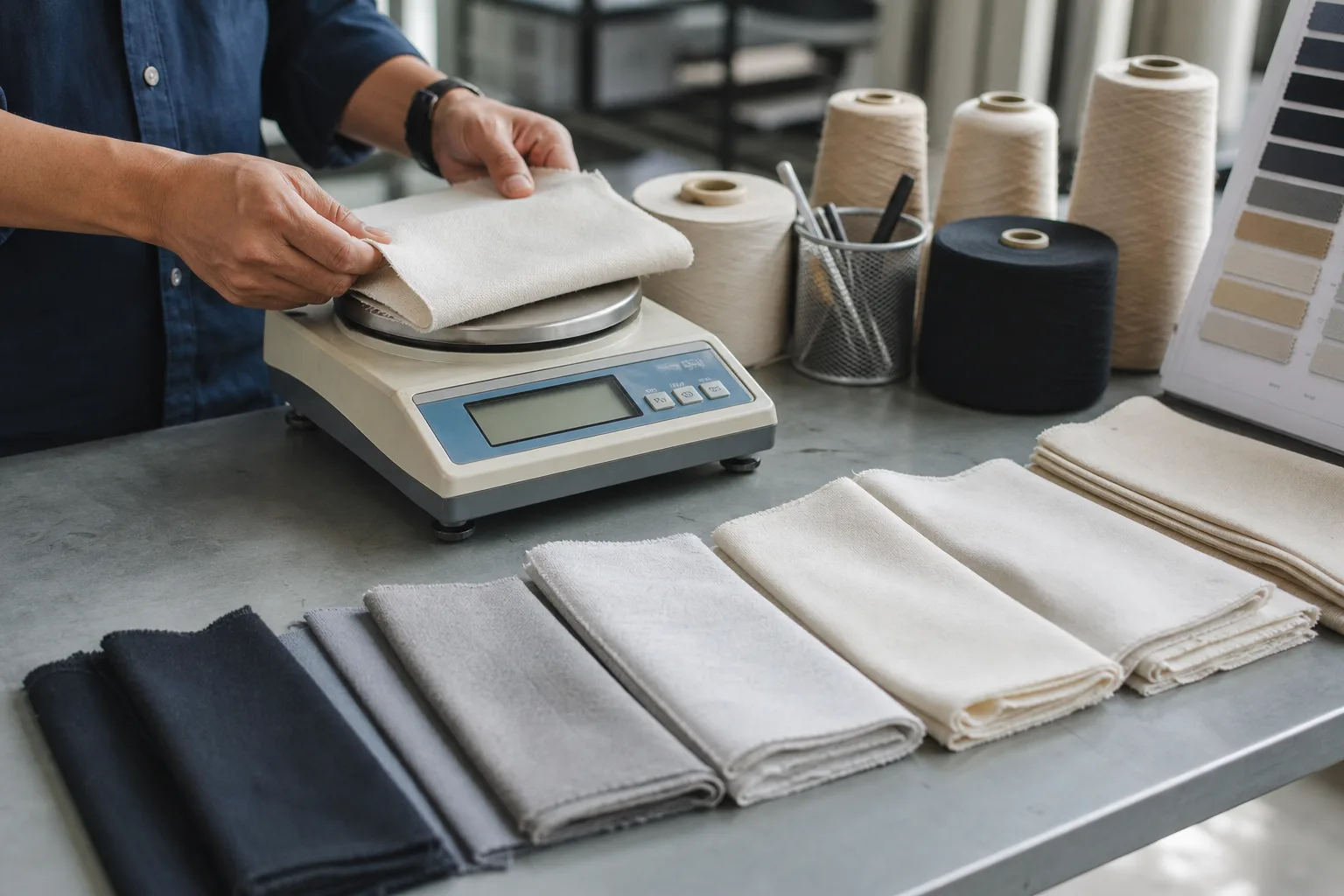
Cotton fabric GSM tells you how much one square meter of fabric weighs in grams. It is useful for comparing likely weight, substance, coverage and material yield, especially when two fabrics have similar fiber content and construction. It is not, by itself, a grade of cotton quality. A heavier fabric can use uneven yarn, weak construction or an unstable finish, while a lighter fabric can be made from well-selected fibers and fine, uniform yarn. For a sound buying decision, treat GSM as one specification in a system that also includes fiber properties, yarn type, fabric structure, finishing, test conditions and care.
What GSM measures—and what it does not
GSM means grams per square meter. A 200 GSM fabric has a mass of 200 grams for every square meter measured under the applicable sampling and conditioning procedure. In the United States, fabric weight may instead be stated in ounces per square yard. One ounce per square yard is approximately 33.91 GSM, so a 6 oz/yd² fabric is about 203 GSM.
GSM is mass per area, not thickness
Weight and thickness often move in the same direction, but they are not interchangeable. A compact woven fabric and a lofty brushed fabric can have similar GSM while feeling very different. Pile, loop length, yarn bulk, weave or knit geometry, compression and finishing all affect apparent thickness.
GSM is not a complete quality score
Raw cotton is classified using measurable properties such as fiber length, length uniformity, strength, micronaire, color and trash. USDA cotton classing does not assign a fabric GSM or certify the quality of a finished shirt, sheet or towel.[1] CottonWorks likewise explains that fiber length and uniformity influence yarn strength, evenness and processing performance.[2] Those fiber characteristics matter, but subsequent spinning, construction and finishing can preserve or undermine their advantages.
- GSM can indicate: fabric mass, relative substance and potentially greater material consumption.
- GSM cannot confirm: fiber length, yarn strength, abrasion life, pilling resistance, shrinkage, colorfastness or sewing quality.
- GSM comparisons work best when: the products have the same intended use, fiber blend, construction and finish state.
Light, medium and heavy cotton fabrics compared
There is no universal GSM boundary separating lightweight, medium-weight and heavyweight cotton. A weight that is substantial for a bedsheet may be unsuitable as a bath towel, while a normal towel GSM would be extremely heavy for a shirt. Use the following as application-specific orientation rather than as official quality grades.
| Product or construction | Published weight example | Likely buying implication | What GSM cannot settle |
|---|---|---|---|
| Percale sheet fabric | About 100–140 GSM in CottonWorks guidance | Relatively light, with the crisp character associated with percale construction | Yarn quality, shrinkage, tearing strength and finish durability |
| Sateen sheet fabric | About 120–155 GSM in CottonWorks guidance | More mass may support coverage and substance, but the smooth feel comes primarily from the weave and finish | Snagging, pilling, breathability or whether a high thread count is meaningful |
| Flannel sheet fabric | About 140 GSM described as good; 170–200 GSM as an upper, more durable range | Higher weight can provide more material for brushing, warmth and wear | Nap retention, yarn quality and shrinkage after laundering |
| Cotton towels | Roughly 400–600 GSM for lighter, faster-drying towels; 600–800 GSM for a plusher product | Higher GSM usually means more pile mass and a fuller hand within otherwise comparable towels | Loop security, absorbency rate, drying conditions and long-term lint loss |
| Denim | About 3.5–8 oz/yd² for many tops and shirts; 8–16.5 oz/yd² for many trousers, jeans and jackets | Heavier denim generally feels more substantial and structured | Fiber and yarn quality, stretch recovery, seam strength, dye behavior or comfort after break-in |
The sheet and towel examples come from CottonWorks buying guidance, while the denim ranges are drawn from its technical overview.[3][4][5] They are useful reference points, not guarantees that every product inside a range will perform alike.
How GSM changes feel, comfort and durability
Feel and drape
Lower-GSM cotton often feels lighter and may drape or move more easily, but yarn fineness and construction can reverse that expectation. A tightly constructed lightweight poplin may feel firmer than a heavier, loosely knitted jersey. Brushing, enzyme treatments, mechanical softening and applied softeners can also change the initial hand without changing the underlying fiber quality.
Coverage and opacity
More mass per area can improve opacity when comparing closely related fabrics. It is not a universal rule: dark color, yarn spacing, knit loop geometry and weave cover can make a lower-GSM fabric less transparent than a heavier but more open construction. Buyers evaluating shirts, underwear or bedding should assess opacity in the relevant stretched, backlit or in-use condition rather than relying only on a specification sheet.
Warmth and drying
Heavier fabrics place more material against or around the user and may provide greater warmth, but thermal comfort also depends on trapped air, surface structure, airflow, moisture and garment design. A plush towel may absorb more water per unit area but take longer to dry than a lighter towel under the same conditions. GSM alone does not establish breathability.
Durability
Within the same construction, extra material can provide a larger wear reserve. That does not make high GSM automatically durable. Fabric life can be shortened by weak or irregular yarn, low loop security, abrasive finishes, excessive residual shrinkage, poor colorfastness or unsuitable care. Evaluate relevant performance results through the fabric test explainers, not by weight claims alone.
Why two fabrics with the same GSM can perform differently
A specification of 180 GSM describes only the measured mass per area. It does not explain how that mass was created. Two 180 GSM cotton fabrics can differ substantially for the following reasons.
Fiber selection
Fiber length, uniformity, strength, fineness and maturity affect spinning behavior and yarn properties. Longer, more uniform cotton can support finer, more even yarn, but a fiber name or origin claim is not a finished-fabric test result. See the guides to staple length, micronaire, fiber strength and HVI testing.
Yarn system and yarn size
Carded, combed, ring-spun and open-end yarns can differ in evenness, hairiness, strength, hand and cost. Yarn size also changes how many yarns or loops are needed to reach a target weight. Compare combed and carded cotton and ring-spun and open-end yarn before treating equal-GSM fabrics as equivalent.
Woven or knitted construction
Wovens are defined partly by warp and filling yarn arrangement; knits by interconnected loops and variables such as stitch length and density. A compact woven fabric may resist distortion, while a knit at the same GSM may offer more stretch and softness. Even within sheets, percale and sateen produce different surfaces and drape at comparable weights.
Finishing and measurement state
Washing, relaxation, compaction, brushing, coating and chemical finishing can alter width, length, moisture content and mass per area. CottonWorks processing examples show that delivered and relaxed fabric dimensions and weight per area can differ.[6] Commercial specifications should therefore identify whether GSM applies to greige, finished, conditioned, relaxed or laundered fabric.
How to compare GSM before buying
Consumers can use this checklist for retail products, while sourcing teams can turn the same questions into specification and tolerance requirements.
- Match the product category. Compare towels with towels or similar T-shirt constructions with each other—not a towel number with a jersey number.
- Confirm fiber content. “Cotton feel” is not a fiber disclosure. In the United States, covered textile labels generally identify fibers by percentage of total fiber weight. A 100% cotton statement addresses composition, not GSM or performance.[7]
- Identify the construction. Record whether the fabric is woven or knitted, along with the weave, knit, pile or loop description.
- Ask which state was measured. Finished and relaxed GSM is more relevant to the purchased product than an unexplained greige-fabric number.
- Request a tolerance. A single target without an allowed manufacturing range is incomplete for commercial sourcing.
- Check dimensions after care. Shrinkage changes product size and can change mass per unit area even when total material mass changes little.
- Pair GSM with use-specific tests. Depending on the product, these may address dimensional change, bursting or tensile strength, abrasion, pilling, absorbency, colorfastness or seam performance.
- Compare total value. Consider usable life, comfort, laundering, drying time and construction—not just the highest GSM at the lowest price.
The practical verdict on cotton fabric GSM
Choose GSM by use, not by the assumption that heavier always means better. For comparable towels, a higher number commonly indicates a denser, plusher product, while a lower number may be easier to handle and faster to dry. In apparel, lighter fabric may be preferred for drape and warm conditions, while heavier fabric may offer structure, coverage and a larger wear reserve. In sheets, weave, yarn and finishing can matter as much as weight.
When specifications are available, compare fiber content, yarn system, construction, finished GSM, dimensional stability and relevant performance results together. Retail shoppers can use the same hierarchy: verify the label, judge whether the weight suits the use, inspect construction and seams, and follow the stated cotton care guidance. For a broader evaluation framework, see how to tell cotton quality and the cotton buying guides.
Frequently asked questions
Is higher GSM cotton always better quality?
No. Higher GSM means more fabric mass per square meter, not better fiber, yarn or workmanship. Compare GSM within the same product type and construction, then consider shrinkage, strength, pilling, colorfastness and care.
What is a good GSM for a cotton towel?
CottonWorks describes roughly 400–600 GSM as a lighter, faster-drying towel range and 600–800 GSM as plusher. Construction, loop security, yarn quality and drying conditions still affect performance.
Can two cotton fabrics have the same GSM but different thicknesses?
Yes. Yarn bulk, weave or knit structure, pile, brushing, compression and finishing can produce different thickness and hand at the same mass per area.
Does a 100% cotton label confirm the fabric GSM?
No. The label identifies fiber composition. It does not verify fabric weight, cotton fiber grade, shrinkage, durability or any other finished-product performance result.
How do I convert ounces per square yard to GSM?
Multiply ounces per square yard by approximately 33.91. For example, 6 oz/yd² is about 203 GSM. Treat converted values as approximate when the original specification is rounded.
How this guide was prepared
This page is based on desk research of USDA cotton-classing information, FTC textile-labeling guidance and CottonWorks technical and buying resources accessed on October 1, 2026. It translates those sources into buying guidance without claiming laboratory testing, product trials, supplier audits, certification review or first-hand fabric handling.
Review status: Publishable quality advisory.
Sources and scope
- Cotton Classing ServicesUSDA Agricultural Marketing Service
Explains the measured raw-cotton properties used in USDA classification, including length, uniformity, strength, micronaire, color and trash.
Accessed 2026-10-01 - Cotton Fiber QualityCottonWorks
Describes how cotton fiber length, uniformity, fineness and maturity affect spinning and yarn or fabric outcomes.
Accessed 2026-10-01 - Cotton Sheets Buying GuideCottonWorks
Provides application-specific fabric-weight examples for percale, sateen, flannel and knitted sheets.
Accessed 2026-10-01 - Cotton Home Buyer's GuideCottonWorks
Provides towel GSM guidance and emphasizes the combined roles of fiber, yarn, construction and finishing.
Accessed 2026-10-01 - Denim BasicsCottonWorks
Provides finished denim weight examples for shirts, tops, trousers, jeans and jackets.
Accessed 2026-10-01 - A Guide to Improve Shrinkage Performance of Cotton FabricsCottonWorks
Shows how processing, relaxation and dimensional change can alter reported cotton fabric weight per area.
Accessed 2026-10-01 - Calling It Cotton: Labeling and Advertising Cotton ProductsFederal Trade Commission
Explains U.S. fiber-content disclosures and why a cotton label identifies composition rather than fabric weight or overall quality.
Accessed 2026-10-01