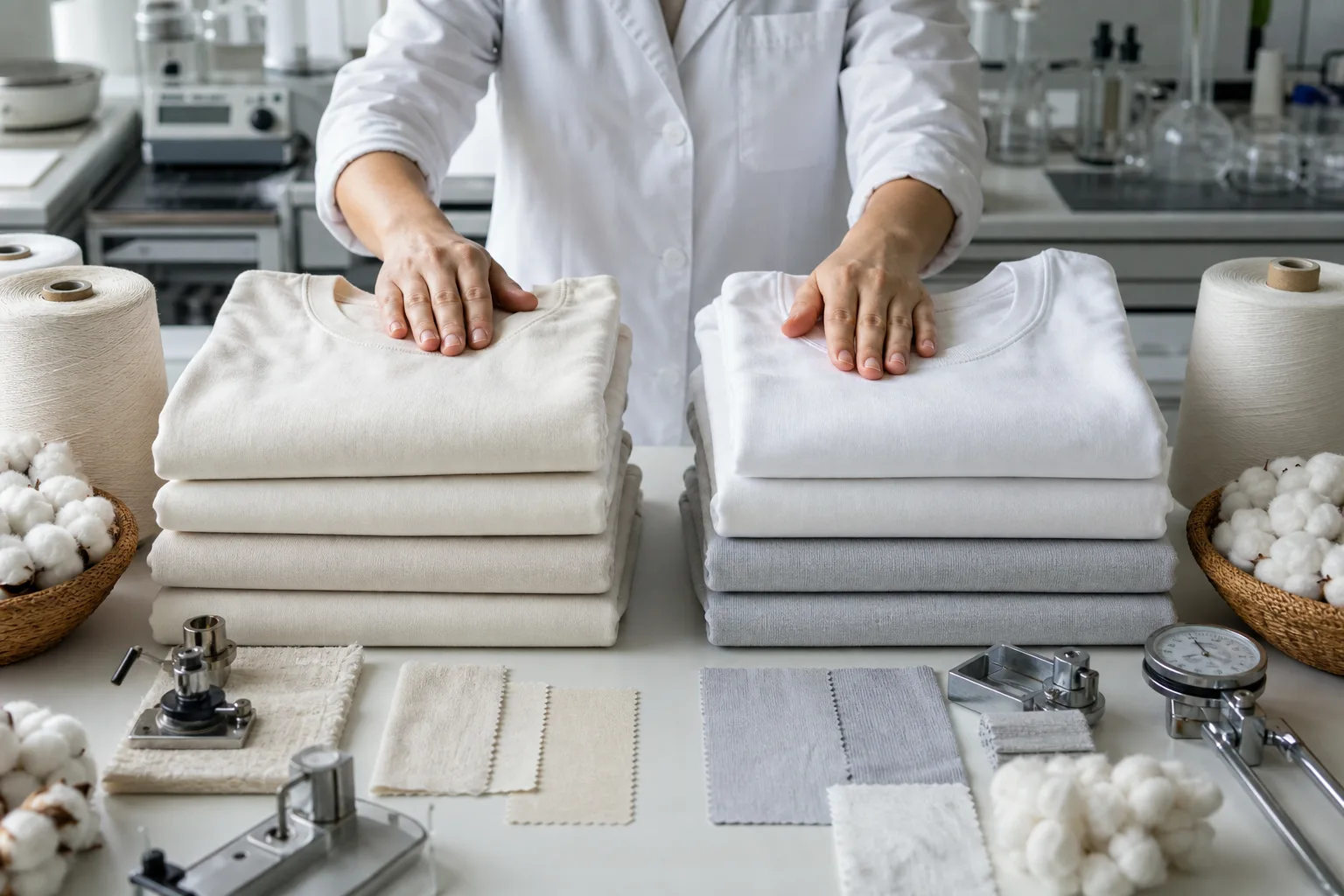
Organic cotton is not inherently softer, stronger or longer-lasting than regular cotton. “Organic” identifies a certified agricultural production system and, depending on the product label, may also indicate supply-chain controls. Measurable quality comes from the cotton’s fiber properties, the yarn, fabric construction, finishing and workmanship. A well-made conventional cotton product can outperform a poorly made organic one; when two products are otherwise comparable, organic certification can provide additional value for buyers who prioritize verified sourcing.
Organic cotton vs regular cotton at a glance
In this comparison, regular cotton means cotton that is not sold with a verified organic claim. It is often called conventional cotton, although a retail label may simply say “cotton.” Both organic and conventional systems can produce fibers suitable for anything from heavy canvas to fine sheets. The farming designation alone does not tell you the species, staple length, strength, maturity or cleanliness of those fibers.
| Question | Organic cotton | Regular cotton |
|---|---|---|
| What does the term describe? | A certified agricultural production system; some standards also verify custody or textile processing | Usually cotton without a certified organic claim |
| Is it automatically softer? | No | No |
| Is it automatically stronger? | No | No |
| Can it be high quality? | Yes, when fiber, yarn and construction are suitable | Yes, when fiber, yarn and construction are suitable |
| Does the term control dyeing and finishing? | Not by itself; this depends on the finished-product standard | Not by the word “cotton” alone |
| What should buyers verify? | Fiber percentage, certification scope, construction and care information | Fiber percentage, construction, workmanship and care information |
The practical conclusion is simple: choose organic cotton for a credible, relevant sourcing claim, but assess product quality separately.
What “organic” actually means
It is a production standard, not a cotton species
Organic cotton is still cotton. It may come from different cotton species, varieties, countries and growing conditions. Under USDA organic requirements, organic crop production restricts most synthetic fertilizers and pesticides and excludes genetic engineering, while allowing specified substances and practices under the regulations. Land generally must be managed without prohibited materials for 36 months before an organic crop is harvested. These rules address production methods; they do not assign the harvested fiber a premium quality grade.[1]
Fiber certification and finished-product certification are different
A garment described as “made with organic cotton” is not necessarily certified as an organic finished textile. USDA guidance allows a label to identify a specific fiber as organic, with its percentage, when all instances of that fiber are certified organic. Unless the finished product meets the applicable USDA requirements, however, the label must not imply that the whole product is USDA organic or display the USDA organic seal.[2]
The Organic Content Standard, or OCS, is designed to verify organically grown material and its chain of custody from one supply-chain stage to the next. It supports content claims, but it should not be interpreted as a softness, durability or finished-fabric performance test.[3]
GOTS has a broader finished-textile scope, including requirements for processing, chemical inputs, environmental controls and social criteria. Its “Organic” label grade requires at least 95% certified organic fiber content, while “Made with organic materials” requires at least 70%. A valid GOTS label should also identify the approved certification body and certified entity.[4]
What determines quality, feel and durability?
Raw fiber properties
Cotton quality is measured through properties such as staple length, length uniformity, strength, micronaire, color and trash content. USDA cotton classification data helps mills source raw cotton for particular manufacturing needs, while High Volume Instrument testing provides objective measurements of several important properties.[5]
- Staple length: Longer fibers can support finer, smoother and stronger yarns when processed appropriately.
- Length uniformity: A more consistent fiber-length distribution can improve spinning efficiency and yarn evenness.
- Fiber strength: Stronger fibers can help a yarn withstand processing and use, although yarn structure still matters.
- Micronaire and maturity: These influence processing behavior, yarn formation and dye uniformity. Micronaire is not a simple softness score.
- Trash and contamination: Cleaner raw material is generally easier to process consistently.
Organic and conventional bales can each fall across a range of these measurements. Without fiber data or a meaningful product specification, the farming label cannot resolve which material is technically superior.
Yarn often matters more to the hand feel
Fiber selection is only the beginning. Carding or combing, spinning method, yarn twist, yarn count and ply all affect smoothness, strength, hairiness and pilling behavior. Combed yarn removes more short fibers and impurities than basic carded yarn, while different spinning systems create different balances of efficiency, evenness and surface character. See the comparisons of combed vs carded cotton and ring-spun vs open-end yarn for those distinctions.
Fabric construction and finishing shape the product
A dense, balanced weave may resist wear better than a loose construction made from a similar yarn. In knits, stitch density, yarn quality and fabric weight affect stability, drape and abrasion. Brushing, enzyme treatments, mercerization, resin finishes, silicone softeners and garment washing can substantially change the initial feel.
This is why a very soft product is not necessarily made from better cotton. A finish can create immediate softness yet diminish with laundering. Conversely, a fabric that feels firm when new may soften gradually and retain its structure. Organic fiber content alone does not disclose any of these choices.
Which offers better comfort and value?
Softness and sensitive-skin claims
Either type can feel soft against the skin. For a realistic comparison, look at yarn smoothness, fabric weight, seams, applied finishes and washing instructions. Organic cotton should not automatically be described as hypoallergenic, chemical-free or safer for every person. Those are separate claims requiring appropriate evidence.
Buyers concerned about irritation may get more useful information from a complete ingredient or fiber disclosure, a credible finished-textile certification, restrained finishing, washable construction and a return policy. Our cotton guide for sensitive skin explains what can and cannot be inferred from a label.
Durability and cost per use
There is no universal durability winner. Strong fiber, even yarn, suitable twist, adequate fabric density, secure seams and appropriate care can all extend service life. Organic cotton can deliver excellent durability, but certification does not compensate for thin fabric, weak stitching or an unsuitable construction.
Organic products may cost more because certification, segregation, documentation, sourcing and supply conditions add requirements beyond physical manufacturing. Whether the premium represents good value depends on what is being verified and whether the product itself is well made. Compare specifications rather than assuming a higher price proves better performance.
- For sheets, assess construction, yarn quality, finish, fit and realistic thread-count information.
- For towels, examine pile density, loop security, absorbency after washing and the ground fabric.
- For T-shirts, check fabric weight, recovery, seam quality, shrinkage information and shape retention.
- For baby clothing, prioritize comfortable seams, practical care and accurate fiber and certification labels.
Use the relevant guides for cotton bed sheets, cotton towels, cotton T-shirts and baby clothes when comparing finished products.
How to evaluate sustainability claims
Organic standards provide a defined framework for agricultural practices and verification. That is more meaningful than an unqualified word such as “natural,” but it does not make every organic product environmentally preferable in every measurable category. Location, irrigation, rainfall, yield, energy sources, processing, dyeing, product life and disposal can change the result.
Be particularly cautious with universal claims that organic cotton uses a fixed percentage less water or produces a fixed percentage fewer emissions. Textile Exchange has warned that results from specific life-cycle assessments should not be extrapolated into blanket claims about all organic and conventional cotton. Its guidance notes that differences found between particular farm samples do not guarantee the same savings when another farm changes production systems.[6]
A useful sustainability comparison should identify:
- the system boundary, such as farm gate, fiber, fabric or finished product;
- the countries, seasons and farms represented;
- whether water means rainfall, irrigation withdrawal or consumption;
- whether results are calculated per hectare, kilogram of fiber or finished item;
- which processing, transport and use stages are included;
- who verified the claim and whether the calculation is publicly available.
Certification can establish that specified rules and custody requirements were followed. It cannot, by itself, predict a garment’s lifespan or provide a complete impact comparison with an unnamed conventional alternative. For broader context, visit the cotton sustainability hub.
A practical buying and label checklist
Use this sequence to separate sourcing claims from product performance:
- Read the fiber-content statement. Confirm the percentage of cotton and identify any polyester, elastane or other fibers. FTC guidance requires covered U.S. textile products to disclose fibers representing 5% or more by weight, with limited exceptions, and a product should not be called 100% cotton unless it contains only cotton apart from permitted trim.[7]
- Identify the exact organic claim. “Organic cotton,” “made with organic cotton,” OCS and GOTS do not necessarily communicate the same scope.
- Look for verification details. A certification name without a percentage, certifier, license number or verifiable supplier information may be incomplete.
- Check the yarn and construction. Look for useful details such as combed yarn, ply, fabric weight, weave or knit type, and reinforcement at high-wear areas.
- Inspect workmanship. Uneven stitching, distorted grain, sparse pile, loose loops and poorly secured seams are warning signs regardless of fiber origin.
- Review care requirements. A product you can wash and dry correctly is more likely to retain its fit, surface and strength.
- Challenge vague performance language. Words such as premium, pure, luxurious, eco-friendly and hotel quality are not substitutes for measurable specifications.
If physical quality is your main priority, start with our guide to how to tell cotton quality and the explainers on staple length, micronaire and fiber strength. If claim verification is the priority, review how to verify cotton sheet labels.
Bottom line: buy organic cotton when its verified farming or supply-chain requirements match your priorities. Buy for softness and durability only after evaluating the fiber specification, yarn, fabric, finish, workmanship and care. The strongest choice is not a marketing term; it is a traceable claim attached to a product whose construction suits its intended use.
Frequently asked questions
Is organic cotton softer than regular cotton?
Not automatically. Softness depends on fiber selection, yarn type, fabric construction, finishing and laundering. Organic certification does not set a universal softness requirement.
Does organic cotton last longer?
Organic cotton can be durable, but the farming designation does not guarantee longevity. Fiber strength, yarn quality, fabric density, stitching, finishing and care are more direct indicators.
What is the difference between OCS and GOTS?
OCS primarily verifies certified organic material content and chain of custody. GOTS covers certified organic fiber content plus broader requirements for textile processing, chemical inputs, environmental controls and social criteria.
Is regular cotton the same as conventional cotton?
The phrase regular cotton has no precise technical grade. In retail comparisons it usually means cotton that is not marketed with a certified organic claim. Its measurable quality may still be low, average or excellent.
Is organic cotton worth the higher price?
It may be worth the premium when verified organic production and traceability are priorities and the product is also well constructed. Certification alone does not prove superior feel, fit or durability.
How this guide was prepared
This page is based on desk research conducted on September 29, 2026 using USDA organic and cotton-classing guidance, FTC textile-labeling guidance, CottonWorks fiber-science material, Textile Exchange standards and LCA guidance, and GOTS certification rules. No laboratory testing, product trial, farm visit, supplier audit or first-hand certification assessment was performed.
Review status: Publishable quality advisory.
Sources and scope
- Organic Land ManagementUSDA Agricultural Marketing Service
USDA organic land-transition requirements, prohibited materials, boundaries and contamination controls.
Accessed 2026-09-29 - Organic TextilesUSDA Agricultural Marketing Service
How organic fiber claims differ from claims that an entire textile product is USDA organic.
Accessed 2026-09-29 - Organic Content Standard (OCS)Textile Exchange
The OCS scope, third-party certification of organic material and chain-of-custody verification.
Accessed 2026-09-29 - Certification and LabellingGlobal Organic Textile Standard
GOTS label grades, minimum organic-content thresholds and mandatory certification-label elements.
Accessed 2026-09-29 - Cotton Fiber QualityCottonWorks
Technical explanations of cotton staple length, uniformity, strength, micronaire, color, trash and HVI classification.
Accessed 2026-09-29 - LCA FAQTextile Exchange
Limitations on extrapolating results from specific cotton life-cycle assessments into universal organic-versus-conventional claims.
Accessed 2026-09-29 - Calling It Cotton: Labeling and Advertising Cotton ProductsFederal Trade Commission
U.S. fiber-content disclosure requirements and guidance for truthful cotton type and percentage claims.
Accessed 2026-09-29