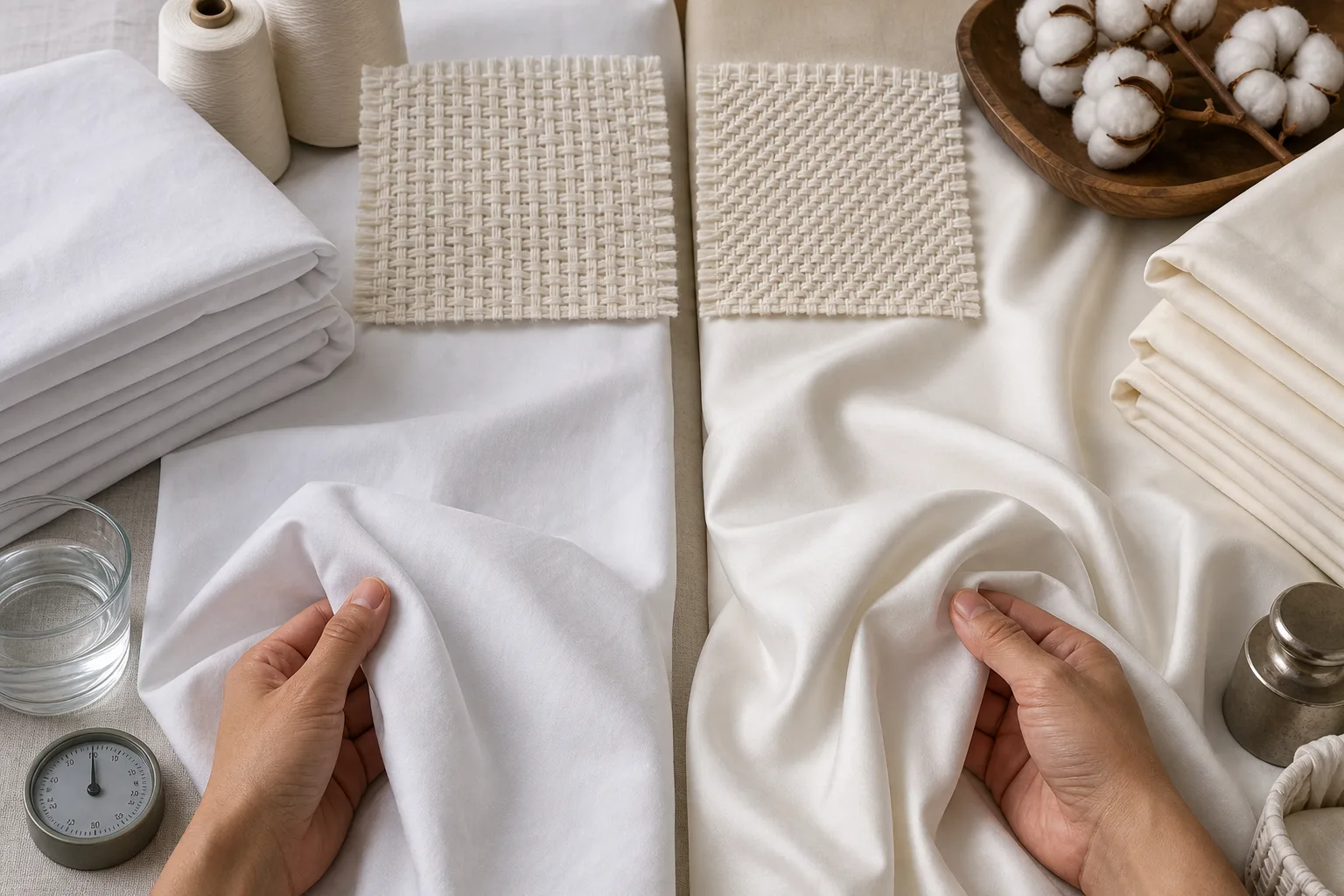
Percale and sateen are different woven constructions, not grades of cotton. Percale uses a plain weave that generally produces a crisp, matte and relatively stable sheet. Sateen uses a satin-type weave with longer yarn floats, giving it a smoother face, more luster and greater drape. Percale is usually the better starting point for sleepers who prefer an airy, freshly laundered feel; sateen suits people who want a silkier surface and a sheet that settles closely around the body. Neither name, by itself, proves fiber quality, durability or value.
Percale vs sateen at a glance
| Factor | Percale | Sateen |
|---|---|---|
| Construction | Plain weave, usually one yarn over and one under | Satin-type weave with longer surface floats |
| Typical hand | Crisp, dry and smooth | Smooth, soft and silk-like |
| Appearance | Matte or low luster | Subtle to noticeable sheen |
| Drape | More structured | More fluid |
| Temperature impression | Often feels lighter and airier | Often feels closer and somewhat warmer |
| Surface vulnerability | Generally resistant to snagging because yarns interlace frequently | Longer floats can be more exposed to picking and snagging |
| Wrinkling | Usually shows wrinkles readily | Often appears smoother, although it can still wrinkle |
| Best starting point for | Crisp-sheet fans, warm rooms and buyers prioritizing stability | Buyers seeking softness, luster and flowing drape |
These are tendencies rather than guaranteed outcomes. Yarn fineness, fabric weight, thread density, finishing and laundering can make two percales—or two sateens—perform very differently. Cotton Incorporated's technical sheet guide likewise treats fiber type, spinning system, yarn count, fabric weight, construction and finishing as separate contributors to performance. CottonWorks cotton sheeting guide
How the weave changes the fabric
Percale: frequent interlacing and a stable structure
Percale is a plain-woven fabric. In the basic plain weave, each warp yarn passes over one filling yarn and under the next, while the neighboring warp yarn follows the opposite sequence. This creates more crossover points than the other basic weave families. The resulting fabric tends to be stable, relatively firm and less drapey, with fewer inherent problems involving skew, seam slippage, picking or snagging. CottonWorks explains the basic woven structures.
That structure helps explain percale's familiar crispness, but “crisp” should not be confused with “rough.” A well-made percale can have a smooth, fine surface. Coarser yarns, projecting fibers, excessive fabric weight or certain finishes can make another percale feel harsher.
Sateen: longer floats and a smoother face
Sateen is made with a satin-type weave, commonly described as a filling-face construction in cotton sheeting. Instead of interlacing at every alternating yarn, sections of yarn float over several crossing yarns before being bound into the structure. Those floats cover more of the face, reflecting light more evenly and creating the characteristic smoothness and luster.
The same construction creates trade-offs. CottonWorks notes that satin-weave fabrics offer excellent drape but may be more susceptible to picking, snagging, skew and seam slippage. That does not mean every sateen is fragile: sufficient density, fine strong yarns and sound finishing can produce a durable sheet. It does mean that “sateen” is not evidence of superior strength, just as “percale” is not proof of premium quality.
Feel, sleep comfort and appearance
Which feels cooler?
At comparable fiber content, yarn size and fabric weight, percale often feels airier because of its firm, less enveloping hand. Sateen's smoother drape tends to place more fabric in close contact with the sleeper, and commercial sateens are often constructed at higher weights or densities. This can create a warmer impression.
However, weave name alone cannot predict thermal comfort. A lightweight sateen may feel cooler than a heavy, densely woven percale. Room temperature, humidity, bedding layers, mattress protection and personal perspiration also matter. Buyers should therefore treat “cooling percale” or “temperature-regulating sateen” as performance claims requiring product-specific evidence, not automatic properties of the weave.
Which feels softer?
Sateen usually feels smoother immediately because the exposed floats reduce the number of intersections perceptible at the surface. Percale has a drier, crisper hand and may relax after repeated washing. Whether either fabric feels genuinely soft also depends on yarn hairiness, combing, spinning method, fabric preparation and chemical or mechanical finishing.
A showroom-soft sheet may have been treated to change its initial hand. That sensation does not necessarily predict how the fabric will feel after laundering. Buyers who want to separate construction from finishing should compare washed-sample information, where available, and review the seller's return policy rather than relying on package handling alone.
Matte versus lustrous
Percale generally looks clean and matte, making it suitable for buyers who prefer a tailored bed. Sateen reflects more light and normally has a richer, more fluid appearance. Luster is an aesthetic result of the exposed yarn surface; it is not a measurement of cotton grade, tensile strength or useful life.
What actually determines quality and durability?
Fiber and yarn come before weave
Cotton quality begins with measurable raw-fiber properties, including staple length, length uniformity, strength, micronaire, color and foreign matter. Fiber length and uniformity influence yarn evenness and strength, while micronaire provides information related to fineness and maturity and can affect processing and dye uniformity. USDA cotton classing applies standardized procedures to raw cotton, but a bale classification is not a certification that a finished sheet will meet a particular performance level. USDA Cotton Classing Services; CottonWorks cotton fiber quality overview.
Longer cotton is useful when it supports the production of fine, even and adequately strong yarn, but fiber origin or variety is not the whole specification. Carding versus combing, ring spinning versus other spinning systems, yarn twist and the use of single or plied yarns can all change surface smoothness, strength, hairiness and price. Explore these distinctions in the guides to combed versus carded cotton and ring-spun versus open-end yarn.
Thread count is not a quality score
Thread count describes construction, but it should not be read as a universal ranking. Very high figures may be produced by counting components of plied yarns or by using multiple filling insertions. CottonWorks specifically cautions that higher thread count is only one consideration and that excessive density may produce a stiffer fabric, poorer drape, a harsher hand or lower tear strength.
A credible comparison should disclose enough information to put the number in context: whether the yarns are single or plied, the approximate fabric weight, the weave and ideally the yarn size. A balanced, well-made sheet at a moderate count can offer better comfort and durability than a heavier product sold mainly on a four-digit number.
Finishing and workmanship complete the product
Singeing, preparation, mercerization, calendaring, softening and wrinkle-resistant treatments can alter appearance and hand. Seam construction, elastic quality, pocket dimensions and dimensional stability also affect practical value. These factors explain why one brand's percale may outlast another brand's sateen—or the reverse.
For durability, inspect the complete specification rather than choosing by weave alone. Percale's frequent interlacings usually give it a less snag-prone surface. Sateen requires particular attention to float security, yarn quality and density. Neither construction has a guaranteed lifespan without product-specific testing and defined pass criteria.
How to buy better cotton sheets
A practical comparison checklist
- Choose the hand first. Select percale for crispness and structure or sateen for smoothness and drape.
- Read the fiber-content label. “Percale” and “sateen” identify constructions, not fiber. Either can contain cotton, another fiber or a blend.
- Check whether cotton claims are complete. Under US textile labeling guidance, a product should not be called “100% cotton” unless it contains only cotton, apart from permitted trim. Named cotton types must be described truthfully. FTC cotton labeling guidance
- Question unsupported thread counts. Ask how the figure was calculated and whether the sheet uses single or plied yarns.
- Look for useful construction details. Fabric weight, yarn type, combing and post-wash dimensions are more informative than adjectives such as “luxury” or “hotel quality.”
- Review fitted-sheet dimensions. Compare mattress depth with the maker's stated pocket depth and allow for any disclosed shrinkage.
- Check care instructions before buying. Required washing temperature, drying method and ironing can affect ownership cost and convenience.
- Evaluate evidence behind performance claims. Terms such as “cooling,” “pilling resistant” or “long-lasting” should be supported by a named method, comparative basis and result.
For a wider specification guide, see how to buy cotton bed sheets and how to verify cotton sheet labels.
Care, value and sustainability claims
Care for the product you bought, not the weave stereotype
Follow the product's instructions because dyes, finishes, elastic and sewing components may impose limits that cannot be inferred from “percale” or “sateen.” In general, avoiding unnecessary heat and overdrying can reduce stress on cotton fabric and fitted-sheet elastic. Launder sheets separately from items with exposed zippers, hooks or rough fasteners, especially when caring for sateen's more exposed floats.
Promptly removing bedding from the dryer may reduce creasing. Percale will normally retain a more visibly rumpled character, while sateen may present a smoother face. Neither appearance indicates that the fabric is dirty or defective.
Price and value
A higher-priced sateen is not necessarily better than a lower-priced percale, because the constructions deliver different sensory results. Value is the relationship between price and verified attributes: suitable fiber content, even yarns, appropriate weight, secure stitching, dimensional stability, colorfastness, useful care requirements and performance over the intended service life.
Industry buyers should establish measurable specifications and tolerances rather than sourcing against “premium percale” or “luxury sateen.” Consumer buyers can use detailed disclosures, credible warranties and post-wash reviews as practical proxies when laboratory data are not published.
Weave is not a sustainability certification
Percale and sateen describe fabric construction. Neither establishes how cotton was grown, whether processing chemicals met a standard, whether workers were covered by social criteria or whether the finished product is traceable. Environmental statements should identify the specific benefit and scope. The FTC advises against broad, unqualified claims such as “green” or “eco-friendly” and notes that a certification does not remove the marketer's responsibility to substantiate express and implied claims. FTC Green Guides summary
If sustainability matters, check exactly what is certified, the percentage or component covered, the chain-of-custody model, the certifier and any public verification details. Then compare those facts separately from comfort and weave. A certified product may still be wrong for a buyer's preferred hand, and a favored weave does not prove an environmental advantage.
Which should you choose?
Choose percale if you prioritize a crisp hand, matte appearance, structural stability and a lighter sleep sensation. Choose sateen if you prioritize immediate smoothness, luster and fluid drape and are prepared to protect the surface from rough hardware or snagging.
For either option, the best purchase is not the product with the most impressive marketing term or highest thread count. It is the sheet whose fiber label, yarn and construction details, finish, dimensions, care requirements and substantiated claims match its price and your intended use.
Frequently asked questions
Is percale or sateen better quality?
Neither weave is automatically better quality. Percale and sateen create different surfaces and drape, while quality depends on fiber properties, yarn construction, fabric density and weight, finishing, sewing and verified performance.
Is percale cooler than sateen?
Percale often feels lighter and airier, while sateen commonly feels closer to the body. This is a useful tendency, not a guarantee: fabric weight, yarn size, density, finishes, room conditions and other bedding layers can change thermal comfort.
Does sateen last as long as percale?
A well-constructed sateen can be durable, but its longer surface floats are generally more exposed to snagging and picking. Percale's frequent interlacings create a stable surface. Actual lifespan still depends on yarn quality, density, workmanship, laundering and use.
What thread count is best for percale or sateen?
There is no universal best number. Thread count must be interpreted with yarn size, single or plied construction, fabric weight and weave. Extremely high figures do not prove better quality and may describe a dense, heavy or artificially inflated construction.
Are percale and sateen always made from cotton?
No. The terms describe woven constructions rather than fiber content. Check the required content label to determine whether a sheet is cotton, another fiber or a blend.
How this guide was prepared
This page is based on desk research of Cotton Incorporated technical material on sheet construction, woven structures and cotton fiber properties; USDA information on raw-cotton classing; and FTC guidance on textile labels and environmental marketing. No products were purchased or handled, no laboratory tests or wash trials were conducted, and no farms, mills, brands or certification bodies were visited. Comfort and durability guidance is therefore presented as construction-based tendency rather than a product-specific test result.
Review status: Publishable quality advisory.
Sources and scope
- A Practitioner's Guide to Cotton Sheeting: Durability, Quality, and Other Technical ConsiderationsCottonWorks / Cotton Incorporated
Comparison of percale and sateen construction, typical hand and performance, thread-count limitations, fabric weight, yarn selection and the multiple variables affecting sheet quality.
Accessed 2026-09-30 - Basic Woven Fabric DesignsCottonWorks / Cotton Incorporated
Technical descriptions of plain and satin weaves, interlacing frequency, floats, stability, drape and potential snagging or seam-slippage issues.
Accessed 2026-09-30 - Cotton Fiber QualityCottonWorks / Cotton Incorporated
How staple length, length uniformity, strength, micronaire, color and foreign matter influence yarn processing and finished textile quality.
Accessed 2026-09-30 - Cotton Classing ServicesUSDA Agricultural Marketing Service
Scope and role of standardized USDA classification of raw cotton.
Accessed 2026-09-30 - Calling It Cotton: Labeling and Advertising Cotton ProductsFederal Trade Commission
US requirements and guidance for truthful cotton fiber-content statements, 100% cotton claims and named cotton types.
Accessed 2026-09-30 - Environmental Claims: Summary of the Green GuidesFederal Trade Commission
Guidance on substantiating environmental claims, qualifying broad green claims and communicating the basis of certifications and seals.
Accessed 2026-09-30