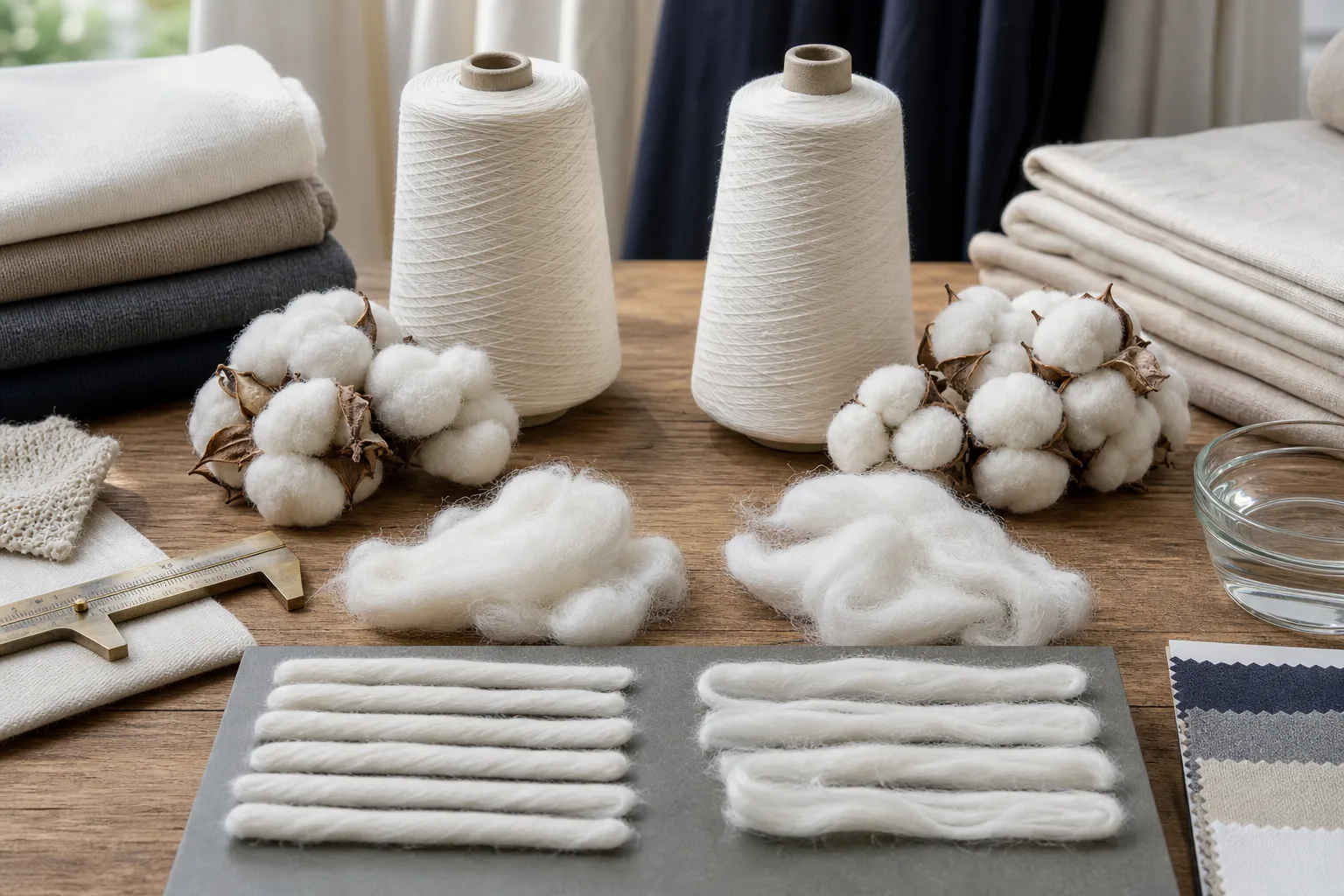
Pima is usually the clearer quality signal, but neither name guarantees the better finished product. Pima identifies extra-long-staple cotton, while Egyptian cotton identifies cotton grown in Egypt and can include extra-long, long and other staple categories. Premium Egyptian varieties can equal or exceed excellent Pima fiber, yet the country name alone does not establish fiber length, yarn quality, fabric construction or durability. When comparing two products, verify the fiber-content claim and then judge the yarn, weave or knit, finishing and care requirements.
Pima vs Egyptian cotton at a glance
The practical difference is that the two names describe cotton in different ways. Pima is associated with a defined fiber class and species group; Egyptian refers primarily to geographic origin. That makes Pima a relatively direct clue about staple length, although it still does not reveal the grade of a particular bale or the quality of the finished textile.
| Buying factor | Pima cotton | Egyptian cotton |
|---|---|---|
| What the name indicates | Extra-long-staple cotton, commonly American Pima when grown in the United States | Cotton of Egyptian origin, potentially drawn from several varieties and staple classes |
| Fiber-length signal | Normally a strong ELS signal | Variable unless the variety, staple class or specification is disclosed |
| Potential feel | Smooth and fine when made into well-spun yarn and suitable fabric | Ranges from ordinary to exceptionally smooth, depending on the variety and manufacturing |
| Potential durability | Long, strong fiber can support fine, even and durable yarn | High for strong long- or extra-long-staple varieties, but origin alone cannot predict it |
| Main label limitation | Does not disclose yarn twist, construction, finish or test results | Does not by itself prove ELS fiber or superior quality |
| Best value test | Confirm 100% Pima content and examine product specifications | Confirm the percentage, origin assurance and measurable quality details |
Choose Pima when you want a more consistent label-level indication of extra-long fiber. Choose Egyptian cotton when the seller identifies the variety or staple class and provides credible fiber, yarn and construction information. If those details are absent, compare the actual fabric rather than paying for the more prestigious name.
What Pima and Egyptian actually mean
Pima is an extra-long-staple cotton
The USDA describes Pima as one of the two main commercial cotton types and identifies it as extra-long-staple cotton. It is associated with Gossypium barbadense, a species also connected with other fine, long-fiber cotton groups. Longer fibers provide more overlap when they are twisted into yarn, helping mills produce fine yarn with good strength and fewer exposed fiber ends. See the broader explanation of cotton staple length.
American Pima is also classed separately from Upland cotton. USDA instruments measure properties including length, length uniformity, strength and micronaire, while color, trash and extraneous matter also form part of classification. These measurements show why “Pima” should not be treated as a complete laboratory result: individual bales still differ. USDA cotton classing guidance explains the measured properties used in raw-fiber marketing.
Egyptian describes origin, not one uniform grade
Egypt produces several named cotton varieties. Some are extra-long staple, while others fall into long or shorter staple categories. An International Cotton Advisory Committee report, for example, classified Giza 45, 87, 88 and 96 as extra-long-staple varieties, Giza 86 and 94 as long staple, and Giza 90 and 95 as medium or shorter categories. The figures describe varieties reported at that time, not every later crop or retail product, but they demonstrate the central point: Egyptian cotton is not one standardized fiber quality.
A premium Giza ELS cotton and a high-grade Pima cotton may have much more in common with each other than either has with shorter cotton sold under a broad regional name. For a fair comparison, ask for measured fiber strength, length uniformity and micronaire rather than assuming origin settles the question.
Quality, softness and durability depend on measurable properties
Longer fiber can support smoother yarn
Long staple length gives a spinner more scope to make fine yarn because more of each fiber can be held within the yarn structure. Fewer loose ends may reach the surface, which can contribute to a smoother handle and reduced fuzz. CottonWorks identifies staple length, length uniformity, strength, micronaire, color and trash as central raw-cotton quality factors, and notes that length affects yarn strength, evenness and spinning efficiency. Its cotton fiber quality guide also emphasizes that each bale has an individual set of properties.
This mechanism explains the appeal of both Pima and the better Egyptian ELS varieties. It does not mean every product made from them will feel silky. A coarse yarn, low yarn twist, abrasive finish or poorly balanced fabric can obscure the advantages of good fiber.
Softness is a product result, not an origin result
Initial softness may come from fiber fineness, yarn structure, fabric construction or a chemical softener. Some finishes wash down over time, while the underlying yarn and fabric remain. A tightly woven cotton percale can feel crisp even when made with ELS fiber; a sateen made from the same fiber can feel smoother because its weave exposes longer yarn floats. Brushed fabric may feel soft because its surface has been mechanically raised, not because the cotton came from a particular country.
For sheets, compare weave, yarn type and credible thread-count information through the bed-sheet buying guide. For towels, pile height, loop integrity, yarn twist, fabric weight and the fiber used in both pile and ground influence absorbency and service life. A product promoted for premium loops may use a different cotton in its structural base.
Durability begins with fiber but continues through manufacturing
Strong, uniform, long fibers can make strong yarn with fewer weak points. Finished durability, however, also depends on yarn twist, ply, fabric density, seam quality, abrasion, bleaching, resin treatments and laundering. A dense, well-constructed Upland product can outlast a lightly constructed Pima or Egyptian product. Pilling likewise reflects the interaction of fiber ends, yarn and fabric rather than the geographic name alone; see how cotton pilling develops.
Yarn, construction and finishing may outweigh the cotton name
Check how the yarn was made
Combing removes some short fibers and impurities before spinning, which can improve yarn evenness and cleanliness. Ring spinning generally creates a different yarn structure from open-end spinning, while ply and twist change strength, bulk and surface character. These processes do not transform poor fiber into premium fiber, but they can determine how much of the raw material’s potential reaches the finished product.
- Combed: useful evidence that additional short-fiber removal occurred, but not proof of Pima or Egyptian origin.
- Ring-spun: describes a spinning process, not a cotton variety.
- Single-ply or multi-ply: affects yarn structure and can complicate headline thread-count comparisons.
- Mercerized: describes a treatment that can alter luster, dimensional behavior and dye response; it does not identify the cotton’s origin.
Use the combed versus carded and ring-spun versus open-end comparisons to separate manufacturing terms from fiber claims.
Match construction to the intended use
Percale and sateen sheets can use the same cotton yet feel and wear differently. Knitted T-shirts respond to yarn count, stitch density and finishing. Terry towels depend heavily on pile construction and the relationship between absorbent loops and the ground fabric. Product category therefore matters more than a universal ranking of Pima vs Egyptian cotton.
Before paying a premium, decide which performance matters: crispness, drape, absorbency, low lint, abrasion resistance or easy care. Then look for specifications tied to that result. The general cotton quality buying guide provides a product-level inspection process.
How to read Pima and Egyptian cotton labels
In the United States, a named cotton type may appear in the fiber-content statement only when the claim is truthful and not deceptive. The Federal Trade Commission states that a mixed-cotton product naming Pima or Egyptian cotton must disclose the named cotton’s percentage and make clear that other cotton is present. A sheet containing 50% Egyptian cotton and 50% Upland cotton, for example, should not be represented as 100% Egyptian cotton. See the FTC’s cotton labeling guidance.
Use this label and specification checklist
- Read the sewn-in fiber label. “100% cotton” does not identify Pima or Egyptian content.
- Look for an explicit percentage. Treat “Pima blend” or “Egyptian cotton feel” as incomplete unless the actual fiber content is stated.
- Separate pile from ground. On a towel, premium cotton loops do not necessarily mean the entire towel uses that cotton.
- Ask what the name proves. A trademark, logo or hangtag may describe a sourcing or verification program, but it is not automatically a fabric-performance test.
- Check yarn and construction. Record weave or knit, yarn type, ply, fabric weight and relevant dimensions.
- Review care instructions. A premium fiber cannot offset avoidable shrinkage, finish damage or abrasion caused by unsuitable laundering.
Origin authentication and chain-of-custody evidence can strengthen a fiber claim, but they answer “where or what is it?” rather than “how will this finished product perform?” Performance claims require tests suited to the product and end use. Learn how to interpret the distinction in the HVI testing explainer and textile tests hub.
Which offers better value—and what about sustainability?
Pay for disclosed quality, not reputation alone
Pima often offers the safer starting point when two labels provide no other technical information because the term more directly signals ELS cotton. Egyptian cotton can be the stronger purchase when a seller identifies a premium variety, verifies origin and combines it with good yarn and construction. Without that supporting evidence, price is not a reliable quality measurement.
A useful buying order is: confirm fiber content; identify staple or variety information; assess yarn; compare construction; inspect finishing; then evaluate price and warranty. For online purchases, favor sellers that provide exact specifications, close product images, complete labels and a workable return policy. Avoid assuming that a very high thread count corrects weak yarn or poor construction.
Neither name proves a sustainability advantage
“Pima” and “Egyptian” do not by themselves establish organic production, water use, pesticide practices, labor conditions, greenhouse-gas performance or supply-chain traceability. Those issues depend on the farm, region, season, production system and later processing. The FTC advises marketers not to make broad, unqualified environmental claims and requires specific claims to have adequate substantiation.
Look for a clearly defined claim, its scope, the applicable product percentage and credible chain-of-custody information. A certification can address selected agricultural or content requirements without proving that a product is environmentally superior in every respect. Compare such claims through the cotton sustainability hub rather than using Pima or Egyptian origin as a shortcut.
Care protects the value of either cotton
Follow the product’s care label because dyes, finishes, trims and construction can impose limits that the fiber name does not reveal. Wash only as hot as needed, avoid unnecessary overdrying and keep abrasive items such as exposed zippers away from fine sheets and knitwear. Correct care cannot repair weak construction, but it can reduce shrinkage, surface wear and premature fiber breakage. The best value is the product whose verified materials, construction and maintenance requirements suit how it will actually be used.
Frequently asked questions
Is Pima cotton better than Egyptian cotton?
Not automatically. Pima more consistently signals extra-long-staple fiber, while Egyptian cotton includes several varieties and staple classes. A verified Egyptian ELS product can equal or outperform Pima, but yarn, construction and finishing must also be compared.
Is all Egyptian cotton extra-long staple?
No. Egyptian cotton is an origin description, and Egyptian varieties have been classified as extra-long, long and shorter staple cottons. Look for a named variety, staple specification or credible verification rather than relying on the country name.
Which cotton is softer for sheets?
Either can make soft sheets. Comparable ELS fibers can support fine, smooth yarn, but sateen versus percale construction, combing, yarn quality and finishing often create the more noticeable difference.
How can I verify a Pima or Egyptian cotton claim?
Read the sewn-in fiber label for the named cotton and its percentage, then look for credible origin or chain-of-custody documentation. Verification of identity does not replace product-performance specifications or testing.
Is Pima or Egyptian cotton more sustainable?
Neither name proves a sustainability advantage. Compare specific, substantiated claims about farming, water, chemicals, energy, labor, traceability and certified content instead of treating fiber type or origin as an environmental rating.
How this guide was prepared
Desk research completed on September 22, 2026 using CottonWorks technical guidance, USDA cotton classification materials, Federal Trade Commission labeling and environmental-claim guidance, and an International Cotton Advisory Committee report on Egyptian varieties. No products were purchased or tested, and no laboratory work, mill inspection, farm visit, supplier interview or certification audit was performed.
Review status: Publishable quality advisory.
Sources and scope
- Cotton Fiber QualityCottonWorks
Explains HVI fiber-quality factors, including staple length, uniformity, strength, micronaire, color and trash, and how length affects yarn strength and evenness.
Accessed 2026-09-22 - Cotton Classing ServicesUSDA Agricultural Marketing Service
Documents USDA measurements used to classify raw cotton, including length, length uniformity, strength, micronaire, color and trash.
Accessed 2026-09-22 - Calling It Cotton: Labeling and Advertising Cotton ProductsFederal Trade Commission
Provides U.S. guidance for truthful Pima and Egyptian cotton fiber-content statements, mixed-cotton disclosures and towel labeling.
Accessed 2026-09-22 - The ICAC Recorder, March 2018International Cotton Advisory Committee
Reports differing staple classifications and measured properties among named Egyptian Giza cotton varieties, demonstrating that Egyptian cotton is not one uniform grade.
Accessed 2026-09-22 - Environmental Claims: Summary of the Green GuidesFederal Trade Commission
Explains why broad environmental claims and certification implications require clear qualification and substantiation.
Accessed 2026-09-22