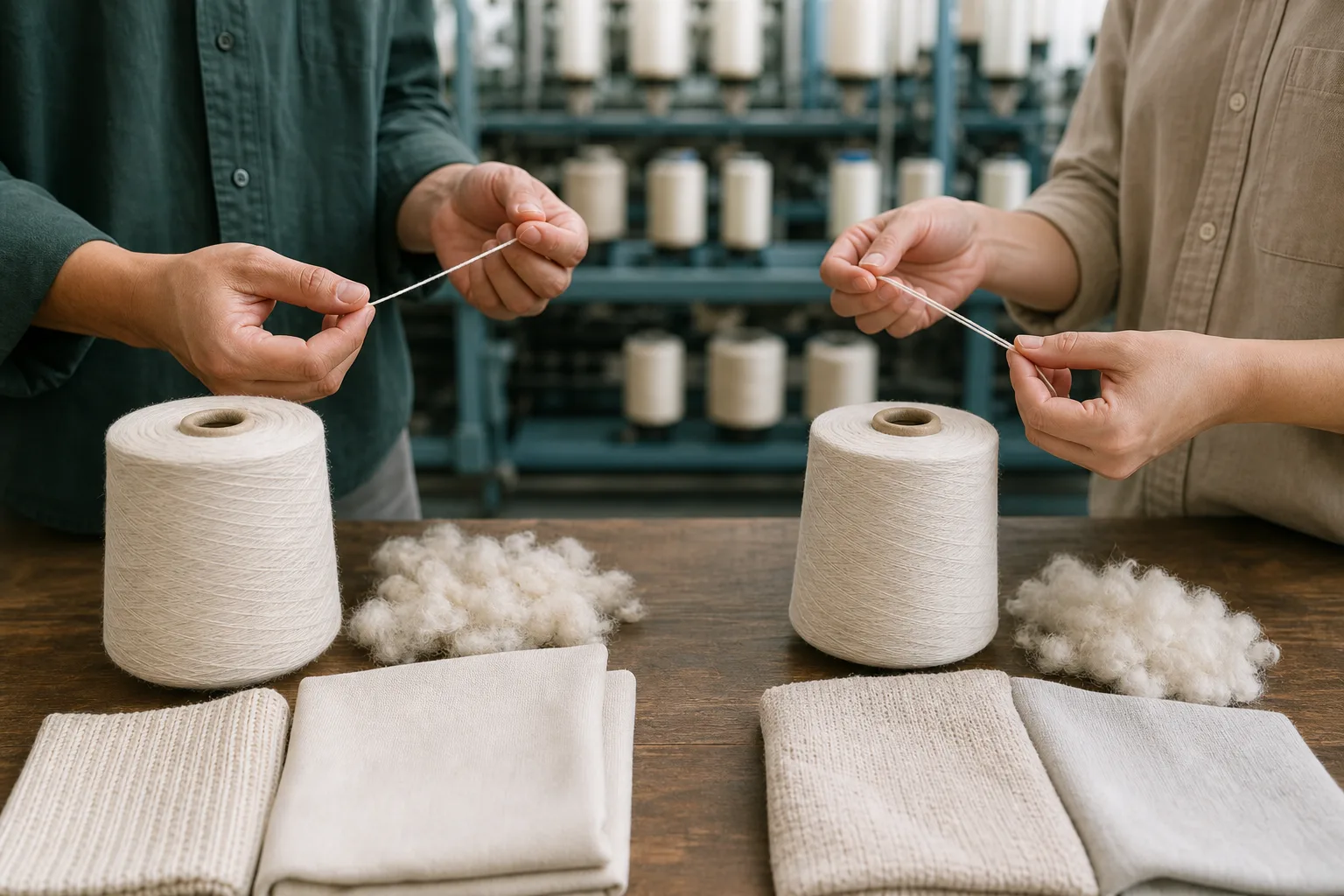
Ring spun cotton is usually the better choice when softness, yarn strength and a refined surface matter; open end cotton is often the better value when cost, production efficiency and consistency in coarser yarns matter more. That is a comparison of spinning systems, not two cotton species or fiber grades. A well-designed open end fabric can outperform a poorly specified ring spun fabric, so buyers should also examine fiber content, yarn count, fabric weight and construction, finishing, workmanship and care instructions.
Ring spun cotton vs open end cotton at a glance
Ring spinning and open end spinning—also called rotor spinning—turn prepared cotton fibers into yarn in different ways. Ring spinning drafts a strand of roving and inserts twist with a spindle, ring and traveler. Open end spinning separates fibers from sliver, carries them into a rotating rotor and continuously draws the newly formed yarn onto a finished package.
Those structures affect performance. Ring yarn tends to have fibers arranged more regularly along the yarn axis, supporting greater strength and a softer hand. Rotor yarn contains characteristic wrapper fibers around its surface. These fibers help bind the yarn but do not contribute to strength in the same way as fibers aligned with its axis. CottonWorks describes open end yarn as generally more even and lower in torque, but usually weaker and harsher than a comparable ring yarn. The size of the difference depends on fiber selection, yarn count, twist and machine settings, so it should not be treated as a universal product result. CottonWorks’ yarn-spinning guide explains the two production routes.
| Decision factor | Ring spun cotton yarn | Open end cotton yarn |
|---|---|---|
| Typical feel | Softer and more refined at a comparable specification | Often drier, bulkier or slightly harsher |
| Yarn strength | Generally higher | Generally lower because of its fiber arrangement |
| Evenness and torque | Can show more natural irregularity and torque | Often more even and lower in torque |
| Fine yarn capability | Wider count range and well suited to fine yarns | Most economical in coarser and medium counts |
| Production route | Requires roving and a later winding stage | Uses fewer stages and forms a usable package on the spinning machine |
| Typical cost position | Higher at a comparable count and specification | Lower because production is faster and more automated |
| Common applications | Premium T-shirts, lighter apparel, soft knits and ring-spun denim | Basic knits, socks, sweatshirts, workwear and much denim |
| What the term proves | The yarn was made by ring spinning | The yarn was made by rotor or open end spinning |
Why ring spun yarn usually feels softer and tests stronger
Fiber alignment changes how the yarn carries a load
Ring spinning drafts fibers before twist binds them into the yarn. More fibers follow the yarn axis and share tensile forces, which usually gives ring yarn greater strength than open end yarn of a comparable count and raw-material specification. CottonWorks’ technical yarn guide reports a general strength disadvantage for open end yarn, but that comparison is not a warranty for every garment or fabric.
Raw cotton quality still matters. USDA cotton classification measures properties including fiber length, length uniformity, strength and micronaire, which combines aspects of fineness and maturity. These are raw-fiber measurements used in cotton marketing and manufacturing; they are not finished-garment scores. Longer, stronger and more uniform fibers can support efficient spinning and more consistent yarn, while excessive short fiber can make yarn formation more difficult. See the guides to cotton staple length, length uniformity, fiber strength and micronaire.
Softness is a system result, not a guaranteed ring-spun trait
Fiber orientation helps explain why comparable ring yarns often feel softer, but consumers touch a fabric rather than an isolated yarn. Knit structure, fabric weight, brushing, enzyme washing, mechanical softening, resin treatments and added softeners can change the initial hand. A soft finish may diminish after laundering, while a denser fabric may feel firmer yet resist wear better.
Compact spinning is another important distinction. It is a ring-spinning variation that draws surface fibers closer to the yarn body, producing a smoother, less hairy yarn than conventional ring spinning. Ordinary “ring spun” wording does not establish that the yarn is compact spun, combed or made from a particular cotton grade. Buyers comparing premium claims should also understand combed versus carded cotton.
Durability depends on more than the spinning method
Yarn strength is not the same as garment life
Ring yarn’s typical strength advantage can support durable fabric, especially where fine yarns must survive knitting, weaving and use. It does not follow that every ring-spun T-shirt, towel or pair of jeans will last longer than every open end alternative. Fabric construction can outweigh the spinning method.
- Fabric weight and density: More material or a tighter construction can improve resistance to holes and abrasion, although heavy fabric is not automatically well made.
- Yarn count and twist: Finer yarns can create smooth, light fabrics but require suitable fibers and twist. Excessive twist may increase firmness; insufficient twist may reduce cohesion.
- Knitted or woven structure: Jersey, interlock, fleece, canvas and denim distribute stress differently.
- Finishing: Washing, sanding, brushing and chemical treatments can alter softness, dimensional stability and surface wear.
- Construction quality: Seam type, stitch density, reinforcement and cutting quality often determine where a garment fails first.
- Care: Heat, aggressive drying, bleach and repeated abrasion can shorten useful life regardless of spinning system.
Pilling cannot be predicted from “ring spun” alone
Pills form when loose or protruding fibers entangle at a fabric surface and remain anchored during rubbing. Conventional ring yarn can be hairier than compact ring yarn, while rotor settings can modify the hairiness and hand of open end yarn. Fiber length, blends, fabric structure and finishing also affect the result. A spinning label without an appropriate fabric test does not establish low-pilling performance. Read the cotton pilling explainer and the overview of textile tests before relying on a broad durability claim.
Which yarn offers better value for each use?
T-shirts and underwear
Ring spun cotton is often worth considering for next-to-skin garments because it can produce fine, strong yarn with a soft hand. For a T-shirt purchase, compare fabric weight, opacity, recovery, seams and post-wash dimensions as well as the yarn claim. Open end yarn can be suitable for heavier promotional shirts, basic garments and products where a substantial, slightly drier hand is acceptable. The cotton T-shirt buying guide provides a product-level checklist.
Denim and workwear
Both systems are established denim options. Open end spinning offers economical production for the coarser yarns commonly used in denim, while ring yarn is selected when a softer hand, higher yarn strength or a deliberately uneven vintage character is desired. A pair of jeans may use ring yarn in both warp and filling, open end yarn in both directions, or a combination. Finishing and wash treatments can make two fabrics with the same spinning description look and feel very different.
Sweatshirts, socks and basic knits
Open end yarn’s evenness, productivity and suitability for coarser counts can make it practical for fleece, socks and everyday outerwear. Ring spinning may justify its premium where softness, lighter weight or a finer surface is central to the product. In either case, evaluate the complete specification rather than paying more solely for the word “ring-spun.”
Sheets and towels
Yarn system is only one variable in household textiles. Sheet feel also depends on yarn count, weave, finishing and misleadingly emphasized metrics such as thread count. Towel performance depends heavily on pile construction, absorbency, weight and laundering behavior. A ring-spun label by itself does not prove better absorbency, faster drying or less linting. Start with the cotton buying hub for product-specific criteria.
How to read labels and supplier specifications
In the United States, textile labels generally identify fiber names and percentages, the responsible company and country of origin. The FTC’s Textile Fiber Rule summary does not make the spinning system a standard required fiber-content disclosure. A label that says “100% cotton” therefore does not tell you whether the yarn is ring spun, rotor spun, carded, combed, compact spun or made from a particular fiber grade.
“Ring spun” can be a useful process description, but it is not a measurable grade. Ask a supplier for evidence tied to the result being claimed. Depending on the product and intended use, useful information may include:
- fiber content and whether the fabric contains elastane, polyester or another blended fiber;
- yarn system, yarn count, ply, twist and carded or combed preparation;
- fabric construction, finished weight and width;
- dimensional change after specified laundering;
- bursting or tensile strength using a named method appropriate to the fabric;
- abrasion, pilling or colorfastness results with the test method and acceptance threshold stated;
- whether reported data describe raw fiber, yarn, unfinished fabric or the final finished product.
USDA cotton classing supplies standardized measurements for raw cotton, including length, uniformity, micronaire and bundle strength. Those values can inform sourcing, but they cannot substitute for testing the yarn or finished fabric. Learn how that distinction works in the HVI testing guide.
Do not assume one spinning system is more sustainable
Open end spinning is faster and eliminates the separate roving and winding stages required by conventional ring spinning. That production advantage can lower manufacturing cost, but it does not by itself prove lower energy use, water use, waste, emissions or overall environmental impact for a finished product. A valid comparison needs equivalent yarn counts and materials, defined factory processes, a stated assessment boundary and current production data.
Ring spun products also should not be described as sustainable merely because they may be stronger or positioned as premium. Longer service life can matter only when durability is demonstrated for the relevant product and considered alongside material sourcing, dyeing, finishing, laundering and end-of-life conditions. The FTC advises marketers to avoid broad, unqualified environmental-benefit claims and to support specific claims with reliable evidence. Use the cotton sustainability hub to separate defined attributes from general marketing language.
A practical buying checklist
- Choose ring spun when a fine yarn, soft hand, higher yarn strength or premium surface is central to the product.
- Choose open end when value, evenness and dependable performance in a coarser yarn matter more than maximum softness.
- Compare like with like: match fiber content, yarn count, fabric weight, construction and finish before attributing a difference to spinning.
- Check the product after care: initial softness cannot reveal shrinkage, distortion, pilling, color loss or finish durability.
- Request named test results when a supplier makes a measurable performance claim; “premium,” “luxury” and “ring spun” are not test outcomes.
- Reject unsupported environmental shortcuts: faster production and higher yarn strength are engineering characteristics, not complete sustainability conclusions.
For a soft, lightweight garment, ring spun cotton is usually the stronger starting specification. For cost-sensitive denim, fleece or basic knits, a properly engineered open end yarn may provide better commercial value. The final decision should follow the fabric specification and verified performance—not the spinning term in isolation.
Frequently asked questions
Is ring spun cotton better than open end cotton?
Ring spun cotton yarn is generally softer, stronger and more suitable for fine yarn counts. Open end cotton yarn is often more even and less expensive to produce. The better choice depends on the fabric construction, finish, use and target price rather than the spinning term alone.
Does ring spun cotton last longer?
It can provide a yarn-strength advantage at a comparable specification, but garment life also depends on fabric weight and density, yarn twist, seams, finishing and care. A ring-spun label does not guarantee superior abrasion resistance, low pilling or dimensional stability.
Is open end cotton the same as low-quality cotton?
No. Open end describes a rotor-spinning process, not a cotton grade. It is widely used for denim, fleece, socks, basic knits and workwear because it is efficient and well suited to coarser yarns. Its typical hand and strength differ from comparable ring yarn, but it can still produce fit-for-purpose fabric.
Can a 100% cotton label identify ring spun yarn?
No. The percentage describes fiber content. It does not ordinarily identify whether the cotton yarn is ring spun or open end, carded or combed, or made from a particular raw-fiber grade. Look for a separate product specification and supporting performance data.
How this guide was prepared
This page is based on desk research of CottonWorks technical material on yarn formation and cotton fiber quality, USDA cotton-classing documentation, and FTC textile-labeling and environmental-marketing guidance. It does not rely on first-hand product trials, laboratory testing, mill inspections, supplier interviews or lifecycle assessment data.
Review status: Publishable quality advisory.
Sources and scope
- Yarn SpinningCottonWorks
Explains ring and rotor spinning processes, production stages, yarn-count ranges, relative production rates, cost drivers and typical differences in softness and yarn quality.
Accessed 2026-09-21 - Textile YarnsCottonWorks
Describes fiber orientation, wrapper fibers, evenness, torque, strength, hand, compact spinning and typical applications of ring and open end yarns.
Accessed 2026-09-21 - Cotton Fiber QualityCottonWorks
Explains how fiber length, length uniformity, strength, fineness and maturity affect spinning performance and yarn quality.
Accessed 2026-09-21 - Cotton Classing ServicesU.S. Department of Agriculture, Agricultural Marketing Service
Defines standardized raw-cotton measurements including length, length uniformity, micronaire, strength, color and trash.
Accessed 2026-09-21 - Textile Fiber RuleFederal Trade Commission
Summarizes U.S. textile labeling disclosures for fiber content, responsible company and country of manufacture, clarifying why a standard fiber label may not identify the spinning system.
Accessed 2026-09-21 - Environmental Claims: Summary of the Green GuidesFederal Trade Commission
Provides guidance against broad, unqualified environmental claims and calls for clear qualifications and reliable substantiation.
Accessed 2026-09-21