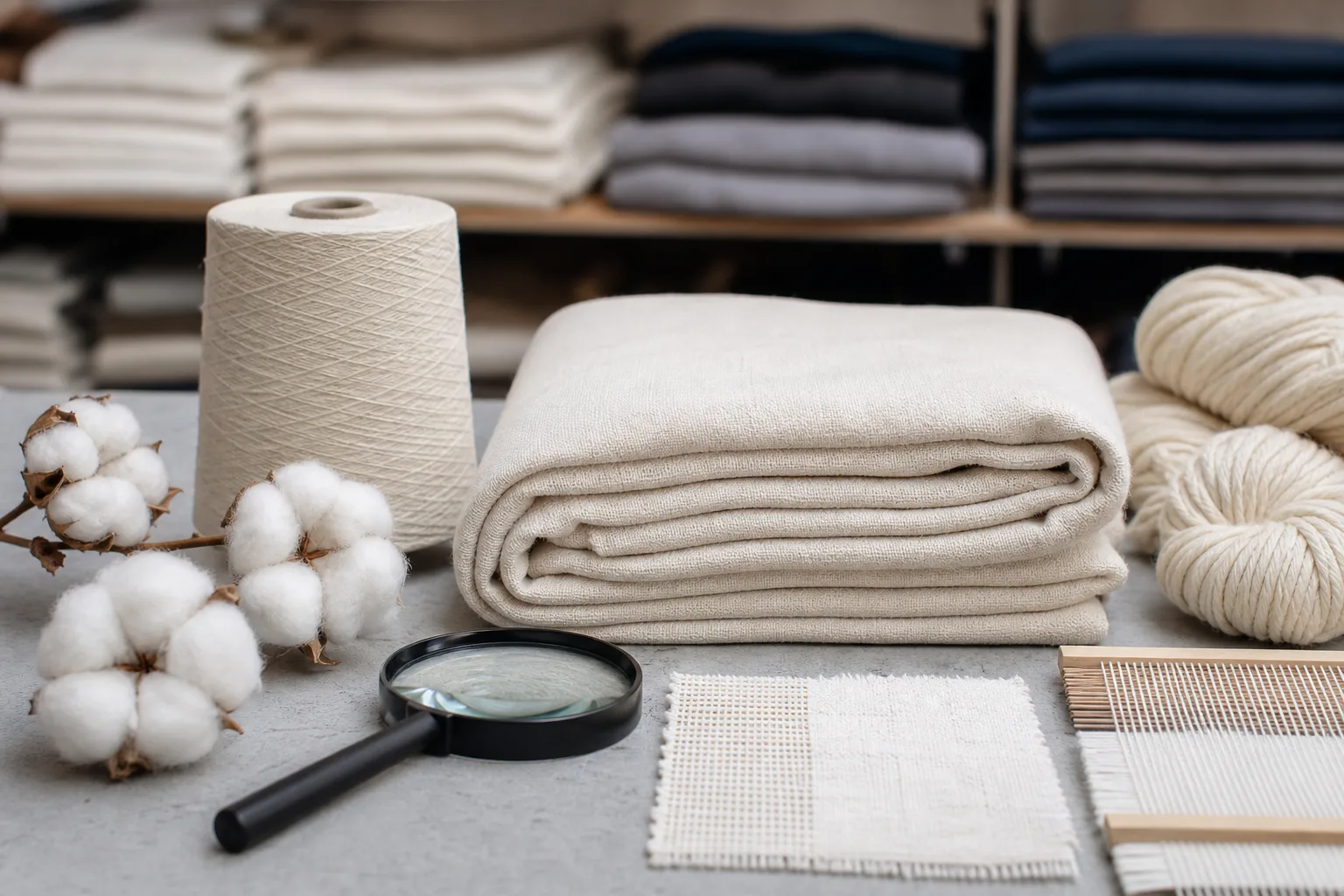
Cotton thread count is useful, but it is not a quality score. It describes how densely a woven fabric is constructed by adding the warp yarns running lengthwise and filling yarns running across one square inch. A well-made 200–300 thread count cotton percale can therefore offer better comfort and value than a poorly specified sheet carrying a much larger number. Compare the count only after checking whether the product is actually cotton, how its yarns are counted, which weave is used and what performance information the seller provides.
What cotton thread count actually measures
Warp ends plus filling picks
In a conventional woven sheet, thread count is the number of warp yarns, or ends, plus the number of filling yarns, or picks, in a square inch. A fabric with 150 warp ends and 150 filling picks is described as 300 thread count. The number concerns fabric construction; it does not directly measure the length or strength of the cotton fiber, yarn evenness, softness, shrinkage, tear resistance or service life.
CottonWorks explains that when yarn counts are held constant, a higher thread count generally creates a tighter fabric. Its cotton sheet guidance also notes that manufacturers can typically fit around 400 yarns comfortably into a square inch, although finer yarns and some filling constructions can produce higher counts. Counts above that point are not automatically false or poor, but they deserve closer examination because the counting method and yarn specification become especially important. CottonWorks cotton sheets buying guide
Why yarn ply must not inflate the number
A plied yarn is made by twisting two or more component strands together. Counting every component within a two-ply yarn as if it were a separate fabric yarn can multiply the advertised figure without placing the claimed number of independent ends and picks in the cloth.
In an FTC staff opinion, the agency cited the accepted approach of counting each warp or filling yarn as one unit, whether it is single or plied. The opinion explained that presenting a fabric made with a 300 construction and two-ply yarn as “600 thread count” would likely mislead consumers; “300 thread count, 2-ply yarn” would distinguish construction from ply. Objective thread-count claims should have a reasonable basis. FTC staff opinion on thread-count representations
Lower versus higher thread counts
There is no universal threshold at which cotton sheets become “premium.” The practical result depends on yarn size, weave and finishing as well as count. The following ranges are buying guides, not laboratory grades or guarantees.
| Construction to investigate | Likely characteristics | Potential advantages | Questions to ask |
|---|---|---|---|
| About 180–250 | More open construction, often found in crisp plain-weave sheets | Can feel light, breathable and quick to dry when made with sound yarns | Is the fabric opaque and even? Does the seller report shrinkage or durability testing? |
| About 250–400 | Moderate to relatively dense construction suitable for percale or sateen designs | Can balance coverage, softness, drape and durability | Is the count based on individual ends and picks? Is the yarn single-ply or plied? |
| Above 400 | May use very fine yarns, multiple filling insertions, plied yarns or a combination | Can be smooth and substantial when intelligently engineered | How was the count calculated? Does added density reduce airflow, drape or tear performance? |
A higher count places more yarn into a given area, but additional density may also make fabric heavier, less permeable or stiffer if yarn fineness and finishing are not balanced. CottonWorks cautions that a high cover factor can contribute to harsher hand, poorer drape and lower tear strength. That is why a four-digit number should not be treated as an automatic improvement over a credible 250- or 300-count construction.
When a lower count may offer better value
Choose a moderate count when you prefer a cooler, crisper sheet, want easier laundering or are comparing products at different prices without reliable construction details. A well-executed 200–300 count percale made from even yarns may outperform a denser fabric made from irregular yarns or promoted through an inflated ply calculation. See the cotton bed-sheet buying guide for a broader product checklist.
When a higher count may be justified
A genuinely dense construction may be appropriate when the yarns are fine enough to preserve flexibility and the desired result is a smooth, close surface. Ask for single-ply construction information, fabric weight and relevant performance specifications. The number becomes more meaningful when a supplier can explain how the fabric was engineered rather than simply repeating a marketing claim.
Fiber and yarn can matter more than the headline number
Cotton fiber properties shape yarn quality
Thread count begins at the fabric stage, but performance begins earlier. The USDA classifies raw cotton using measurements that include fiber length, length uniformity, strength and micronaire, along with color and trash information. These are distinct, measurable properties. Fiber length and uniformity influence spinning efficiency and yarn evenness, while fiber strength contributes to the yarn system from which the fabric is made. Micronaire combines information related to fineness and maturity rather than serving as a direct softness grade. USDA Agricultural Marketing Service cotton classing
Longer cotton can support finer yarns because more fiber length is available for fibers to overlap and hold together during spinning. That can help a manufacturer build a dense fabric without relying on bulky yarn. It does not mean every long-staple product will be soft or durable: fiber selection, preparation, spinning, weaving and finishing still have to be controlled. Explore cotton staple length, fiber strength, micronaire and HVI testing for the measurements behind raw-cotton specifications.
Spinning and preparation change the surface
Carding aligns and cleans fibers to form a usable strand; combing adds a step that removes more short fibers and improves alignment. Combed yarn can consequently support a smoother, more even surface, although “combed” alone does not establish a performance result. Compare combed and carded cotton.
Spinning systems also influence yarn structure, hairiness, uniformity and cost. Ring-spun and open-end yarns are genuinely different constructions, each suitable for particular products. Neither the spinning method nor thread count should be read in isolation. Our ring-spun versus open-end comparison explains the distinction.
Weave and finishing determine how the sheet feels
Percale and sateen are constructions, not quality grades
Percale generally uses a balanced plain weave that produces a matte, crisp surface. Sateen exposes longer yarn floats on the face, giving it a smoother feel and more visible luster. Sateen may feel softer at the point of sale, while percale may feel airier and crisper. Neither is inherently superior, and two fabrics with the same thread count can feel markedly different because their interlacing patterns are different. Use the percale versus sateen guide to choose by feel and use rather than by count alone.
Finishing can disguise construction quality
Mechanical and chemical finishing can change smoothness, luster, wrinkle behavior, dimensions and initial hand. A very soft package sample may reflect applied softener or mechanical treatment rather than unusually fine fiber. That finish may change after laundering. Conversely, an unfinished or lightly finished percale may soften over repeated washes.
Finishing is not automatically undesirable; it is part of textile engineering. The useful question is whether the product continues to meet its intended requirements after care. For commercial evaluation, request test methods and results for properties relevant to the specification, such as dimensional change, tensile or tear strength, pilling, appearance after laundering and colorfastness. A generic phrase such as “tested for quality” is not a result. Visit the textile tests explainer for help interpreting reported evidence.
How to read labels and sustainability claims
Verify fiber content before comparing counts
A cotton thread-count comparison is meaningful only when the products have comparable fiber content. In the United States, most covered textile products must disclose fiber content, country of origin and the identity of the manufacturer or responsible business. Bedding, including sheets and pillowcases, falls within the covered product categories. Required fiber percentages are based on weight, whereas thread count describes woven construction; one disclosure cannot substitute for the other. FTC textile labeling guidance
Check whether the package says 100% cotton or identifies a blend. Terms such as “cotton-rich” should not be interpreted as 100% cotton without the percentage disclosure. Country references, premium-sounding cotton names and thread count also do not replace the required fiber information. Use our guide to verifying cotton sheet labels before comparing prices.
Thread count says nothing about sustainability by itself
A count of 300, 600 or 1,000 does not prove organic production, traceability, lower chemical use, reduced water consumption, safer processing or better labor practices. Those are separate claims requiring appropriately scoped evidence. For example, Textile Exchange describes the Organic Content Standard as a voluntary standard for third-party certification of organic material and its chain of custody. Certification supports a defined content claim; it does not turn thread count into an environmental metric. Textile Exchange Organic Content Standard
Look for the standard name, claim wording, certification body or identifying details needed to verify a product-level claim. Do not assume that a company membership, cotton-sourcing program or general sustainability statement means every physical fiber in a particular sheet has been traced under the same model. See the cotton sustainability hub for claim-specific guidance.
A practical cotton sheet buying checklist
- Start with fiber content. Confirm whether the sheet is 100% cotton or a blend.
- Identify the weave. Choose percale for a typically crisp, matte character or sateen for a typically smooth, lustrous face.
- Check the counting method. Ask whether the stated number is the sum of actual warp ends and filling picks, with plied yarn counted as one yarn.
- Ask about yarn. Look for clear information on single-ply or plied construction, yarn fineness and, where relevant, combing or spinning method.
- Treat very high counts as a prompt for questions. They may be technically achievable, but they are not independent proof of comfort or durability.
- Compare fabric weight and opacity. Two sheets with the same count may use different yarn sizes and therefore have different mass, drape and coverage.
- Look for performance evidence. Prefer identified test methods and numerical or graded results over unsupported claims such as “hotel quality.”
- Review care instructions. Heat, detergent, drying and repeated laundering can affect dimensions, surface appearance and service life. Follow the supplied instructions and consult the cotton care guide.
- Evaluate fit separately. Pocket depth, mattress dimensions and expected shrinkage matter more to fitted-sheet performance than thread count.
- Compare total value. Judge construction clarity, expected use, care requirements, warranty or return terms and verified claims alongside price.
The most defensible buying decision is rarely “choose the highest number.” Choose a credible construction suited to the desired feel, supported by accurate fiber labeling and enough technical detail to distinguish measurable features from marketing language. For additional checks, use how to tell cotton quality.
Frequently asked questions
What is a good thread count for cotton sheets?
There is no single quality threshold, but roughly 200–400 can support many well-made cotton percale and sateen sheets. Fiber quality, yarn size, weave, finishing and accurate counting can matter more than choosing the largest number.
Is 1,000 thread count better than 300?
Not necessarily. A genuine high-density construction may be smooth and substantial, but a four-digit claim may also involve very fine yarns, multiple filling insertions or an inflated ply calculation. A credible 300-count cotton sheet can provide better comfort, airflow and value.
Should two-ply yarn count as two threads?
No. For fabric-count purposes, a plied warp or filling yarn is counted as one yarn unit. Ply can be disclosed separately, such as “300 thread count, two-ply yarn,” rather than used to multiply the thread-count claim.
Does high thread count mean long-staple or organic cotton?
No. Thread count describes woven construction. Staple length is a fiber property, while organic and other sustainability claims concern farming, material verification or processing requirements. Each claim needs separate evidence.
How this guide was prepared
Desk research completed on September 30, 2026, using published technical guidance from CottonWorks, official USDA cotton-classing information, FTC labeling and thread-count guidance, and Textile Exchange certification information. No products were purchased or handled, and no laboratory tests, mill inspections, farm visits or first-hand trials were conducted.
Review status: Publishable quality advisory.
Sources and scope
- Cotton Sheets Buying GuideCottonWorks / Cotton Incorporated
Definition and calculation of thread count, practical construction limits, cover factor, yarn ply and the need to consider fiber, yarn, weave and finishing.
Accessed 2026-09-30 - Cotton Classing ServicesUSDA Agricultural Marketing Service
Official descriptions of cotton fiber length, uniformity, strength, micronaire, color and trash measurements.
Accessed 2026-09-30 - FTC Staff Opinion Concerning Thread Count RepresentationsFederal Trade Commission
Guidance that individual warp and filling yarns are counted as units regardless of ply and that inflated thread-count representations may mislead consumers.
Accessed 2026-09-30 - Threading Your Way Through the Labeling Requirements Under the Textile and Wool ActsFederal Trade Commission
United States textile labeling requirements for fiber content, country of origin and responsible business identity, including coverage of bedding.
Accessed 2026-09-30 - Organic Content StandardTextile Exchange
Purpose and scope of third-party organic-material and chain-of-custody certification, distinguished from product construction claims such as thread count.
Accessed 2026-09-30