
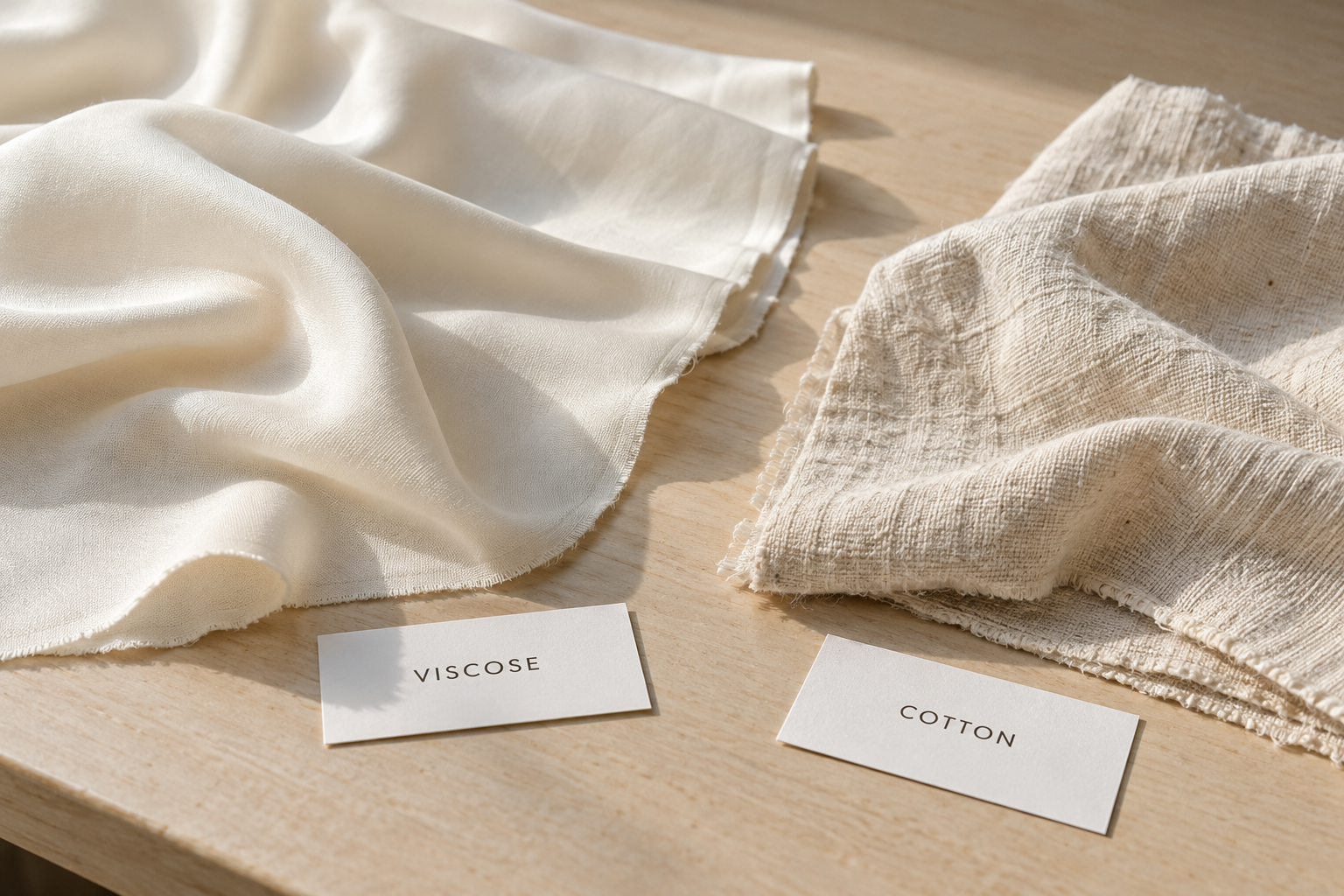
Viscose is not a kind of cotton. Cotton is a natural plant fiber; viscose is a manufactured, regenerated-cellulose fiber, commonly described as viscose rayon. They can share a soft feel and a cellulosic origin while having different production routes. Neither name alone tells you how a finished sheet, shirt or lining will wash or wear.
Read the fiber-content label first. Then compare construction, weight, finishing and care for the product you need. A smooth viscose swatch and a crisp cotton swatch may differ because of their weave and finish as well as their fibers.
Compare identity before performance
| Question | Cotton | Viscose |
|---|---|---|
| Fiber route | Plant-grown fiber prepared and spun into yarn | Cellulose processed and regenerated into manufactured fiber |
| Is it a weave? | No; it can be woven or knitted | No; it can also be woven or knitted |
| What should the label identify? | Cotton and the relevant blend percentages | The proper manufactured-fiber name and relevant blend percentages |
| Does the name establish weight or drape? | No | No |
| Does it prove lower environmental impact? | No | No |
Textile Exchange places viscose among manmade cellulosics. A plant-derived feedstock does not make the finished fiber cotton, and the word “natural” is too imprecise to replace an accurate composition statement.
Read “bamboo” with particular care
FTC guidance distinguishes actual bamboo fiber from rayon or viscose manufactured using bamboo as a cellulose source. Where the product is the latter, appropriate wording identifies rayon or viscose made from bamboo. Do not read a large “bamboo” headline as a statement that the cloth is cotton, unprocessed plant fiber or naturally antibacterial.
A plant’s properties do not automatically survive conversion into a manufactured fiber. Ask for substantiation for antibacterial, health or sweeping environmental claims rather than inferring them from the feedstock. This comparison makes no health or antimicrobial recommendation.
Keep rayon terminology precise
Viscose is a process-specific form within regenerated-cellulose terminology; rayon is used more broadly in some markets. Modal and lyocell are related manufactured cellulosic fibers with different processing definitions. They should not be silently substituted for viscose or described as cotton either.
US FTC guidance permits identified ISO generic names, including viscose, in specified labeling contexts. Other destinations have their own naming rules. For commercial artwork, have the responsible labeling specialist check the actual blend and market rather than copying a marketplace title.
Judge the fabric in the condition you will use it
Ask whether the cloth is woven or knitted, what finish it has and whether the reported weight describes the finished material. Compare samples at similar construction and weight when trying to isolate a fiber difference. A lightweight viscose dress cloth is a poor durability comparison for a heavy cotton workwear twill.
For a garment, check drape, opacity, recovery and seam behavior. For bedding, check fit after laundering, surface feel and the care burden. Do not assume a soft initial hand establishes long-term strength or that a cotton label guarantees machine-wash durability. Follow the finished product’s care label, including restrictions associated with trims, dyes and finishes.
Treat sustainability as a claim with a scope
For viscose, ask about the cellulose source and processing controls. For cotton, ask what is known about the fiber supply and the claimed farming or processing scheme. Neither a plant image nor a single fiber name establishes the comparative impact of the whole product.
A certification may address content, custody or selected processing requirements. It is not interchangeable with measured shrinkage, pilling, colorfastness or service life. Use the certification guide to identify what a particular label covers and how to check its number.
A practical comparison record
Keep the full composition, construction, finished weight, care instructions and relevant performance evidence beside the price. For blends, record the whole blend rather than highlighting only the more appealing fiber. If the listing and sewn label disagree, ask the seller to resolve the discrepancy before relying on either claim.
Choose the item whose documented construction and care suit the job. The useful distinction is between known properties of that item and assumptions made from a fiber headline.
Next steps
Check fabric construction · Compare mass per area · Verify the certification scope
How this guide was prepared
Desk research of public technical guidance and the identified product descriptions. No product testing, installation, supplier audit or site visit is claimed.
Sources and scope
- Textile Exchange — Viscose
Viscose as manufactured cellulosic fiber and the importance of sourcing/processing.
Accessed 2026-11-02 - FTC — Bamboo textiles
Distinguishes actual bamboo fiber from rayon/viscose made from bamboo.
Accessed 2026-11-02 - FTC — Textile labeling guidance
Generic names, percentages and permitted viscose terminology.
Accessed 2026-11-02 - Competition Bureau Canada — Bamboo-derived textiles
Cellulose regeneration and process-specific manufactured-fiber terminology.
Accessed 2026-11-02
Questions & discussion
Share a question or a useful experience about this guide. Comments appear immediately. Your name and comment are public. Email is optional and stays private; reply emails are not enabled yet. Comment privacy.