
HVI Cotton Testing: Metrics, Reports and Limitations
Learn what HVI cotton testing measures, how to read length, strength, micronaire, color and trash data, and what the results cannot prove.
Read guide →Understand the fiber and fabric factors that make cotton products perform differently.
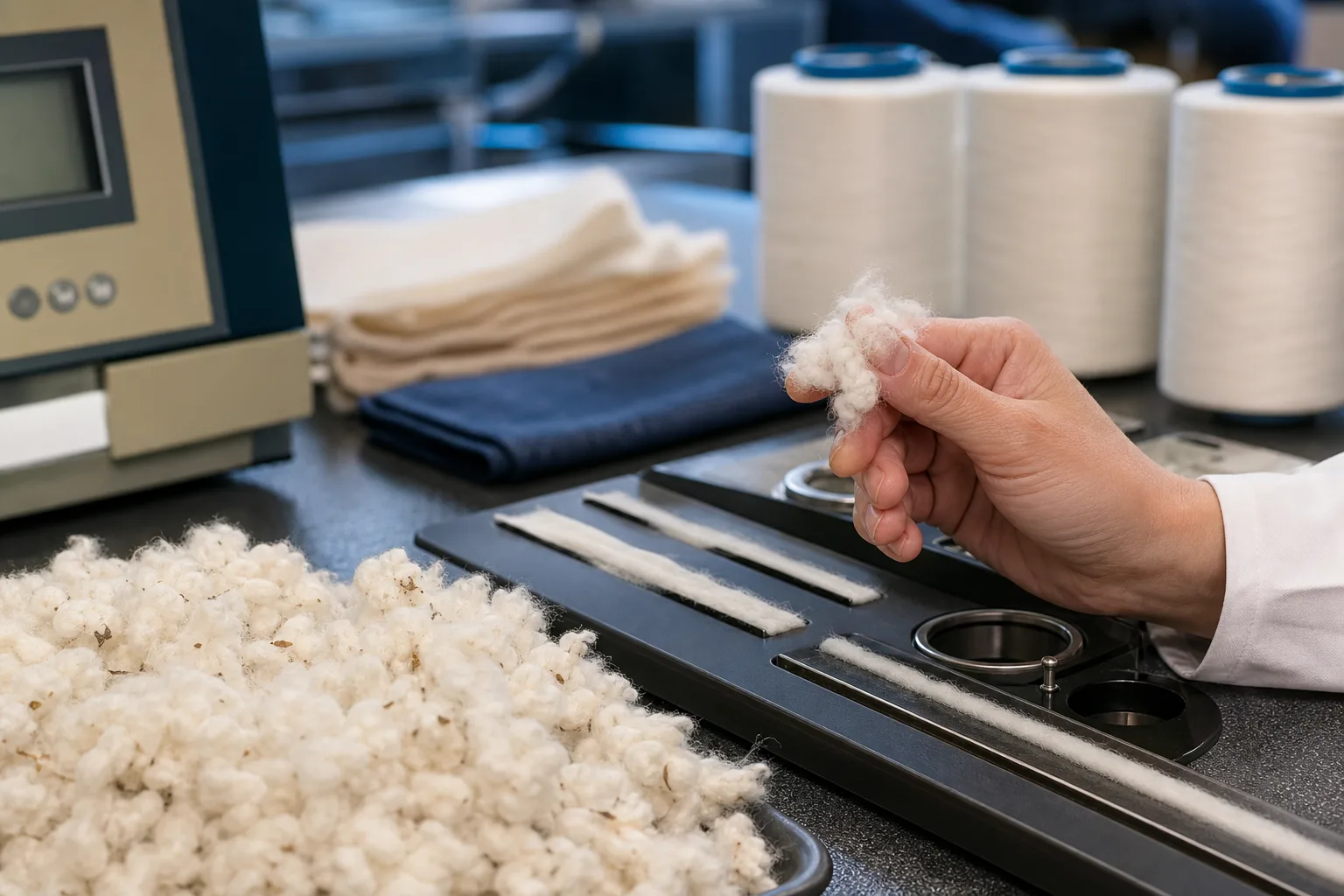
Learn what HVI cotton testing measures, how to read length, strength, micronaire, color and trash data, and what the results cannot prove.
Read guide →Learn how cotton leaf grade, trash percent area and particle count describe lint cleanliness—and what they mean for mills, yarn and buyers.
Read guide →Learn what cotton fiber maturity means, how it affects dye uniformity and yarn performance, and why micronaire cannot measure maturity by itself.
Read guide →Learn what cotton length uniformity means, how HVI testing measures it, and why the result matters for spinning, yarn quality and cotton buying.
Read guide →Learn how cotton fiber strength is measured in grams per tex, how it affects spinning and yarn, and why it does not by itself predict fabric durability.
Read guide →Learn how cotton staple length is measured, why longer fibers can improve yarn, and why construction and finishing still determine fabric quality.
Read guide →Learn how cotton color grade uses reflectance and yellowness, why it affects raw-fiber value, and what the measurement cannot tell textile buyers.
Read guide →Learn what cotton micronaire measures, how readings affect spinning and dyeing, and why micronaire alone cannot predict finished fabric quality.
Read guide →The fiber properties behind feel, warmth, moisture and wear.
Cotton can pill, but fiber content alone does not predict it. Learn how fibers, yarn, construction, finishing, wear and care affect pilling.
Read guide →Learn why cotton accepts many dyes, how cellulose chemistry and preparation affect color, and what fiber labels can and cannot tell you about performance.
Read guide →Learn how cotton abrasion resistance is shaped by fiber quality, yarn design, fabric construction, finishing, testing and care—and how to assess durability claims.
Read guide →Learn how cotton manages heat, air and moisture—and why yarn, fabric construction, finishing, fit and care determine whether a product feels cool or warm.
Read guide →Cotton is often breathable, but airflow depends on yarn, fabric construction, weight, finishing and moisture. Learn how to assess real-world comfort.
Read guide →Learn how cotton absorbs moisture, why absorbency differs from wicking and drying, and how yarn, fabric construction, finishing and care affect performance.
Read guide →Learn how cotton cellulose affects absorbency, strength, dyeing and wrinkles—and why yarn, construction, finishing and care still determine performance.
Read guide →Learn how cotton fiber structure influences spinning, dyeing and absorbency—and why yarn, construction, finishing and care still determine performance.
Read guide →Simple checks you can run at home, and what each one can and cannot prove.
Learn how to calculate fabric GSM from a measured sample, reduce common weighing errors and interpret fabric weight without mistaking it for quality.
Read guide →Learn how to identify cotton by touch, interpret texture clues and understand why finishing, yarn and fabric construction limit this test.
Read guide →Learn how to conduct a cotton burn test safely, interpret flame and ash, recognize blends, and understand why the test cannot prove quality or origin.
Read guide →Use this repeatable 20-wash cotton sheet test to track dimensional change, pilling, appearance and fitted-sheet fit without claiming laboratory results.
Read guide →