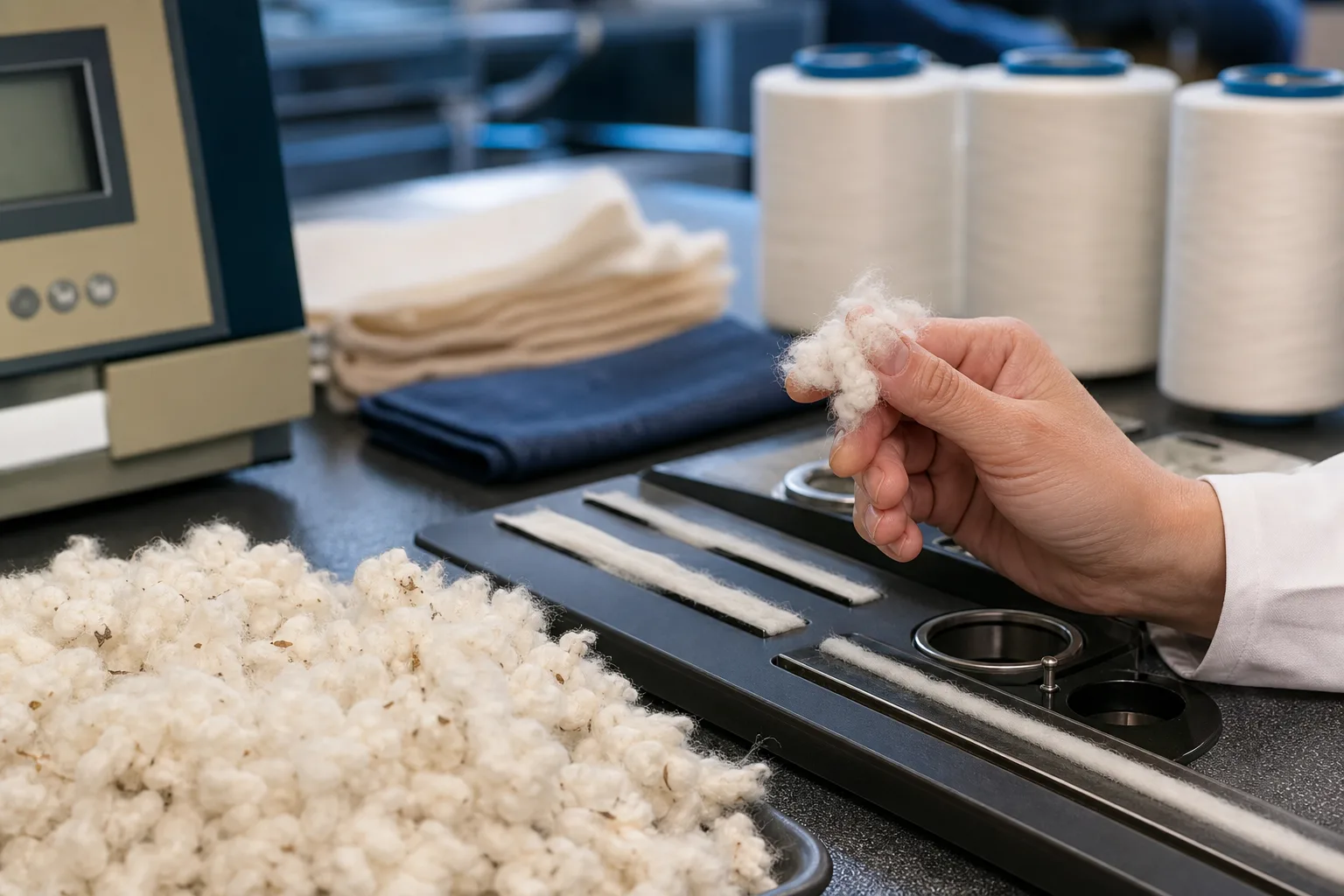
HVI cotton testing is a standardized, high-throughput method for measuring selected properties of raw cotton fibers. A typical report covers fiber length, length uniformity, strength, micronaire, color and non-lint material. These results help cotton classers, merchants and textile mills describe bales and plan processing. They are not, however, a complete score for a finished sheet, shirt or towel: yarn design, fabric construction, dyeing, finishing and care can all change how a cotton product performs.
What HVI cotton testing does
HVI refers to High Volume Instrument testing. Instead of relying only on visual or hand assessment, an HVI system rapidly tests prepared samples under controlled laboratory conditions. In the United States, the Agricultural Marketing Service of the US Department of Agriculture tests a sample from every bale produced and reports measurements used in marketing and manufacturing. USDA classification also includes visual inspection for extraneous matter that instruments may not adequately characterize. The agency describes its current process in its cotton classing guidance.
HVI is valuable because it turns several fiber attributes into comparable numerical data. Calibration materials, atmospheric control, verification samples and standardized procedures are used to improve consistency between instruments, shifts and laboratories. USDA produces calibration cottons with established reference values, while the international CSITC guideline specifies calibration, sampling and testing practices for commercial instrument testing.
What is actually being tested?
The test material is a sample of ginned cotton lint associated with a bale or group of bales. It is not yarn and it is not finished fabric. The resulting numbers describe the sampled raw fiber at the time of testing. They can inform purchasing and mill decisions, but they do not follow automatically into a consumer product without the influence of blending and manufacturing.
HVI data is not a consumer quality label
Terms such as “premium,” “luxury,” “hotel quality” or “soft cotton” are not HVI measurements. A fiber-origin name is also not a substitute for a test report. If a seller makes a measurable claim about long fibers, strength or another property, the relevant question is whether the claim is supported by representative fiber data and whether the tested cotton is traceable to the product—not whether the marketing language sounds technical.
The main HVI metrics explained
USDA classification records can include length, length uniformity, strength, micronaire, color measurements and trash data. Each metric answers a different question, so no single number should be treated as a universal quality grade. For deeper explanations, see the Cotton Good guides to staple length, length uniformity, fiber strength and micronaire.
Fiber length
HVI length is generally reported as upper-half-mean length: the average length of the longer half of the fibers by weight in the tested specimen. USDA may express instrument length in hundredths of an inch and translate it into a staple code based on thirty-seconds of an inch. Longer fibers can give a spinner more flexibility to produce fine or strong yarns, but length alone does not guarantee either outcome.
Length uniformity index
Length uniformity index compares mean fiber length with upper-half-mean length and is reported as a percentage. A higher result indicates a more uniform length distribution within the tested specimen. Low uniformity can signal a greater proportion of shorter fibers, which may make processing control more difficult. It is not the same as a direct short-fiber-content measurement.
Fiber strength
HVI strength is measured by breaking a bundle of parallel fibers and reporting the force in grams per tex. Stronger raw fiber may support higher processing speeds and stronger yarn, depending on fiber length, fineness, yarn system and machine settings. The number does not directly state the tear, tensile or abrasion resistance of a finished fabric.
Micronaire
Micronaire is based on the air permeability of a compressed mass of cotton. It responds to both fiber fineness and maturity, meaning the same micronaire result can arise from different combinations of those properties. It should not be described as a pure diameter or fineness measurement. Separate information may be needed when fiber maturity is important to processing or dye uniformity. CottonWorks provides a technical overview of this distinction in its cotton fiber quality resource.
Color
Instrument color is expressed through reflectance, known as Rd, and yellowness, written as +b. Together these measurements are used to assign a color grade or color quadrant under the applicable classification system. Color data describes raw lint, not the shade accuracy or colorfastness of dyed fabric. Storage conditions and later bleaching, dyeing and finishing also matter. See cotton color grade for a focused explanation.
Trash, leaf and extraneous matter
HVI imaging measures the area occupied by visible non-lint material and counts particles on the presented sample surface. USDA uses trash and particle data in its classification process, while trained classers also inspect samples for extraneous matter such as bark, grass, seed-coat fragments or plastic. A total trash result does not reliably identify every material present. Learn more about leaf and trash measurements.
How to read an HVI report
Begin by confirming the reporting system, cotton type, bale identity and units. The USDA Universal Classification Data Format contains both measurements and translated grades or codes. For example, an instrument length may appear alongside a staple code, and Rd and +b may appear alongside a color grade. USDA explains these fields in Cotton Classification: Understanding the Data.
| Report field | Typical unit or format | What it helps describe | What it does not establish |
|---|---|---|---|
| Upper-half-mean length | Decimal inches or millimetres | Length of the longer half of the fiber distribution | Finished yarn count, pilling or fabric durability |
| Length uniformity index | Percent | Relative evenness of fiber lengths | Exact short-fiber content |
| Strength | Grams per tex | Bundle breaking strength of raw fibers | Garment seam strength or fabric tear strength |
| Micronaire | Micronaire units | Combined response to fineness and maturity | Fiber diameter or maturity considered separately |
| Rd and +b | Instrument units | Raw-lint reflectance and yellowness | Dyed shade, whiteness after processing or colorfastness |
| Trash area and count | Percent area and particle count | Visible non-lint material on the sample surface | Identity of every contaminant or mill cleaning efficiency |
Do not rank two cottons by highlighting only the more favorable number. One lot may be longer but less uniform; another may be stronger but unsuitable for the intended yarn because of micronaire, contamination risk or variation between bales. The useful result is the profile that fits a defined process and product.
From fiber data to yarn and fabric performance
Why mills use HVI results
Mills can use HVI data when selecting bales and designing laydowns—the planned blends fed into production. The objective is often to achieve a controlled average while limiting variation from bale to bale. Fiber length, uniformity, strength and micronaire can affect opening, cleaning, carding, drafting, spinning stability and yarn properties. Their effects are interconnected rather than independent.
A favorable HVI profile increases the options available to a competent spinner; it does not prescribe the result. Ring, rotor and air-jet spinning systems impose different demands. Yarn count, twist, fiber alignment, evenness and hairiness then influence the fabric. Construction choices such as weave or knit structure, yarn density and fabric weight add another layer. Finishes can alter softness, shrinkage, appearance and hand feel. Explore the broader distinction between fiber data and product quality in the cotton quality guide, industry guide and fabric guide.
What buyers should ask for
A professional buyer should define the intended yarn and end use before setting fiber specifications. Ask whether the figures are individual-bale results, lot averages or supplier targets; which organization performed the testing; which test date and classification system apply; and how variability is controlled. Averages without ranges can hide outlying bales that create processing problems.
For a finished product claim, also ask how the tested cotton was connected to the yarn or fabric. A genuine HVI report for an unrelated bale does not validate a product. Traceability, blending records and manufacturing controls are separate evidence questions. The cotton buying guide covers practical claim evaluation beyond laboratory numbers.
Important limitations of HVI testing
- It tests a sample, not every fiber. Cotton is naturally variable, so representative sampling and sample preparation affect how well the result describes a bale.
- It covers selected properties. Standard classification data is not a complete chemical, biological or contamination analysis.
- Some measurements combine effects. Micronaire cannot independently separate fineness from maturity.
- Reported strength is bundle strength. It is not interchangeable with yarn or fabric strength testing.
- Trash imaging has limited specificity. Area and particle results do not necessarily identify the type of non-lint material.
- Laboratory control matters. Conditioning, calibration materials, instrument maintenance, verification frequency and operator procedures influence comparability.
- A result has measurement uncertainty. Small numerical differences should not automatically be interpreted as commercially or technically meaningful.
- It does not verify product claims outside fiber quality. HVI cannot establish organic status, recycled content, farm practices, labor conditions, water use, chemical inputs or lifecycle impact.
The CSITC Guideline for Standardized Instrument Testing of Cotton emphasizes representative sampling, approved calibration materials, atmospheric conditioning and frequent calibration checks. These controls explain why a bare list of numbers without laboratory and sample context should be interpreted cautiously.
HVI data also should not be used as evidence for care claims. Shrinkage, dimensional stability, pilling and laundering performance must be evaluated at the yarn, fabric or product stage using suitable methods. Nor does fiber quality prove a lower environmental impact. Sustainability statements require evidence matched to the specific claim; see the cotton sustainability guide.
A practical HVI evaluation checklist
- Identify the material. Confirm cotton type, crop or lot information and the bale or group represented.
- Check the source. Record the testing or classing organization, report date and applicable system.
- Confirm the units. Do not compare decimal inches with staple codes or millimetres without correct conversion.
- Read the complete profile. Consider length, uniformity, strength, micronaire, color and non-lint material together.
- Look beyond averages. Request ranges, distributions or bale-level data when consistency matters.
- Match results to the end use. Specifications for fine yarn, denim, towels and nonwovens need not be identical.
- Separate fiber evidence from product evidence. Obtain yarn, fabric, finishing and care data for claims about the finished item.
- Do not extend the report beyond its scope. HVI cotton testing does not certify origin, sustainability, chemical safety or consumer durability.
The most defensible interpretation is therefore specific rather than absolute: HVI cotton testing provides standardized measurements of selected raw-fiber properties. Those measurements are highly useful for classification, trade and mill planning, but they become meaningful only when the sample, units, variability and intended manufacturing process are understood.
Frequently asked questions
What does HVI stand for in cotton testing?
HVI stands for High Volume Instrument. The term describes systems that rapidly measure selected properties of prepared raw cotton samples, including length, length uniformity, strength, micronaire, color and visible non-lint material.
Does a high HVI result mean a cotton product is high quality?
Not by itself. HVI results describe raw-fiber properties, while finished-product performance also depends on blending, spinning, yarn design, fabric construction, dyeing, finishing and care. The appropriate fiber profile also varies by end use.
Is micronaire a direct measure of cotton fiber fineness?
No. Micronaire is an air-permeability measurement influenced by both fiber fineness and maturity. A micronaire number cannot independently identify either property without additional information.
Can HVI cotton testing prove a sustainability claim?
No. HVI measures physical raw-fiber properties. It does not certify organic production, recycled content, water use, labor conditions, chemical inputs, traceability or lifecycle impact.
Can two HVI reports be compared directly?
They can be compared only after checking cotton type, sampling basis, units, test or classing system, laboratory controls and whether the figures represent individual bales or averages. Small differences may fall within normal sampling and measurement variation.
How this guide was prepared
This page is based on desk research conducted on September 12, 2026, using USDA Agricultural Marketing Service classing documentation, USDA classification-data guidance, CottonWorks fiber-science material and the ICAC/CSITC standardized instrument-testing guideline. No laboratory testing, mill assessment, farm visit, product trial or first-hand inspection was performed.
Review status: Publishable quality advisory.
Sources and scope
- Cotton Classing ServicesUSDA Agricultural Marketing Service
Current USDA descriptions of instrument-tested properties, classer inspection, laboratory conditioning, verification procedures and the role of classification data in cotton marketing and manufacturing.
Accessed 2026-09-12 - Cotton Classification: Understanding the DataUSDA Agricultural Marketing Service
Definitions and reporting fields for USDA cotton classification data, including length, micronaire, strength, uniformity, color, trash, leaf grade and extraneous matter.
Accessed 2026-09-12 - Cotton Fiber QualityCottonWorks by Cotton Incorporated
Technical explanations of upper-half-mean length, length uniformity, bundle strength, micronaire, color measurements, trash imaging and their relevance to textile processing.
Accessed 2026-09-12 - Guideline for Standardized Instrument Testing of CottonInternational Cotton Advisory Committee, Committee for the Commercial Standardization of Instrument Testing of Cotton
International guidance on sampling, laboratory conditions, approved calibration materials, specimen preparation, reporting precision, calibration checks and measurement comparability.
Accessed 2026-09-12