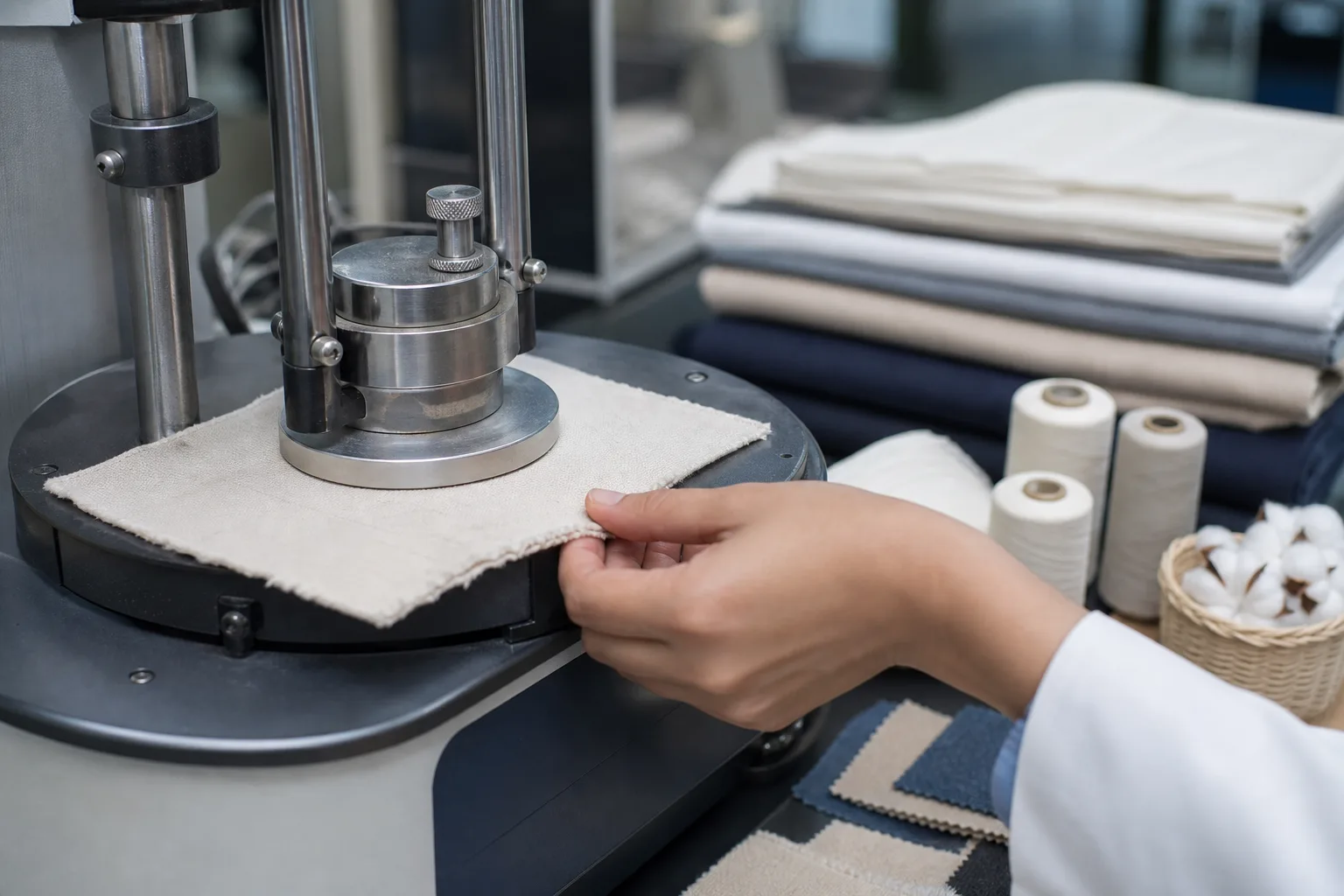
Cotton abrasion resistance is the ability of a cotton fabric to withstand rubbing without excessive surface loss, thinning or eventual breakage. Although the strength and length of the raw fibers matter, abrasion resistance is not a fixed property of cotton itself. It emerges from the complete textile system: fiber selection, yarn structure, fabric construction, finishing, garment design, use and care. For buyers, this means that a “100% cotton,” “premium cotton” or “durable cotton” label does not by itself establish how long a product will resist wear. A meaningful comparison requires a relevant test result or, at minimum, specific information about construction and intended use.
What abrasion does to cotton fabric
Abrasion occurs whenever a textile rubs against another surface or against itself. Common examples include trouser knees contacting the floor, a shirt rubbing beneath a backpack strap, bedding moving against a sleeper and towel loops rubbing during washing and drying. CottonWorks defines abrasion resistance as a fabric’s ability to resist surface loss caused by friction. The result depends on the abradant, force, direction, fabric tension and whether the material is wet or dry. These variables help explain why one laboratory result cannot represent every form of real use. CottonWorks garment durability guidance also treats abrasion as one part of durability alongside strength and pilling resistance.
From surface change to failure
Repeated rubbing can raise loose fiber ends, produce fuzz, alter color and wear down exposed yarns. Continued mechanical stress may break fibers or displace yarns, reducing fabric cover until a thin area or hole develops. The visible sequence varies by product. A brushed sweatshirt may show surface change before structural failure, while a tightly constructed workwear fabric may retain a relatively smooth face for longer.
Abrasion should not be confused with every other durability problem:
- Pilling is the formation of small balls of entangled fibers attached to the surface.
- Tearing is the propagation of a cut or rupture through the fabric.
- Tensile or breaking strength describes resistance to force that pulls material apart.
- Seam failure may involve broken sewing thread, seam slippage or damage beside a seam.
- Color loss may result from dye behavior, washing or light exposure as well as surface abrasion.
These properties can interact, but a product that performs well in one test is not automatically strong in all of them.
How fiber properties influence abrasion resistance
Raw cotton quality establishes important starting conditions for spinning, but bale-classing data is not a direct fabric abrasion score. The USDA Agricultural Marketing Service measures properties including fiber length, length uniformity, micronaire and bundle strength. Those measurements support cotton marketing and help manufacturers select material for particular processes and products; abrasion resistance is not among the listed USDA classing measurements. USDA cotton classing information therefore should not be presented as proof that a finished garment passed an abrasion test.
Length and length uniformity
Longer fibers and a more uniform fiber-length distribution can support stronger, more even yarns when the rest of the spinning system is suitable. CottonWorks notes that staple length and length uniformity affect yarn strength, yarn evenness and processing efficiency. Short fibers are not automatically evidence of a poor product, but excessive short-fiber content or wide length variation can make it harder to produce a clean, consistent yarn surface.
Fiber strength, fineness and maturity
Stronger fibers can contribute to stronger yarn, but the USDA bundle-strength value is not interchangeable with resistance to repeated surface rubbing. Micronaire, meanwhile, reflects a combination of fineness and maturity rather than abrasion performance. Finer fibers can place more fibers in a yarn cross-section, yet their practical effect depends on maturity, processing, yarn count and construction. No single raw-fiber measurement should be used as a stand-alone prediction of product life.
Why yarn and fabric construction often decide performance
Fibers must first be assembled into yarn and then into fabric. CottonWorks identifies yarn size, type, structure, strength, twist and evenness as specifications that influence textile performance. Fabric properties then depend on how those yarns are arranged. This hierarchy is why two products with identical fiber-content labels can wear very differently.
Yarn structure and twist
Twist helps hold staple fibers together. A firmer, appropriately twisted yarn may better restrain surface fibers than a loosely assembled yarn, although increasing twist can also change softness, bulk, absorbency and appearance. CottonWorks notes in its denim guidance that lower-twist yarns tend to abrade or wash down faster than higher-twist yarns. The appropriate level is therefore an engineering balance, not a rule that the highest twist is always best.
Yarn evenness also matters. Thin places may become local weak points, while protruding fibers can be exposed to friction. Plied yarns, compact yarn structures and other spinning choices may change resistance, but their benefit must be assessed in the finished fabric rather than assumed from terminology.
Fabric density, weave and knit structure
Thread count alone is not a universal durability rating. Fabric cover depends on yarn size, thread count and weave design. A dense woven twill or canvas can distribute contact over a substantial yarn network, while an open or lightweight construction exposes fewer fibers and yarns at a given point. Knits provide stretch and comfort but can respond differently to snagging, distortion and local rubbing.
Weight can be useful only within a comparable product category. A heavier fabric often contains more material to wear through, but weight does not reveal weak yarns, an unstable structure, damaging finishing or poor garment engineering. Comparing the weight of a T-shirt with that of work pants would provide little useful information.
Product design and high-wear zones
Finished-product durability also depends on panel orientation, seam placement, reinforcement and fit. Tight garments may experience concentrated rubbing at the thighs, elbows or seat. Bags and workwear may need extra layers where hardware, tools or straps contact the fabric. Testing only an undisturbed fabric swatch can miss these product-level stresses.
Finishing can improve or reduce resistance
Mechanical and chemical treatments can alter the surface, fiber mobility, yarn cohesion and strength of cotton fabrics. Brushing and other processes that deliberately raise fibers can create softness but also expose more surface material. Aggressive garment abrasion may be used to produce a faded denim appearance, meaning some surface wear is intentional rather than a manufacturing defect.
Other finishes are designed to increase yarn or fabric durability. During weaving preparation, sizing places a temporary protective film around warp yarns to reduce hairiness and abrasion on the loom. Performance finishes may also be applied to yarn, fabric or garments. However, the presence of a branded finish or words such as “tough,” “reinforced” or “long-lasting” is not itself a numerical quality result. The claim should identify the tested material, method, condition, comparison and result.
Finishes can involve trade-offs involving hand, stiffness, absorbency, appearance, sewability or other properties. Buyers specifying products should evaluate the complete performance package after the intended number of care cycles, not abrasion resistance in isolation.
How abrasion resistance is tested and reported
Laboratories use controlled equipment to rub a specimen under defined conditions. Two methods identified by CottonWorks are the Martindale abrasion method, ASTM D4966, for textile fabrics and the flexing-and-abrasion method, ASTM D3885, for woven fabrics. Method names should be reported precisely because the motions, specimen arrangements and applicable materials differ. A modified method must also be identified as modified.
What a report needs to make a comparison useful
| Report item | Why it matters | Question to ask |
|---|---|---|
| Test method and edition | Different methods impose different motions and stresses. | Was ASTM D4966, ASTM D3885 or another defined method used? |
| Any modification | A different abradant, load or endpoint can change the result. | Was the standard followed without modification? |
| Specimen description | Fiber blend, yarn, structure, weight and finish affect performance. | Does the tested specimen match the product being sold? |
| Preconditioning or laundering | Care can change the surface and remove temporary treatments. | Was the fabric tested new, after washing or in both states? |
| Endpoint | Failure may mean yarn breakage, a hole, mass loss or appearance change. | What exactly ended the test? |
| Replicates and variation | One specimen may not represent a production lot. | How many specimens were tested and how variable were they? |
| Comparison basis | Results are meaningful only under equivalent conditions. | Were both fabrics tested in the same laboratory setup? |
A higher cycle count can indicate better resistance within the same test configuration, but counts from different methods or modified protocols should not be ranked as though they share a common scale. CottonWorks also notes that there is no universal durability level for every textile product; satisfactory performance should be agreed for the individual product and end use.
Practical guidance for buyers, brands and consumers
For consumers
Fiber content is useful, but inspect the whole item. Look for an even fabric surface, consistent yarns, secure seams and appropriate reinforcement in high-wear areas. Consider whether the construction suits the use: a light jersey intended for comfort should not be expected to behave like a workwear twill.
Follow the care label rather than assuming that every cotton product tolerates the same routine. The FTC Care Labeling Rule requires covered apparel to provide regular care instructions, and manufacturers or importers must have a reasonable basis for those instructions. A care label is not an abrasion grade, but it tells the user which cleaning procedure the supplier considers appropriate for the complete product. FTC Care Labeling Rule
- Wash only when needed and use the labeled cycle and temperature.
- Close zippers and hooks that could scrape other surfaces.
- Turn printed or visibly abraded garments inside out when compatible with the instructions.
- Avoid overloading, which can increase rubbing and prevent effective cleaning.
- Use the specified drying method and heat setting.
- Repair small holes or damaged seams before they enlarge.
For sourcing and quality teams
Start with the failure mode and end use rather than requesting “high abrasion resistance” without definition. Identify the wear zone, substrate type, expected care routine and acceptable endpoint. Then establish a test method and minimum result that have been validated against relevant products. Include requirements for conditioning, laundering, specimen direction, number of replicates and production-lot verification.
A practical specification should combine abrasion testing with other relevant measures such as bursting or tensile strength, tear strength, pilling, dimensional stability, colorfastness and seam performance. This avoids improving one laboratory number while overlooking another cause of early product failure.
Durability and sustainability claims require separate evidence
A product that remains usable longer may need replacement less frequently, but abrasion performance alone does not prove that it has a lower overall environmental impact. Such a conclusion depends on actual service life, manufacturing inputs, care, repair, reuse and disposal. A laboratory cycle count should therefore be described as a durability result, not automatically converted into a claim that the product is “sustainable,” “green” or environmentally superior.
The FTC advises marketers not to make broad, unqualified environmental-benefit claims and requires appropriate substantiation for express and implied claims. A more defensible statement identifies the exact attribute and evidence—for example, that a specified fabric resisted more cycles than a named control under the same method and conditions. Even then, the result applies to that comparison; it does not establish every environmental consequence of the product.
The practical conclusion is straightforward: cotton abrasion resistance is measurable, but it belongs to a defined fabric or product under defined test conditions. Cotton content, fiber classing data, construction terms, finishes, labels and sustainability language each communicate different information. Keeping those categories separate leads to more accurate purchasing decisions, specifications and marketing claims.
Frequently asked questions
Is cotton naturally abrasion resistant?
Cotton fibers can be used to make abrasion-resistant textiles, but cotton content alone does not determine the result. Fiber quality, yarn twist and evenness, fabric density and structure, finishing, product design and care all influence the finished material.
Does a higher thread count mean better abrasion resistance?
Not necessarily. Thread count is only one construction variable and does not describe yarn size, strength, weave, finishing or fabric weight. Abrasion results from comparable finished-fabric tests provide stronger evidence.
What test is used for cotton abrasion resistance?
Methods include ASTM D4966 using a Martindale abrasion tester and ASTM D3885 using a flexing-and-abrasion tester for woven fabrics. The appropriate method, abradant, load, specimen condition and failure endpoint must be stated.
Is abrasion resistance the same as pilling resistance?
No. Abrasion resistance concerns surface loss from friction, while pilling resistance concerns the formation of entangled fiber balls on the surface. The mechanisms can interact, but they are evaluated as distinct properties.
Does abrasion resistance prove that a cotton product is sustainable?
No. It provides evidence about one aspect of durability under specified conditions. Environmental claims require separate evidence covering the claim's actual scope, potentially including manufacturing, care, service life and disposal.
How this guide was prepared
This explainer is based on desk research completed on September 19, 2026 using CottonWorks technical education materials, USDA cotton-classing guidance and FTC rules and marketing guidance. It translates documented fiber, yarn, construction, testing, care and claims principles into consumer and industry guidance. No laboratory testing, product trial, mill visit, farm visit or first-hand performance assessment was conducted.
Review status: Publishable quality advisory.
Sources and scope
- Garment DurabilityCottonWorks, Cotton Incorporated
Defines fabric abrasion resistance, identifies variables affecting abrasion and explains its relationship to strength, pilling and end-use requirements.
Accessed 2026-09-19 - Cotton Fiber QualityCottonWorks, Cotton Incorporated
Explains cotton staple length, length uniformity, bundle strength and micronaire, including their effects on yarn quality and processing.
Accessed 2026-09-19 - Quality TestingCottonWorks, Cotton Incorporated
Describes how fiber, yarn specifications, fabric construction, care and testing contribute to finished-product performance.
Accessed 2026-09-19 - Cotton Classing ServicesUSDA Agricultural Marketing Service
Lists the raw-cotton properties measured during USDA classing and establishes that abrasion resistance is not a listed bale-classification measurement.
Accessed 2026-09-19 - Care Labeling of Textile Wearing Apparel and Certain Piece GoodsFederal Trade Commission
Establishes U.S. requirements for regular care instructions and the need for a reasonable basis supporting those instructions.
Accessed 2026-09-19 - Environmental Claims: Summary of the Green GuidesFederal Trade Commission
Supports the distinction between a specific durability result and broad environmental-benefit claims that require separate substantiation.
Accessed 2026-09-19