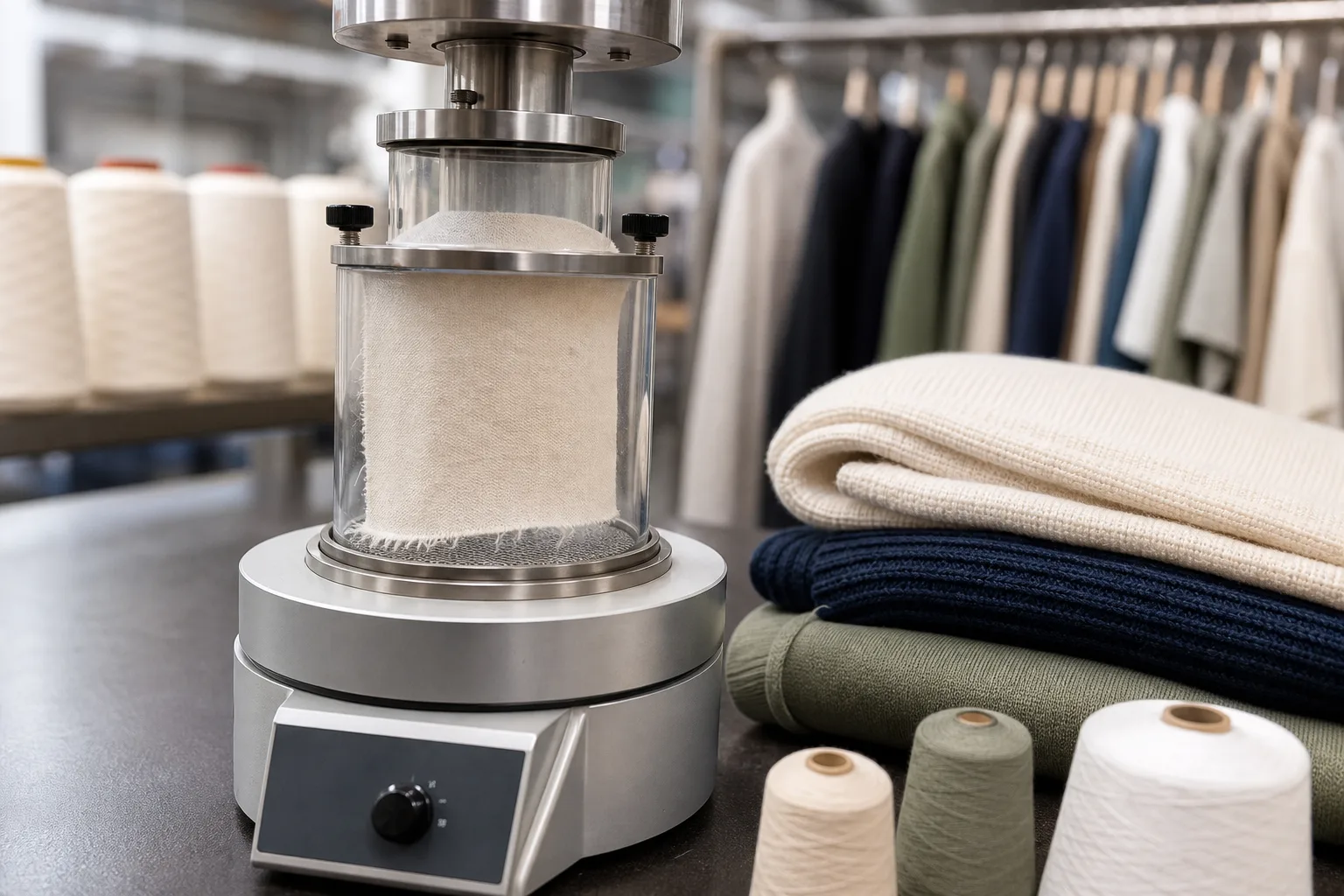
Yes, cotton is often breathable, but not every cotton product is equally breathable. Cotton fibers can absorb moisture, while gaps between yarns and stitches can let air pass through a fabric. In practice, however, breathability is a property of the finished textile system—not a guarantee created by the word “cotton” on a label. Yarn size and twist, knit or weave structure, fabric weight, finishing treatments, garment fit and accumulated moisture can all change how cool, ventilated or clammy a product feels.
What does “breathable” mean?
Breathable is a useful description of comfort, but it is not one universal textile measurement. A seller may use it to mean that a fabric allows air through, releases water vapor, absorbs perspiration or simply feels comfortable in warm conditions. Those qualities are related, but they are not interchangeable.
Air permeability
Air permeability describes how readily air passes through a textile under defined conditions. It is mainly controlled by the open spaces in the fabric and by anything that obstructs them. CottonWorks notes that resistance to air penetration can result from fabric construction, fiber content, chemical treatments or a combination of these factors.[1]
A loose cotton gauze may therefore permit substantial airflow, while a tightly woven cotton shell may resist wind. Both can truthfully be labeled cotton.
Water-vapor and moisture behavior
Comfort also depends on what happens to perspiration. A textile may absorb liquid, spread it across a larger area, transfer it from one surface to another or allow vapor to move into the surrounding air. Each mechanism can affect sensation differently. A fabric that absorbs sweat can initially feel comfortable because liquid is removed from the skin, but it may later feel heavy or damp if it becomes saturated or dries slowly.
For that reason, “breathable,” “moisture-wicking,” “absorbent” and “quick-drying” should not be treated as synonyms. CottonWorks describes airflow, absorbency, wicking, moisture movement and drying as separate quality-assurance considerations.[1]
Why cotton often feels breathable
The fiber can interact with moisture
Cotton is a cellulose-based natural fiber with an internal structure that can take up moisture. This absorbency helps explain why many cotton products do not immediately leave small amounts of perspiration sitting as liquid on the skin. It is one component of cotton comfort, but it does not determine how quickly a wet garment will dry.
Moisture held within or between fibers still has to move and evaporate. A light, open cotton fabric exposes more surface area to circulating air than a dense, heavy one. When ventilation is limited or humidity is high, absorbed water may remain in the textile longer.
Fabric pores provide the airflow route
Air moves primarily through spaces between yarns, fibers and stitches. Cotton does not create airflow simply because it is a natural fiber. Manufacturers create more or less ventilation through yarn selection, knitting or weaving settings, fabric density and finishing.
This explains why cotton can be used for apparently opposite purposes. Open jersey, seersucker, voile and gauze can be suitable for warm-weather products, while dense canvas, tightly woven poplin, brushed flannel and multilayer cotton structures can reduce airflow or retain insulating air. The fiber is the same category; the textile architecture is different.
Fiber quality matters, but it is not a breathability score
Raw cotton is evaluated for properties that help mills select and process fiber. USDA cotton classification includes measurements such as length, length uniformity, strength, micronaire, color and trash, along with classer determinations for leaf and extraneous matter.[2] These measurements are important for manufacturing consistency and potential yarn quality, but USDA classing does not give a finished garment a general “breathability grade.”
Do not confuse micronaire with fabric airflow
Micronaire deserves particular care because its measurement involves airflow. It reflects the resistance to air flow through a controlled mass of compressed raw cotton and is associated with fiber fineness and maturity. CottonWorks describes it as the air permeability of a constant mass of fibers compressed to a fixed volume.[3]
That does not mean a higher or lower micronaire value directly predicts whether a shirt, sheet or towel will feel more breathable. Finished-fabric airflow depends on what happens after classing: blending, spinning, yarn twist, knitting or weaving, wet processing, finishing and product construction. Micronaire can influence processing and yarn characteristics, but it is not a consumer breathability rating.
Length, uniformity and strength have indirect roles
Fiber length, length uniformity and strength affect spinning performance and the kinds of yarn a mill can produce. Longer or more uniform fiber may help a manufacturer make fine, even yarns, but the manufacturer must still choose a suitably open construction if airflow is the objective. High-quality raw cotton can be engineered into either an airy fabric or a dense protective fabric.
Explore the underlying measurements in the guides to staple length, length uniformity, fiber strength and micronaire.
What changes cotton breathability most?
Yarn size, twist and packing
Fine yarns can be used to make lightweight textiles, but yarn fineness alone is not decisive. Many fine yarns packed closely together may form a dense surface. Coarser yarns arranged in a loose weave or open knit may leave larger air pathways. Twist and yarn structure also influence compactness, surface texture and the spaces within the textile.
Knit or weave construction
Knitted fabrics are formed from intermeshing loops and often stretch more readily than woven fabrics. Some lightweight knits open slightly during movement, supporting ventilation. Meshes, tuck structures and deliberately open stitches can increase visible pore space. Yet a compact double knit can be substantially less airy than a lightweight woven cotton.
Woven fabrics cross warp and filling yarns. Plain weave, twill, sateen and more specialized structures can all be made at different densities. Weave name is therefore a clue, not a complete answer. Weight, yarn count, thread spacing and finishing must be considered together.
Fabric weight and thickness
Lower-weight cotton frequently feels cooler because less material surrounds the body and many lightweight constructions are relatively open. The relationship is not absolute: a thin but coated fabric can resist airflow, while a thicker cellular knit may contain ventilation channels. Weight should be assessed alongside structure rather than used as a stand-alone quality judgment.
Finishes, coatings and added layers
Resins, water-repellent treatments, printing systems, films, laminates and heavy surface coatings may partially block fabric openings or alter moisture behavior. Some engineered finishes are designed to preserve airflow or improve moisture movement, while others prioritize wind resistance, wrinkle control, durability or water protection. Linings, padding and fused components can also dominate the performance of the outer cotton fabric.
Fit and product design
A loose shirt allows air to circulate between skin and fabric. A close-fitting garment may reduce that circulation even when the textile itself is air-permeable. Vent panels, open collars, sleeve shape and layering can affect practical comfort as much as fiber percentage.
How to evaluate a breathable cotton product
A fiber label is the starting point, not the conclusion. In the United States, covered textile products generally disclose constituent fibers by percentage of weight. The FTC explains that a product should not be described as “100% cotton” unless it contains only cotton apart from qualifying trim.[4] That disclosure verifies composition; it does not certify airflow, drying speed or thermal comfort.
| Check | What it can indicate | What it cannot prove |
|---|---|---|
| Fiber-content label | Whether the textile is cotton, a cotton blend or another fiber | How open, light or quick-drying the finished fabric is |
| Visible structure | Larger gaps, mesh areas or loose loops may support airflow | A standardized air-permeability result |
| Weight and thickness | Light fabrics often place less material around the body | Breathability if coatings or dense construction block air |
| Finish description | Whether moisture management, water repellency or wind resistance is intended | Performance without a defined method and reported result |
| Fit and design | Whether air can circulate around the wearer | The intrinsic permeability of the fabric |
| Supplier test report | Performance for the tested sample under stated conditions | Identical results for changed colors, finishes or production lots |
A practical consumer checklist
- Read the complete fiber percentages rather than relying on a cotton-themed product name.
- Hold the fabric toward a light source to compare openness, while recognizing that this is only an informal visual check.
- Consider the intended use: airflow may be desirable for summer shirts but undesirable for a wind-resistant outer layer.
- Look for lightweight or open constructions rather than assuming a high thread count means greater comfort.
- Check whether the product has a coating, lining, membrane or heavy print.
- Allow enough ease for air to circulate if warm-weather comfort is the priority.
An industry specification checklist
- Define whether the requirement concerns air permeability, absorbency, wicking, drying, water-vapor transfer or subjective wear comfort.
- Name the test method, conditioning requirements, units and acceptance range instead of specifying “breathable” alone.
- Test the finished fabric or garment, not only the incoming raw fiber.
- Confirm results after relevant laundering or durability cycles when the claim is expected to last through care.
- Control construction variables, finish application and production tolerances across lots and colorways.
- Avoid extending one sample’s result to materially different constructions without evidence.
See the broader cotton quality and textile testing resources for help separating measurable specifications from general product language.
Breathability, care and product life
Washing and drying can change dimensions, surface texture and fit. Shrinkage may make a garment sit closer to the body, reducing the space available for circulation. Residues from excessive laundry products can also affect hand and moisture response, although the result depends on the formulation, dose and fabric.
Follow the sewn-in care instructions and avoid assuming that hotter or more aggressive cleaning will improve performance. Use enough water and rinsing for the selected laundry process, dry as directed and store the item fully dry. If a previously comfortable product has become tight, stiff or coated, the change in fit or surface condition may matter more than the cotton fiber itself. More guidance is available in the cotton care hub.
What breathability claims do—and do not—tell you
“Breathable cotton” should be understood as a performance claim about a particular product, not an automatic consequence of fiber identity. Stronger evidence states what was measured, identifies the method and reports a result for the relevant finished material. A bare adjective provides much less information.
Breathability also says nothing by itself about farming practices, organic status, chemical management, durability or overall environmental impact. Those are separate questions requiring separate evidence. The FTC advises marketers to avoid broad, unqualified environmental benefit claims and to support specific claims with an appropriate basis.[5]
For buyers, the practical conclusion is straightforward: cotton is capable of excellent warm-weather comfort, but choose the fabric rather than the fiber name alone. Prioritize an open or appropriately lightweight construction, suitable fit and transparent performance information. For developers, translate “breathable” into measurable requirements and test the finished product under conditions relevant to its intended use.
Frequently asked questions
Is 100% cotton always breathable?
No. A 100% cotton label describes fiber composition, not airflow. A loose cotton gauze can be highly ventilating, while dense canvas, a compact knit or a coated cotton fabric may allow much less air through.
Does cotton wick sweat?
Cotton naturally absorbs moisture, but absorption is not the same as directional wicking. Wicking, spreading and drying depend on yarn structure, fabric construction and any applied finish.
Is lightweight cotton more breathable?
Often, but not automatically. Lightweight fabrics commonly use less material and may have a more open structure, yet a dense weave, coating or lining can still restrict airflow.
Does a higher thread count make cotton less breathable?
It can when more yarn is packed into a given area, but thread count alone is incomplete. Yarn size, weave, weight, multiple-ply counting practices and finishing also affect the final result.
Is micronaire a cotton breathability rating?
No. Micronaire is a raw-fiber measurement associated with cotton fineness and maturity. Although its test uses airflow through a controlled compressed sample, it does not report the breathability of a finished fabric or garment.
How this guide was prepared
This page is based on desk research conducted on September 18, 2026 using technical guidance from CottonWorks, USDA cotton-classing information and FTC textile-labeling and environmental-claims guidance. It translates published fiber and fabric principles into consumer and industry guidance. No laboratory testing, product trial, mill or farm visit, supplier assessment, certification review or first-hand wear evaluation was performed.
Review status: Publishable quality advisory.
Sources and scope
- Quality Assurance BasicsCottonWorks by Cotton Incorporated
Distinguishes air permeability, absorbency, wicking, moisture management and drying, and explains that fabric construction, fiber content and chemistry can affect air penetration.
Accessed 2026-09-18 - Cotton Classing ServicesUSDA Agricultural Marketing Service
Identifies the raw cotton properties measured during USDA classification, including micronaire, length, uniformity and strength.
Accessed 2026-09-18 - Cotton Fiber QualityCottonWorks by Cotton Incorporated
Explains fiber-quality measurements and clarifies that micronaire uses airflow through a compressed cotton sample to indicate fineness and maturity.
Accessed 2026-09-18 - Calling It Cotton: Labeling and Advertising Cotton ProductsFederal Trade Commission
Provides official guidance on cotton fiber-content statements and the conditions for describing a textile product as 100% cotton.
Accessed 2026-09-18 - Environmental Claims: Summary of the Green GuidesFederal Trade Commission
Explains why broad environmental claims should be qualified and why specific environmental benefits require substantiation.
Accessed 2026-09-18