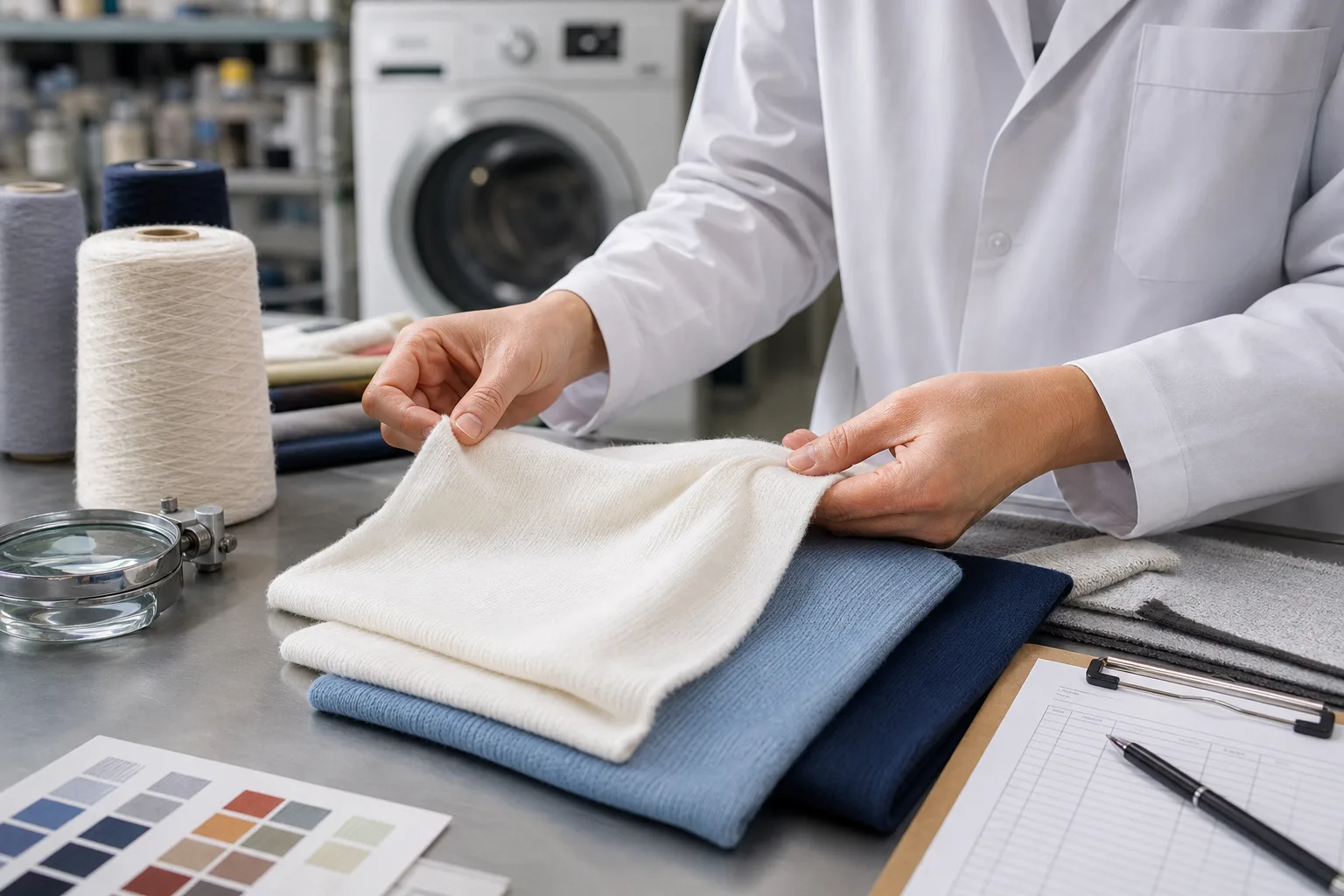
Cotton cellulose is the long-chain plant polymer that forms the main structural material of a mature cotton fiber. Its arrangement helps cotton take up moisture, accept dyes and retain useful strength when wet. However, knowing that a product contains cotton cellulose does not tell you whether it will be soft, durable, quick-drying, wrinkle-resistant or dimensionally stable. Those results also depend on fiber maturity and length, yarn design, fabric construction, preparation, finishing, garment engineering and care.
What cotton cellulose is
A natural polymer built from glucose units
Cellulose is a macromolecule: a large polymer made from repeating glucose-based units joined into long chains. Hydroxyl groups along those chains can form hydrogen bonds with neighboring cellulose molecules and with water. Some molecular regions are closely ordered, while others are more accessible to moisture and chemical treatments. The balance and organization of these regions contribute to the fiber’s strength, absorbency and response to processing. ([cottonworks.com](https://cottonworks.com/product-innovation/nonwovens/technical-and-performance-guide/?utm_source=openai))
Cotton begins as a single elongated cell growing from the surface of a seed. During fiber development, a thin primary wall forms first. The plant then deposits a much thicker secondary wall composed almost entirely of cellulose microfibrils. When the boll opens, the cell dries, collapses and develops ribbon-like twists known as convolutions. These twists help individual staple fibers hold together when they are spun into yarn. ([cottonworks.com](https://cottonworks.com/fiber/fiber-science/cotton-fiber-growth-harvesting-and-ginning/?utm_source=openai))
Raw fiber and prepared cotton are not chemically identical
Unprocessed cotton also contains small amounts of waxes, pectins, proteins and other natural materials, particularly around the outer layers. Scouring removes many of these impurities and improves wetting. A CottonWorks technical guide reports that cotton after scouring and bleaching can be about 99% cellulose, but that figure should not be applied automatically to every raw fiber, dyed fabric or finished product. Dyes, softeners, wrinkle-resistant treatments, water repellents and other finishes can add material or change surface behavior. ([cottonworks.com](https://cottonworks.com/product-innovation/nonwovens/technical-and-performance-guide/?utm_source=openai))
How cellulose affects cotton’s behavior
Moisture absorption and wicking
The hydroxyl groups in cellulose provide sites that interact with water through hydrogen bonding. Cotton’s fine internal and surface capillaries also help move liquid. This explains why appropriately prepared cotton can absorb moisture effectively, but it does not mean every cotton fabric manages sweat or spills in the same way. Yarn twist, fabric density, pile height, surface treatments and the spaces between yarns can increase or restrict liquid movement.
Absorbency and drying speed are different properties. A fabric that takes up a large amount of water may need more time or energy to dry than a lighter fabric that holds less. A dense cotton towel, an open cotton gauze and a jersey T-shirt all contain cellulose, yet their mass, construction and exposed surface area produce different wetting and drying behavior. CottonWorks accordingly defines absorbency at the level of the fiber, yarn and spaces within a fabric structure—not as a consequence of chemistry alone. ([cottonworks.com](https://cottonworks.com/encyclopedia-item/absorbency/?utm_source=openai))
Strength, including strength when wet
Closely packed cellulose chains, crystallinity and hydrogen bonding contribute to cotton fiber strength. Cotton generally becomes stronger as its moisture content increases, unlike some regenerated cellulosic fibers that lose substantial strength when wet. This helps explain cotton’s suitability for washable textiles, wipes and other products handled while damp. It does not guarantee long product life: abrasion, weak yarns, short fibers, low fabric weight, damaging finishes, seam construction and laundering conditions can still cause failure. ([cottonworks.com](https://cottonworks.com/product-innovation/nonwovens/technical-and-performance-guide/?utm_source=openai))
Dyeing and finishing
Cellulose’s reactive hydroxyl groups provide routes for dyes and finishing agents to interact with cotton. Preparation remains critical. Scouring improves cleanliness and absorbency, while mercerization changes the physical structure of cotton and can improve dye uptake, strength, smoothness and luster when properly controlled. These are processing results, not properties proven merely by the words “cotton” or “cellulose” on a label. ([cottonworks.com](https://cottonworks.com/learning-hub/dyeing/dyeing-preparation/?utm_source=openai))
Wrinkling, heat and dimensional change
Moisture can disrupt and allow the re-formation of hydrogen bonds in new positions as a cotton textile dries, contributing to wrinkling. Finishes may crosslink cellulose to improve wrinkle recovery, but the performance and trade-offs depend on the chemistry and application. Cotton is not thermoplastic: it does not melt like polyester. At sufficiently high temperatures it degrades instead, so “natural” should never be interpreted as immune to heat damage. ([cottonworks.com](https://cottonworks.com/product-innovation/nonwovens/technical-and-performance-guide/?utm_source=openai))
Shrinkage is also not a direct reading of cellulose content. CottonWorks identifies fiber, yarn, knit or weave construction, wet processing, finishing, sewing and consumer care as relevant variables. Knits are often less dimensionally stable than tightly engineered wovens because their looped structures can relax and rearrange. A preshrunk claim or documented dimensional-change result is therefore more informative than fiber content alone. ([cottonworks.com](https://cottonworks.com/learning-hub/quality-assurance/shrinking-and-skewing/?utm_source=openai))
What cellulose cannot tell you about quality
“Cellulosic,” “plant-based” and “100% cotton” describe composition or material origin. They are not measurable grades of softness, durability or workmanship. Two textiles with the same fiber-content label can perform very differently because a finished product is a layered system.
- Fiber properties: Length, length uniformity, maturity, fineness, strength, color and foreign material influence spinning and processing.
- Yarn: Yarn count, twist, spinning method, evenness, hairiness and ply affect strength, smoothness and appearance.
- Construction: Knit or weave type, stitch or thread density, fabric weight and pile structure affect drape, stability, airflow and absorbency.
- Preparation and finishing: Scouring, bleaching, mercerization, softening, compaction and chemical finishes can change the surface and performance.
- Product engineering: Seams, hems, trims, reinforcement and garment shape influence service life.
- Care: Washing, drying, stain treatment and ironing can preserve or reduce performance.
For U.S. textile labeling, “100% cotton” is primarily a fiber-content statement. The Federal Trade Commission says a product should not carry that statement unless it contains only cotton, apart from qualifying trim or ornamentation. The statement does not certify staple length, yarn quality, fabric weight, shrinkage, finish safety or expected lifespan. Named cotton types must also be presented truthfully and without implying a greater percentage than the product contains. ([ftc.gov](https://www.ftc.gov/business-guidance/resources/calling-it-cotton-labeling-advertising-cotton-products-0?utm_source=openai))
Connecting cellulose science to measurable cotton quality
USDA cotton classification measures properties of raw cotton that are useful for marketing and manufacturing. Its instrument measurements include fiber length, length uniformity, bundle strength, micronaire, color and trash. Micronaire reflects a combination of fineness and maturity rather than cellulose content by itself. The USDA list does not include a single overall “quality score,” nor does it predict every characteristic of a finished garment or household textile. ([ams.usda.gov](https://www.ams.usda.gov/services/grading/cotton-classing?utm_source=openai))
| Question or claim | What to examine | What cellulose alone cannot prove |
|---|---|---|
| Will the yarn be strong and even? | Staple length, length uniformity, fiber strength, maturity and spinning specifications | Yarn strength, evenness or low hairiness |
| Will the fabric absorb water? | Scouring, surface finish, yarn structure, density, pile and an appropriate absorbency test | Absorption rate or total capacity |
| Will it dry quickly? | Fabric mass, thickness, construction, moisture capacity and drying conditions | Drying time |
| Will it resist shrinking? | Construction, compaction or other finishing, care method and dimensional-change results | Post-laundering dimensions |
| Will it stay smooth? | Weave or knit, finish disclosure where available and wrinkle-recovery performance | Wrinkle resistance or ease of ironing |
| Is it environmentally preferable? | Defined claim boundary, production data, chemical processing, durability, care and end-of-life evidence | A lower overall environmental impact |
For industry sourcing, the practical sequence is to set an end-use requirement, select suitable fiber and yarn specifications, define construction and finishing, and then test the actual fabric or product. For consumers, the useful evidence is more accessible: accurate fiber and care labels, fabric weight and construction, workmanship, transparent performance claims and return policies. A scientific-sounding material term should not substitute for those details.
A practical buying and care checklist
Before buying
- Read the complete fiber label. Check whether the product is all cotton or a blend; do not rely only on front-of-package wording.
- Match construction to use. Towels need effective loops and sufficient mass, sheets need an appropriate weave and yarn quality, and T-shirts need stable knitting and seams.
- Look for a defined result. “Preshrunk,” “wrinkle resistant” or “quick drying” is meaningful only when the supplier defines the claim and has suitable evidence for the finished product.
- Inspect workmanship. Even stitching, secure hems, aligned grain or knit courses and consistent fabric are directly relevant to serviceability.
- Be cautious with softness. Initial softness may come from fiber selection, yarn and construction, but it can also come from a finish that changes after laundering.
During use and care
- Follow the attached care label because it should address the finished item, including its dyes, finishes, trims and construction—not cellulose in isolation. The FTC requires covered manufacturers and importers to provide regular-care instructions for ordinary use. ([ftc.gov](https://www.ftc.gov/legal-library/browse/rules/care-labeling-textile-wearing-apparel-certain-piece-goods-text?utm_source=openai))
- Use only as much washing and drying intensity as the item and soil level require. Repeated high heat and aggressive mechanical action can accelerate color change, abrasion and dimensional change.
- Remove items promptly after washing or drying and reshape them when appropriate to reduce set-in wrinkles.
- Compare performance after several care cycles rather than judging only the new product’s hand or appearance.
- For commercial specifications, state the care procedure used for testing. A shrinkage or appearance result without a defined procedure is incomplete.
Cellulose and sustainability claims
Cotton cellulose comes from a plant and is therefore bio-based, but material origin is only one part of sustainability assessment. It does not by itself establish impacts associated with cultivation, ginning, spinning, dyeing, finishing, transportation, product durability, laundering or disposal. A cotton-rich product may also contain sewing thread, elastic, coatings, dyes, finishes, labels and trims that affect its full composition and end-of-life behavior.
Likewise, “cellulosic” is not proof that a complete product will biodegrade under customary disposal conditions. The FTC advises marketers to avoid broad, unqualified environmental-benefit claims and to substantiate claims such as degradable, compostable or made with renewable materials. The relevant evidence must address what the whole claim communicates, not merely the presence of a plant-derived component. ([ftc.gov](https://www.ftc.gov/business-guidance/resources/environmental-claims-summary-green-guides?utm_source=openai))
The most defensible interpretation is narrow: cotton cellulose explains important mechanisms within the fiber. It helps account for moisture interaction, wet strength, dye responsiveness and the effects of certain finishes. Product quality and environmental performance still require evidence at the appropriate level—fiber, yarn, fabric, finished item or supply chain—rather than an inference from a material name.
Frequently asked questions
Is cotton cellulose the same as cotton fiber?
Not exactly. Cellulose is the main structural polymer within cotton fiber. Raw cotton also contains small amounts of natural waxes, pectins, proteins and other materials, while finished textiles may contain dyes and finishes.
Does more cellulose mean higher-quality cotton?
No. Cellulose is fundamental to cotton, but finished quality depends on measurable fiber properties, yarn design, fabric construction, preparation, finishing, workmanship and care.
Why does cotton absorb water?
Hydroxyl groups in cellulose interact with water, and capillary spaces in and between fibers and yarns help move liquid. The absorption rate and capacity of a product still depend strongly on construction and finishing.
Does a 100% cotton label guarantee softness or durability?
No. It identifies fiber content under applicable labeling rules. It does not certify softness, staple length, fabric weight, shrinkage, wrinkle resistance, workmanship or lifespan.
Is cotton automatically biodegradable because it contains cellulose?
That conclusion is too broad for a finished product. Dyes, finishes, blends, trims and disposal conditions matter, and environmental claims should be supported by evidence covering the complete product and stated conditions.
How this guide was prepared
This explainer is based on desk research conducted on September 17, 2026, using CottonWorks technical fiber-science materials, USDA Agricultural Marketing Service cotton-classing guidance and Federal Trade Commission labeling and environmental-claims guidance. No laboratory testing, product trials, farm or mill visits, supplier interviews, certifications or first-hand performance observations were conducted.
Review status: Publishable quality advisory.
Sources and scope
- Technical & Performance GuideCottonWorks, Cotton Incorporated
Cellulose chemistry, cotton fiber morphology, moisture interaction, wet strength, heat response and the composition of scoured and bleached cotton.
Accessed 2026-09-17 - Cotton Fiber Growth, Harvesting & GinningCottonWorks, Cotton Incorporated
Cotton fiber development, secondary-wall cellulose deposition, maturation, collapse and convolutions.
Accessed 2026-09-17 - Cotton Classing ServicesUSDA Agricultural Marketing Service
Official cotton classification measurements, including length, uniformity, strength, micronaire, color and trash.
Accessed 2026-09-17 - Calling It Cotton: Labeling and Advertising Cotton ProductsFederal Trade Commission
U.S. fiber-content labeling principles for cotton products and truthful use of named cotton types.
Accessed 2026-09-17 - Environmental Claims: Summary of the Green GuidesFederal Trade Commission
Guidance on substantiating environmental, degradable, compostable and renewable-material claims.
Accessed 2026-09-17