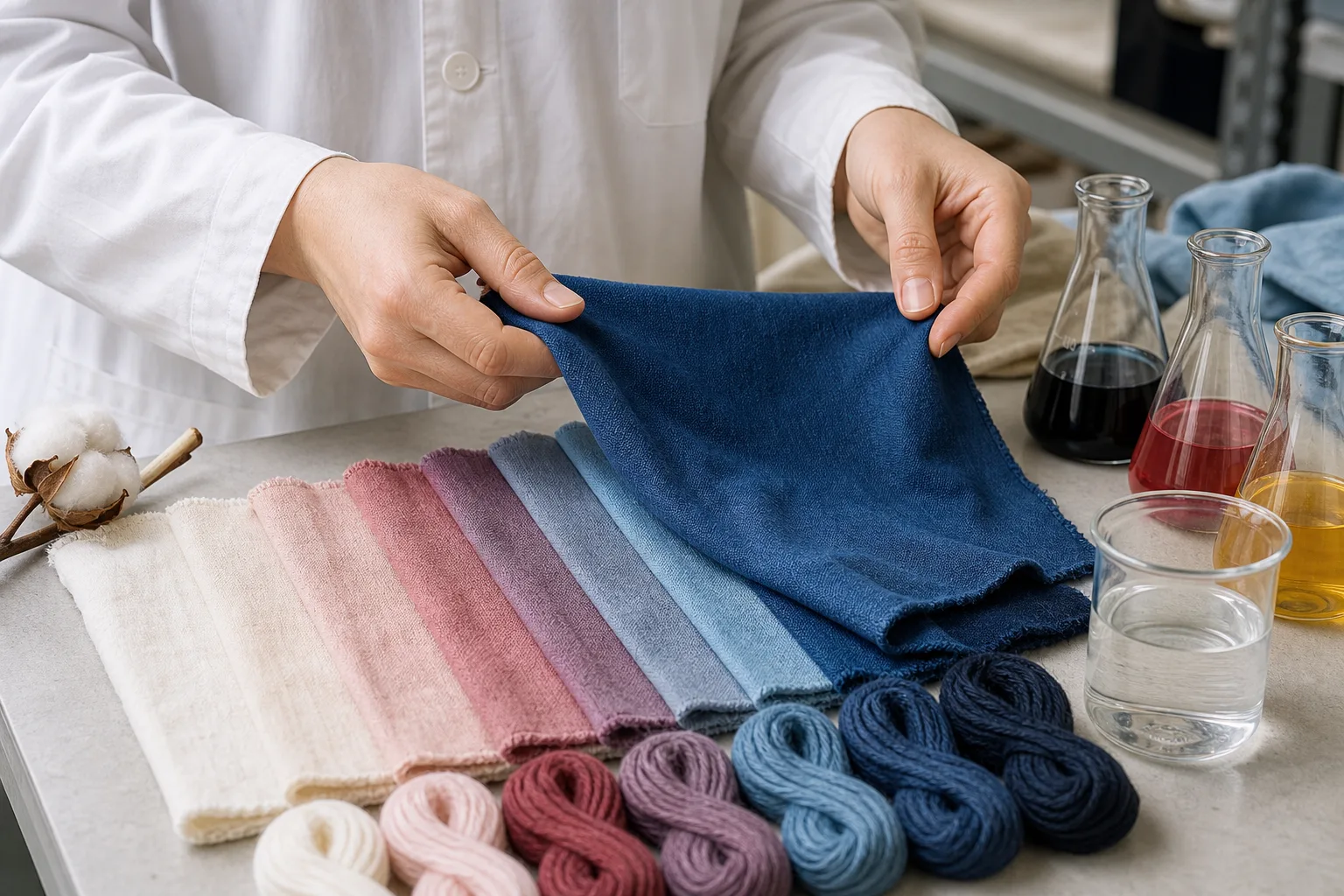
Cotton dyes well because its cellulose structure can take in water, admit dissolved dye molecules and, with suitable dye chemistry, form durable associations or chemical bonds with the colorant. Cotton fibers contain microscopic pores and capillary spaces, while the hydroxyl groups in cellulose attract water and can participate in dyeing reactions. These properties make cotton compatible with several major dye classes, including reactive, direct, vat and sulfur dyes. They do not guarantee that every cotton product will have deep, even or colorfast dyeing: fiber maturity, preparation, dye selection, yarn and fabric construction, finishing and care all affect the result.
The fiber mechanism behind cotton dye absorption
Cellulose provides accessible chemical sites
After scouring and bleaching, cotton is predominantly cellulose. Cellulose consists of long chains of linked glucose-derived units. Each repeating unit contains hydroxyl groups that contribute to hydrogen bonding within the fiber, attract water and provide chemically reactive sites for dyes and finishes. CottonWorks describes these hydroxyl groups as both water-sorption sites and sites that can undergo reactions during dyeing and finishing. Its account of cotton morphology and cellulose chemistry also identifies pores and capillary spaces between the fiber’s fibrils.
When prepared cotton enters an aqueous dye bath, water wets and swells the accessible fiber structure. Dissolved dye can move from the bath to the fiber surface and then diffuse into accessible regions. The exact attraction depends on the dye class. Some dyes rely mainly on weaker intermolecular forces; reactive dyes can form covalent bonds with cellulose; vat dyes are temporarily made soluble so they can enter the fiber before being converted back to an insoluble form.
Porosity helps transport color into the fiber
A mature cotton fiber is not a solid rod. Its walls contain fibrils, fine capillaries and pore spaces, and a central lumen runs along the fiber. Capillary action helps liquids enter this structure. This physical access matters because a dye cannot react with or lodge inside a region it cannot reach. Absorbency and dyeability are related through liquid access, although they are not identical performance claims. A fabric that quickly absorbs water may still dye unevenly if it contains inconsistent fibers, residual impurities or nonuniform finishes.
Different cotton dyes use different mechanisms
“Dyed cotton” identifies neither the dye class nor the expected level of colorfastness. CottonWorks’ dyeing guidance distinguishes several systems with different application requirements and limitations.
Reactive dyes form chemical bonds
Fiber-reactive dyes are widely used for cotton because they can form strong covalent bonds with cellulose, generally producing good wash fastness and a broad color range. The process must still be controlled. Reactive dye can react with water instead of cellulose through hydrolysis, and unfixed dye must be removed during afterwashing. Poor fixation or inadequate wash-off can leave color that later transfers in laundering or rubbing.
Direct, vat and sulfur dyes behave differently
- Direct dyes have affinity for cotton and are comparatively easy to apply, but their attachment relies on weaker forces. They may need after-treatment to achieve adequate wash fastness and can have limited brightness or chlorine resistance.
- Vat dyes begin as water-insoluble colorants. They are chemically reduced to a soluble form, allowed to adsorb and diffuse into cotton, and then oxidized back to an insoluble form inside the fiber. They can provide good wash fastness.
- Sulfur dyes also require temporary solubilization. They are commonly associated with economical dark shades, especially black, but performance against chlorine, rubbing or light varies by shade and process.
- Pigments are not dyes and have no inherent affinity for cotton. A binder fixes pigment particles to the surface, so binder formulation and curing affect color durability and fabric feel.
The practical lesson is that cotton’s compatibility with colorants creates options rather than one predictable outcome. A reactive-dyed T-shirt, vat-dyed fabric and pigment-printed sweatshirt can all be cotton while showing different fading, rubbing and hand characteristics.
Preparation often decides whether color is even
Raw-fiber components can obstruct wetting
Cotton’s natural outer cuticle contains waxes and other non-cellulosic material that protect the growing fiber but resist water. Processing can also introduce oils, size, soil or metal contamination. Scouring removes unwanted material, improves absorbency and creates a more uniformly clean substrate. Bleaching may then provide a consistent pale base for light or bright shades. CottonWorks emphasizes in its dyeing-preparation guidance that later dyeing faults can originate in inadequate preparation.
Preparation must be uniform across the fiber, yarn, fabric or garment. A remaining oil spot may repel the bath. Uneven natural color can alter the apparent shade. Residual alkali or peroxide can interfere with later chemistry. For mills, controlled time, temperature, pH, rinsing and neutralization are therefore parts of color quality rather than separate housekeeping steps.
Mercerization can increase dye uptake
Mercerization exposes cotton to concentrated caustic soda, usually with controlled tension. The fiber swells, becomes rounder and develops a more open structure, increasing its receptiveness to dye. Mercerization can also increase luster and alter strength and surface smoothness. A “mercerized” description therefore identifies a real treatment, but it does not by itself state the final shade accuracy, colorfastness grade or environmental impact of the process.
Fiber quality matters, but it is not the whole fabric result
Maturity and micronaire can affect uniformity
Mature cotton has a more fully developed secondary cell wall than immature cotton. Differences in maturity and fineness can contribute to uneven dye response, including streaky or barred appearance when inconsistent fibers are distributed through yarn or fabric. CottonWorks notes that micronaire—a combined indication influenced by fiber fineness and maturity—provides useful information about dyeing behavior and that uneven micronaire distribution can contribute to poor color uniformity.
The USDA’s cotton classing service measures bale properties including micronaire, color, trash, length, length uniformity and strength. These data support cotton marketing and manufacturing decisions. They do not certify the colorfastness, shade consistency or dye process of a finished garment. Those outcomes appear later in the supply chain and require evaluation of the actual yarn, fabric or product.
Yarn and construction change visible color
Yarn twist, hairiness, blend distribution and surface regularity affect how light reflects and how readily dye reaches the material. Fabric density and construction also matter. A compact woven fabric, an open jersey knit and a looped terry surface can display the same nominal shade differently because their surfaces, shadows and exposed fiber areas differ.
Blends add another variable. Cotton and polyester require different dye systems under conventional processing: reactive or other cellulose-compatible dyes address the cotton component, while disperse dyes address polyester. Unequal dyeing of the components may be intentional, as in a heather effect, or may reveal process variation. A fiber-content label tells the buyer what fibers are present by weight; it does not describe dye class, penetration or fastness.
How to interpret cotton color claims
| Information or claim | What it can indicate | What it does not prove |
|---|---|---|
| 100% cotton | The textile fiber content is cotton, apart from permitted exclusions such as certain trim. | Dye class, shade evenness, wash fastness, rubbing fastness or resistance to fading. |
| Pima, Egyptian or another cotton type | A claimed cotton identity or proportion that must be presented truthfully. | That all fibers are that type unless the stated percentages say so, or that the finished color meets a particular grade. |
| Mercerized cotton | The cotton has undergone a swelling treatment that can increase dye affinity and luster. | A specific colorfastness result or automatically lower-impact processing. |
| Reactive dyed | A dye capable of bonding chemically with cellulose was used. | Correct fixation, complete wash-off or resistance to every exposure. |
| Garment dyed | The assembled product was colored after construction. | Better or worse quality than piece dyeing without additional evidence. |
| Colorfast or fade resistant | An asserted performance characteristic. | A measurable result unless the claim names a relevant method, conditions or rating and is supported by evidence. |
| Eco-friendly dyeing | A broad marketing message. | A defined environmental benefit unless the claim is specifically qualified and substantiated. |
In the United States, the FTC requires covered textile labels to identify fiber content accurately. Its cotton-labeling guidance explains that a product should not be labeled “100% cotton” unless its fiber content supports that statement and that named cotton types must not be presented deceptively. Fiber identification should not be treated as a test result for dye performance.
A practical color-quality checklist
- Read the full fiber-content label, especially for cotton-polyester or cotton-elastane blends.
- Check whether the seller identifies a dye or print process, but do not assume the process name is a performance grade.
- Look for specific, relevant fastness evidence when color durability is important, including the tested exposure and result rather than an unsupported “colorfast” statement.
- Inspect seams, folds, underarms, collars and large uninterrupted areas for visible shade changes or streaking.
- For dark towels or garments, consider whether loose surface color or lint could transfer during early use.
- Follow the product’s care label instead of applying a general rule for all cotton products.
Care and sustainability require product-specific evidence
Heat, detergent, bleach, abrasion, sunlight and contact with other wet textiles can affect color. The appropriate care method depends on the dye, finish, construction, trim and complete product—not only on the cotton fiber. The FTC’s Care Labeling Rule guidance says covered manufacturers and importers must have a reasonable basis for instructions and warnings and must consider whether the finished garment can be cleaned without substantial harm. A care label is therefore the first source for washing decisions, even when past experience with another cotton item suggests a different method.
Wash dark or strongly colored products as directed, separate colors when transfer is plausible, and avoid chlorine bleach unless the label permits it. Turning garments inside out can reduce direct surface abrasion, while prompt drying can limit prolonged contact between wet colors. These steps may help preserve appearance, but they cannot correct dye that was poorly fixed or washed off during manufacture.
Cotton’s ability to accept dye does not make a dyeing process inherently sustainable. Dye chemistry, fixation efficiency, water and energy use, salt or alkali requirements, wash-off, wastewater treatment, shade remakes and product life all influence the larger assessment. A farm-level or fiber-sourcing claim also does not describe the wet processing used later. The FTC’s Green Guides summary cautions against broad, unqualified claims such as “green” or “eco-friendly” and calls for environmental benefits to be stated clearly, specifically and with substantiation. Buyers and product teams should ask what part of the product or process a claim covers, what measurable change occurred and what evidence supports the comparison.
Frequently asked questions
Why does cotton absorb dye better after scouring?
Scouring removes natural waxes and processing impurities that can resist water or block uniform contact with the dye bath. It improves wetting and exposes the cellulose structure more consistently.
Does 100% cotton mean the color will not fade?
No. A 100% cotton label identifies fiber content, not dye class or colorfastness. Fading and transfer depend on dye selection, fixation, afterwashing, finishing, exposure and care.
Why can two cotton fabrics take the same dye differently?
They may differ in fiber maturity, micronaire distribution, natural color, yarn twist, fabric density, preparation, mercerization or previous finishes. These variables change dye access and visible shade.
Is reactive-dyed cotton always more sustainable?
No. Reactive describes how the dye can bond with cellulose. Environmental performance also depends on fixation efficiency, water, energy and chemical use, wash-off, wastewater controls and product durability.
How this guide was prepared
This page is based on desk research of CottonWorks technical material on cellulose chemistry, cotton morphology, dye classes, preparation and fiber quality; USDA cotton-classing documentation; and FTC guidance on textile labels, care instructions and environmental marketing claims. No laboratory dyeing, product testing, mill visit, farm visit or certification review was performed.
Review status: Publishable quality advisory.
Sources and scope
- Technical & Performance Guide: Cotton Morphology and ChemistryCottonWorks, Cotton Incorporated
Cellulose structure, hydroxyl groups, hydrogen bonding, cotton pores, capillary spaces, liquid access and the composition of prepared cotton.
Accessed 2026-09-20 - Dyeing BasicsCottonWorks, Cotton Incorporated
Mechanisms and practical characteristics of reactive, direct, vat and sulfur dyes and the distinction between dyes and surface-bound pigments.
Accessed 2026-09-20 - Dyeing PreparationCottonWorks, Cotton Incorporated
The roles of scouring, bleaching, rinsing, neutralization and mercerization in absorbency, dye uptake and uniformity.
Accessed 2026-09-20 - Cotton Fiber QualityCottonWorks, Cotton Incorporated
Micronaire, maturity, cotton color measurements and the relationship between uneven fiber properties and fabric color uniformity.
Accessed 2026-09-20 - Cotton Classing ServicesUSDA Agricultural Marketing Service
Official bale-classing measurements, including micronaire, color, trash, length, uniformity and strength.
Accessed 2026-09-20 - Calling It Cotton: Labeling and Advertising Cotton ProductsFederal Trade Commission
U.S. fiber-content disclosures and truthful use of cotton type names and percentages.
Accessed 2026-09-20 - Clothes Captioning: Complying with the Care Labeling RuleFederal Trade Commission
Requirements for substantiated garment-care instructions and consideration of the complete product.
Accessed 2026-09-20 - Environmental Claims: Summary of the Green GuidesFederal Trade Commission
Guidance against broad, unqualified environmental benefit claims and the need for clear, specific substantiation.
Accessed 2026-09-20