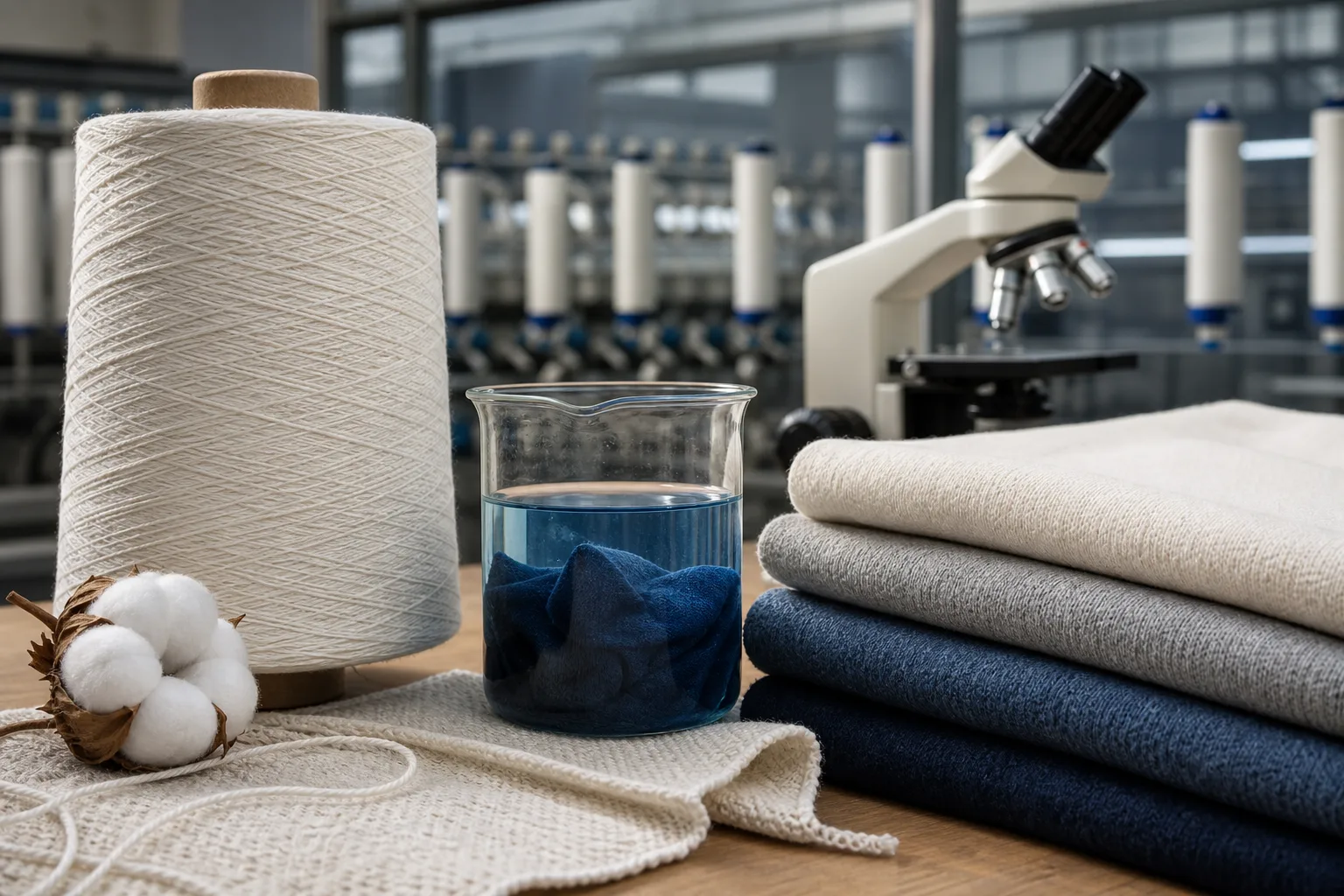
Cotton fiber structure is the microscopic architecture of a single cotton fiber: an elongated plant cell with an outer cuticle, cell walls made largely from cellulose and a central cavity called the lumen. As the fiber matures and dries, it collapses into a twisted, ribbon-like form. This structure helps fibers grip one another during spinning and provides pores that can interact with liquids. However, it does not by itself guarantee softness, durability, absorbency, low shrinkage or sustainability. Those outcomes also depend on measured fiber properties, yarn engineering, fabric construction, finishing, garment design and care.
What a cotton fiber actually is
Each cotton fiber develops as a single cell on the surface of a cottonseed. During early growth, the cell elongates inside the boll. It then deposits a thicker secondary wall, composed almost entirely of cellulose, inside its original primary wall. The secondary wall gradually occupies more of the cell volume and narrows the lumen. When the boll opens, the fiber loses moisture, collapses and dies, leaving the familiar flattened form used in textile production.[1]
Why the fiber becomes twisted
The cellulose microfibrils in the secondary wall are arranged in helical patterns that reverse direction at points along the fiber. During drying and collapse, this organization contributes to natural twists known as convolutions. The irregular ribbon shape and convolutions promote contact and cohesion among fibers, helping a bundle hold together as it is drafted and twisted into yarn.
That natural cohesion is useful, but yarn strength does not come from convolutions alone. Fiber length, length uniformity, strength, fineness, maturity, alignment, yarn twist and spinning method all matter. See the broader cotton science hub for the relationship between biological material and textile engineering.
The layers of cotton fiber structure
Technical descriptions vary slightly in how they divide transitional wall layers, but the main functional features are consistent: an outer cuticle, a primary wall, a thick cellulose-rich secondary wall and the lumen. The table translates those features into practical meaning without treating any one feature as a stand-alone quality grade.
| Fiber feature | Structural role | Practical meaning |
|---|---|---|
| Cuticle | A thin outer coating containing waxes and other non-cellulosic material. | Protects and lubricates the growing fiber. Textile preparation such as scouring removes much of this material so water, dyes and finishes can interact more readily with the cellulose. |
| Primary wall | The original flexible wall formed while the cell elongates. | Contains a network of cellulose microfibrils plus natural non-cellulosic components. Its fine pores contribute to the fiber's interaction with liquids after preparation. |
| Secondary wall | Concentric, cellulose-rich layers deposited after much of the fiber's elongation. | Forms most of a mature fiber's substance. Its degree of development is central to maturity, strength potential and dyeing behavior. |
| Lumen | The channel that held living cell contents during development. | Becomes a central void after drying. Its relative size depends partly on how fully the secondary wall developed. |
| Convolutions | Reversing twists along the collapsed, ribbon-like fiber. | Help fibers interlock during spinning, although yarn performance still depends on fiber selection and process control. |
Pores, cellulose and liquid movement
Cotton contains capillary spaces within and between its cellulose structures. Once natural waxes and processing residues have been appropriately removed, this porous network helps liquid enter and move through the fiber. At product level, however, perceived absorbency and drying behavior also depend on yarn bulk, loop or pile geometry, fabric density, surface finishes and the presence of other fibers. A dense cotton fabric and an open cotton fabric can therefore manage moisture very differently even when both labels say 100% cotton.
How structure becomes measurable fiber quality
Microscopic structure is connected to measurable properties, but the two should not be confused. In United States cotton classing, instruments assess properties including fiber length, length uniformity, bundle strength, micronaire, color and trash. Micronaire is a combined indication affected by fineness and maturity rather than a direct measurement of either property alone.[2]
Maturity and secondary-wall development
Fiber maturity describes the degree of secondary-wall development relative to fiber size. A mature fiber has deposited more cellulose in this wall than an otherwise comparable immature fiber. Immature fibers tend to collapse more completely and may form tangles or neps during processing. Because they contain less developed cellulose, they can also absorb dye differently, contributing to pale specks or uneven color.
Micronaire can help mills manage these risks, but a single micronaire number is not a universal ranking from bad to good. A similar reading can arise from different combinations of fineness and maturity. The useful range also depends on the yarn and product being made.[3]
Length, uniformity and strength
Staple length affects how many fiber ends must be managed within a yarn. Length uniformity describes the consistency of lengths in the tested sample, while fiber strength measures the force required to break a bundle under specified conditions. These are distinct properties. Long cotton is not automatically mature, strong or clean, and a marketing name does not substitute for measured results.
Instrument data are primarily supply-chain and manufacturing tools. Consumers usually will not find complete bale-classing results on a product label, so retail evaluation must also consider construction, specifications, finish and intended use.
Fiber is only the first level of a textile
A useful product assessment separates the material into levels. Claims made at one level should not be treated as proof at another.
Fiber properties
These include length, fineness, maturity, strength, uniformity, color and foreign matter. They affect processing possibilities and consistency, but they are not a finished-product score.
Yarn design
Spinning method, yarn size, twist, ply and fiber alignment can change smoothness, strength, hairiness and bulk. Terms such as “combed” or “ring-spun” describe processing choices. They may be relevant, but neither is a guarantee that every resulting fabric will outperform every alternative.
Fabric construction
Weave or knit type, density, yarn arrangement and pile structure strongly affect the product. Percale and sateen use different weave organizations; jersey is knitted; terry towels rely on loops. Construction helps explain why two 100% cotton products can differ in airflow, drape, abrasion resistance, warmth and drying time. Explore the fabric guide or the practical guide to telling cotton quality.
Finishing and product design
Scouring, bleaching, dyeing, printing, mercerization, softening, wrinkle-control treatments and shrinkage-control processes can change appearance, hand, dimensions and liquid interaction. Seams, elastic, interlinings, coatings and trims can also become the limiting parts of a garment. “Premium,” “hotel quality” and similar promotional phrases are not laboratory results unless accompanied by defined, relevant evidence.
What labels and sustainability claims do—and do not—prove
Fiber-content labels identify composition
In the United States, covered textile products must accurately disclose fiber content. A product should not be represented as 100% cotton if non-cotton fiber is present beyond applicable exclusions, and claims naming a particular cotton type must be truthful and properly disclosed.[4] The label “100% cotton” answers a composition question. It does not establish staple length, maturity, yarn quality, construction density, colorfastness or expected lifespan.
Structure does not prove sustainability
Cotton's biological origin and cellulose structure do not, on their own, demonstrate a product's environmental or social performance. Such an assessment may involve agricultural practices, location, water context, energy, chemistry, labor conditions, manufacturing efficiency, transport, durability, care and end-of-life pathways. These factors cannot be determined from a microscopic fiber image or a generic cotton statement.
Broad terms such as “green,” “eco-friendly” or “sustainable” should not be accepted as measurable results without a clear scope, basis and supporting evidence. The US Federal Trade Commission advises marketers to qualify general environmental claims with specific benefits and to substantiate both express and implied claims, including those communicated through certifications or seals.[5] For a broader framework, visit cotton sustainability.
A practical checklist for evaluating cotton products
Fiber science is most useful when it improves the questions asked before purchase, production or specification. Use this checklist rather than relying on one prominent term.
- Confirm composition: Read the sewn-in label, including percentages and any separate disclosure for components such as towel loops and ground fabric.
- Identify the construction: Determine whether the product is woven, knitted, brushed, piled or coated. Construction often explains performance more directly than fiber content alone.
- Look for relevant specifications: Depending on the product, useful information may include fabric weight, yarn description, weave or knit type, dimensions and documented performance tests.
- Treat descriptors as clues, not conclusions: Terms such as long-staple, combed, ring-spun or mercerized identify a fiber attribute or process only when used accurately. Ask what measurable outcome the seller is claiming.
- Check the care label before buying: Dye, finish, construction and trims can require gentler care than raw cotton might suggest. Do not assume every cotton item should be washed or dried at high temperature.
- Match performance to use: A crisp sheet, soft T-shirt and absorbent towel need different yarns and constructions. There is no single ideal cotton structure or specification for every application.
- Interrogate environmental language: Look for the exact attribute, product scope, verification system and limits of the claim rather than relying on an undefined seal or slogan.
For product-specific decisions, compare the features that matter for bed sheets, towels or T-shirts. Follow the product's care instructions and consult the cotton care guide rather than choosing a wash routine from fiber content alone.
The practical conclusion is simple: cotton's layered, cellulose-rich and convoluted structure creates valuable possibilities for spinning, dyeing and liquid interaction. Whether a finished product realizes those possibilities depends on the complete material and manufacturing system. Fiber structure is a foundation—not a finished quality verdict.
Frequently asked questions
What is the basic structure of a cotton fiber?
A cotton fiber is a single elongated plant cell. Its main features are an outer cuticle, a flexible primary wall, a thick cellulose-rich secondary wall and a central lumen. When it dries, it collapses into a twisted, ribbon-like form.
Why do cotton fibers have natural twists?
Helically arranged cellulose structures reverse direction along the fiber. As the mature fiber dries and collapses, it develops twists called convolutions, which help fibers grip one another during yarn spinning.
Does longer cotton always make a better fabric?
No. Length can support fine, even yarns, but finished quality also depends on length uniformity, maturity, strength, cleanliness, spinning, yarn design, fabric construction, finishing and manufacturing control.
Does a 100% cotton label indicate high quality or sustainability?
No. It identifies fiber composition, not a quality grade or environmental result. Product performance and sustainability claims require additional, relevant evidence.
How this guide was prepared
This page is based on desk research conducted on September 17, 2026 using technical education from CottonWorks and current US government guidance from USDA and the Federal Trade Commission. It translates published fiber science, classing and labeling information into practical guidance. No laboratory testing, product trials, farm or mill visits, supplier interviews, certifications or first-hand performance observations were conducted or claimed.
Review status: Publishable quality advisory.
Sources and scope
- Cotton Fiber Growth, Harvesting & GinningCottonWorks
Cotton fiber development, primary- and secondary-wall formation, lumen collapse, cellulose microfibrils and convolutions.
Accessed 2026-09-17 - Cotton Classing ServicesUSDA Agricultural Marketing Service
Instrument-based cotton classification properties, including length, uniformity, strength, micronaire, color and trash.
Accessed 2026-09-17 - Cotton Fiber QualityCottonWorks
Practical relationships among fiber length, strength, fineness, maturity, micronaire, spinning and dyeing behavior.
Accessed 2026-09-17 - Calling It Cotton: Labeling and Advertising Cotton ProductsFederal Trade Commission
US fiber-content disclosures and requirements for truthful claims about cotton and named cotton types.
Accessed 2026-09-17 - Environmental Claims: Summary of the Green GuidesFederal Trade Commission
Qualification and substantiation of broad environmental claims, certifications and seals.
Accessed 2026-09-17