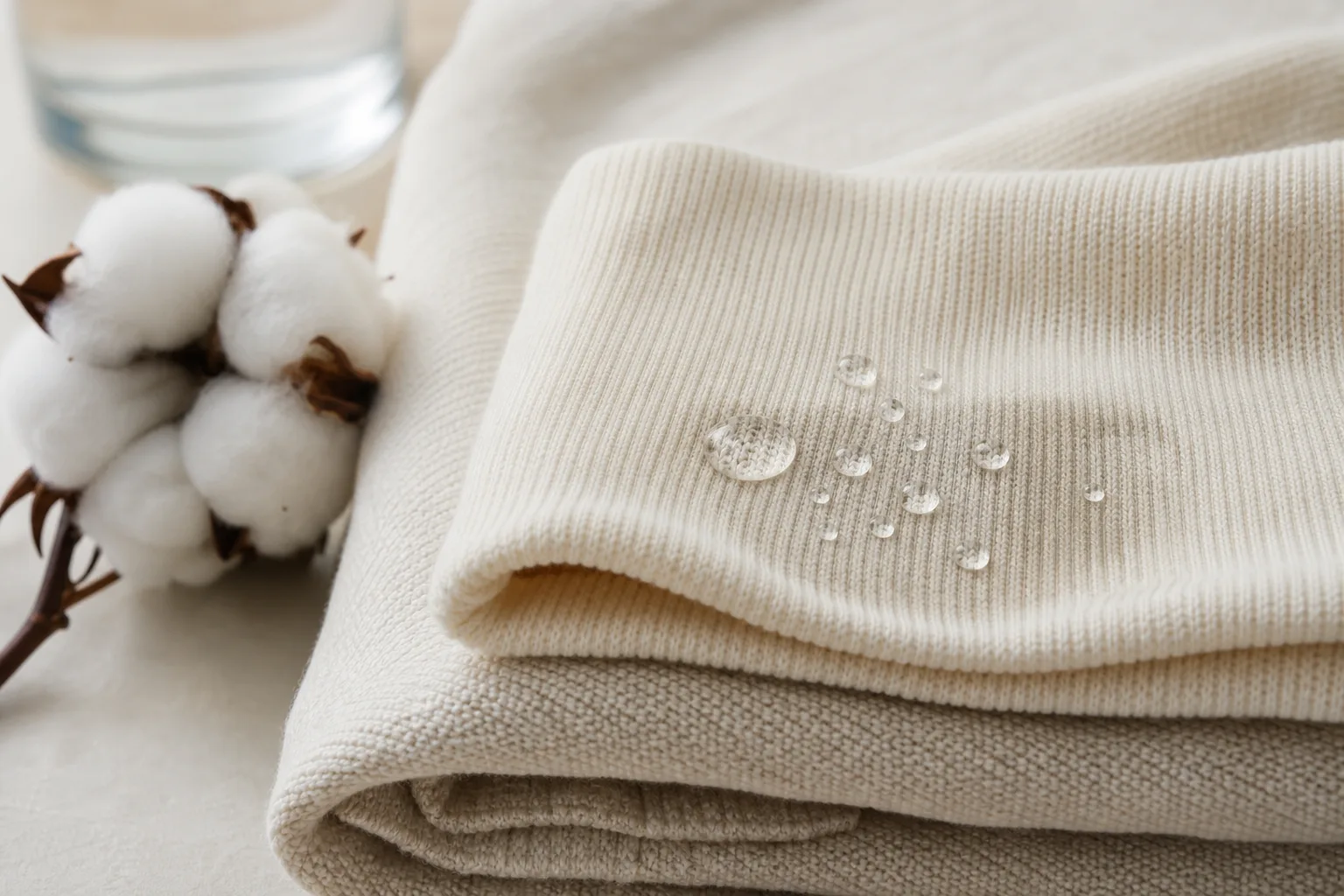
Cotton absorbs moisture because water molecules are attracted to its cellulose and can enter less-ordered regions of the fiber. Liquid can also travel through microscopic spaces within fibers, yarns and fabric. This inherent affinity for water helps explain cotton’s usefulness in towels, clothing and bedding, but it does not guarantee that every cotton product will absorb quickly, wick effectively or dry rapidly. Those outcomes depend on the whole textile system: fiber, yarn, construction, preparation, finish, product design and care.
How cotton moisture absorption works
Cellulose attracts water molecules
Cotton fiber consists largely of cellulose, a polymer containing polar hydroxyl groups. These groups can form hydrogen bonds with water. According to research published by the National Institute of Standards and Technology, cotton commonly has a moisture regain in the range of 7% to 11% under the referenced conditions because of its hydroxyl groups and physical structure. Moisture regain expresses the mass of water relative to the material’s oven-dry mass; it is not the percentage of a towel or shirt that can be filled with liquid. The exact result depends on temperature, relative humidity, material condition and the method used. NIST’s discussion of fiber regain and water transport provides the underlying definitions and mechanism.
Water enters accessible fiber regions
Cellulose chains are arranged in both more ordered, crystalline regions and less ordered, amorphous regions. Water enters the accessible amorphous regions more readily, where it can associate with hydroxyl groups and cause swelling. Cotton’s layered walls, internal lumen and spaces between fibrils also contribute to water movement. CottonWorks describes the fiber as a complex porous structure in which capillary action draws liquid into spaces between fibrils. Its technical guide to cotton morphology and chemistry explains these features in more detail.
Two processes therefore operate together:
- Sorption into the fiber: water vapor or liquid associates with cellulose and enters accessible regions of the fiber wall.
- Capillary transport through the textile: liquid moves through channels within and between fibers and yarns.
This distinction matters because a fabric can take up water without spreading it efficiently, or spread water across its surface while storing relatively little inside the fibers.
Absorbency, wicking and drying are different properties
Moisture-related terms are often used as though they describe one result. In practice, each refers to a different stage of interaction between water and a textile.
| Property | What it describes | Why it matters | What it does not prove |
|---|---|---|---|
| Moisture regain | Water held by a conditioned material relative to its oven-dry mass | Indicates affinity for atmospheric moisture under stated conditions | How fast a finished product absorbs a spill |
| Absorbency | Ability to take in and hold liquid in fibers, yarns or fabric spaces | Important for towels, wipes and other liquid-handling products | Fast transport away from skin or fast drying |
| Wicking | Movement of liquid through or across a textile by capillary action | Can spread perspiration and increase the area available for evaporation | That the fiber itself holds a large amount of water |
| Drying rate | Speed at which water leaves the textile under defined conditions | Affects turnaround time and the duration of a damp sensation | Absorbency, unless it is measured separately |
| Breathability | Often used for air permeability or moisture-vapor transfer | Can influence thermal and moisture comfort | Any single measurable result unless the claim identifies the property and test |
CottonWorks notes that absorbency, horizontal and vertical wicking, drying and air permeability require separate evaluations. A statement such as “moisture managing” should therefore be treated as a performance claim, not as a standardized quality grade by itself. The test method, conditions, comparison product and measured result are needed to interpret it. CottonWorks’ quality-assurance overview identifies these as distinct testing areas.
Why one cotton fabric absorbs differently from another
Fiber is only the starting point
Fiber maturity, fineness, length and cleanliness influence manufacturing, but a raw-cotton classification does not predict finished-fabric moisture performance on its own. USDA cotton classing measures properties including color, trash, micronaire, length, length uniformity and strength under controlled laboratory conditions. Absorbency and drying rate are not among the listed classing measurements. USDA Cotton Classing Services also shows why conditioning matters: its laboratories maintain specified temperature and relative-humidity ranges to support consistent fiber measurements.
For a fuller explanation of the raw material, see cotton fiber structure, cotton cellulose and the cotton quality guide. Metrics such as micronaire and staple length can affect processing and yarn design, but they should not be presented as direct absorbency scores.
Yarn changes pore size and liquid pathways
Yarn count, twist, ply, spinning system and bulk determine how closely fibers are assembled. Higher twist may make a yarn compact, while lower twist or bulkier structures can provide different capillary spaces and exposed surface area. The result cannot be judged from fiber content alone. Yarn choices also involve trade-offs among absorbency, softness, linting, strength, abrasion resistance and durability.
Construction determines capacity and spread
A looped terry towel, a dense woven shirt and a lightweight jersey may all be labeled 100% cotton yet behave very differently. Terry loops provide substantial exposed yarn and storage space for liquid. A heavy or thick textile may hold more water but take longer to dry because more water must evaporate. A lighter construction may have less total capacity while drying sooner.
Construction variables include:
- fabric mass and thickness;
- woven, knitted, nonwoven or pile structure;
- yarn density and loop or pile geometry;
- surface area exposed to water and air;
- open spaces available for capillary movement; and
- blended fibers or elastomeric components.
Explore the fabric construction guide when comparing products intended for different uses.
Preparation and finishing can change the result
Raw cotton is not the same as prepared cotton
The outer portions of an untreated cotton fiber contain naturally occurring waxes and other non-cellulosic material that can resist wetting. Textile preparation commonly includes scouring to remove impurities and improve uniform absorbency. Bleaching, dyeing and mercerization may further change cleanliness, morphology and accessibility. CottonWorks states that scouring improves absorbency and that mercerization makes the fiber more open and receptive to dye. Its dyeing-preparation guidance also emphasizes process control rather than assuming all prepared cotton behaves identically.
Finishes may increase, redirect or resist wetting
A finish can be designed to alter softness, wrinkle resistance, water repellency or moisture movement. Some treatments reduce initial wetting; others create directional transport or encourage liquid to spread over a larger area. Even a softener selected during manufacturing can be evaluated partly for its rewetting properties when the intended product is a towel.
Consequently, “100% cotton” identifies fiber content, not the absence of finishes and not a guaranteed moisture result. A performance finish is not inherently good or bad: suitability depends on the product’s purpose. Water repellency can be valuable in outerwear but undesirable on a towel intended to absorb water immediately.
How to evaluate cotton products and claims
Consumer checklist
- Start with the intended use. Towels need liquid uptake and capacity; activewear may prioritize spreading and drying; bedding requires a broader balance of comfort, construction and care.
- Read fiber content accurately. “100% cotton” means the textile fiber content is cotton, apart from permitted exclusions such as certain trim. It does not quantify absorbency, wicking or drying.
- Examine construction. For towels, consider pile, loop density, yarn structure, weight and thickness rather than relying only on a named cotton type.
- Look for a defined claim. “Absorbs a stated amount,” “dries in a stated time” or “tested after a stated number of washes” is more informative than “high performance” when the method and conditions are supplied.
- Check the comparison. A “faster-drying” claim should identify what the product was compared with and whether specimens had equivalent dimensions and conditioning.
- Follow the care label. Washing, drying and product residues can affect the surface and structure. Use the specified procedure before deciding whether performance is defective.
The FTC requires cotton fiber-content statements to be truthful, but a fiber label is not a moisture-performance certificate. FTC guidance on labeling cotton products explains the distinction between required fiber information and additional marketing language. For broader purchasing guidance, see how to tell cotton quality, buying cotton towels and buying cotton bed sheets.
Industry specification checklist
- Define whether the target is absorption time, liquid capacity, wicking distance, drying rate, vapor transfer or a combination.
- Specify the recognized test method and current edition rather than using an internal marketing label alone.
- State specimen preparation, preconditioning, wash history and finish status.
- Control fabric mass, dimensions and construction when making comparisons.
- Set pass/fail limits appropriate to the end use.
- Verify performance after relevant laundering or aging cycles when durability is claimed.
- Keep fiber-classing data separate from finished-product performance data.
The textile tests hub and HVI testing guide provide useful context for distinguishing raw-fiber measurements from product testing.
Comfort, care and sustainability: reasonable conclusions
Moisture absorption can contribute to comfort by taking up perspiration, but comfort is not controlled by absorbency alone. Environmental temperature, activity, garment fit, fabric mass, air permeability, wicking, evaporation and the amount of retained water all matter. A fabric that holds more liquid can remain damp longer; one that spreads liquid may expose more surface area for evaporation. Product-specific testing is required to determine the balance.
Care can also influence practical performance. Follow the manufacturer’s instructions, allow wet products to dry fully and investigate changes in wetting only after checking for soil or laundry-product buildup. Avoid applying a universal household remedy to specialized finishes, coated textiles or products with safety-related instructions. See the cotton care guide for general care principles.
Finally, absorbency is a material-performance property, not evidence that a product is environmentally preferable. It does not establish how cotton was grown, how a textile was processed, how much energy or water was used, how durable the product will be or what happens at end of life. Sustainability statements need defined scope and supporting evidence. FTC guidance cautions against broad, unqualified environmental-benefit claims and calls for competent, reliable evidence. The FTC’s Green Guides summary is a useful baseline for evaluating such language. For topic-specific context, visit the cotton sustainability hub.
The practical conclusion is simple: cotton has an inherent molecular and physical capacity to absorb moisture, but the finished product determines how that capacity is expressed. Judge towels, apparel and bedding by relevant construction details and substantiated performance results—not by fiber content or a marketing term alone.
Frequently asked questions
Why does cotton absorb moisture?
Cotton contains cellulose with polar hydroxyl groups that attract water molecules. Water can enter accessible, less-ordered regions of the fiber, while liquid also moves through microscopic capillary spaces within fibers, yarns and fabric.
Does 100% cotton mean a product is highly absorbent?
No. The label identifies fiber content, not a guaranteed absorbency result. Yarn twist, fabric weight, pile or loop structure, preparation, finishing and care can make two 100% cotton products perform differently.
Is moisture absorption the same as wicking?
No. Absorption is the uptake and retention of water in fibers or textile spaces. Wicking is the movement of liquid through or across a textile. A fabric may perform strongly in one property without performing equally strongly in the other.
Does more absorbent cotton always dry more slowly?
Not necessarily, but a textile that holds more water has more moisture to remove. Drying also depends on thickness, construction, exposed surface area, airflow, temperature, humidity and whether liquid spreads through the fabric.
Is cotton moisture absorption a sustainability measure?
No. Absorbency does not establish agricultural practices, processing impacts, durability or end-of-life outcomes. Environmental claims require separate evidence with a clearly defined scope.
How this guide was prepared
This page is based on desk research conducted on September 18, 2026 using NIST fiber research, USDA cotton-classing guidance, FTC labeling and environmental-claim guidance, and CottonWorks technical material on fiber morphology, textile preparation and quality assurance. No laboratory testing, product trials, mill inspections, farm visits or first-hand performance evaluations were conducted.
Review status: Publishable quality advisory.
Sources and scope
- Regain and Water Transport Properties of Measured FibersNational Institute of Standards and Technology
Defines standard moisture regain and explains how hydroxyl groups, amorphous cellulose regions and cotton fiber structure influence water uptake and transport.
Accessed 2026-09-18 - Technical & Performance GuideCottonWorks, Cotton Incorporated
Explains cotton cellulose chemistry, hydroxyl sorption sites, layered fiber morphology, capillary spaces, the lumen and liquid movement through the fiber.
Accessed 2026-09-18 - Quality Assurance BasicsCottonWorks, Cotton Incorporated
Distinguishes absorbency, moisture management, horizontal and vertical wicking, drying, air permeability and water repellency as separate performance areas.
Accessed 2026-09-18 - Dyeing PreparationCottonWorks, Cotton Incorporated
Describes how scouring improves absorbency and how bleaching, mercerization and controlled textile preparation can change cotton properties.
Accessed 2026-09-18 - Cotton Classing ServicesAgricultural Marketing Service, U.S. Department of Agriculture
Lists the raw-fiber properties measured in USDA cotton classification and documents controlled atmospheric conditions used for consistent testing.
Accessed 2026-09-18 - Calling It Cotton: Labeling and Advertising Cotton ProductsFederal Trade Commission
Explains what cotton fiber-content statements mean and the requirement that cotton labeling and additional claims be truthful and non-deceptive.
Accessed 2026-09-18 - Environmental Claims: Summary of the Green GuidesFederal Trade Commission
Provides guidance against broad, unqualified environmental claims and emphasizes clear qualification and reliable substantiation.
Accessed 2026-09-18