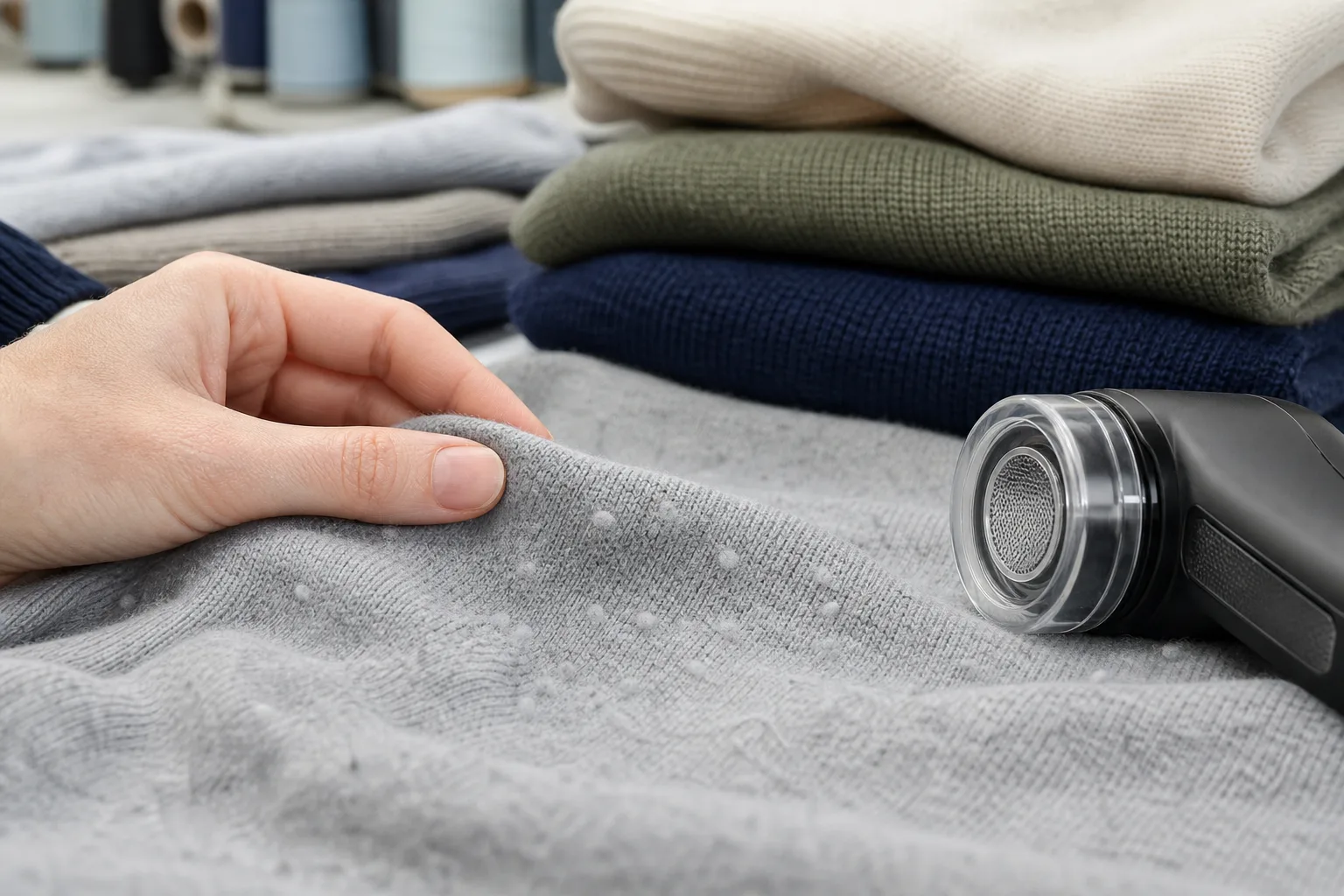
Yes, cotton can pill. Pilling occurs when friction brings loose fiber ends to a fabric’s surface, where they become entangled into small balls that remain attached by one or more fibers. Whether this happens quickly, severely or at all depends on the cotton fiber dimensions, yarn structure, fabric construction, finishing, use and laundering. A “100% cotton” label identifies fiber content; it does not guarantee a pill-free surface.
What cotton pilling is
A pill is a compact ball of entangled fibers attached to a textile surface. It differs from free lint, which has detached from the product, and from general fuzzing, where raised fiber ends create a hairy surface without forming distinct balls. Pilling can occur alongside color change, frosting or loss of surface cover, so a worn fabric may show several forms of appearance change at once. CottonWorks describes pilling as a complex property affected by fiber type and dimensions, yarn and fabric construction, finishing and end use in its garment durability guidance.
How a pill forms
- Fibers rise from the surface. Rubbing during wear, washing or drying moves exposed fiber ends and can release additional ends from the yarn.
- The loose ends tangle. Repeated movement rolls nearby fibers together, first producing fuzz and then a recognizable pill.
- Some fibers remain anchored. A pill stays visible while fibers still connect it to the yarn or fabric.
- The pill persists or breaks away. Continued abrasion may enlarge it, flatten it or eventually detach it. The outcome depends on the fibers and the structure holding them.
This sequence explains why softness and pilling are not opposites. A textile can feel soft because its surface is raised, brushed or loosely structured, but those same exposed fibers may provide material from which pills can develop. Softness is a sensory property; pilling resistance is a separate performance result.
Why some cotton fabrics pill and others do not
Cotton is a staple fiber, meaning that yarn is made by assembling and twisting finite-length fibers rather than using one continuous filament. Fiber ends are therefore a normal part of spun cotton yarn. Good material selection and manufacturing can control how many ends project from the yarn and how securely they are held, but the word “cotton” alone cannot describe those conditions.
Fiber length and length uniformity
Longer fibers generally give the spinner more overlap within a yarn. Length uniformity indicates how consistent the fiber lengths are and provides information related to short-fiber content. CottonWorks connects cotton length and length uniformity with yarn hairiness and fabric pilling in its cotton fiber quality material. These relationships make staple length and length uniformity relevant upstream controls, but neither value predicts a finished garment’s pilling by itself.
The USDA classes raw cotton using measurements that include micronaire, fiber length, length uniformity and strength. These data support cotton marketing and manufacturing decisions, but the USDA classing result is not a finished-fabric pilling score. Yarn spinning, knitting or weaving, finishing and garment construction still intervene between a bale and the product. The scope of the measurements is listed by the USDA Agricultural Marketing Service.
Strength and fineness require context
Fiber strength, maturity and micronaire influence processing and other performance properties, but they should not be converted into unsupported claims such as “high-strength cotton never pills.” Pilling requires fibers to reach the surface, tangle and remain attached. No single raw-fiber number captures that whole mechanism.
Yarn, construction and finishing often decide the result
Yarn structure
Yarn count, spinning system, twist, evenness and hairiness affect the finished surface. A structure that holds fibers securely can limit the supply of loose ends available to form pills. A softer, bulkier or hairier yarn may expose more fibers. Increasing restraint is not an unlimited solution, however: changing twist or yarn structure can also change softness, drape, absorbency, appearance and production behavior.
Knitted and woven structures
Construction controls yarn movement and surface exposure. An open or mobile structure may permit more rubbing and fiber migration than a compact structure made from comparable yarn, but “knit” does not automatically mean poor pilling resistance and “woven” does not guarantee good resistance. Stitch or weave design, density, yarn selection and finishing must be considered together. Explore the distinction between material and construction in the fabric guide.
Location matters as well. Underarms, cuffs, inner thighs, seat areas, bedding contact zones and surfaces rubbed by bags or upholstery experience more friction than protected areas. Localized pills can therefore reflect use conditions even when the rest of the product remains smooth.
Finishing
Singeing, surface shearing, enzyme processes and chemical or mechanical finishes may alter surface fibers and appearance. Their effect depends on the exact process and substrate. A finish described as “anti-pill” is a treatment claim, not a measurable result unless it is connected to an appropriate test method, preparation procedure and acceptance requirement. Finishes can also involve trade-offs in handle, strength, shade or durability after repeated care.
Laundering and drying add abrasion that can expose fuzz or pilling, according to CottonWorks’ quality-testing overview. For product development, appearance should therefore be assessed after the care cycles relevant to the intended use rather than only on new fabric.
What labels and sustainability claims do not prove
Fiber-content labels answer a composition question. In the United States, a product labeled “100% cotton” generally must contain only cotton apart from qualifying trim; a blend label identifies fibers by percentage under the applicable rules. The FTC’s cotton labeling guidance does not make that statement a guarantee of yarn quality, construction or pilling performance.
| Statement or metric | What it can tell you | What it does not establish |
|---|---|---|
| 100% cotton | The declared fiber composition | Pilling resistance, yarn quality or expected service life |
| Named cotton type | The claimed cotton identity and proportion when properly disclosed | A finished-product performance grade |
| Long staple | A claim about fiber length, if accurate and adequately defined | That construction and finishing are suitable for the end use |
| USDA classing data | Measured properties of sampled raw cotton, including length, uniformity, strength and micronaire | The pilling score of a particular fabric or garment |
| Organic or recycled content certification | Attributes covered by the named standard, such as verified material content or chain of custody | Automatic softness, durability or pilling resistance |
| Anti-pill | A claimed finish or performance feature | A defined result unless the seller supplies a method and acceptance level |
The same boundary applies to sustainability language. For example, Textile Exchange describes the Organic Content Standard as verifying organic material and chain of custody from source to final product. Its stated scope is not a laboratory assessment of pilling; see the Organic Content Standard overview. A product can have a substantiated sourcing attribute and still need separate performance specifications. Broad environmental claims also require appropriate qualification and evidence under the FTC’s Green Guides summary.
Care can reduce abrasion but cannot redesign the fabric
The manufacturer’s care label should be the first instruction because it applies to the complete product, including dyes, finishes, trims and construction. Under the FTC Care Labeling Rule, covered manufacturers and importers must have a reasonable basis for the care procedure they provide. A fiber-generic rule such as “all cotton should be washed hot” can conflict with the requirements of a particular item.
Practical care checklist
- Follow the stated wash, drying, bleaching and ironing instructions.
- Turn garments inside out when the label permits to reduce direct rubbing on the visible face.
- Close zippers and hook-and-loop fasteners that could abrade nearby textiles.
- Separate smooth, lightweight items from rough towels, rigid garments and heavily textured loads.
- Avoid overloading the machine, which can increase contact and prevent effective rinsing.
- Use the gentlest suitable cycle and drying condition allowed by the label.
- Clean lint filters and avoid confusing deposited lint with pills anchored to the fabric.
These steps may limit unnecessary friction, but they cannot correct a yarn or fabric that was predisposed to pill. CottonWorks notes that control should begin with material specifications and mill processing. Once pills exist, a fabric shaver may improve appearance on a robust, flat surface, but it removes material. Test an inconspicuous area, keep the tool away from seams and raised structures, and do not pull pills by hand because that can draw more fiber from the yarn. More product-specific guidance belongs in the cotton care hub.
How to buy or specify cotton for pilling resistance
Consumer checks
- Read composition and care together. Neither one replaces the other.
- Inspect the surface. Heavy fuzz on a new item is not proof that it will pill, but it identifies exposed fibers that deserve attention in a high-friction use.
- Match structure to use. A delicate, brushed surface may not be the best choice for constant rubbing, even if its hand feels appealing.
- Look for a defined performance claim. “Tested for pilling resistance” is more useful when the method, care preparation and pass level are disclosed.
- Keep marketing terms in scope. Cotton type, organic status, recycled content and softness do not substitute for performance evidence.
Brand and sourcing checklist
CottonWorks states that there is no universal satisfactory durability level for every textile product; customer and supplier must agree on performance appropriate to the product and end use. A sourcing specification should therefore record:
- the exact fiber composition and any cotton identity claim;
- relevant fiber requirements, including length and length uniformity where justified;
- yarn count, structure, twist and acceptable hairiness or evenness controls;
- fabric construction, density and finished weight;
- all surface, softening and performance finishes;
- the pilling test method and specimen preparation;
- whether testing occurs before or after specified laundering or other conditioning;
- the exposure interval and rating procedure;
- the minimum acceptable result for the intended product;
- production-lot verification and an agreed response to failure.
Compare results only when the method and test conditions match. A rating from one procedure or exposure interval should not be presented as equivalent to a result produced under different conditions. For broader evaluation, connect pilling resistance with abrasion resistance, strength, dimensional stability, color change and the other relevant quality tests. The most useful buying question is not simply “does cotton pill?” but “what finished-product evidence supports this fabric’s expected appearance after its intended wear and care?”
Frequently asked questions
Does 100% cotton pill?
It can. A 100% cotton label identifies fiber composition, not the yarn structure, fabric construction, finish or tested pilling resistance.
Does long-staple cotton pill less?
Longer and more uniform fibers can help reduce yarn hairiness and support a cleaner surface, but they do not guarantee a pill-free product. Spinning, construction, finishing and care remain important.
Are cotton pills caused by incorrect washing?
Washing and drying can reveal or accelerate pilling through abrasion, but a product's underlying tendency comes largely from its fibers, yarn, construction and processing. Follow the care label to avoid unnecessary friction.
Does organic cotton resist pilling better?
Organic status describes agricultural production and verified content under the applicable standard. It does not, by itself, measure fiber dimensions, yarn quality or finished-fabric pilling resistance.
Can pilling be removed permanently?
A fabric shaver can remove visible pills from some robust fabrics, but it does not change the construction that allowed them to form. Pills may return with continued wear and laundering.
How this guide was prepared
Desk research prepared for /cotton-science/pilling/ using official CottonWorks technical education, USDA cotton-classing documentation, FTC textile labeling and care rules, and Textile Exchange standards-scope material. No laboratory testing, garment trials, mill visits, farm visits or first-hand product evaluations were performed.
Review status: Publishable quality advisory.
Sources and scope
- Garment DurabilityCottonWorks
Definition of pilling; factors affecting pilling; laundering and wear context; need to control performance through product specifications and mill processing.
Accessed 2026-09-20 - Cotton Fiber QualityCottonWorks
Cotton fiber length, length uniformity, micronaire and strength definitions and their relationships with yarn and fabric properties.
Accessed 2026-09-20 - Cotton Classing ServicesUSDA Agricultural Marketing Service
Scope of USDA raw-cotton instrument measurements, including micronaire, length, length uniformity and fiber strength.
Accessed 2026-09-20 - Calling It Cotton: Labeling and Advertising Cotton ProductsFederal Trade Commission
Requirements and limitations of cotton fiber-content and named-cotton labeling claims.
Accessed 2026-09-20 - Care Labeling of Textile Wearing Apparel and Certain Piece GoodsFederal Trade Commission
Requirement for regular care instructions and a reasonable evidentiary basis for those instructions.
Accessed 2026-09-20 - Organic Content StandardTextile Exchange
Scope of organic material verification and chain of custody, illustrating why an organic-content claim is not a pilling-performance result.
Accessed 2026-09-20 - Environmental Claims: Summary of the Green GuidesFederal Trade Commission
Need to qualify and substantiate environmental marketing claims rather than treating broad sustainability language as proof of unrelated product performance.
Accessed 2026-09-20