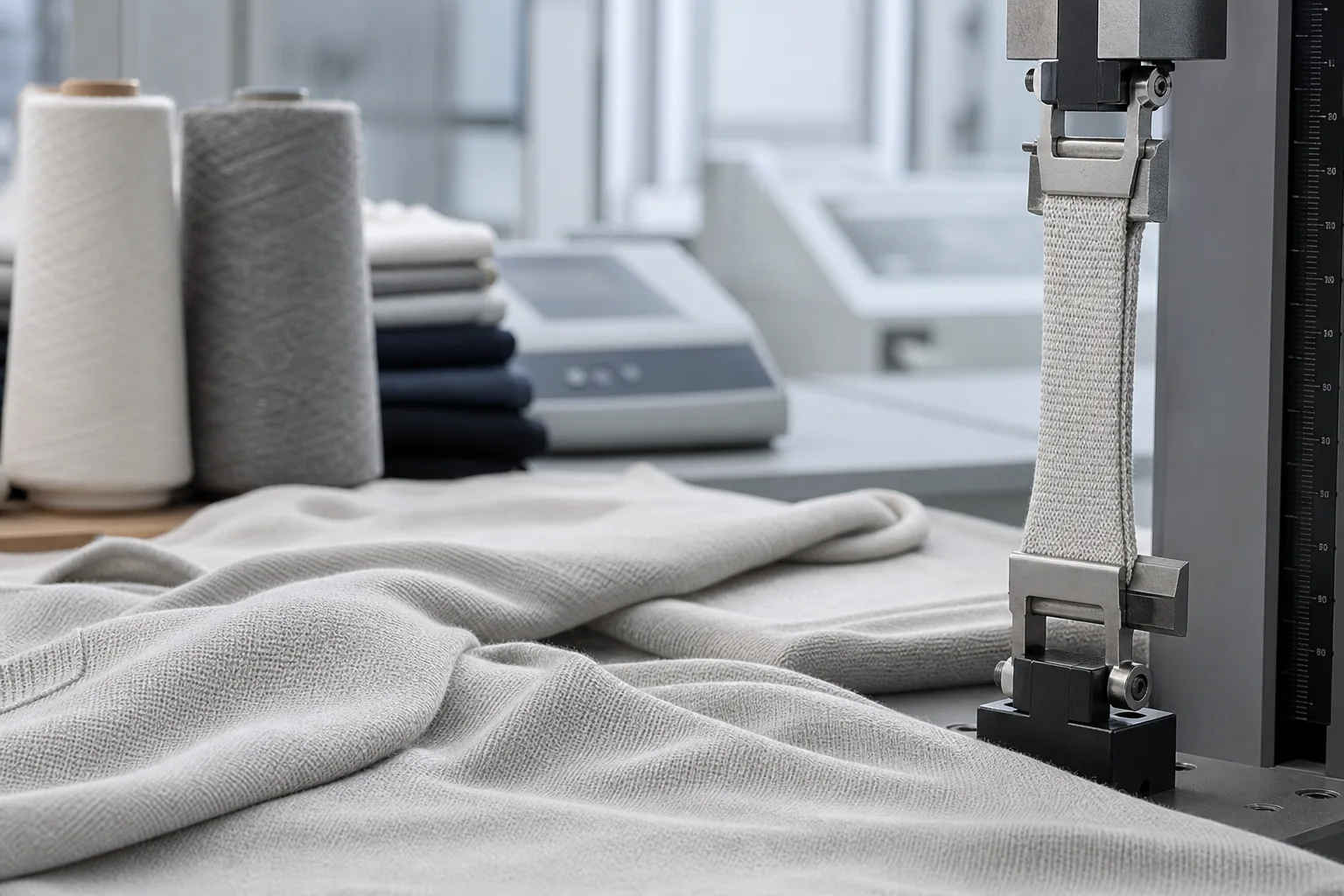
Cotton thermal properties cannot be reduced to “cool” or “warm.” Cotton fiber absorbs moisture, but a textile’s actual heat transfer, airflow, drying behavior and insulation depend heavily on yarn, fabric construction, thickness, trapped air, finishing, fit and environmental conditions. A light, open cotton voile may feel airy in summer; a lofty cotton fleece can retain warmth in cool weather. Fiber content identifies the material, not the finished product’s thermal performance.
What cotton thermal properties actually describe
Thermal comfort is the result of heat and moisture moving among the body, clothing and surrounding air. Several distinct properties matter, and they should not be treated as interchangeable.
Thermal conductivity and thermal resistance
Thermal conductivity describes how readily heat travels through a material. Thermal resistance describes how strongly a complete material or fabric system resists that transfer. In clothing and bedding, resistance is strongly affected by thickness and the amount of relatively still air held within or between layers.
Cotton fabrics can therefore be engineered for greater insulation by increasing loft, creating three-dimensional structures or limiting air exchange. CottonWorks describes tightly knit outer surfaces, blister structures and spacer constructions as ways to trap air and increase thermal and wind resistance. It also notes that thermal resistance may be evaluated with a sweating guarded hotplate. These examples demonstrate the importance of construction; they do not establish one universal value for every cotton textile. CottonWorks: Cotton Engineered to Insulate
Air permeability is not the same as insulation
Air permeability measures how readily air passes through fabric under specified conditions. An open structure can support ventilation, while a dense structure can reduce wind penetration. However, airflow alone does not describe conductive heat transfer, moisture behavior or the thermal effect of multiple garment layers.
This is why “breathable” should not be read as a numerical promise unless the seller supplies a result, test method and relevant conditions. Learn more about the distinction in our guide to cotton breathability.
Moisture changes the experience
Cotton is hydrophilic: its cellulose structure interacts readily with water. Moisture may be held within the fiber as well as between fibers and yarns. This can help a fabric take perspiration away from the immediate skin surface, after which spreading and evaporation may contribute to cooling. But an absorbent cotton fabric can also become saturated, heavier and slower to feel dry. In cool or windy conditions, wetness may increase discomfort because water replaces insulating air and evaporation removes heat.
Absorbency, wicking and drying time are different behaviors. They depend on construction and finishing as well as fiber chemistry. See cotton moisture absorption for a closer explanation.
From fiber to finished product: where performance is created
The thermal behavior of a cotton product emerges through a chain of design decisions. A useful evaluation separates the fiber from the yarn, fabric, finish and complete product.
Fiber properties set inputs, not final results
Raw cotton varies in length, uniformity, strength, fineness and maturity. These properties influence processing choices and the yarns a mill can make. USDA cotton classification measures properties including length, length uniformity, strength and micronaire, with micronaire combining aspects of fineness and maturity. Thermal resistance is not among the listed bale-classification measurements. USDA Agricultural Marketing Service: Cotton Classing Services
Longer or finer fibers may support particular yarn designs, but a staple-length or micronaire result does not prove that a finished shirt will feel cooler or a blanket warmer. Explore the underlying metrics in cotton quality, staple length and micronaire.
Yarn controls compactness and surface character
Yarn count, twist, ply, spinning method and hairiness affect how fibers are assembled. Fine, compact yarns can be used in smooth lightweight fabrics. Bulkier or textured yarn arrangements can help create thickness and air space. A marketing phrase such as “ring-spun” identifies a production route, not a complete thermal specification.
Construction often has the largest visible effect
Fabric weight, thickness, density, loop geometry and surface texture can make two 100% cotton products perform very differently. Open gauze permits more air exchange than dense canvas. Jersey, interlock, terry, flannel and brushed fleece each arrange yarn and air differently. Knits form yarn into intermeshing loops, while woven structures interlace warp and weft; neither category is automatically cooler or warmer without additional specifications.
Finishing can alter the baseline
Brushing or raising can increase surface loft. Calendering can flatten or smooth a fabric. Water-repellent, moisture-management and phase-change treatments can change wetting, spreading or heat-management behavior. Their presence should be disclosed accurately, and their durability should be evaluated after the intended number of care cycles. “Cooling cotton” or “thermal cotton” is a performance claim, not a recognized fiber grade by itself.
How cotton can feel cool in one product and warm in another
Warm-weather cotton
A lightweight cotton fabric can support comfort when it combines low mass, an appropriate degree of openness, space between the garment and skin, and a route for moisture to spread and evaporate. Examples may include voile, lawn, lightweight poplin, gauze and some single jerseys. Dark color, tight fit, heavy coatings or dense multilayer construction can change the result even when the fiber label still says 100% cotton.
Cold-weather cotton
For warmth, look for loft, thickness, protected air spaces and reduced wind penetration. Brushed sweatshirting, flannel, quilted layers and engineered spacer fabrics may provide greater insulation than a thin cotton knit. Yet untreated absorbent cotton is not automatically the best next-to-skin layer for prolonged cold, wet or high-sweat exposure. The appropriate system depends on activity, weather, drying opportunities and any additional fibers or finishes.
Indoor and sleep conditions
Sheets and sleepwear interact with mattresses, blankets, room temperature, humidity and personal perspiration. Fiber content alone cannot predict whether a person will sleep hot. Fabric weight, weave, yarn size, finish and the complete bedding stack deserve more attention than terms such as “crisp,” “buttery” or “hotel quality.” For product-specific guidance, see how to choose cotton bed sheets.
Practical checklist for evaluating a cotton product
Use the following hierarchy rather than relying on one label or marketing adjective.
| Check | What it can tell you | What it cannot prove |
|---|---|---|
| Fiber-content label | Whether the item is cotton, a cotton blend or another fiber composition | Warmth, cooling, airflow, drying speed or overall quality |
| Fabric weight and thickness | How much material is present and whether the fabric may hold substantial air | Exact insulation without a controlled test |
| Construction | Whether the textile is open, dense, looped, brushed, quilted or multilayered | Performance under every temperature, humidity and wind condition |
| Finish disclosure | Whether moisture-management, water-repellent or other technology is claimed | Durability unless results after laundering are supplied |
| Performance result | A measured value when method, units, conditioning and sample details are given | Direct comparability with a result produced under different conditions |
| Care label | How the manufacturer says the complete product should be cleaned and dried | That harsher or hotter care will preserve size, finish and loft |
Questions for suppliers and product teams
- Was the complete fabric tested, or only a fiber, yarn or unfinished development sample?
- What property was measured: thermal resistance, air permeability, drying time, moisture transport or surface temperature?
- Which method, units and conditioning environment were used?
- What were the fabric weight, thickness, composition and construction?
- Was the comparison made at equal weight, equal thickness or equal end use?
- Were results collected before and after laundering?
- Does the tested sample match the production product?
A result is most useful when it identifies the sample and method clearly. Without those details, statements such as “five times warmer” or “temperature regulating” may be impossible to interpret fairly. Visit cotton testing guides for more on reading textile results.
Labels and marketing terms: what they do and do not mean
In the United States, covered textile products generally must identify their constituent fibers and percentages by weight. The FTC specifically states that a product should not be labeled “100% cotton” unless it contains only cotton, apart from permissible non-cotton trim. That statement concerns composition; it is not a thermal-performance certification. Federal Trade Commission: Calling It Cotton
- “100% cotton” states fiber composition, not fabric weight, softness or insulation.
- “Breathable” may describe perceived comfort or measured airflow; look for clarification.
- “Moisture-wicking” should indicate moisture movement, not merely absorption.
- “Cooling” should be tied to a defined mechanism and substantiated comparison.
- “Thermal” or “temperature regulating” is not meaningful on its own; ask which property changed and by how much.
- Thread count, GSM and fabric name provide partial construction information but are not complete comfort scores.
The same caution applies to cotton types and origin terms. A named cotton may communicate provenance or fiber characteristics, but it does not override yarn, construction, finishing and product design. Use our cotton quality buying guide to evaluate the complete item.
Care can change thermal behavior
Laundering may relax, shrink, compact, abrade or raise a cotton fabric. These changes can alter thickness, porosity, fit and surface texture. Repeated care may also reduce the effect of some topical finishes. CottonWorks notes that fabric specifications and performance should be considered across fiber, yarn, fabric and garment levels, including appearance after cleaning. CottonWorks: Quality Testing
Follow the product’s care label rather than applying one rule to all cotton. The FTC requires covered manufacturers and importers to provide regular care instructions and to possess a reasonable basis for those instructions. Federal Trade Commission: Care Labeling Rule
- Use the recommended wash and drying temperatures.
- Avoid assuming that maximum dryer heat is harmless because the fiber is cotton.
- Measure garments or bedding before and after initial washes if dimensional stability matters.
- For treated performance products, check whether the brand states a tested wash-life.
- Restore loft gently where the care instructions permit, rather than using unapproved high heat.
See our complete cotton care guidance for washing and drying considerations.
Thermal performance is separate from sustainability
A fabric’s warmth or cooling behavior does not establish that it has a lower environmental impact. Likewise, organic, recycled, regenerative or program-related sourcing claims do not automatically indicate superior thermal comfort. These are different claim categories requiring different evidence.
The FTC advises marketers not to make broad, unqualified environmental claims such as “green” or “eco-friendly” and says that specific environmental benefits should be clear and substantiated. A certification also does not remove the responsibility to support express and implied claims. Federal Trade Commission: Environmental Claims and the Green Guides
Evaluate thermal performance with relevant textile measurements, composition with accurate labeling, and sustainability with defined scope, traceability and credible evidence. For the broader context, visit cotton sustainability.
Bottom line: cotton provides an adaptable moisture-responsive cellulose fiber, but the finished textile determines most practical thermal behavior. Start with the intended use, then examine construction, weight, thickness, finishes, fit, test conditions and care. No single cotton label can replace that complete evaluation.
Frequently asked questions
Is cotton a good thermal insulator?
Cotton fiber alone does not determine insulation. A thick, lofty or multilayer cotton fabric can trap air and provide useful thermal resistance, while a thin, open cotton fabric provides little insulation. Construction, thickness, wind penetration, moisture and layering are decisive.
Does cotton keep you cool in hot weather?
Lightweight, appropriately open cotton can support airflow and absorb perspiration, while moisture spreading and evaporation may contribute to cooling. Dense construction, heavy weight, close fit, high humidity or saturation can reduce that benefit.
Why can wet cotton feel cold?
Water can displace insulating air within a textile, while evaporation removes heat. An absorbent fabric may also remain wet against the body. The effect depends on temperature, wind, humidity, activity, fabric design and available drying time.
Does a 100% cotton label prove breathability or warmth?
No. The label identifies fiber composition. It does not specify air permeability, thermal resistance, thickness, drying time, yarn structure, fabric density or finishing. Those properties require additional product information or relevant testing.
What should a credible cotton cooling or thermal claim include?
Look for the measured property, test method, units, sample composition and construction, conditioning environment, comparison basis and results before and after relevant laundering. The tested sample should match the product being sold.
How this guide was prepared
This page is based on desk research conducted on September 19, 2026 using current technical guidance from CottonWorks, official USDA cotton-classification information and Federal Trade Commission textile-labeling, care-labeling and environmental-claims guidance. No laboratory testing, product trials, farm or mill visits, supplier interviews, certifications or first-hand performance assessments were conducted. The article therefore explains mechanisms and evidence requirements without assigning universal thermal values to cotton products.
Review status: Publishable quality advisory.
Sources and scope
- Cotton Engineered to InsulateCottonWorks by Cotton Incorporated
Definitions of air permeability and thermal resistance, guarded-hotplate evaluation, and examples of cotton fabric structures designed to increase loft, trap air and resist wind.
Accessed 2026-09-19 - Cotton Classing ServicesUSDA Agricultural Marketing Service
Official description of U.S. raw-cotton classification measurements, including length, uniformity, strength and micronaire.
Accessed 2026-09-19 - Calling It Cotton: Labeling and Advertising Cotton ProductsFederal Trade Commission
Requirements and guidance for accurate cotton fiber-content statements, including use of the term 100% cotton.
Accessed 2026-09-19 - Care Labeling of Textile Wearing Apparel & Certain Piece GoodsFederal Trade Commission
Requirements for regular care instructions and a reasonable basis for the care information supplied with covered textile products.
Accessed 2026-09-19 - Environmental Claims: Summary of the Green GuidesFederal Trade Commission
Guidance against broad, unqualified environmental-benefit claims and the need to substantiate specific claims, including those accompanied by certifications.
Accessed 2026-09-19 - Quality TestingCottonWorks by Cotton Incorporated
The distinction among fiber, yarn, fabric and garment specifications and the role of construction and laundering in product performance.
Accessed 2026-09-19