
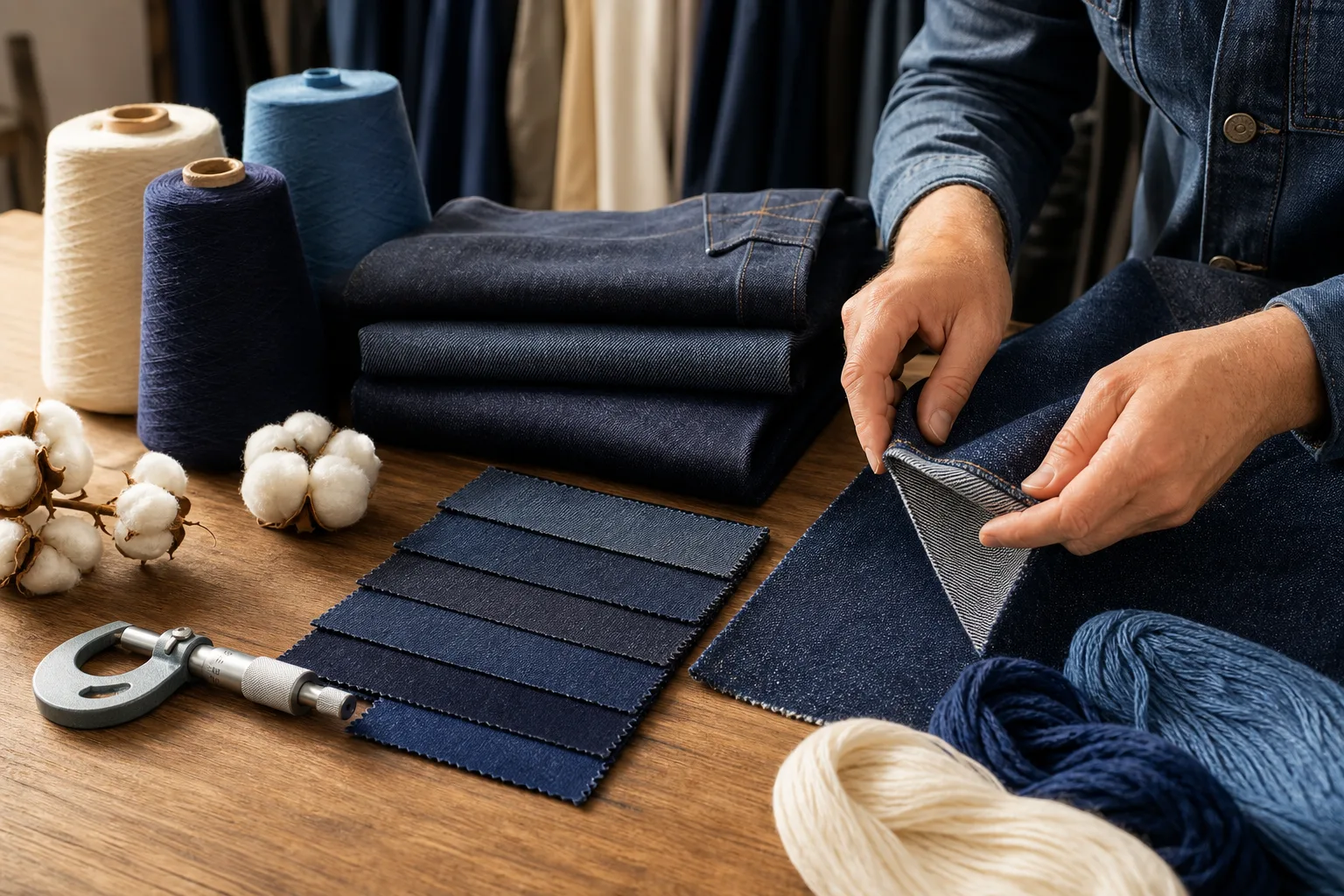
What makes good cotton denim? The short answer is fitness for purpose: suitable cotton fiber spun into consistent yarn, woven to an appropriate weight and density, finished without unacceptable damage, and made into a garment that fits and holds up in its intended use. Heavy, rigid denim may be excellent for workwear but uncomfortable in a summer shirt; a light stretch denim may suit close-fitting jeans but not a rugged chore coat. Fiber names, “premium” wording, selvedge edges and high fabric weight can describe features, but none proves quality by itself.
The quick quality test: judge the whole material system
Denim quality develops in stages. Raw cotton influences spinning performance and yarn consistency. Yarn controls much of the fabric's surface, strength and response to abrasion. The weave and fabric density affect weight, stability and drape. Indigo application creates the characteristic fading behavior, while washing and finishing alter color, softness and sometimes strength. Sewing, fit and care then determine how the finished item performs in use.
This means a buyer should not ask only whether denim is “100% cotton” or made with a named cotton type. Instead, check five things:
- Fiber content: Is it all cotton or a blend containing stretch or synthetic fiber?
- Construction: Is the weight, weave and firmness appropriate for the product?
- Surface and consistency: Are irregularities intentional, as with slub yarn, or signs of uneven manufacture?
- Finishing: Has the desired softness or worn appearance been achieved without obvious weak spots?
- Finished-garment execution: Are seams, stress points, sizing and care instructions suitable for repeated use?
For a broader framework, see cotton quality and the guide to how to tell cotton quality.
Fiber quality matters, but it does not tell the whole story
What raw-cotton measurements can indicate
The USDA classifies raw cotton using measurements that include fiber length, length uniformity, strength, micronaire, color and trash. CottonWorks explains that fiber length and length uniformity affect yarn strength, evenness and spinning efficiency, while micronaire provides information related to fiber fineness and maturity. USDA classing data helps manufacturers select cotton for particular end products. These are meaningful technical properties, not lifestyle descriptors. USDA Cotton Classing Services and CottonWorks cotton fiber quality guidance describe these measurements in detail.
For denim, stronger and more uniform yarn can support efficient weaving and consistent fabric, but a raw-fiber result is not a guarantee of garment durability. Processing can introduce variation, and aggressive abrasion or poor sewing can weaken an otherwise sound fabric. Conversely, a deliberately irregular yarn may be selected for visual character rather than maximum surface uniformity.
Do not use cotton type as a complete quality grade
A named cotton type may provide useful sourcing information when the claim is accurate, but it does not reveal the denim's weave density, yarn twist, finish, seam strength, shrinkage or fit. Longer-staple cotton can support fine, even yarns, yet denim performance still depends on every later manufacturing stage. Learn more about individual measurements such as staple length, length uniformity, fiber strength and micronaire.
Yarn and weave create denim's structure and character
Yarn consistency, twist and spinning system
CottonWorks notes that denim's appearance and feel depend heavily on yarn size, twist, evenness and spinning method. Even yarns generally produce a smoother surface and more uniform response to washing or abrasion. Slub yarns contain planned thick and thin areas, creating visible vertical or crosswise variation. That texture can be desirable, but it should be controlled rather than random.
Ring-spun and open-end yarns can both be used successfully. The spinning-system name alone does not establish whether the finished denim is good or bad; the yarn specification must suit the intended look, strength, cost and finish. See ring-spun versus open-end yarn for the practical differences.
Twill construction and fabric density
Traditional denim is commonly warp-faced twill: more dyed warp yarn is visible on the face, while lighter filling yarn is more apparent on the reverse. Common structures include 3 × 1, 2 × 1 and 2 × 2 twills, along with broken twills. In a 3 × 1 twill, each warp yarn passes over three filling yarns and under one in the repeat, producing a pronounced diagonal line. Broken twill interrupts that diagonal and can change the visual effect and fabric behavior.
Fabric density—the number and size of warp and filling yarns within a given area—works with weave design to influence cover, firmness and weight. A dense-looking fabric is not automatically durable, because yarn quality, finishing damage and garment construction also matter. Denim is woven rather than knitted; the guide to weaving versus knitting explains the structural distinction.
Choose denim weight for the intended use
CottonWorks reports finished denim weights ranging from approximately 3.5 to 16.5 ounces per square yard. It identifies 3.5–8 oz fabrics as typical for shirts, tops and blouses, while trousers, jeans and jackets commonly use 8–16.5 oz denim. These are useful application ranges, not universal quality grades. CottonWorks Denim Basics provides the construction and weight context.
| Feature to check | What it may tell you | What it does not prove |
|---|---|---|
| Lightweight denim | More suitable for shirts, warm conditions, layering or fluid silhouettes | That the fabric is weak or low quality |
| Midweight denim | A balance of structure, comfort and versatility for many jeans | How well the garment will fit after laundering |
| Heavyweight denim | Greater substance and potential suitability for structured jeans or jackets | Superior yarn, sewing, colorfastness or abrasion resistance |
| Rigid 100% cotton | No intentionally added stretch fiber; often a firmer initial feel | That the garment will not relax, shrink or change with wear and washing |
| Cotton-stretch blend | Potential for easier movement and a closer fit | Long-term shape recovery; that depends on fiber percentage, fabric engineering and finishing |
| Selvedge edge | How the fabric edge was formed and, often, the loom or production format used | Higher strength, better fit or better cotton |
Fabric weight may be expressed in ounces per square yard or grams per square meter. It should always be interpreted with fiber content and construction rather than used as a stand-alone ranking. See the fabric GSM guide for help comparing units.
Dyeing and finishing can improve appearance—or reduce performance
Indigo and controlled fading
Classic blue denim usually has indigo-dyed warp yarns and undyed or lighter filling yarns. Indigo's placement near the yarn surface helps produce the contrast and fading associated with worn denim. A dark, uniform shade, a vintage wash and high-contrast fading are different aesthetic targets; none is inherently the highest-quality result.
When comparing garments, inspect whether the color and abrasion pattern look controlled. Check folds, pocket edges, knees, seat and seams for holes, unusually thin patches or damage that seems excessive for a new garment. Artificial whiskers and worn areas are design features, not evidence that the denim has survived long-term wear.
Softness is not a direct measure of durability
Denim may be softened through washing, mechanical abrasion, enzyme processing or added softeners. CottonWorks explains that cellulase treatments remove material from the cotton surface and can produce weight reduction or strength loss when the process is not appropriately controlled. Finishing can therefore create immediate softness while changing the fabric's remaining material and performance. CottonWorks Denim Finishing outlines common processes and their trade-offs.
Buyers should treat “pre-washed,” “vintage,” “distressed” and “premium wash” as process or style descriptions. To support a measurable durability claim, a supplier would need relevant test results for the actual fabric or garment—not just the name of the finish.
How to read labels and buy good cotton denim
Start with the required fiber disclosure
In the United States, covered textile products generally must disclose fiber content, country of origin and the responsible business identity. The FTC states that a product should not be labeled “100% cotton” unless it contains only cotton apart from permitted non-fiber trim. A functional fiber present below 5%, such as spandex, may be identified by name. Claims naming Pima or another cotton type must also be truthful and consistent with the actual content. FTC cotton labeling guidance explains these requirements.
A fiber-content label tells you what fibers are present by weight. It does not certify weave quality, dye durability, shrinkage, seam construction, comfort or environmental performance.
A practical denim buying checklist
- Match weight and flexibility to the use. Sit, bend and walk when trying on jeans; consider lighter denim for shirts and warmer weather.
- Read the full fiber percentages. Do not assume “cotton-rich” means 100% cotton or that “stretch denim” identifies how much stretch fiber is present.
- Inspect both fabric faces. Look for unintended streaks, snags, bare areas and inconsistent abrasion while recognizing that slub texture may be deliberate.
- Check stress points. Examine pocket corners, belt loops, crotch seams, fly attachments and button or rivet areas.
- Compare cut pieces. Twill direction and shade should appear reasonably consistent unless panel contrast is part of the design.
- Read the care label before buying. Decide whether the permitted washing and drying methods fit your routine.
- Ask for evidence behind performance claims. Terms such as “extra durable,” “low shrinkage” or “colorfast” should be supported by relevant test methods and results for the product being sold.
Care and sustainability claims require context
Follow the garment-specific care instructions
The FTC requires covered garments to carry regular-care instructions supported by a reasonable basis. The correct method depends on the complete garment, including fabric, dye, finishes, thread, trims and construction—not cotton alone. FTC care-label guidance emphasizes that instructions should not cause substantial harm when followed.
When the label permits, turning denim inside out, using a gentle cycle, avoiding unnecessary high heat and drying only as much as needed may help limit surface abrasion, color change and dimensional stress. New dark denim may behave differently from heavily washed denim, so do not replace the product's instructions with a universal rule. See washing cotton and preventing cotton shrinkage for further guidance.
Verify the scope of environmental claims
“Sustainable denim,” “eco denim” and similar phrases are not measurable quality results unless the claimed benefit and its scope are stated. The FTC advises against broad, unqualified environmental benefit claims and says certifications do not remove the need to substantiate expressed and implied claims. Ask whether a statement concerns the farm, fiber percentage, recycled input, dyeing process, finishing, factory, transport, durability or end-of-life pathway. The FTC Green Guides summary provides the relevant marketing principles.
For example, the Organic Content Standard is a voluntary standard for third-party certification of organic materials and chain of custody. That can help verify organically grown content, but it does not by itself establish fit, fabric strength, low-impact finishing or long service life. Textile Exchange's OCS overview describes its defined scope.
Good purchasing decisions separate verified attributes from broad impressions. Look for a named standard, the certified product or organization, the applicable content percentage, a verifiable certification reference where relevant, and clear wording about what has—and has not—been assessed. Explore cotton certifications and cotton life-cycle considerations for more context.
Frequently asked questions
Is 100% cotton denim always better than stretch denim?
No. Rigid 100% cotton denim may suit buyers who want a firm fabric and no added stretch fiber. A cotton blend containing a small amount of stretch fiber may offer easier movement and a closer fit. Quality depends on yarn, construction, recovery, finishing and garment execution as well as fiber content.
Does heavier denim mean higher quality?
Not by itself. Heavier denim has more substance and may suit structured jeans, jackets or workwear, but weight does not prove yarn quality, seam strength, controlled finishing or comfort. The appropriate weight depends on the product and conditions in which it will be worn.
Is selvedge denim automatically better?
No. Selvedge describes a finished fabric edge and often reflects a particular loom or production format. It may be desirable for its appearance or manufacturing character, but it does not independently guarantee better cotton, durability, fit or color performance.
How can I tell whether distressed denim is durable?
Inspect the abraded areas for excessive thinning, holes or damage at seams and stress points. Ask whether durability or strength claims are supported by relevant testing on the actual fabric or garment. A distressed appearance is a design result, not proof of long-term wear performance.
How this guide was prepared
This guide is based on desk research conducted on October 15, 2026 using USDA cotton-classing information, CottonWorks technical material on fiber quality and denim manufacture, FTC textile-labeling and environmental-claims guidance, and Textile Exchange information about the Organic Content Standard. No garments or fabrics were purchased, worn, washed or laboratory-tested, and no mills, farms, brands or certification bodies were visited or interviewed.
Sources and scope
- Cotton Fiber QualityCottonWorks by Cotton Incorporated
Explains HVI fiber-quality factors and how staple length, length uniformity, strength and micronaire relate to yarn processing and consistency.
Accessed 2026-10-15 - Cotton Classing ServicesUSDA Agricultural Marketing Service
Identifies the raw-cotton properties measured through USDA classing and explains how manufacturers use bale-level classification data.
Accessed 2026-10-15 - Denim BasicsCottonWorks by Cotton Incorporated
Provides technical guidance on denim yarn, indigo, common twill constructions and typical fabric-weight ranges for apparel uses.
Accessed 2026-10-15 - Denim FinishingCottonWorks by Cotton Incorporated
Describes stonewashing, enzyme treatments and other denim finishing processes, including possible fiber weight and strength loss.
Accessed 2026-10-15 - Calling It Cotton: Labeling and Advertising Cotton ProductsFederal Trade Commission
Explains U.S. fiber-content disclosures and requirements for truthful claims about 100% cotton and named cotton types.
Accessed 2026-10-15 - Clothes Captioning: Complying with the Care Labeling RuleFederal Trade Commission
Explains the requirement for garment care instructions and the need for reliable evidence supporting those instructions.
Accessed 2026-10-15 - Environmental Claims: Summary of the Green GuidesFederal Trade Commission
Supports guidance on qualifying environmental claims, substantiating benefits and interpreting certifications or seals.
Accessed 2026-10-15 - Organic Content StandardTextile Exchange
Defines the Organic Content Standard's scope as verification of organic materials and chain of custody.
Accessed 2026-10-15
Questions & discussion
Share a question or a useful experience about this guide. Comments appear immediately. Your name and comment are public. Email is optional and stays private; reply emails are not enabled yet. Comment privacy.