
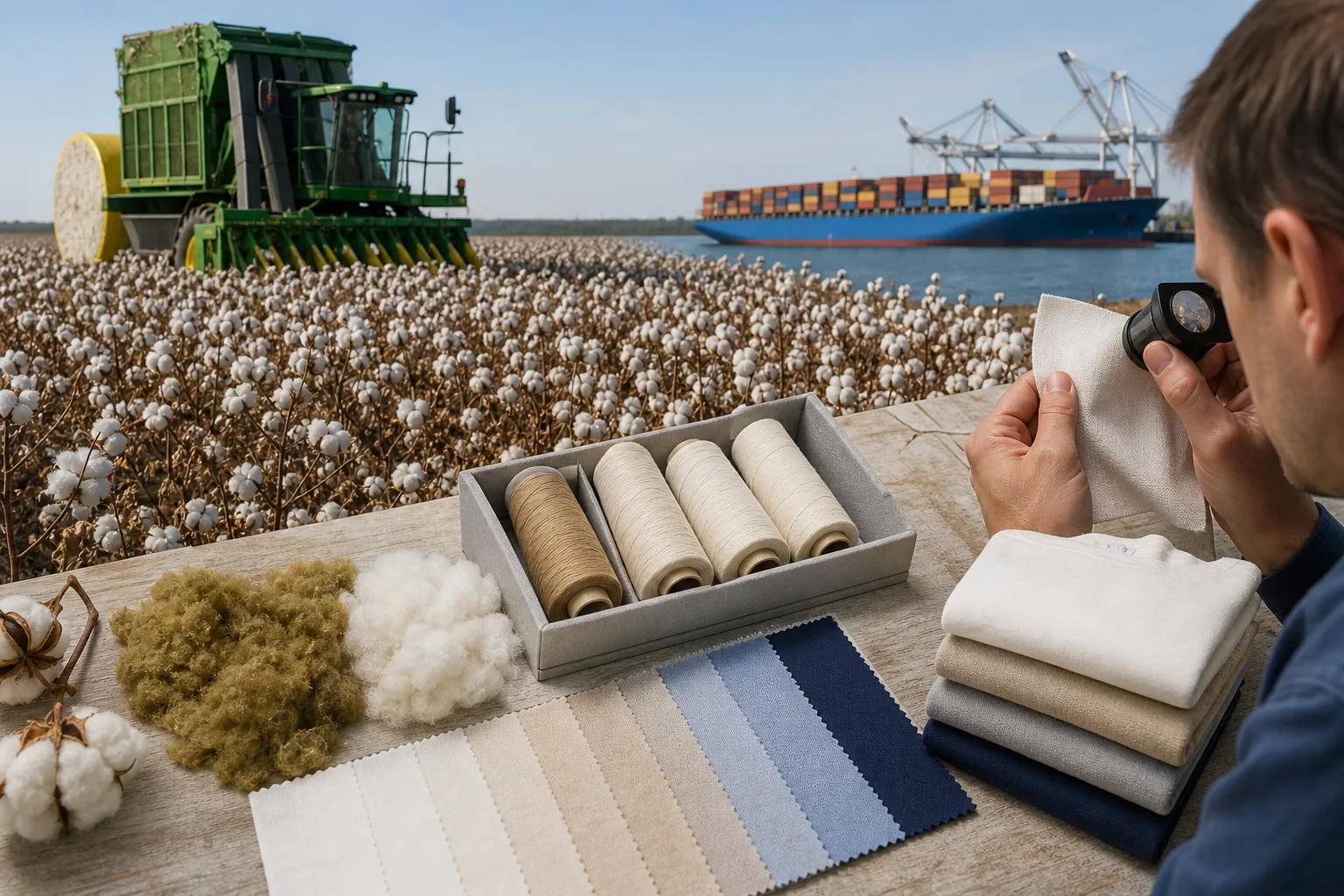
The US cotton industry is a major supplier of raw fiber to domestic and overseas textile mills. Its defining features include production across several growing regions, a crop dominated by Upland cotton, smaller volumes of extra-long-staple American Pima, and bale-specific USDA classification data. For the 2026/27 marketing year, USDA’s October 2026 projection puts US production at 13.44 million 480-pound bales, exports at 12.30 million bales and domestic mill use at 1.50 million bales. These figures show an industry oriented strongly toward raw-cotton exports, but they do not tell buyers how any particular sheet, towel or garment will feel or perform. USDA WASDE, October 2026
US cotton production at a glance
Cotton is grown across the country’s Cotton Belt, commonly discussed in four broad regions: the Southeast, Delta, Southwest and West. Weather, water availability, variety selection, harvest conditions and regional agronomy can all influence yield and fiber properties. Consequently, country of origin alone is not a fiber specification.
Current 2026/27 outlook
As of October 9, 2026, USDA projected 10.45 million planted acres and 8.16 million harvested acres, with an average yield of 790 pounds per harvested acre. Forecast production was 13.44 million bales, up from USDA’s September forecast but below the estimated 13.90 million bales produced in 2025/26. The forecast remains subject to harvest results, ginning data and later revisions. USDA WASDE, October 2026
| 2026/27 measure | USDA October projection | What it indicates |
|---|---|---|
| Planted area | 10.45 million acres | Land planted, not the area ultimately harvested |
| Harvested area | 8.16 million acres | Area expected to produce a harvested crop |
| Average yield | 790 pounds per harvested acre | National average; individual regions and farms vary |
| Production | 13.44 million 480-pound bales | Forecast raw-fiber output |
| Domestic mill use | 1.50 million bales | Raw cotton expected to be used by US mills |
| Exports | 12.30 million bales | Raw cotton expected to be shipped to overseas markets |
USDA’s separate October crop report forecast about 13.1 million bales of Upland cotton and 383,000 bales of Pima cotton. Those estimates confirm that Upland accounts for most US output. USDA Crop Production, October 2026
Upland and American Pima are different fiber categories
Upland cotton
Upland cotton provides the great majority of US production and supports a wide range of yarns, woven fabrics, knits, denim, towels and nonwovens. The category contains substantial variation. A bale’s length, strength, uniformity, micronaire, color and foreign-matter results are more informative for spinning decisions than the word “Upland” by itself.
American Pima
American Pima is US-grown extra-long-staple cotton. Its longer fibers can support fine, strong yarns when appropriately selected and processed. However, “Pima” is a fiber identity, not proof that a finished product has fine yarn, dense construction, careful finishing or good durability. A Pima product can still be compromised by weak yarn preparation, unsuitable construction or aggressive finishing.
Buyers should therefore separate three questions: What cotton type is present? What measurable fiber and fabric specifications were used? How was the finished product made? For a broader view of cotton categories, see the cotton types guide.
How USDA cotton classification works
USDA Agricultural Marketing Service states that its Cotton and Warehouse Program tests a sample from every bale produced in the United States. Although classing is performed at producers’ request rather than imposed as a universal legal mandate, USDA reports that every produced bale is classed. The resulting bale-level data supports marketing, price-support participation and mill sourcing. USDA Cotton Classing Services
Properties measured on raw fiber
| Classing result | What it measures | Why mills consider it |
|---|---|---|
| Fiber length | Upper-half-mean length, converted to a staple designation | Influences spinning potential, yarn evenness and yarn strength |
| Length uniformity | Consistency of fiber lengths within the sample | Helps assess processing efficiency and yarn uniformity |
| Fiber strength | Force needed to break a fiber bundle, in grams per tex | Relates to spinning performance and potential yarn strength |
| Micronaire | Air-permeability value influenced by fineness and maturity | Helps mills manage processing and dye-uniformity risks |
| Color | Reflectance and yellowness | Supports color grading and decisions about bleaching or dyeing |
| Trash and particle count | Visible non-lint material on the sample surface | Indicates cleaning requirements and contributes to leaf grade |
| Extraneous matter | Material such as bark, grass, seed-coat fragments or plastic | Flags contamination that can disrupt processing or appearance |
These measurements are valuable, but no single number defines “best” cotton. For example, micronaire combines effects of fineness and maturity; it is not a simple scale on which the lowest number always wins. Similarly, longer fiber can expand spinning options, but it cannot compensate for poor yarn engineering or fabric construction. Explore the individual guides to staple length, fiber strength, length uniformity, color grade and leaf and trash.
CottonWorks explains that length affects yarn strength, evenness and spinning efficiency, while variation in micronaire can contribute to uneven dyeing or barre. These are relationships between raw fiber and manufacturing—not guaranteed consumer outcomes. CottonWorks Cotton Fiber Quality
Fiber quality is not finished-product quality
Classing data describes raw cotton before spinning. Once the fiber enters textile manufacturing, additional variables become decisive. Mills blend bales, clean and card the fiber, may comb out shorter fibers, and select a spinning system and yarn specification. Manufacturers then choose knitted or woven construction, fabric weight, density, dyeing, mechanical or chemical finishing and garment assembly.
Questions classing data cannot answer by itself
- Yarn: Was it carded or combed, ring-spun or open-end, single or plied? Compare combed and carded cotton and ring-spun and open-end yarn.
- Construction: Is the fabric knitted or woven, and what are its weight, density and structure? See weaving versus knitting.
- Finishing: Was the material sanforized, brushed, mercerized, resin-finished, garment-washed or treated for a performance effect?
- Testing: Has the finished product been evaluated for shrinkage, pilling, colorfastness, seam strength or dimensional stability under a stated method?
- Care: Will the user follow suitable washing and drying instructions? Heat, abrasion and chemistry can change dimensions, color and surface appearance.
This distinction matters to consumers. “US cotton,” “Pima,” “long staple” and “premium cotton” may provide sourcing or material information, but none is a complete performance result. For product selection, combine fiber information with fabric specifications, care instructions and relevant test evidence. The cotton quality buying guide provides a practical framework.
Trade and the US cotton supply chain
The gap between USDA’s projected exports of 12.30 million bales and domestic mill use of 1.50 million bales shows that most US raw-cotton demand is expected to come from export markets in 2026/27. This does not mean most finished cotton products sold in the United States were manufactured domestically. Raw fiber can be exported, spun and made into fabric or garments elsewhere, then return through textile and apparel trade.
From field to mill
- Cotton is harvested as seed cotton.
- A gin separates lint from seed and removes portions of plant material and field contamination.
- Lint is compressed into bales, and samples are submitted for classification.
- Merchants and mills use bale data to assemble lots suited to particular yarn requirements.
- Fiber is opened, blended, carded and sometimes combed before spinning.
- Yarn is knitted or woven, then dyed, finished and converted into products.
Traceability becomes more complicated after bales are blended and transformed. A claim about US-grown fiber therefore needs supply-chain records connecting the raw cotton to the yarn, fabric and final item. Learn more in the cotton supply-chain guide. Market forecasts and prices also change independently of product quality; see the cotton price guide for that distinction.
How to read labels and origin claims
In the United States, covered textile labels generally disclose fiber content, the responsible manufacturer or marketer, and the country where the product was processed or manufactured. The FTC says a product should not be labeled “100% cotton” unless it contains only cotton, apart from permitted non-cotton trim. If a specific cotton type is named, the statement must be truthful and must not imply that all cotton in a blended-cotton product is that type. FTC: Calling It Cotton
Keep the following claims separate:
- “100% cotton” describes fiber content, not staple length, quality grade, origin or construction.
- “US cotton” or “US-grown cotton” concerns raw-fiber origin and requires traceability; it does not necessarily mean the product was spun, woven, knitted or sewn in the United States.
- “Made in USA” is a product-origin claim, not a raw-fiber quality measurement.
- “Pima cotton” identifies a cotton type but does not establish the yarn count, fabric weight or finishing quality.
- “Premium” or “luxury” has no useful technical meaning unless accompanied by measurable specifications.
For purchasing checks, see how to verify cotton sheet labels and the broader certification guide.
Sustainability claims need their own evidence
US origin, USDA classing and high fiber strength do not by themselves establish organic status, reduced water use, lower greenhouse-gas emissions or better soil outcomes. Fiber quality data and sustainability evidence answer different questions.
The FTC advises marketers not to make broad, unqualified claims such as “green” or “eco-friendly” and notes that a third-party certification does not remove the need to substantiate the claims communicated by it. FTC Green Guides summary Standards can also have different scopes. For example, Textile Exchange describes its Organic Content Standard as a voluntary standard covering third-party certification of organic materials and chain of custody; it is not a finished-product performance grade. Textile Exchange Organic Content Standard
Practical verification checklist
- Identify exactly what the claim covers: farm practices, fiber content, chain of custody, processing or the whole product.
- Check the certified organization, product or transaction rather than relying only on a logo.
- Look for a percentage when a product contains both claimed and non-claimed material.
- Do not infer softness, durability or low shrinkage from an environmental certification.
- Request the test method and result when a seller makes a measurable performance claim.
- Treat national averages for water, carbon or yield as context—not proof about a particular farm or product.
Readers comparing environmental attributes can continue to the guides on cotton water use, soil health, carbon footprint and life-cycle assessment. For broader production and market coverage, visit the cotton industry hub.
Frequently asked questions
What type of cotton does the United States mainly produce?
Upland cotton accounts for most US production. USDA’s October 2026 forecast was approximately 13.1 million bales of Upland cotton and 383,000 bales of Pima cotton for the 2026 crop.
Does USDA test every bale of US cotton?
USDA Agricultural Marketing Service reports that its classing program tests a sample from every bale produced in the United States. The results include length, uniformity, strength, micronaire, color, trash and checks for extraneous matter.
Does US cotton mean a textile was made in the United States?
No. US cotton refers to raw-fiber origin when the claim is properly traceable. The fiber may be exported and spun, woven, knitted, finished or sewn in another country. Product manufacturing origin and cotton-growing origin are separate facts.
Is American Pima always better than Upland cotton?
Not for every use. American Pima’s extra-long fibers can support fine, strong yarns, but finished performance also depends on yarn preparation, fabric construction, finishing and care. Well-engineered Upland fabric may outperform poorly made Pima fabric.
Does USDA cotton classification prove that a product is sustainable?
No. USDA classing measures raw-fiber properties for marketing and manufacturing. Organic status, chain of custody, water use, emissions and other sustainability claims require separate, claim-specific evidence.
How this guide was prepared
This country profile is based on desk research completed on October 14, 2026, using current USDA production and trade projections, USDA classing documentation, CottonWorks fiber-science guidance, FTC textile and environmental-claim guidance, and Textile Exchange standards information. No farms, gins, classing offices, mills or products were visited or tested. Forecast figures may be revised as harvest, ginning and trade data become available.
Sources and scope
- World Agricultural Supply and Demand Estimates, October 2026United States Department of Agriculture
Current 2026/27 US cotton acreage, yield, production, domestic mill use, exports, supply and ending-stock projections.
Accessed 2026-10-14 - Crop Production, October 2026USDA National Agricultural Statistics Service
October 2026 production forecasts for all cotton, Upland cotton and Pima cotton, including harvest progress and forecast uncertainty.
Accessed 2026-10-14 - Cotton Classing ServicesUSDA Agricultural Marketing Service
USDA bale-classing scope, instrument measurements, visual inspection, laboratory controls and use of classification data.
Accessed 2026-10-14 - Cotton Fiber QualityCottonWorks by Cotton Incorporated
Technical explanations of staple length, length uniformity, strength, micronaire, color, trash and their relevance to processing.
Accessed 2026-10-14 - Calling It Cotton: Labeling and Advertising Cotton ProductsFederal Trade Commission
US fiber-content labeling guidance, requirements for 100% cotton claims and truthful use of specific cotton-type names.
Accessed 2026-10-14 - Environmental Claims: Summary of the Green GuidesFederal Trade Commission
Guidance on broad environmental claims, substantiation, certifications and seals.
Accessed 2026-10-14 - Organic Content StandardTextile Exchange
Scope of the Organic Content Standard as a voluntary certification framework for organic material and chain of custody.
Accessed 2026-10-14
Questions & discussion
Share a question or a useful experience about this guide. Comments appear immediately. Your name and comment are public. Email is optional and stays private; reply emails are not enabled yet. Comment privacy.