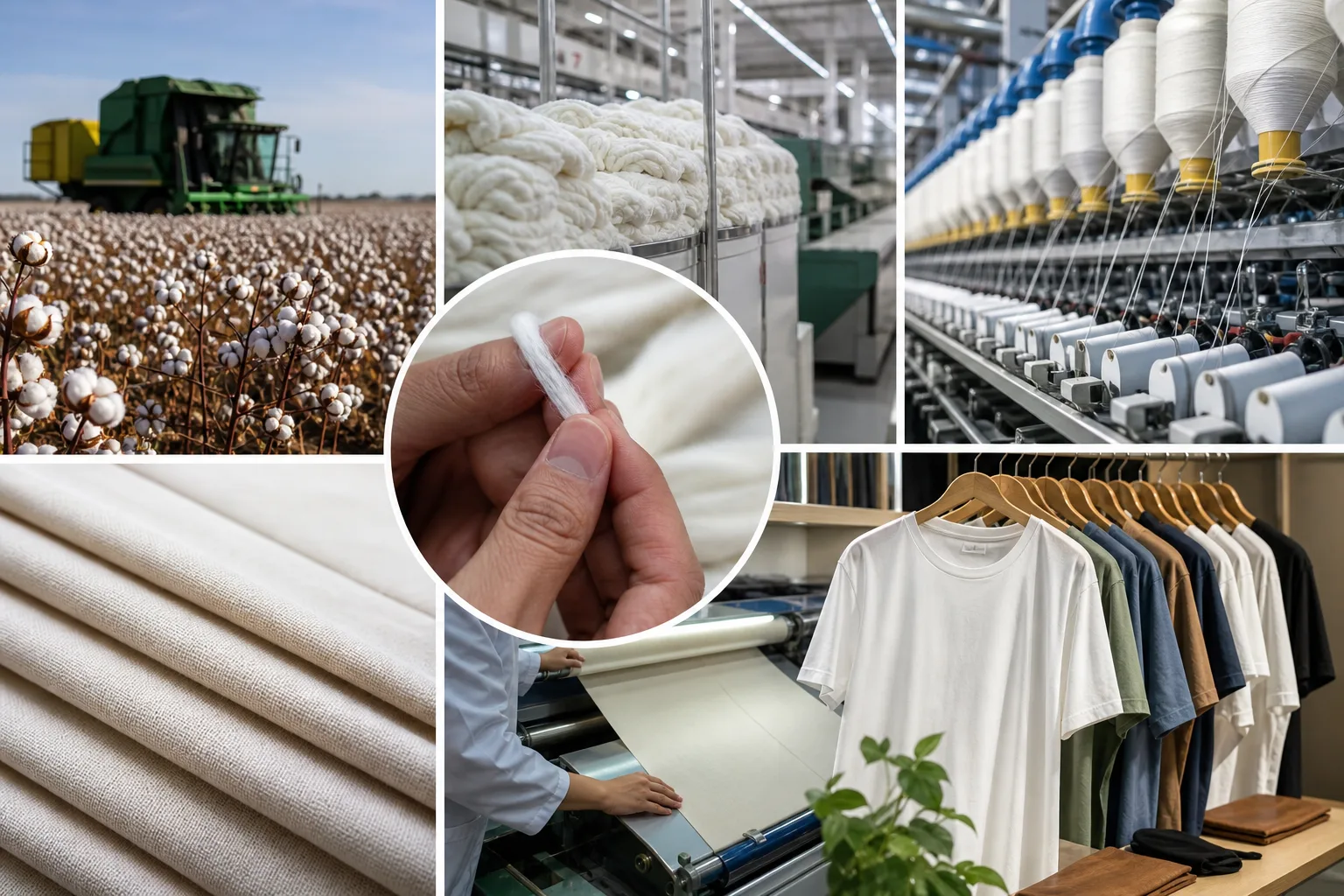
The cotton supply chain is the sequence that moves cotton from farms through ginning, classing, trading, spinning, fabric formation, finishing, product manufacturing and retail. Each stage changes the material or adds information about it. Raw-fiber measurements help mills select suitable bales, but they do not by themselves guarantee a soft, durable or well-made finished product. Yarn design, fabric construction, chemical and mechanical finishing, sewing quality, labeling and care all contribute to the result.
The cotton supply chain at a glance
A simplified route is farm to gin, bale classification, merchant or cooperative, spinning mill, fabric mill, dyeing and finishing facility, product manufacturer, brand or retailer, and finally the user. These operations may occur within one country or across several countries. Some businesses combine multiple steps, while others use specialist suppliers.
- Growing and harvesting: Farmers choose varieties and manage the crop before harvesting seed cotton, which contains lint and seed.
- Ginning: The gin separates lint from seed, removes some non-lint material and compresses the lint into bales.
- Classing and marketing: Bale samples are evaluated for properties used in trading and mill selection.
- Spinning: Mills blend, clean, align and twist fibers into yarn.
- Fabric formation: Yarn is woven, knitted or used in another textile structure.
- Wet processing and finishing: Fabric may be prepared, bleached, dyed, printed or treated to alter appearance and performance.
- Product manufacturing and distribution: Fabric is cut, sewn, labeled, packed and moved through wholesale or retail channels.
This map is useful, but it is not a universal custody record. A company claiming a particular origin, certified material or preferred production method needs documentation appropriate to that claim.
From the field to a marketable bale
Growing and harvesting influence the starting material
Cotton fibers develop on the seed. Variety, weather, crop management, maturity at harvest and handling can influence properties such as length, strength, color and micronaire. These influences matter to a mill, but a regional or varietal name is not a complete quality specification. Cotton from the same broad origin can still vary among fields, harvest periods and bales.
Ginning separates fiber from seed
Seed cotton arrives at a gin, where drying and cleaning may be used before the lint is separated from the seed. The lint is then further cleaned as required and formed into a bale. Ginning must balance cleanliness with fiber preservation: processing can remove unwanted material, but overly aggressive handling can contribute to fiber damage or short-fiber content.
A bale is a raw-material unit, not a roll of standardized fabric. It still contains a distribution of individual fiber lengths and other natural variations. Mills commonly combine cotton from multiple bales to build a more consistent processing mix.
Classing turns fiber properties into market information
In the United States, USDA Agricultural Marketing Service classing provides bale-specific data used by owners, merchants and manufacturers. Instrument measurements include length, length uniformity, strength, micronaire, color and trash, while trained classers inspect samples for extraneous matter. USDA also maintains calibration materials and standardized laboratory procedures for consistent measurement. USDA AMS cotton classing guidance
The main measurements describe raw cotton rather than finished-product performance. CottonWorks identifies staple length, length uniformity, strength, micronaire, color and trash as central fiber-quality factors. Length and uniformity can affect spinning efficiency and yarn evenness; strength helps indicate resistance to breakage during processing; and micronaire reflects the combined influence of fineness and maturity rather than functioning as a direct fineness measurement. CottonWorks fiber-quality overview
| Information | Why the trade uses it | What it does not prove |
|---|---|---|
| Staple length and length uniformity | Help mills plan spinning systems, yarn sizes and processing settings | That a finished fabric will automatically feel soft or resist pilling |
| Fiber strength | Helps assess processing potential and likely yarn-strength contribution | The seam strength or service life of a finished garment |
| Micronaire | Provides combined information related to fiber fineness and maturity | An independent measurement of fineness, maturity or comfort |
| Color and trash | Support valuation, cleaning decisions and preparation for dyeing or bleaching | The final shade, colorfastness or absence of every foreign particle |
| Origin or cotton type | May narrow sourcing options and indicate a production region or fiber category | A guaranteed laboratory result for every bale or finished item |
Classing therefore gives the market a shared technical language. Buyers can compare lots and mills can select cotton suited to a target yarn. The commercial value of a bale may reflect these measurements alongside location, availability, contract terms and the needs of a particular mill. For definitions of individual metrics, see HVI testing, staple length, micronaire and fiber strength.
Spinning converts variable fibers into controlled yarn
Preparation, carding and optional combing
At the spinning mill, bales are selected and blended to create a controlled laydown. Opening and cleaning separate compressed tufts and remove additional foreign matter. Carding disentangles and aligns the fibers into a continuous strand called sliver. Combing, when specified, removes more short fibers and improves alignment, but it also adds processing and material loss. It is therefore a manufacturing choice rather than proof that every combed product is superior for every use.
CottonWorks describes carding as the point at which loose cotton first takes a textile form as sliver. Subsequent drawing improves blending and regularity before roving or direct spinning, depending on the system. CottonWorks fiber-preparation guidance
Yarn structure changes performance
Ring spinning, open-end or rotor spinning, air-jet systems and other methods assemble fibers differently. Yarn count, twist, evenness, hairiness, ply and the presence of blends all affect processing and fabric behavior. A finer yarn may support a lighter or denser fabric, but fineness alone does not establish durability. Higher twist can increase cohesion while changing softness and absorbency. Plied yarns may improve balance or strength, although performance depends on the complete specification.
Terms such as ring-spun, combed and long-staple identify inputs or processes; they are not finished-product test results. Compare the underlying distinctions in combed versus carded cotton and ring-spun versus open-end yarn.
Construction and finishing shape the finished fabric
Woven and knitted structures behave differently
Woven fabrics interlace warp and filling yarns, while knitted fabrics form connected loops. Construction variables—including yarn count, fabric density, knit gauge, weave or stitch pattern and fabric weight—can alter drape, stretch, air permeability, abrasion behavior and dimensional stability. This is why fiber content alone cannot tell a buyer how a shirt, towel or sheet will perform.
Thread count and grams per square meter can be useful when they are accurately measured and interpreted within the same product category. Neither number is a universal quality score. A high thread count cannot compensate for weak yarn, unstable construction or unsuitable finishing, and a heavier fabric is not automatically more durable or comfortable. See how to interpret thread count, how to interpret GSM and cotton fabric structures.
Finishing can improve one property while changing another
Preparation and finishing may include desizing where applicable, scouring, bleaching, mercerization, dyeing, printing, softening, resin treatment, mechanical surface treatment or shrinkage control. The exact sequence depends on the product. Finishes can change hand, appearance, wrinkle behavior, absorbency or dimensional stability, but broad words such as premium, luxury or hotel quality do not identify a measurable treatment or performance threshold.
Product developers normally evaluate performance against specifications for the intended use. Relevant checks may include fabric weight, tensile or bursting strength, abrasion, pilling, colorfastness, shrinkage, skewness and seam performance. The necessary methods and acceptance limits vary by product and buyer; no single test establishes total cotton quality. CottonWorks likewise separates fiber, yarn, construction, durability and care-related testing rather than treating quality as one measurement. CottonWorks quality-testing overview
Labels and traceability answer different questions
A fiber label identifies content, not overall workmanship
For products covered by U.S. textile labeling rules, the label generally identifies fiber content, country of origin and the responsible manufacturer or dealer. The Federal Trade Commission states that a product should not be labeled “100% cotton” unless it contains only cotton, apart from permitted exclusions such as certain trim. A cotton type or geographic term used in a fiber statement must also be truthful and non-deceptive. FTC cotton-labeling guidance
A 100% cotton statement does not disclose staple length, yarn system, fabric density, finishing quality or shrinkage performance. Country of origin for the finished product also may not be the same as the country where the cotton was grown. Buyers should read fiber, origin and care information as separate disclosures and seek additional evidence when a seller makes a more specific claim.
Chain of custody supports material claims
Traceability systems document how a claimed material moves between organizations. Textile Exchange describes its Content Claim Standard as a chain-of-custody framework addressing product flow, documentation, volume reconciliation and material controls. Such systems support certified-content claims, but the exact assurance depends on the named standard, custody model, certification scope and transaction records. Textile Exchange Content Claim Standard
Custody models are not interchangeable. The Better Cotton Initiative, for example, distinguishes mass-balance sourcing from physical cotton models. Under mass balance, qualifying cotton may be mixed with conventional cotton, so the physical origin of cotton in a specific finished product is not guaranteed. Physical models apply different handling and documentation requirements. Better Cotton Initiative chain-of-custody guidance
Similarly, words such as organic, regenerative, responsible, traceable or sustainable should not be treated as synonyms. A credible claim should define what was assessed, which organization set the requirements, what part of the supply chain was covered and whether the claim concerns physical product content, booked volumes, farming practices or facility processes.
A practical cotton sourcing and buying checklist
- Define the end use. A towel, T-shirt, bedsheet and workwear fabric require different combinations of yarn, construction and finishing.
- Separate fiber facts from marketing language. Ask for measurable properties or a clear specification behind words such as premium, long-staple or high quality.
- Check the yarn description. Record spinning system, count, twist, ply, blend and whether the cotton is carded or combed when these factors matter.
- Check construction. Use fabric weight, density, weave, stitch or gauge alongside the intended performance—not as isolated quality scores.
- Identify finishes. Ask what was applied, what benefit is claimed and whether performance was evaluated after laundering when relevant.
- Read labels narrowly. Fiber content tells you composition; origin, care and certification information answer different questions.
- Verify sustainability claims. Look for the named standard, certification body where applicable, custody model, scope and a way to confirm the claim.
- Request product-level evidence. A supplier's general certification or an example laboratory report may not cover the item being purchased.
- Consider care. Washing and drying can affect dimensions, color and surface appearance. Follow the product's instructions and review cotton washing guidance and shrinkage prevention.
The most reliable buying decision connects each claim to the correct stage of the supply chain. Fiber measurements help describe raw cotton; yarn and construction specifications explain how it was assembled; finishing and product testing address performance; and documented custody systems support defined sourcing claims. None should be used as a substitute for the others.
Frequently asked questions
What are the main stages of the cotton supply chain?
The main stages are growing and harvesting, ginning, bale classing and trading, spinning, fabric formation, dyeing and finishing, product manufacturing, distribution and retail. The route varies because some companies combine stages and cotton may cross national borders several times.
Does better raw cotton always make a better finished product?
No. Suitable fiber properties give a mill a stronger starting point, but yarn design, fabric construction, finishing, sewing and care also affect comfort, appearance and durability. Raw-fiber data should be matched to the intended product rather than treated as a complete quality score.
Is 100% cotton a quality grade?
No. It is a fiber-content statement. It does not specify staple length, yarn type, fabric weight, construction, finishing, shrinkage or durability. Two products labeled 100% cotton can therefore perform very differently.
Does traceable or certified cotton guarantee product quality?
Not by itself. A traceability or certification system may provide evidence about material origin, custody or defined production requirements. Finished-product quality still depends on manufacturing specifications and performance testing. Check the named standard, its scope and the custody model behind the claim.
How this guide was prepared
This page is based on desk research of official technical, government, regulatory and standards-body material accessed on October 5, 2026. It synthesizes USDA cotton-classing information, CottonWorks fiber and manufacturing guidance, FTC labeling guidance, and current chain-of-custody information from Textile Exchange and the Better Cotton Initiative. No farm or mill visits, laboratory testing, product trials, supplier audits or first-hand certification reviews were performed. U.S. classing and labeling details should not be assumed to apply unchanged in other jurisdictions.
Review status: Publishable quality advisory.
Sources and scope
- Cotton Classing ServicesU.S. Department of Agriculture, Agricultural Marketing Service
Explains U.S. bale classification, instrument measurements, visual inspection, standardized laboratory conditions and the role of classification data in cotton marketing and manufacturing.
Accessed 2026-10-05 - Cotton Fiber QualityCottonWorks by Cotton Incorporated
Defines major raw-cotton quality factors and explains how length, uniformity, strength, micronaire, color and trash relate to processing.
Accessed 2026-10-05 - Calling It Cotton: Labeling and Advertising Cotton ProductsFederal Trade Commission
Provides U.S. guidance on truthful cotton fiber-content statements, 100% cotton labeling and the use of cotton type or geographic terms.
Accessed 2026-10-05 - The Content Claim StandardTextile Exchange
Explains chain-of-custody controls for tracking and verifying claimed materials, including documentation, material flow, segregation and volume reconciliation.
Accessed 2026-10-05 - Connecting Supply & Demand: Chain of CustodyBetter Cotton Initiative
Explains current Better Cotton Initiative chain-of-custody requirements and the distinction between mass-balance and physical cotton sourcing models.
Accessed 2026-10-05